Summary
- With over 130 Lichtenstein works, the Whitney explores the process behind his iconic imagery and the evolution of his artistic practice beyond pop art fame.
- Lichtenstein’s early training in Hoyt Sherman’s Flash Lab shaped his approach to visual perception, which the exhibition explores alongside his wartime imagery and new works included by curator Alex Da Corte.
- Look Mickey (1961) marked Lichtenstein’s shift toward comic-inspired art, introducing the Ben-Day dots and bold outlines that became his signature pop art style.
- His early pop paintings turned everyday objects into studies of shape and form. In Portrait of Madame Cézanne (1962), Lichtenstein satirized an academic diagram that simplified Cézanne’s work, while expressing his admiration for the artist.
- Lichtenstein’s 1962 solo show at Leo Castelli’s gallery brought fame and controversy over whether commercial imagery belonged in fine art; the Whitney recreates the landmark exhibition.
- The artist reworked comic imagery into carefully constructed paintings, raising questions about appropriation and authorship that the Whitney further explores through his collaborations with other artists.
- Later, Lichtenstein explored repetition and optical effects, drawing on Monet’s cathedral series to experiment with light, reflections, and architectural forms.
- Inspired by Matisse, Lichtenstein’s Artist’s Studio series brought together earlier works and new ideas.
- His Greene Street Mural brings together motifs from his career in a large-scale work, recreated for the exhibition to highlight the labor behind his art and raise questions about its preservation.
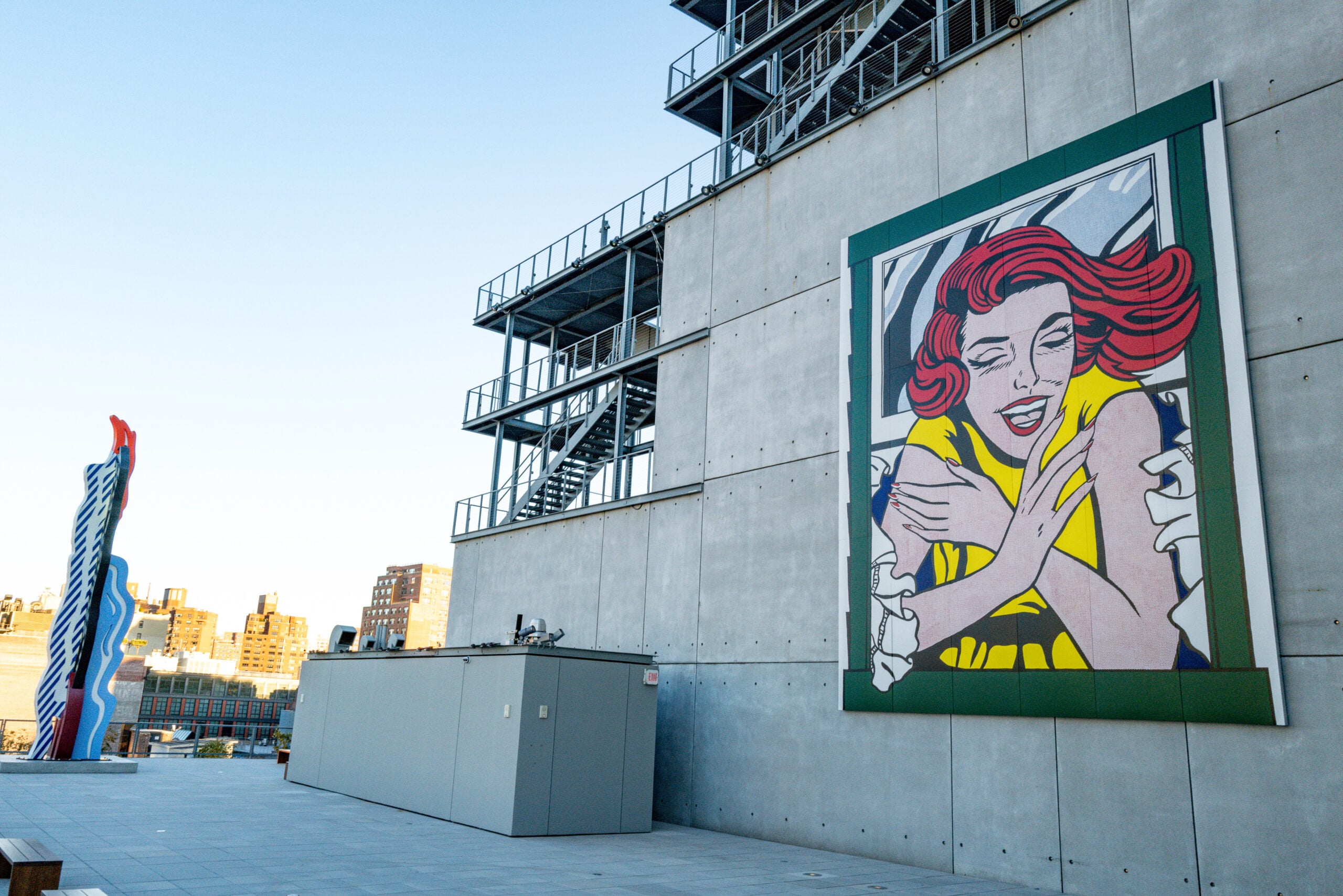
- The exhibition extends outdoors with large-scale versions of Coups de Pinceau and Girl in Window, showcasing Lichtenstein’s approach to public art.
- In his later landscapes, Lichtenstein drew on Chinese painting traditions, revealing a quieter side of his practice and continuing his exploration of originality and artistic appropriation.
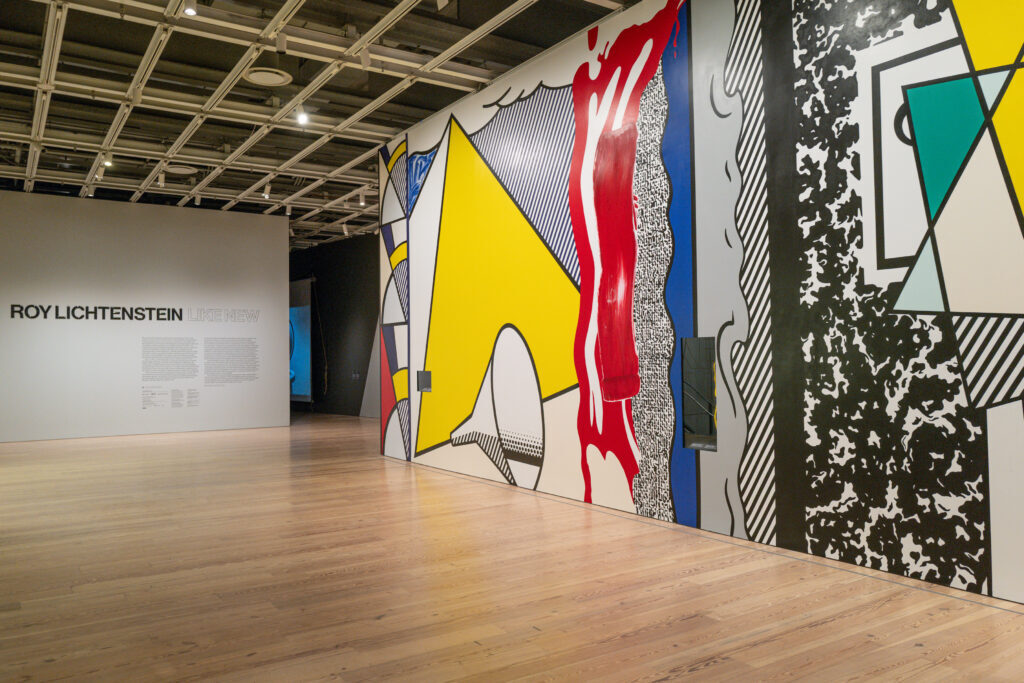
Installation view of Roy Lichtenstein: Like New, Whitney Museum of American Art, October 11, 2026–May 10, 2027, New York. Artwork © Estate of Roy Lichtenstein. Photograph by Jason Lowrie/BFA.com.
Through more than 130 works spanning six decades, the Whitney details the artistic process behind the familiar Ben-Day dots and comic-book imagery. Drawings, sculpture, murals, prints, and film appear alongside paintings that reveal Lichtenstein‘s sustained engagement with Paul Cézanne, Pablo Picasso, and Henri Matisse.
The exhibition connects Lichtenstein’s artistic training, education, and early experimentation with his commercial success and later practice, showing how his interests developed rather than having his pop art fame carry the entire story.
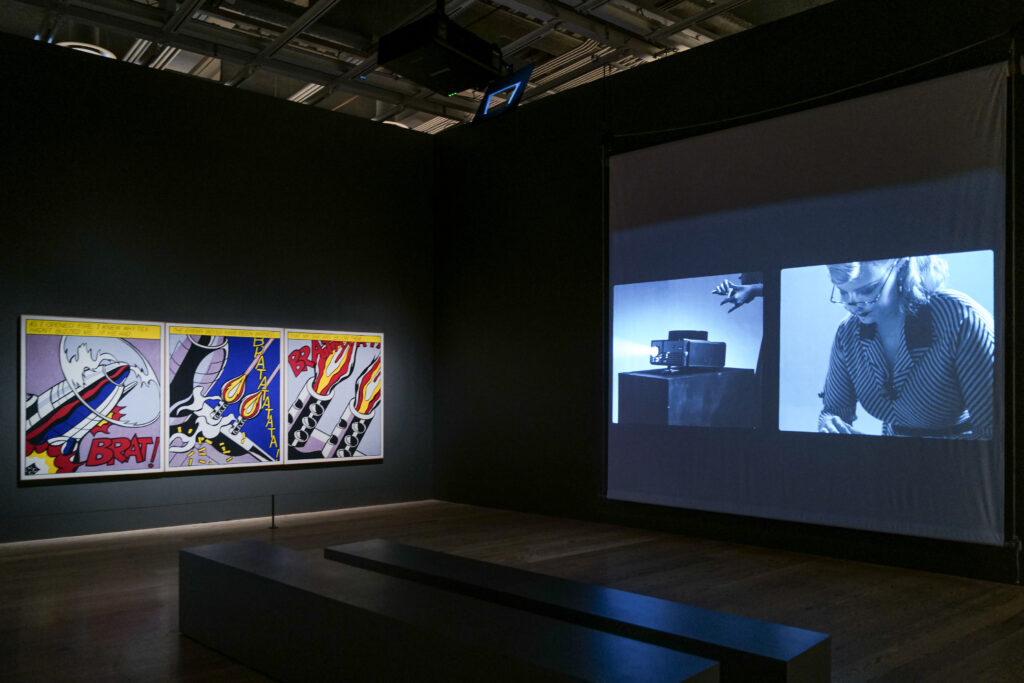
Installation view of Roy Lichtenstein: Like New, Whitney Museum of American Art, October 11, 2026–May 10, 2027, New York. Artwork © Estate of Roy Lichtenstein. Photograph by Jason Lowrie/BFA.com.
Learning to See at the Flash Lab
Born in New York in 1923, Lichtenstein grew up going to museums with his mother and was already drawing, painting, and sculpting by his teens. Picasso was one of his first major influences, and he often named Guernica as his favorite painting.
Lichtenstein enrolled at Ohio State University in 1940. His World War II service interrupted his studies, but he continued drawing and painting before returning in 1946 for his MFA. At OSU, he studied with Hoyt Sherman, whose Flash Lab tested visual perception by flashing words, objects, or images in a darkened classroom for a tenth of a second, then asking students to draw what they remembered.
The experiments were meant to train the eye to grasp relationships between forms. Lichtenstein repeatedly credited Sherman with teaching him “how to look,” and summarized his central lessons as art being all about “organized perception.”
Sherman did not see those exercises as only useful for artists. The Whitney’s archival display includes letters showing that the military saw potential in his methods for training pilots in difficult atmospheric conditions. By including the war comic triptych As I Opened Fire… (1964) in the same gallery, the exhibition links the depictions of combat to Sherman’s instruction that “Seeing must be developed as an aggressive act.”
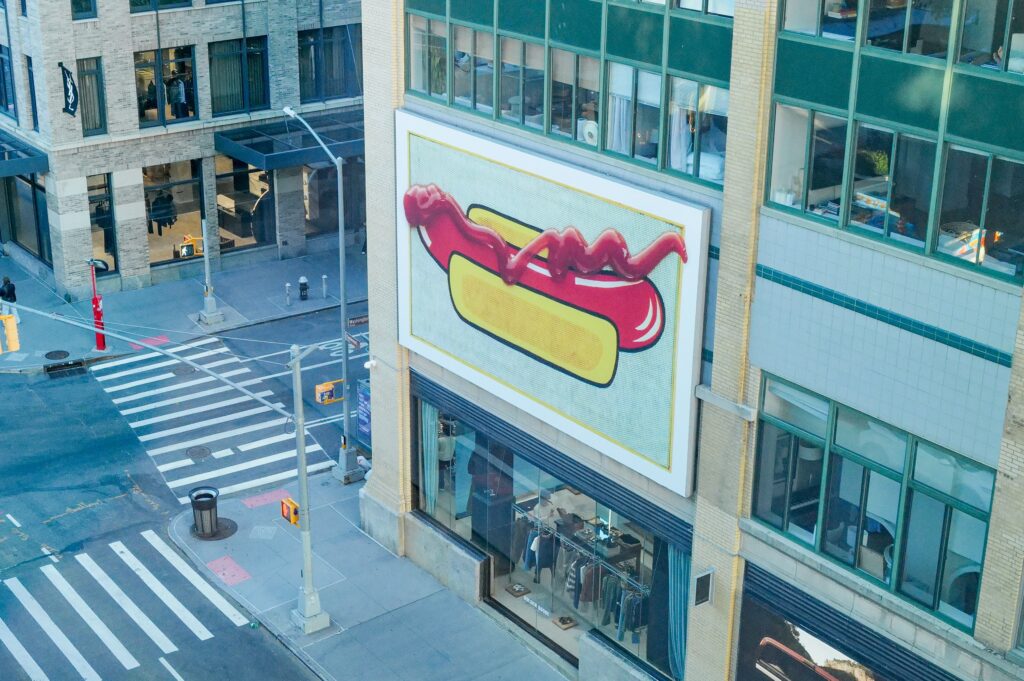
Installation view of Roy Lichtenstein: Like New, Whitney Museum of American Art, October 11, 2026–May 10, 2027, New York. Alex Da Corte, Hot Dog with Ketchup, 2026. Photograph by Jason Lowrie/BFA.com.
The exhibition’s curators are Meg Onli, co-curator of the Whitney’s 2024 Biennial, and Alex Da Corte, a Venezuelan American artist, writer, and alum of the 2019 Venice Biennale, whose work challenges recognizable imagery in popular culture. Da Corte transformed himself into Sherman and performed the experimental teacher’s role in Drawing by Seeing (2026), a 14-minute film included in the exhibition, where visitors can see Flash Lab exercises play out on screen.
Da Corte also produced original work for the show, including a mural based on a printout of Lichtenstein’s Hot Dog (1963), where he squirted actual ketchup over the copied image. His Hot Dog with Ketchup (2026), on the building facade across from the Whitney, was also made in recognition of the ubiquitous New York City hot-dog cart vendors outside the museum.
Finding Pop Art
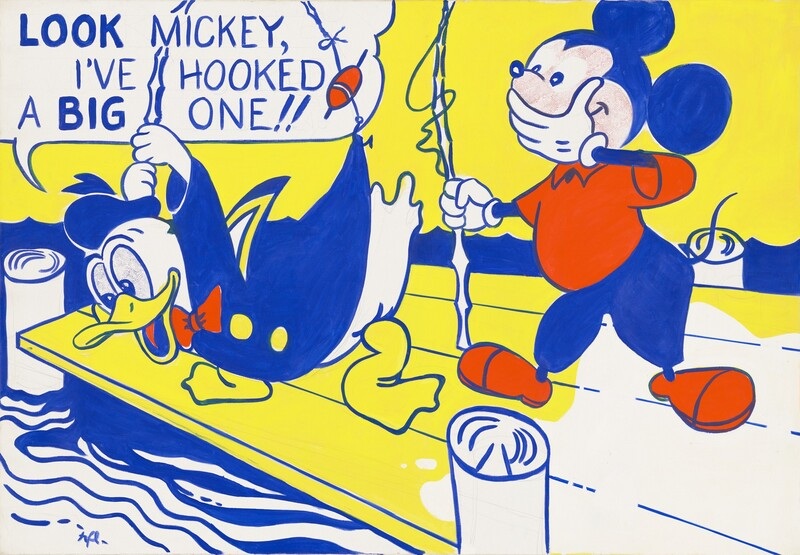
Roy Lichtenstein, Look Mickey, 1961, National Gallery of Art, Washington, DC, USA. Artwork © Board of Trustees.
Lichtenstein explored Cubism and abstraction before becoming an assistant professor of art at Douglass College in New Brunswick, New Jersey, in 1960. Lichtenstein was 38 and had been exhibiting in New York for a decade when he painted Look Mickey (1961), a breakthrough in what had been an ongoing artistic exploration.
Years earlier, in 1957, he had used a projector to trace Mickey Mouse on his son’s bedroom wall and experimented with cartoon figures against abstract backgrounds. Look Mickey was the first painting in which he imitated the commercial-printing dots that became his trademark, using them sparingly on Mickey’s face and in Donald Duck’s eyes.
Lichtenstein’s biographer, Avis Berman, said he kept the canvas in his studio for a week and found that his earlier abstractions suddenly looked like “mush.” He then moved rapidly into paintings based on comics, advertisements, and consumer objects. Berman notes that Lichtenstein called it his “first painting with no expressionism in it.”
These first dots were not yet the regular, uniform patterns of Lichtenstein’s mature pop style. In 1962, he began applying them by hand through perforated metal screens to imitate Ben-Day dots, a commercial printing system developed by Benjamin Day to create tonal effects. That pattern, alongside the bold black outlines of comic books, became his signature and made the work look mechanically produced despite the careful decisions behind its composition, color, and technique. In today’s terms, it would be like taking a handmade drawing and deliberately tweaking it until it looked AI-generated.
Painting Everyday Objects
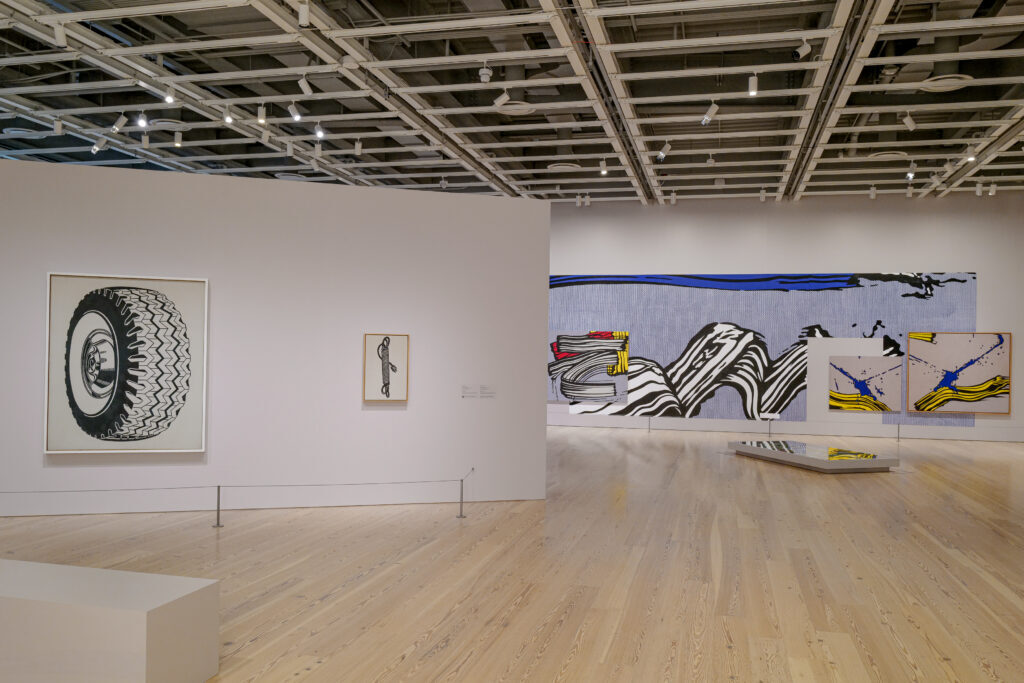
Installation view of Roy Lichtenstein: Like New, Whitney Museum of American Art, October 11, 2026–May 10, 2027, New York. Artwork © Estate of Roy Lichtenstein. Jason Lowrie & Yvonne Tnt/BFA.com.
Lichtenstein also made paintings from printed depictions of everyday items. A selection of early pop paintings, like Electric Cord from 1961, and Tire, Golf Ball, and Curtains, all from 1962, show how the artist isolated each object from the uses and environment automatically associated with it. The forms of household items become subjects in their own right.
These works are closely connected to Sherman’s teachings. Once separated from their context, an everyday object can be perceived as a simple arrangement of shapes and forms.
Cézanne, Picasso’s Master
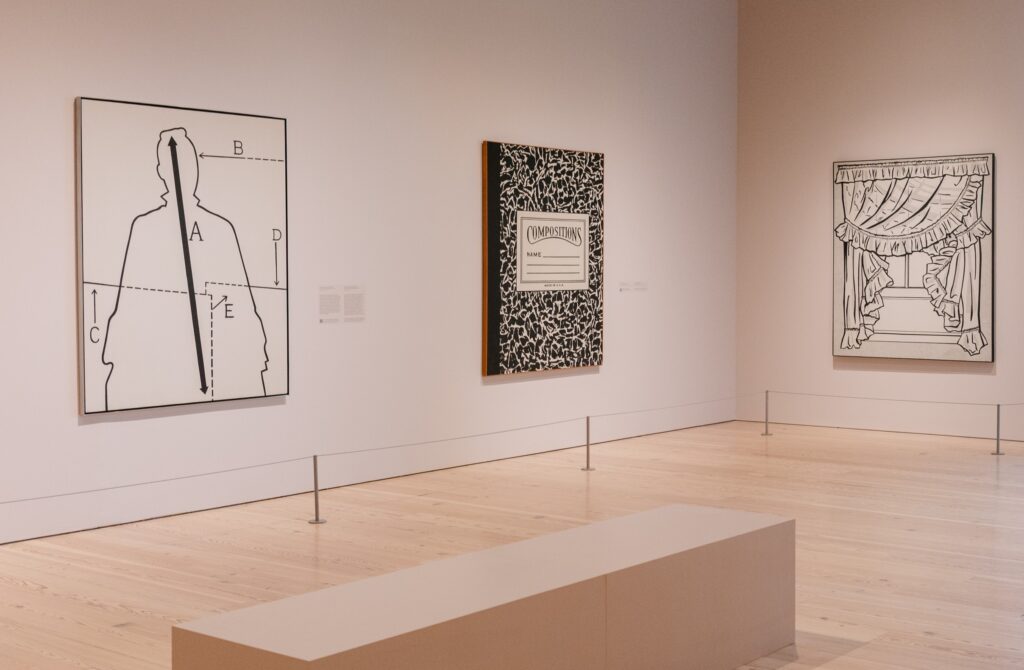
Installation view of Roy Lichtenstein: Like New, Whitney Museum of American Art, October 11, 2026–May 10, 2027, New York. Artwork © Estate of Roy Lichtenstein. Jason Lowrie & Yvonne Tnt/BFA.com.
Pablo Picasso was one of the artists Lichtenstein revered most. Picasso, in turn, worshiped Cézanne, calling him his “one and only master” in 1943. In Portrait of Madame Cézanne (1962), Lichtenstein reproduced a teaching diagram by painter and art historian Erle Loran. Cézanne’s portrait of his wife had become a black-and-white illustration with arrows, primed for academic study and analysis.
Lichtenstein’s biographer explains that the artist found the diagram reductive because heavy outlines eliminated the color, texture, and shading of Cézanne’s work. Cézanne himself struggled to define an outline, and Loran’s diagram made the task look straightforward; Lichtenstein wanted to satirize that discrepancy. Loran was not amused and publicly objected. Lichtenstein’s point remained clear: “The things that I have apparently parodied I actually admire.”
The Castelli Breakthrough
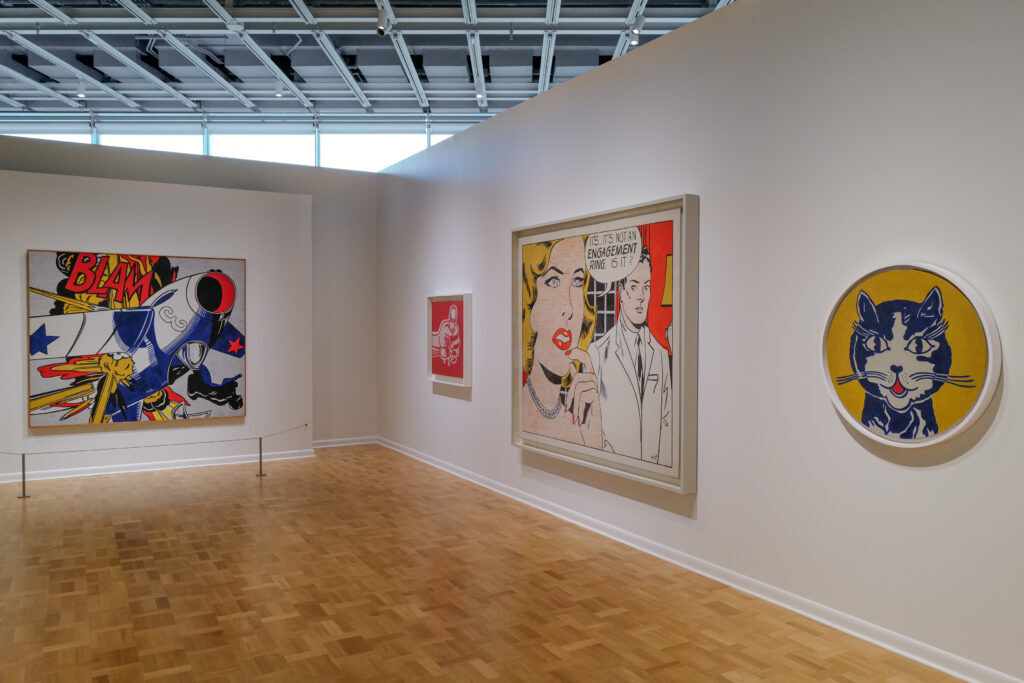
Installation view of Roy Lichtenstein: Like New, Whitney Museum of American Art, October 11, 2026–May 10, 2027, New York. Artwork © Estate of Roy Lichtenstein. Photograph by Jason Lowrie/BFA.com.
Lichtenstein’s first solo exhibition of pop paintings ran from February 10 to March 3, 1962, at Leo Castelli’s gallery on East 77th Street. Castelli had already presented landmark exhibitions of Jasper Johns and Robert Rauschenberg; Lichtenstein’s show sold out and brought him both success and notoriety.
Life magazine published an interview with Lichtenstein in 1964 leading with, “Is he the worst artist in the U.S.?” It addressed Lichtenstein’s popularity and whether canvases based on commercial printing belonged in the same realm as fine art; Andy Warhol was guilty of a similarly brazen move by choosing mass-media as artistic inspiration.
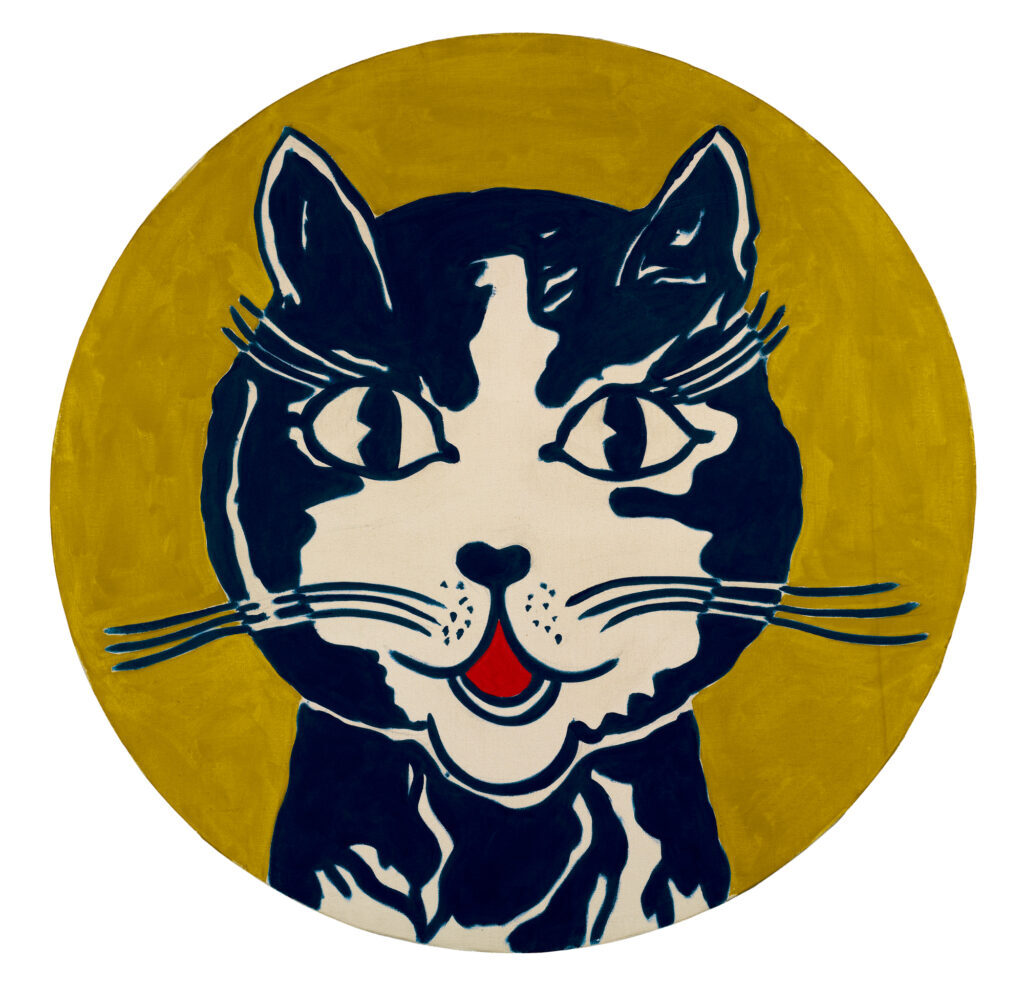
Roy Lichtenstein, Laughing Cat, 1961, private collection. © Estate of Roy Lichtenstein/DACS 2026. Press materials.
The Whitney’s reconstruction of the Castelli exhibition is one of the show’s most memorable installations, reuniting eight paintings at their original hanging heights and restoring the broad range of subjects that were part of Lichtenstein’s early experimentation.
Among them is Laughing Cat (1961), later owned by Warhol, who was independently developing his own pop art language at the same time as Lichtenstein. Warhol received it in 1975 as part of an exchange for commissioned portraits.
The Art of Borrowed Drama
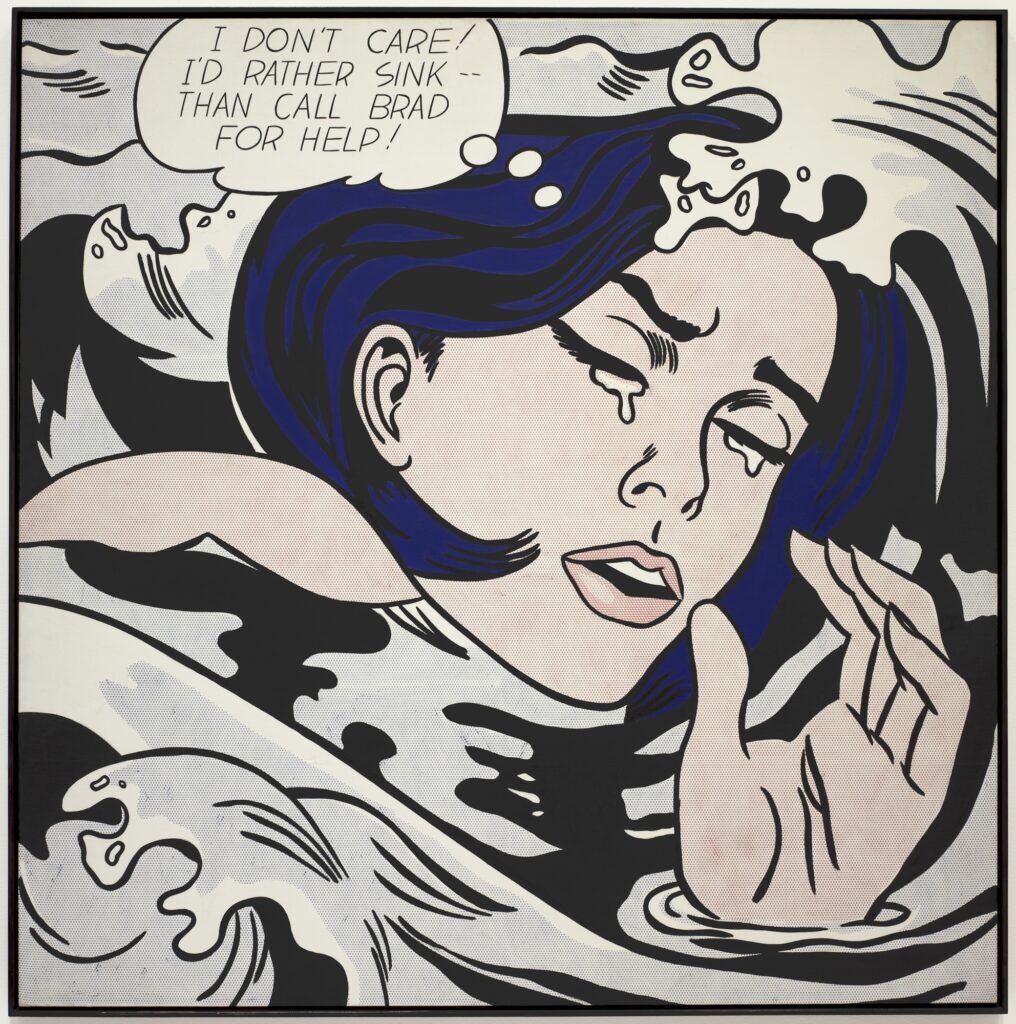
Roy Lichtenstein, Drowning Girl, 1963, Digital Image © Museum of Modern Art, New York City, NY, USA. Artwork © Estate of Roy Lichtenstein/DACS 2026.
Lichtenstein found ample drama in romance and war comics, where unhinged heroines dropped a full emotional crisis in a few words and anti-aircraft weapons went Whaam! In Drowning Girl (1963), the woman’s declaration, “I don’t care! I’d rather sink than call Brad for help!” is fit for contemporary discussions on gender bias.
Drowning Girl was adapted from a romance comic anthology published by DC Comics. Lichtenstein removed the boyfriend and his overturned boat, changed his name, and shortened the woman’s words. The Whitney includes a facsimile of the comic illustrated by Tony Abruzzo that reveals the edits. The centrality of the wave can also be considered a nod to Hokusai‘s The Great Wave and the influence of the bold outlines of Japanese prints in American comics.
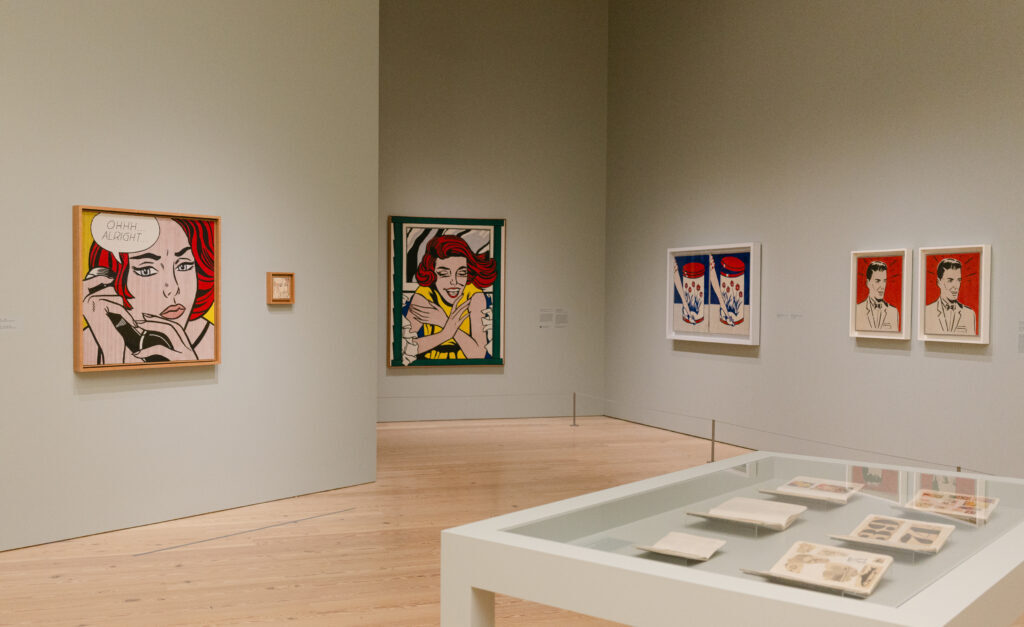
Installation view of Roy Lichtenstein: Like New, Whitney Museum of American Art, October 11, 2026–May 10, 2027, New York. Artwork © Estate of Roy Lichtenstein. Jason Lowrie & Yvonne Tnt/BFA.com.
Lichtenstein was repeatedly accused of “stealing” by artists who felt denied recognition. The 2023 documentary WHAAM! BLAM! Roy Lichtenstein and the Art of Appropriation reported that many of the comic artists whose illustrations he reworked received no financial benefit from the artist, and sometimes lived in dire circumstances. Many of Lichtenstein’s famed “copied” comic-book protagonists and war imagery made the cut at the Whitney.
In Image Duplicator: Roy Lichtenstein and the Emergence of Pop Art, art historian Michael Lobel explains that Lichtenstein did not simply copy comic panels. He redrew and projected selected elements onto canvas, adjusted the composition, and painted in the dots, colors, and outlines by hand, making the finished work look mechanically reproduced even though it was carefully constructed.
I know that my work has been accused of looking like the things that I copy, and it certainly does look like the things I copy, and I think a lot of this is that people assume that similar things are identical… [Art] as an idea is very illusive, and one can never say where the art is in one’s work and what art is… But it is that quality, whatever art is, that transforms the work of art.
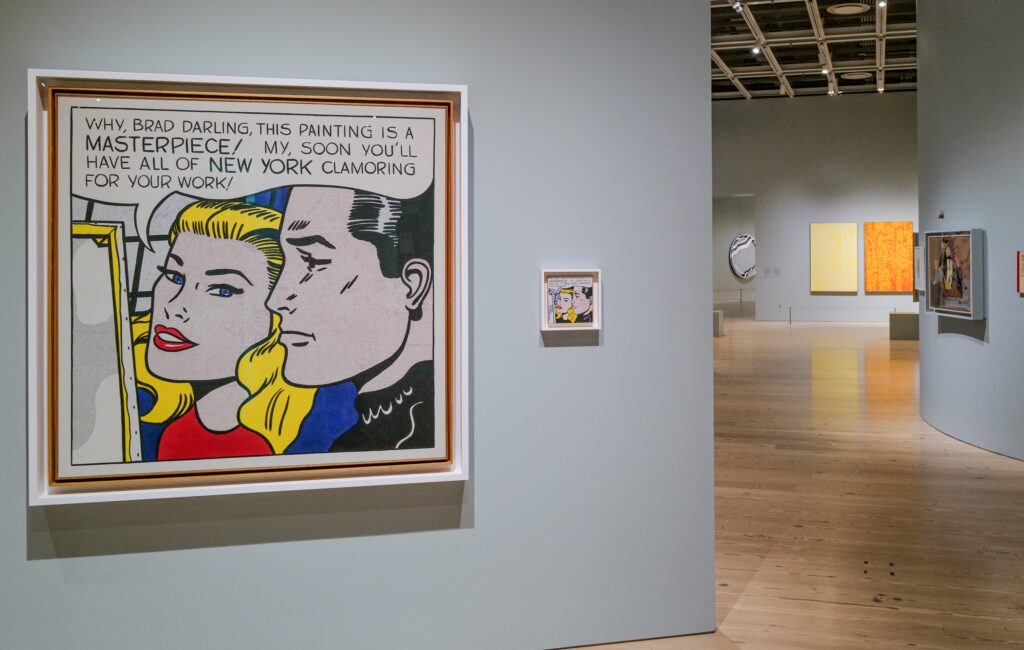
Installation view of Roy Lichtenstein: Like New, Whitney Museum of American Art, October 11, 2026–May 10, 2027, New York. Artwork © Estate of Roy Lichtenstein. Photograph by Jason Lowrie/BFA.com.
Lichtenstein so strongly believed in borrowing sources that he assisted other artists in appropriating his own paintings. He gave Elaine Sturtevant stencils to help her make her versions and signed the back of a painting by Richard Pettibone. The Whitney pairs Happy Tears (1964) and Masterpiece (1962) with Sturtevant’s Study for Lichtenstein’s Happy Tears (1967–1968) and Pettibone’s Roy Lichtenstein, “Masterpiece,” 1962 (1975).
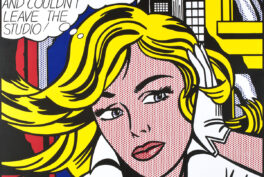
In Lichtenstein’s Masterpiece, a blonde woman tells a handsomely drawn man, “Why, Brad darling, this painting is a masterpiece!” and predicts that New York will soon be clamoring for his work. The commentary becomes more poignant when you realize that he created it in the year of his Castelli breakthrough. The Whitney treats these exchanges as an important part of Lichtenstein’s thinking about authorship. Helping a contemporary artist actively reproduce your work is a striking approach that deeply resonates in a culture where reposting is currency and at a time when posting an image can start a lawsuit over credit.
Repetition and Reflection
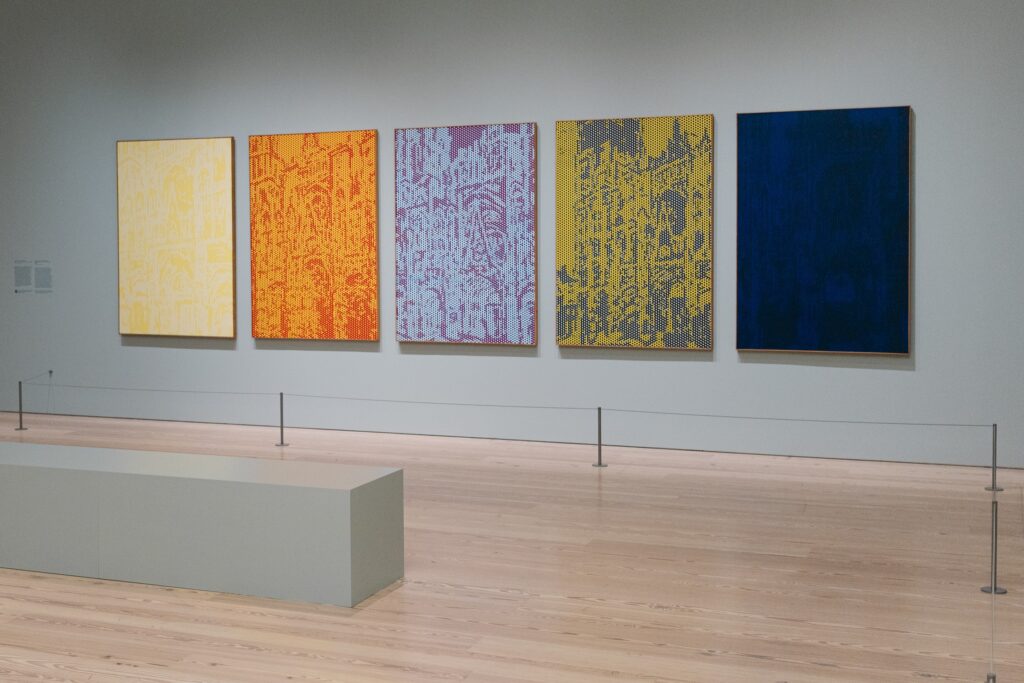
Installation view of Roy Lichtenstein: Like New, Whitney Museum of American Art, October 11, 2026–May 10, 2027, New York. Artwork © Estate of Roy Lichtenstein. Jason Lowrie & Yvonne Tnt/BFA.com
In the late 1960s, Lichtenstein began making series of paintings on the same subject. Claude Monet’s repetitive renderings of the facade of Rouen Cathedral offered an ideal precedent, melding Lichtenstein’s wide-ranging interests in art history and the visual perception of form. For Rouen Cathedral, Set III (1968–1969), he reconsidered Monet’s changing light through a deliberately restricted painting method.
By 1969, Lichtenstein became interested in how advertising brochures for mirrors illustrated reflective surfaces—without showing anything. For Mirrors (1969), he photographed actual mirrors and used his observations to develop forms that emulated light and shadow across flat surfaces; the photographs became his source imagery.
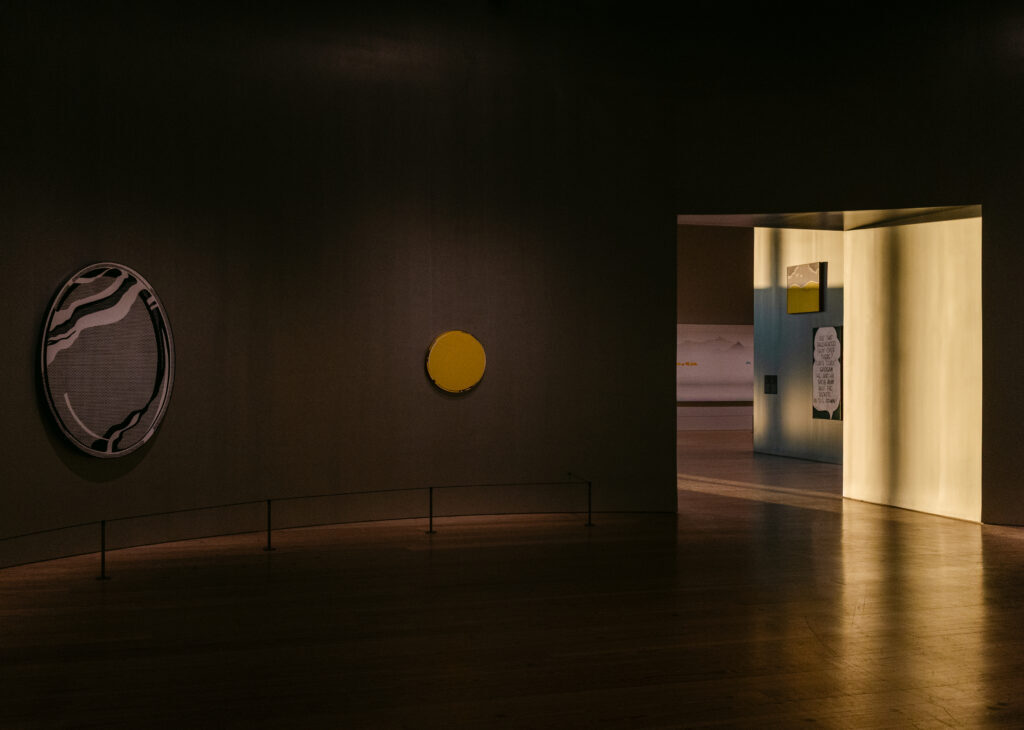
Installation view of Roy Lichtenstein: Like New, Whitney Museum of American Art, October 11, 2026–May 10, 2027, New York. Artwork © Estate of Roy Lichtenstein. Jason Lowrie & Yvonne Tnt/BFA.com.
The mirror paintings, a highlight of the Whitney show and of Lichtenstein’s mature style, are displayed in an oval silver-hued gallery that itself suggests a reflective surface with no mirror image. Onli places the mirrors alongside Lichtenstein’s interest in Op Art, where artists used patterns and contrast to produce and enhance optical effects.
Lichtenstein’s own photographic practice was also the source of the Entablatures of the early 1970s. He took pictures around Manhattan to recreate architectural details already copied and repeated throughout the city. Additional experiments also include Three Landscapes (1970–1971), Lichtenstein’s only film, featuring three short, repeating seascapes that mix filmed footage with images of his signature style.
Modern Masters Studio
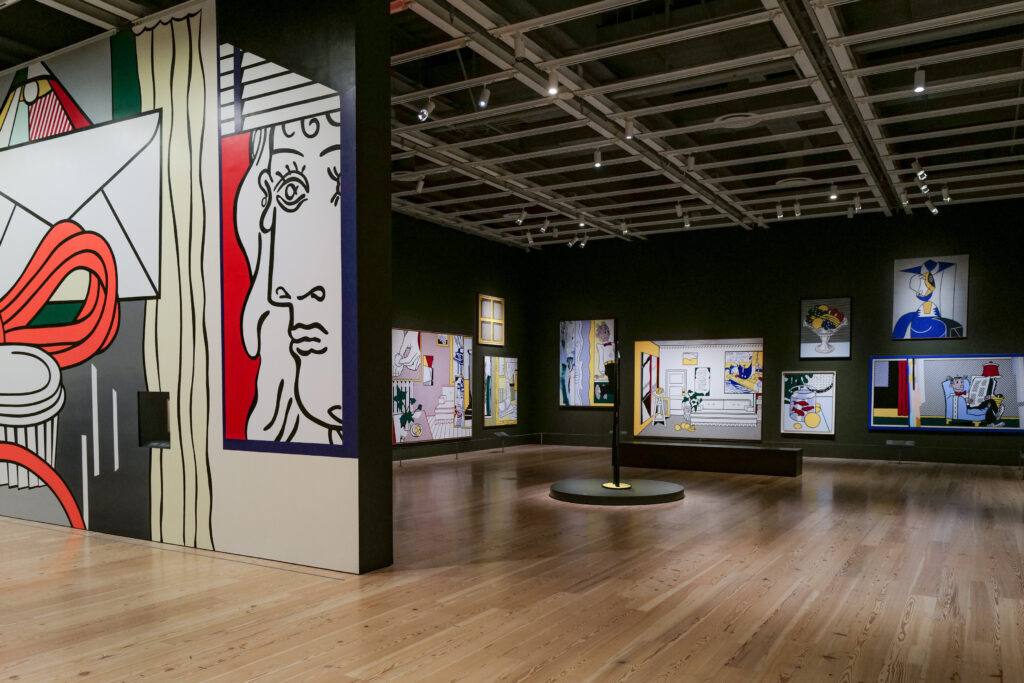
Installation view of Roy Lichtenstein: Like New, Whitney Museum of American Art, October 11, 2026–May 10, 2027, New York. Artwork © Estate of Roy Lichtenstein. Photograph by Jason Lowrie/BFA.com.
Picasso, Cézanne, and Matisse continued to inspire Lichtenstein. Matisse’s The Red Studio became a model for his Artist’s Studio series, inspired by an artist surrounding himself with his own works within a painted room. Lichtenstein used the studio to bring together some of his earlier works and ideas still in development. In Artist’s Studio (Look Mickey) (1973), he included Look Mickey and an invented landscape that became a separate painting the following year.
The Whitney shows the Artist’s Studio gallery salon-style, packing related works and studies closely together, including Matisse’s own Study After Dance (I). Visitors can follow Lichtenstein quoting himself while paintings both real and imagined, copies and originals, challenge perceptions of authorship.
Brush Strokes Go Big
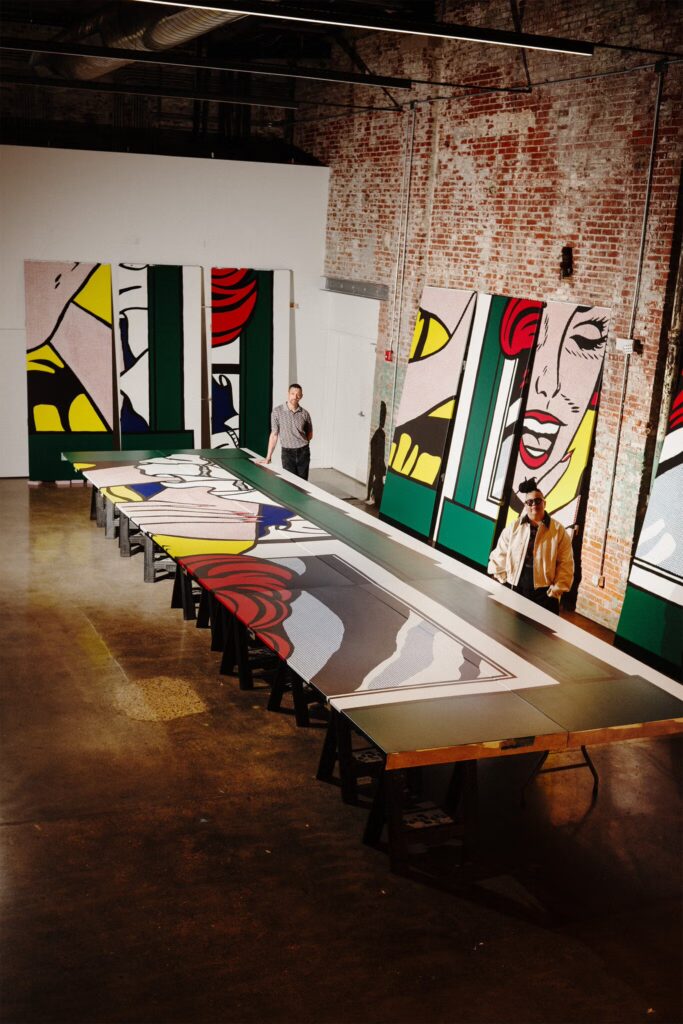
Curator Meg Onli (right) with artist Alex Da Corte (left) in his North Philadelphia studio, with the painted plywood panels for the recreation of Lichtenstein’s Girl in Window (1963), originally made for the 1964–1965 World’s Fair. David Billet/The New York Times.
Lichtenstein reused his signature imagery on a much larger scale in Greene Street Mural (1983). The exhibition welcomes visitors with a hand-painted recreation by DaCorte’s studio. Painted in situ for Leo Castelli’s SoHo gallery, the nearly 100-ft composition brings together motifs from across the artist’s career. Onli and Da Corte understand it as a retrospective organized by the artist himself. The curators also inserted display cases with working materials into the mural to show the labor behind Lichtenstein’s apparently mechanical reproductions.
Lichtenstein intended the original mural to be temporary. With his consent, it was covered in 1984 and destroyed in 1988. Its recreation therefore also adds to the conversation about the subsistence of artworks beyond their original intended form.
Public Art and the World’s Fair
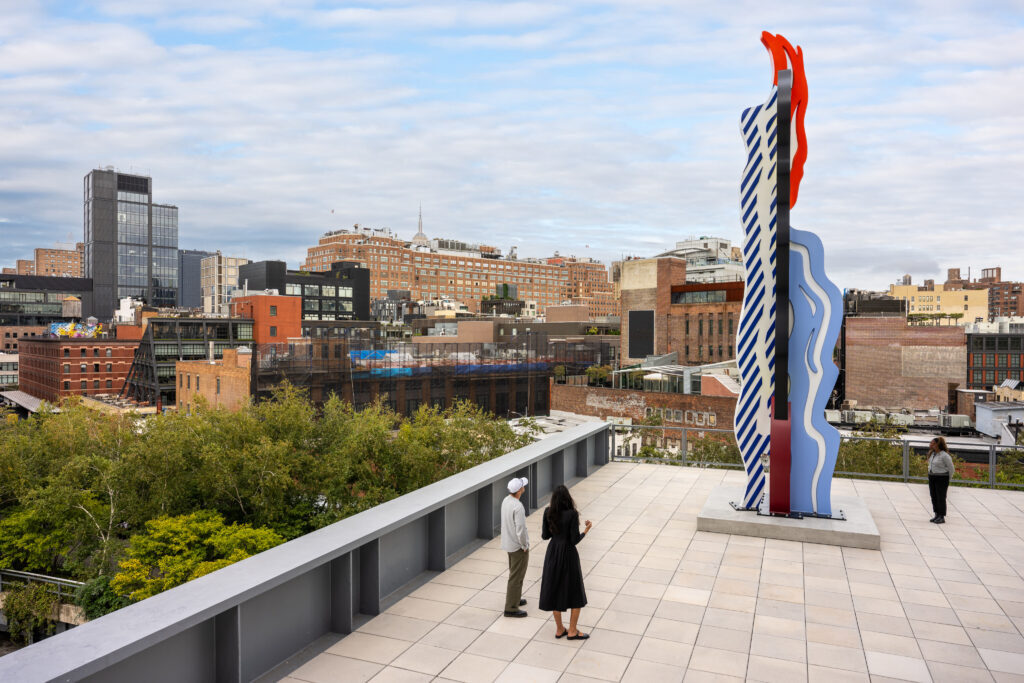
Installation view of Roy Lichtenstein: Like New, Whitney Museum of American Art, Oct 11, 2026–May 10, 2027, New York. Roy Lichtenstein, Coups de Pinceau, 1988 (fabricated 2011). Photograph by Filip Wolak.
The exhibition extends outside the Whitney, with a display of Coups de Pinceau on the magnificent fifth-floor terrace. Conceived in 1988, the first full-scale version of the 30-ft (over 9 m) sculpture was originally installed at the Caisse des Dépôts in Paris.
In true Lichtenstein form, the Roy Lichtenstein Foundation authorized the production of a copy in 2011, and that artist proof is the one on display. Executed by Amaral Custom Fabrications, it follows Lichtenstein’s precise blueprints and color matrices. Modern viewers might appreciate it as a freestanding digitally printed version of Lichtenstein’s visual language.
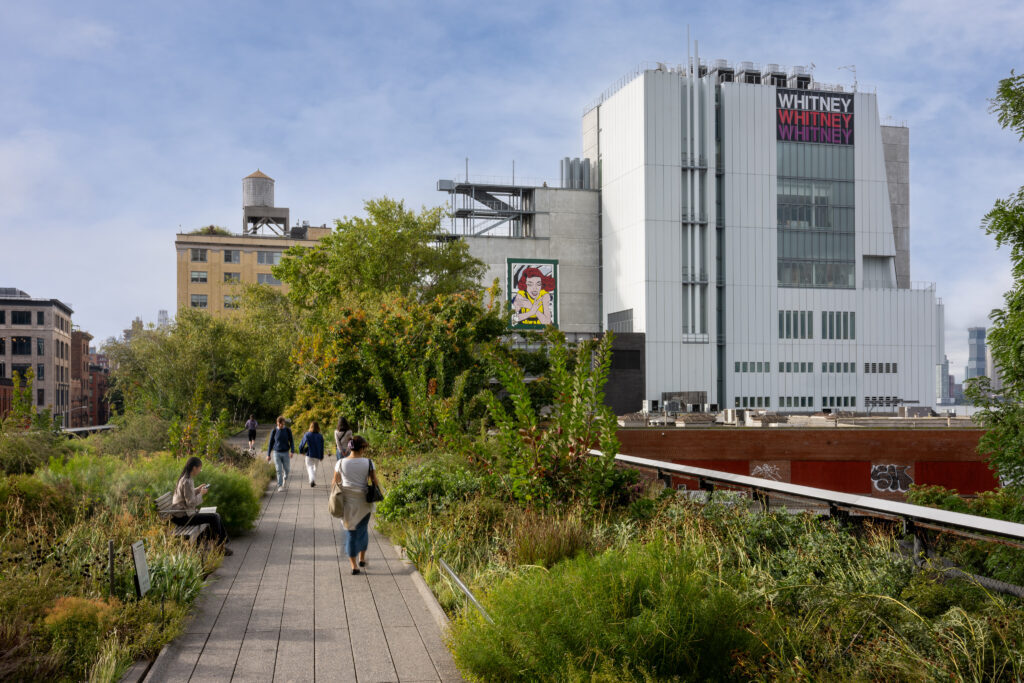
Installation view of Roy Lichtenstein: Like New, Whitney Museum of American Art, Oct 11, 2026–May 10, 2027, New York. Roy Lichtenstein, New York World’s Fair Mural (Girl in Window),1963/2026 (Recreation by Alex Da Corte studio). Photograph by Filip Wolak.
The Whitney terrace also features a recreated version of the mural Girl in Window, originally made for the 1964–1965 World’s Fair in Queens. The exhibition itself features the study for the 20-ft (6 m) mural, with a smiling redhead looking like she’s leaning out toward the city. Both artworks can be experienced at their intended architectural scale and show the range of Lichtenstein’s public art.
The installation is particularly poignant on a platform that opens to the reflective surface of the Hudson River, overlooking the final port of call for the RMS Titanic, as well as the High Line, a 1.5-mile elevated linear park and viral sensation that welcomes over eight million visitors a year.
Late Experiments and Legacy
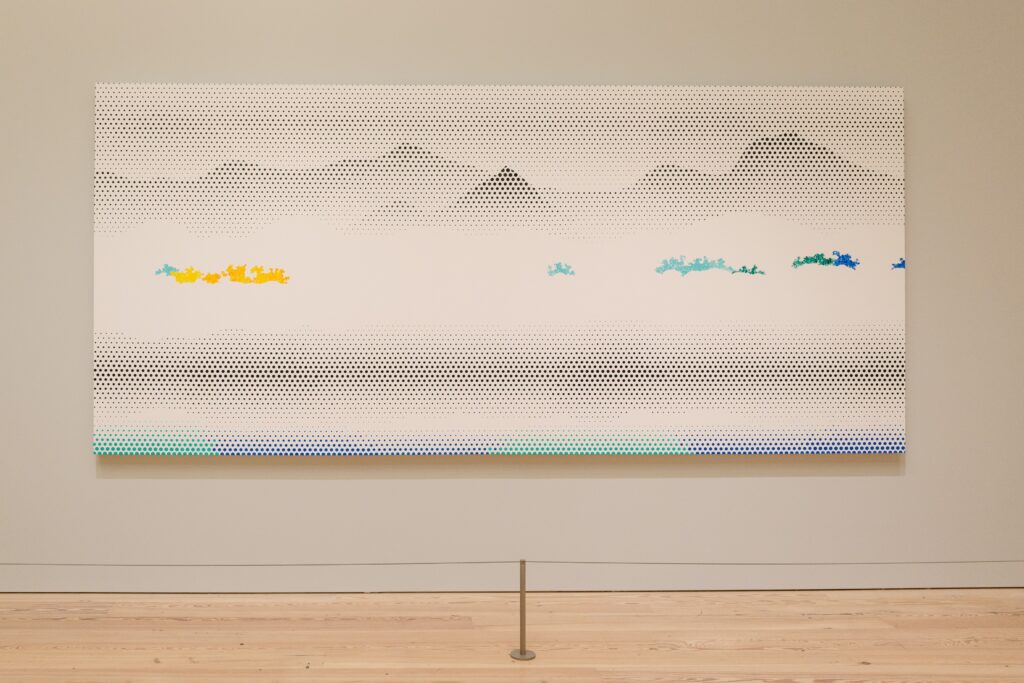
Roy Lichtenstein, Treetops Through the Fog, 1996. Installation view of Roy Lichtenstein: Like New, Whitney Museum of American Art, October 11, 2026–May 10, 2027, New York. Artwork © Estate of Roy Lichtenstein. Photograph by Jason Lowrie; Yvonne Tnt/BFA.com.
In his 70s, Lichtenstein returned to landscape, a subject he had explored for decades. His Landscapes in the Chinese Style drew on the classical landscape painting of the Song dynasty. A 1994 exhibition on Edgar Degas’ landscapes at the Metropolitan Museum of Art helped prompt the series.
In Treetops Through the Fog (1996), Lichtenstein aims to suggest the mist, expansiveness, and flatness of Chinese landscape painting using his own visual language. The painting gives the exhibition a rare moment of stillness. An artist so closely associated with hard lines, dots and comic books, could also make a landscape in which many of the forms seem to disappear.
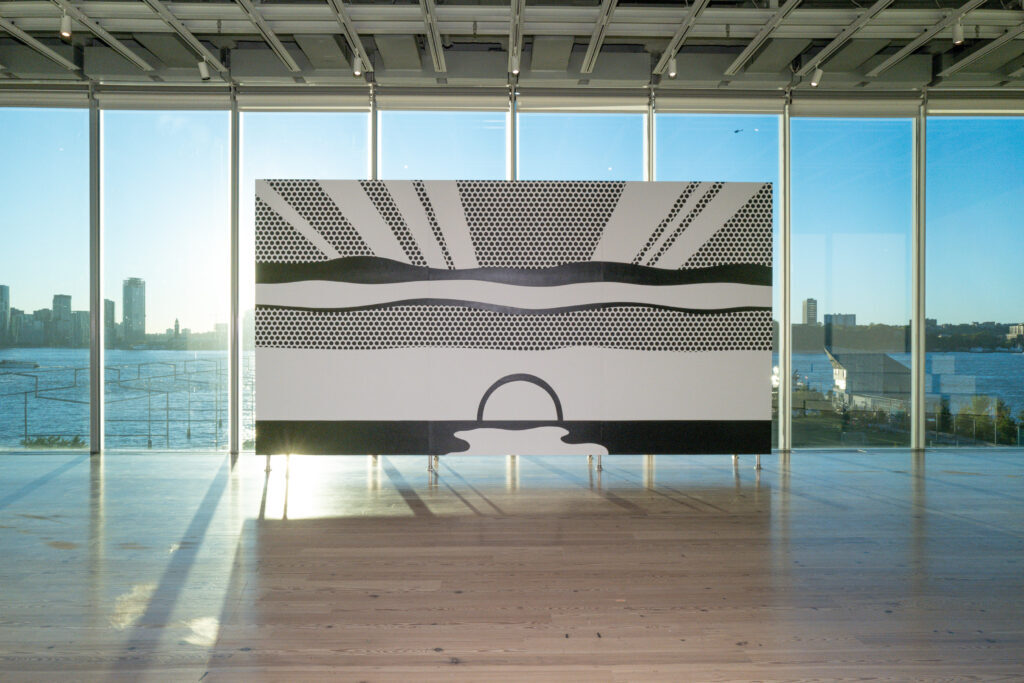
Installation view of Roy Lichtenstein: Like New, Whitney Museum of American Art, October 11, 2026–May 10, 2027, New York. Roy Lichtenstein, Super Sunset Billboard, 1967/2026 (Recreation by Alex Da Corte studio) © Estate of Roy Lichtenstein. Photograph by Jason Lowrie; Yvonne Tnt/BFA.com.
Roy Lichtenstein died in 1997 at 73. His comic-book heroines might get top billing, but they are just one part of the story. His teaching, experimentation, photography, reworking of source imagery, large public works, and willingness to help other artists remake his paintings, turn originality and authorship from art-world theory into the practical business of how art gets made and appropriated throughout history.
Long before AI, Lichtenstein was already testing what makes an image original. And every repost restarts the argument.
Roy Lichtenstein: Like New is on view at the Whitney Museum of American Art in New York, USA, through May 10, 2027.