Summary
- Hokusai was extraordinarily prolific and embraced aging as a source of artistic growth.
- Mount Fuji is described as a sacred Japanese symbol linked to eternity, long approached by pilgrims and artists, including Hokusai.
- In Fujimigahara in Owari Province, Mount Fuji is shown watching over a barrel maker, suggesting a calm, lasting connection between nature and people.
- Senju in Musashi Province shows Hokusai’s simple ukiyo-e style, using clear composition to immerse the viewer in nature and sensory detail.
- Nihonbashi in Edo uses deep perspective to guide the eye from city crowds and social hierarchy up to Mount Fuji, shown as a steady, constant presence.
- Under the Wave off Kanagawa is seen as Hokusai’s most influential work, often interpreted as symbolizing Japan’s strength, with nature portrayed as powerful and overwhelming.
- Kajikazawa in Kai Province shows the mountain subtly echoed in the composition, while contrasting turbulent water with the fisherman’s calm stability.
- Mishima Pass in Kai Province shows travelers resting under a large tree, with Mount Fuji placed to echo it as a distant symbol of permanence.
- In Ejiri in Suruga Province, Hokusai depicts a sudden gust of wind scattering people and objects, with the mountain looming behind as a reminder of nature’s overpowering force.
- In View from the Other Side of Fuji from the Minobu River, Hokusai shows an expansive, unruled landscape of mountains, river, and clouds.
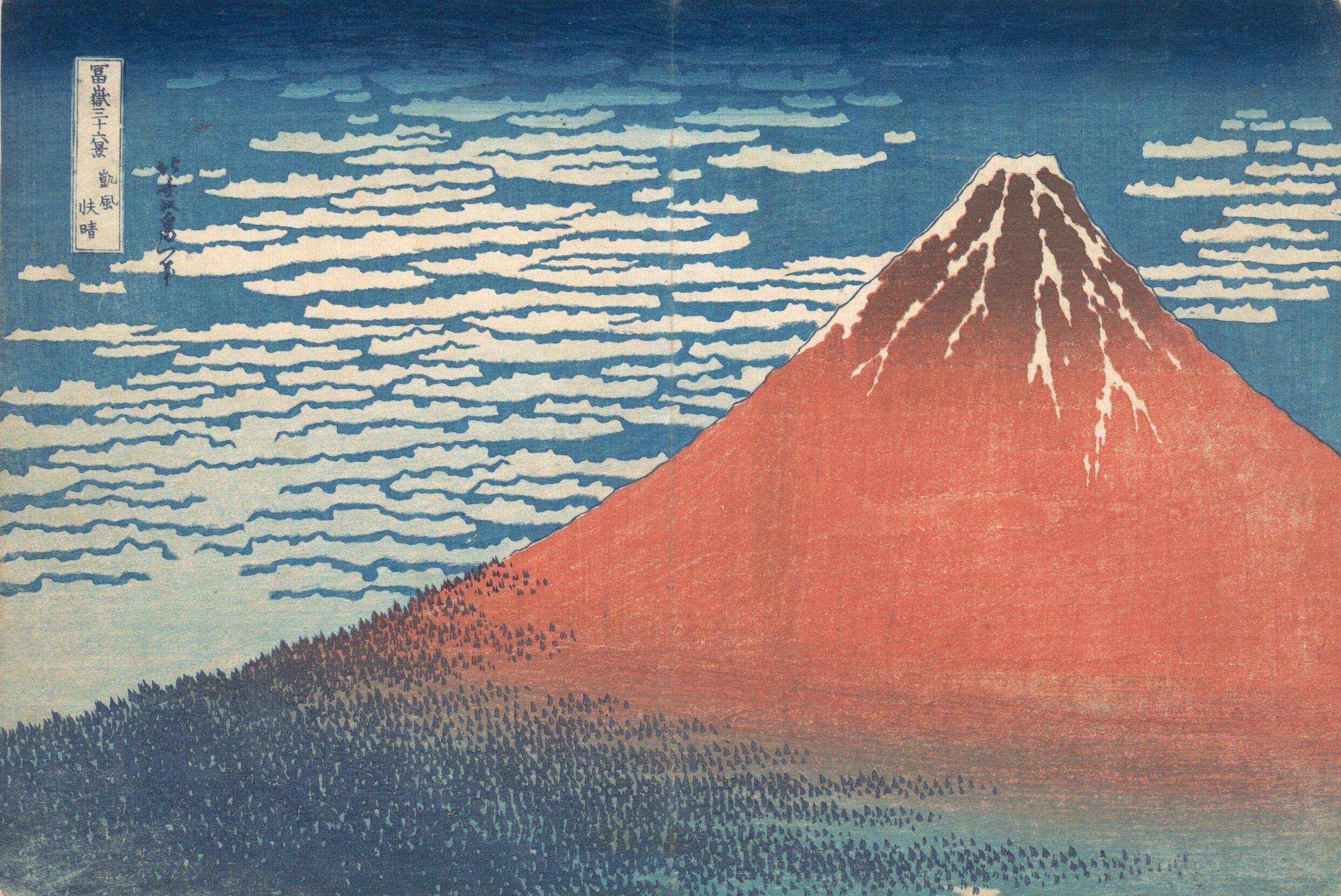
- South Wind, Clear Sky (Red Fuji) shows a solitary Mount Fuji in a dawn-lit landscape, without people, emphasizing its calm presence.
- Groups of Mountain Climbers shows weary pilgrims ascending toward Mount Fuji, treating it as a sacred destination of rest and spiritual enlightenment.
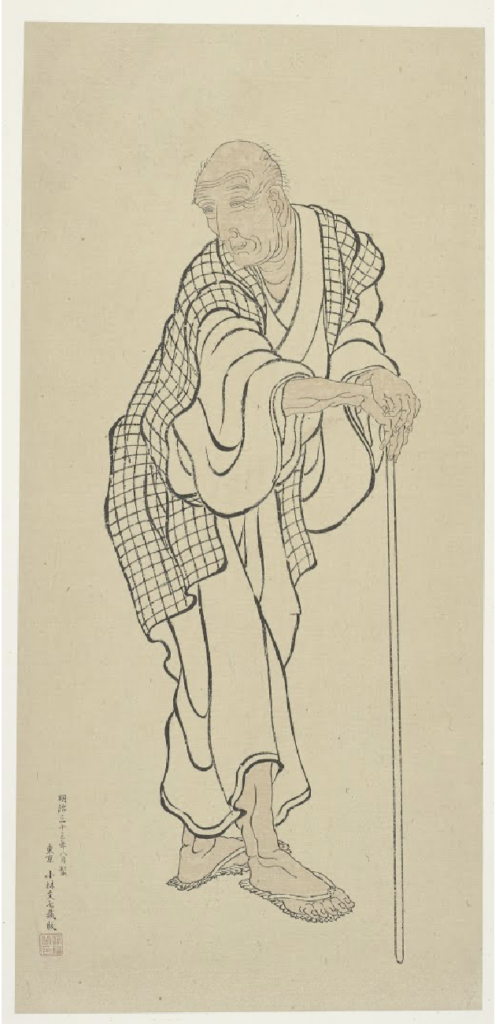
Hokusai in 10 Artworks: Hokusai, Hokusai as an Old Man, National Museum of Asian Art, Washington, DC, USA.
The Old Man Mad About Painting
Hokusai made over a staggering 30,000 works and went by over 30 names, each marking how his works changed. Many well-known wood-block prints are authored by Hokusai, to name a few, The Great Wave off Kanagawa, which is described below, The Snow Leopard, and the erotic The Dream of the Fisherman’s Wife, which sees its “tentacles” having a far-reaching influence of its own in today’s world.
Hokusai prided himself on working quickly and believed that as he advanced in age, his wisdom and technique would further blossom into greater and greater works. He celebrated getting older, and in a popular quote discussing this, he stated: “…until the age of 70, nothing I drew was worthy of notice.” He had plans for when he was 80 and then when he was 90 because these were milestones he eagerly anticipated. In our world, many fret getting older, seeing the passing years as steps towards death. We fear and worry that our best years will be behind us, and perhaps because of this purveying mood, it is we of our new age that can learn from this old master. So, drawing inspiration from the words of Hokusai himself, I will be focusing on the prints mainly from his masterful series Thirty-six Views of Mount Fuji.
The Mountain
Mount Fuji is a sacred icon in Japan, a doorway to understanding eternity. We in all corners of the earth desire immortality and wrestle against the idea of death that crashes against us like an icy wave, threatening to cool our firebrand souls. Hokusai, like many in the Edo period of Japan, sought to approach this holy mountain and even hoped to understand the secret to immortality that is said to be seated at its far leaping summit. Pilgrims, painters, and poets have made the approach for centuries. Through the vibrant artworks of Hokusai, we too make our approach.
1. Fujimigahara in Owari Province (Bishū Fujimigahara)
冨嶽三十六景 尾州不二見原|
Distance to Mt. Fuji: 214 km
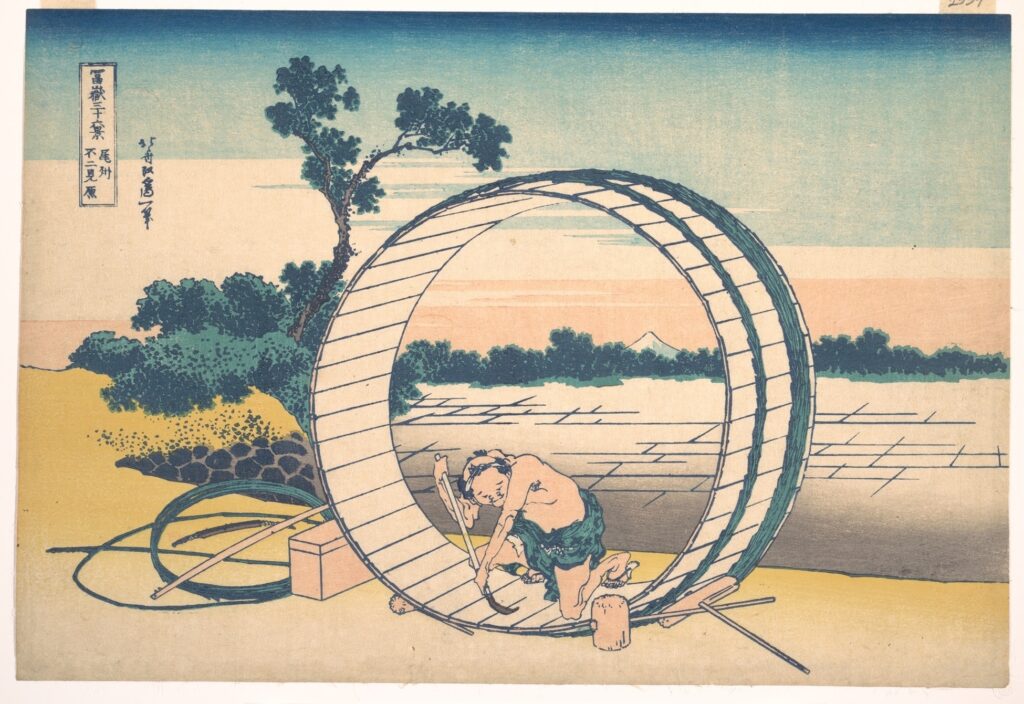
Hokusai in 10 Artworks: Hokusai, Fujimigahara in Owari Province (Bishū Fujimigahara), from the series Thirty-six Views of Mount Fuji (Fugaku sanjūrokkei), ca. 1830–1832, Metropolitan Museum of Art, New York City, NY, USA.
At the farthest distance from Mount Fuji, we see a barrel maker steadily working at his craft. The tranquility of the Edo period, in which Hokusai painted, was a much-welcomed balm to the national wounds Japan had suffered under the bloody civil wars of the Sengoku period. The ivory face of the mountain looks over the vast land between her and the humble worker with a watchful parent’s atmospheric presence. With careful placement within the circular window of the open barrel where the craftsman is also in, Hokusai seems to suggest a sealed eternal unity between Mount Fuji and the Japanese people.
2. Senju in Musashi Province (Bushū Senju)
冨嶽三十六景 武州千住
Distance to Mt. Fuji: 152 km
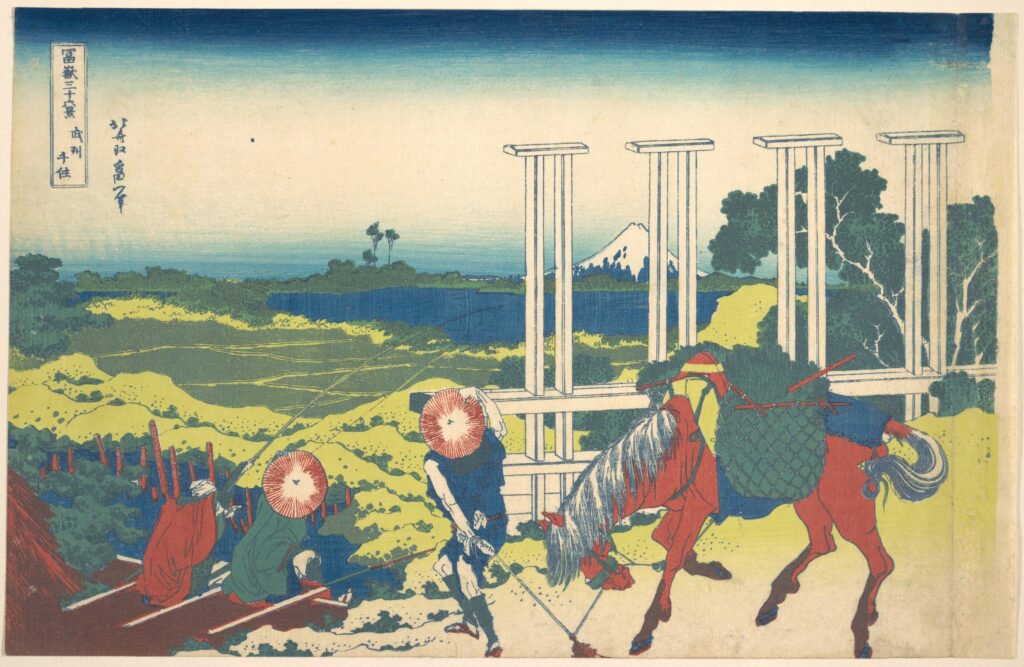
Hokusai in 10 Artworks: Hokusai, Senju in Musashi Province (Bushū Senju), from the series Thirty-six Views of Mount Fuji (Fugaku sanjūrokkei), ca. 1830–1832, Metropolitan Museum of Art, New York City, NY, USA.
Being out in nature, I have come to learn, is a central aspect of Japanese living. Hokusai approaches the depiction of nature through the simple and more graphic style of ukiyo-e. There is a magic to that simplicity; every line, every shade of color used, every subject placed is done so with such clarity that it has the effect of leaving space for our other senses. Because of the ease of viewing, we are more immediately immersed within the scene, allowing for a deeper sense penetration.
The warmth of the sun, the sharp coolness of an early spring wind, the warbling water that the anglers dip their lines into, senses like these become pronounced within simplicity. It is within this clear day that the farmer and anglers look at the majestic Mount Fuji that rules their vista. Hokusai frames the mountain between the structure of the sluice (water gate), making an open path for us to sit and wonder with it.
3. Nihonbashi in Edo (Edo Nihonbashi)
冨嶽三十六景 江戸日本橋
Distance to Mt. Fuji: 131 km
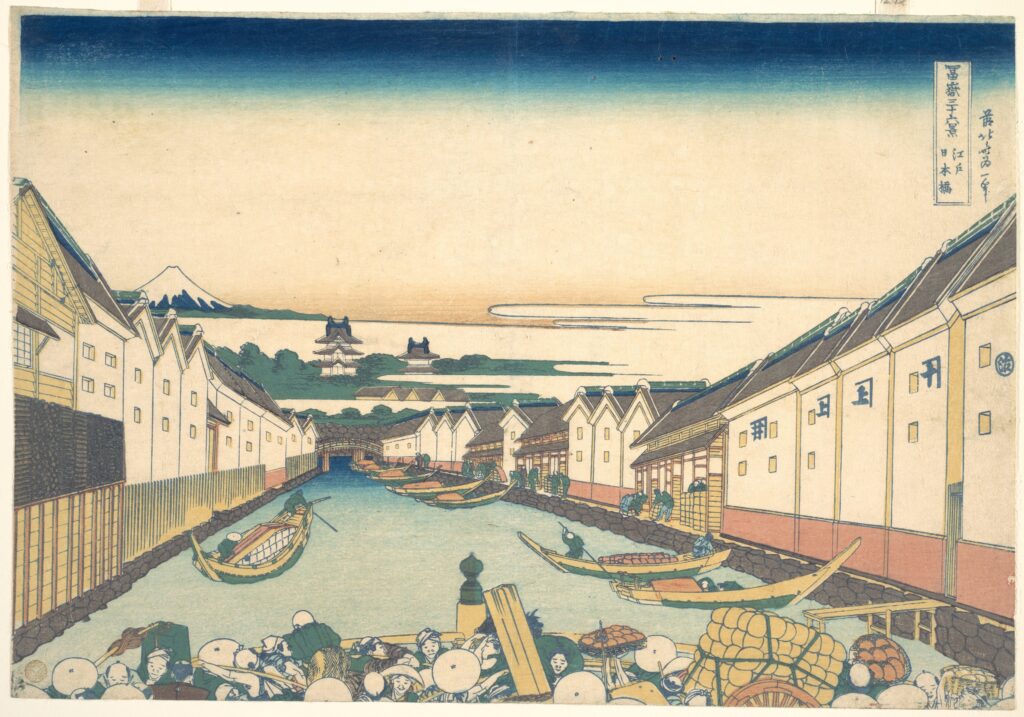
Hokusai in 10 Artworks: Hokusai, Nihonbashi in Edo (Edo Nihonbashi), from the series Thirty-six Views of Mount Fuji (Fugaku sanjūrokkei), ca. 1830–1832, Metropolitan Museum of Art, New York City, NY, USA.
Hokusai shows off some of the Western influence he gleaned from the Dutch, specifically the use of deep perspective. He pulls our attention far into the thrumming city; the crowded Nihonbashi bridge is nearly in the peripherals. As our eyes scale the cityscape, we visually pass through the class systems of Edo society.
Merchants and craftsmen fill the bottom half of the print, yet, inevitably, our eyes follow the leading lines up to the grand castles where the nobility and rulers exist, watching over the rest of society. But our eyes are meant to keep climbing. There above all sits snowy-faced Mount Fuji peaking above the clouds, and in a beautiful manner, all things are subjected to its mighty rule—nobility, merchant, craftsman, and artist are all harmoniously one under Mount Fuji.
This portrait of Edo is a glimpse into a society that never stopped moving. The years flowed on, the crowds endlessly expanded, and the river never slowed. The “Bridge of Japan” has since been built over and made small by the ever encroaching jungle of modernity that would reshape this now antiquated city into the behemoth that is Tokyo. But especially in the breathtaking currents of change that we are inevitably shaped by, it is most important to look to and lean on that which is always steady and permanent, and to this day, Mount Fuji continues to ground that city and people that move so quickly they might otherwise flutter endlessly away.
4. Under the Wave off Kanagawa (Kanagawa oki nami ura)
「富嶽三十六景 神奈川沖浪裏」
Distance to Mt. Fuji: 121 km
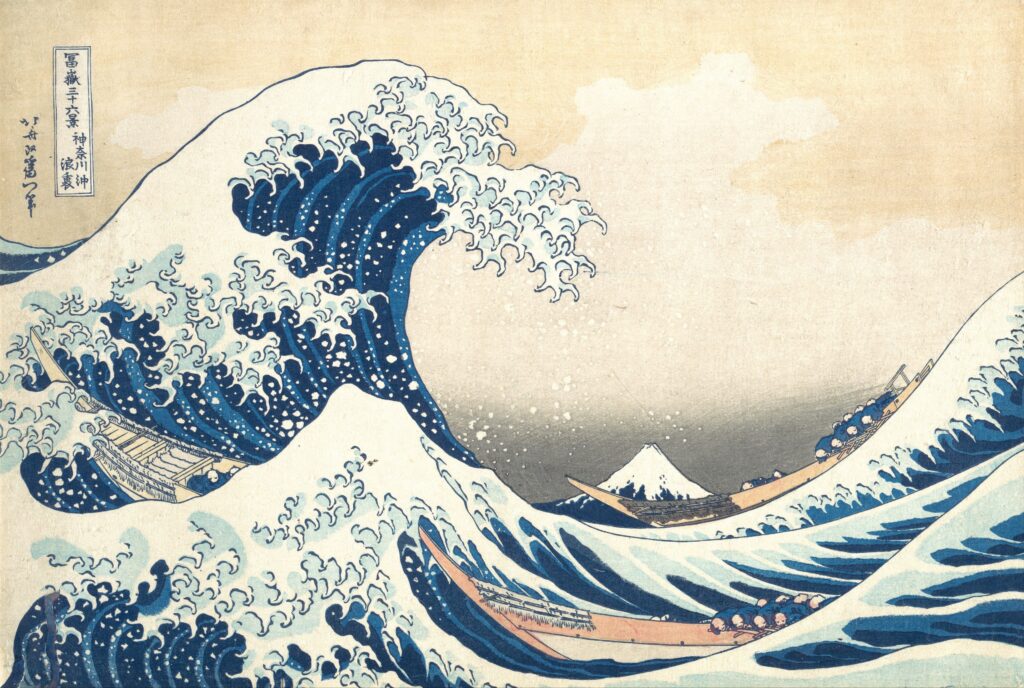
Hokusai in 10 Artworks: Hokusai, Under the Wave off Kanagawa (Kanagawa oki nami ura) or The Great Wave, from the series Thirty-six Views of Mount Fuji (Fugaku sanjūrokkei), ca. 1830–1832, Metropolitan Museum of Art, New York City, NY, USA.
This print is considered by most to be the single most influential piece of art from Japan. Hokusai has inspired many all over the world with his terrible wave gaping open, ready to consume the insignificant boats. Many have seen the wave as a symbolic martial spirit of Japan during the time in which the borders were closed off completely to outsiders, representing the strength of the Japanese people and their culture. It is, however, ironic that this mighty wave is cast in a beautifully vibrant Prussian Blue.
What is often missed is that cradled within the maw of the wave is the foamy white peak of Mount Fuji, crowned with a dark stormy sky around, giving the feeling that the frothing wave is an appendage to the far-seeing mountain. Nature here is seen as a commanding presence to be respected and feared, or else we’ll be humbled by it.
5. Kajikazawa in Kai Province (Kōshū Kajikazawa)
冨嶽三十六景 甲州石班沢
Distance to Mt. Fuji: 87 km
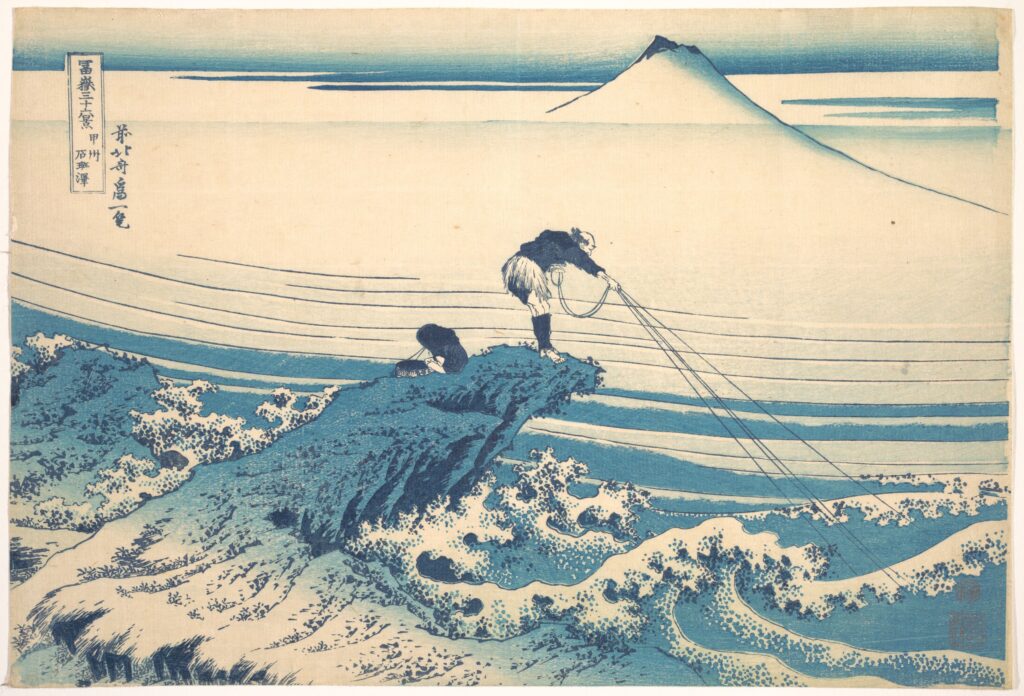
Hokusai in 10 Artworks: Hokusai, Kajikazawa in Kai Province (Kōshū Kajikazawa), from the series Thirty-six Views of Mount Fuji (Fugaku sanjūrokkei), ca. 1830–1832, Metropolitan Museum of Art, New York City, NY, USA.
The image of Mount Fuji ripples through this print. We see the mountain depicted in its barest form, as not much more than a suggestion made with an indigo line, nearly escaping view within the mist. Though it’s rendered to a near apparition state, we see its shape made again in the fisherman’s bent back and the long slope of the fishing line, as well as a third time in the small cliff he stands on.
The genius of this print is not in this visual motif alone; it is also flowing with symbolism, atmosphere, and mood. The fisherman stands on the precipice of the cliff, surrounded by swirling water, all is shadowed in striking indigo, creating a dreamlike mood. Like in the Under the Wave off Kanagawa, the water has tremendous energy and moves wildly. Much like the fisherman surrounded by waves and mist, we are constantly surrounded by unpredictability and violent commotion and in need of sure footing.
In the print, we are shown two examples of stability: 1. Mount Fuji, and 2. the fisherman on the cliff. It is here with the symbology, atmosphere, and most importantly emotion that the visual motif finds its true depth and weight, a fisherman as steady as the mountain, calmly existing in cooperation with the waves, fishing, because it is within the swirling waters he finds himself fulfilled.
6. Mishima Pass in Kai Province (Kōshū Mishima goe)
冨嶽三十六景 甲州三島越
Distance to Mt. Fuji: 66.6 km
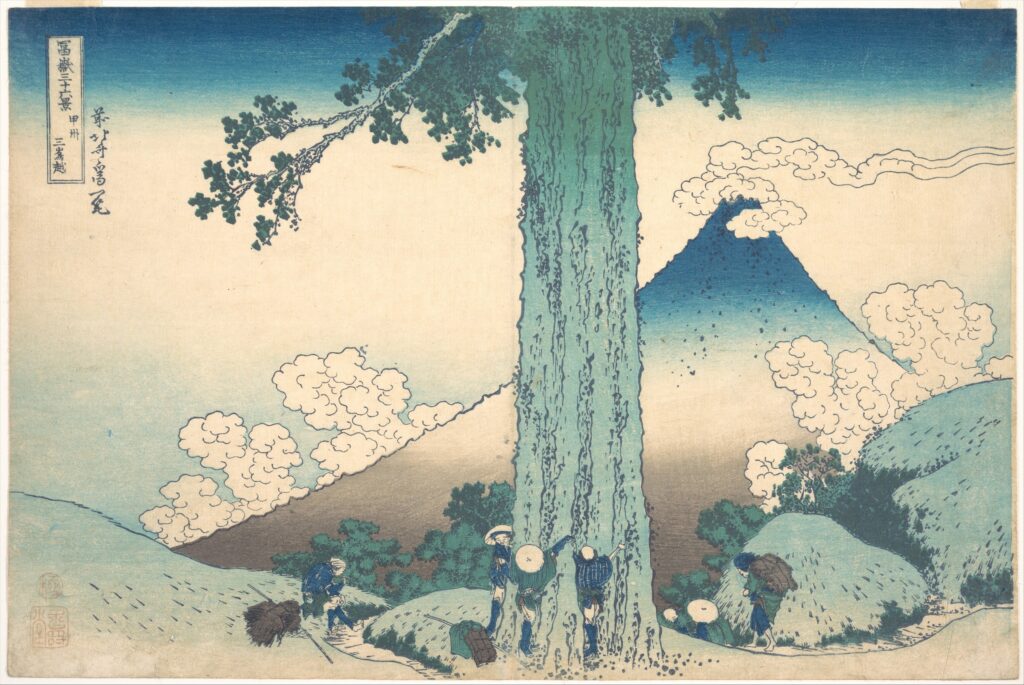
Hokusai in 10 Artworks: Hokusai, Mishima Pass in Kai Province (Kōshū Mishima goe), from the series Thirty-six Views of Mount Fuji (Fugaku sanjūrokkei, ca. 1830–1832, Metropolitan Museum of Art, New York City, NY, USA.
In Shinto belief, large objects like rocks and trees are referred to as Yorishiro, or places in which spirits can dwell, like the famous Kodama or tree spirits. The travelers depicted in the print find respite and celebration from their long journey in the shade and presence of a large tree. Some cling to it together with outstretched arms in a genuine moving gesture of appreciation towards the world they live in. They are all small near its strong trunk. It stands above them like an older sibling watching as they rejoice.
Hokusai places Mount Fuji, topped with mysterious clouds, in such a position where it could be seen as a long cast shadow of the tree directly linking the two as monuments of permanence and spiritual centers for the weary human travelers to come and lean on their great strength.
7. Ejiri in Suruga Province (Sunshū Ejiri)
冨嶽三十六景 駿州江尻
Distance to Mt. Fuji: 40 km
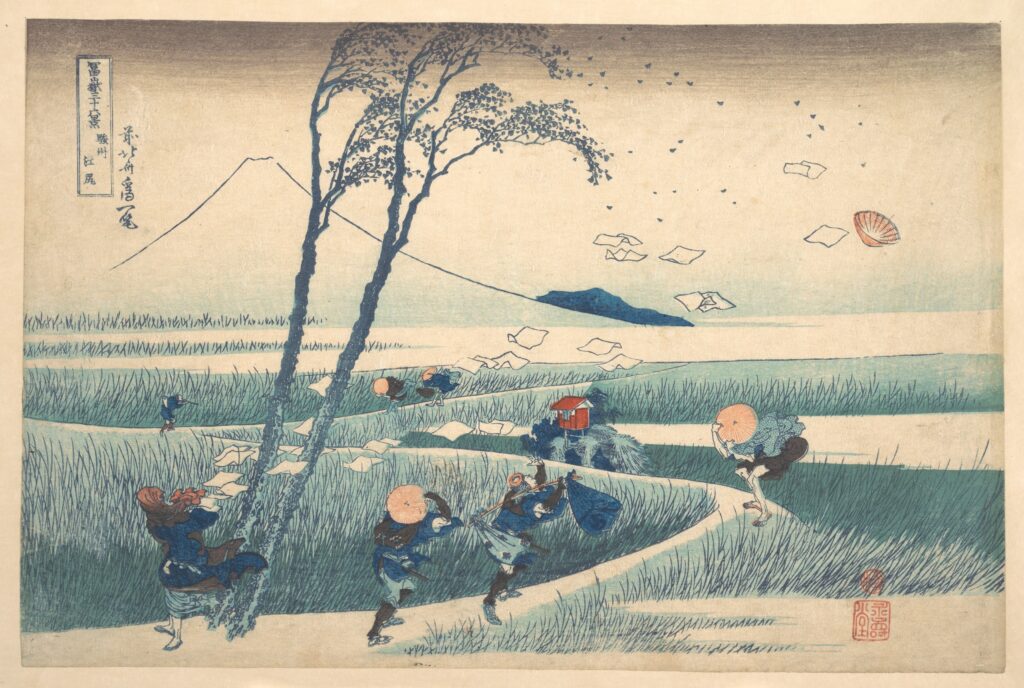
Hokusai in 10 Artworks: Hokusai, Ejiri in Suruga Province (Sunshū Ejiri), from the series Thirty-six Views of Mount Fuji (Fugaku sanjūrokkei), ca. 1830–1832, Metropolitan Museum of Art, New York City, NY, USA.
In most artworks in Hokusai’s series Thirty-six Views of Mount Fuji, we see the relationship between people and nature on display. Nature is seen as beautiful, mysterious, and even as a raw force to submit to. What I love about this print is that we also see it as mischievous in the way of the bellowing rush of wind interrupting what could be seen as an otherwise unremarkable day.
A straw hat is blown off the head of a well-dressed man while his companion holds on to his own, farmers along the winding path crouch low in the strength of the wind, and a woman’s kimono is blown into her face while her papers are caught up into the gust and carried away with the leaves of the tree. Mount Fuji looms behind the wind as if it had taken a deep inhale, pulling those caught in its vortex towards it. Again, Hokusai posits that despite our own determinations, people are ever only at the mercy of nature.
8. View from the Other Side of Fuji from the Minobu River (Minobugawa ura Fuji)
冨嶽三十六景 身延川裏不二
Distance to Mt. Fuji: 30 km
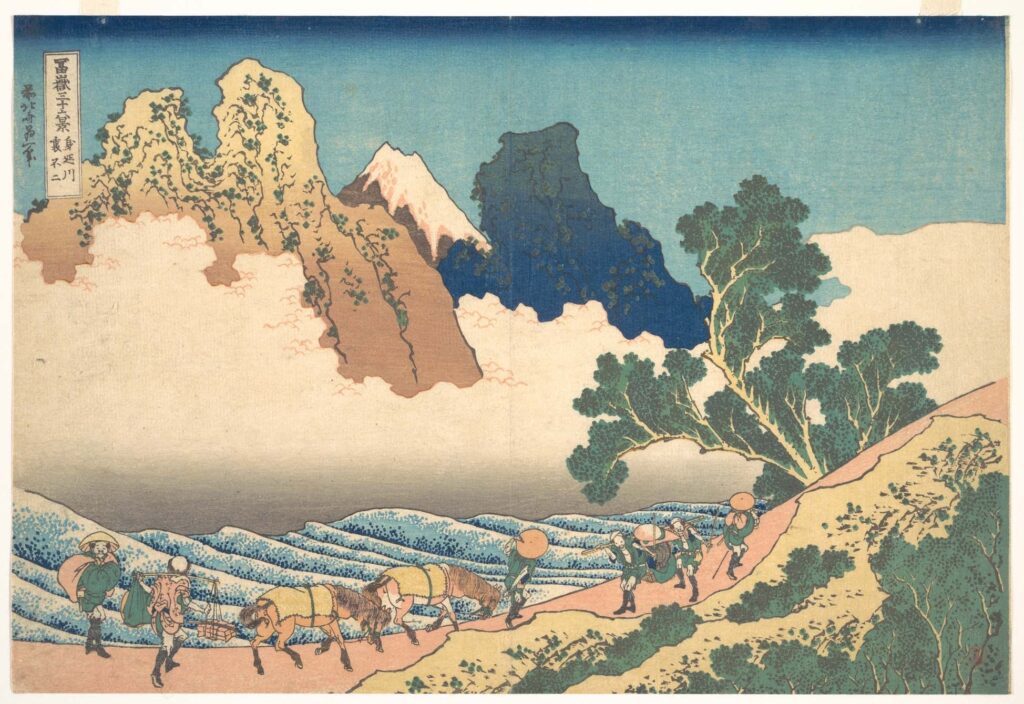
Hokusai in 10 Artworks: Hokusai, View from the Other Side of Fuji from the Minobu River (Minobugawa ura Fuji), from the series Thirty-six Views of Mount Fuji (Fugaku sanjūrokkei), ca. 1830–1832, Metropolitan Museum of Art, New York City, NY, USA.
The vastness of the very heavens is crowded by the peaks of mountains, the river rolls into itself, the clouds lie as pillows in the laps of the rocky guardians of eternity, and a few of the passersby stare into the magnitude of nature’s sum.
Hokusai showed parts of Japan unordered and unruled, which surely struck a chord of pride within audiences who must have reveled in seeing such depictions of the elemental quarry in which they were cut. Strong people of a still wild land. The colors are vibrant and layered beautifully on top of each other with clean, unblended lines, making the print ever vivid today as it must have been when first created.
9. South Wind, Clear Sky (Gaifū kaisei)
冨嶽三十六景 凱風快晴
Distance to Mt. Fuji: 20 km
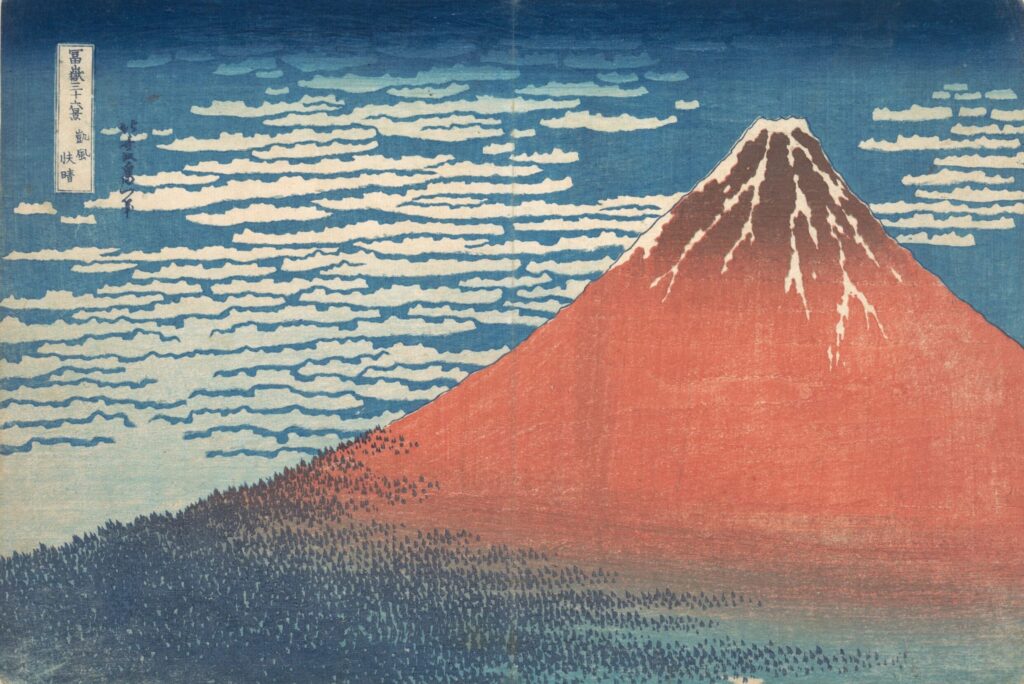
Hokusai in 10 Artworks: Hokusai, South Wind, Clear Sky (Gaifū kaisei) or Red Fuji, from the series Thirty-six Views of Mount Fuji (Fugaku sanjūrokkei), Metropolitan Museum of Art, New York City, NY, USA.
There is a totally unique feeling when one is in complete solitude within nature. Relationships, careers, aspirations, meetings, things we feel we should have done but haven’t, successes, failures, all obligations and aspects of our daily lives and routines, all are as far away and faded as a thin image of a dream now awakened from. It is this moment of ethereal solitude that Hokusai has provided.
This is the only artwork on our list today that does not feature any people. The only subject is the sacred perennial mountain, and the only person is you, the sole viewer. The old artist places you at the expansive base of the mountain, experiencing its full unobstructed majesty. There is a mystical red glow to Fuji due to an early autumn dawn illuminating its volcanic rock face (the popular title of this print is Red Fuji).
A large stillness settles around every tree, rock, and living thing in its presence. The air is crisp and the wind rejuvenating, earth has become new again and you empty out at its base. The clouds are heavenly steps leading upward to immortal knowledge. The rolling paths of all nature come to their point in Mount Fuji. In turn, it nurtures Japan like the earthen breast of a mother goddess where the wonder-starved children of the world are fed the answers to life’s mysteries and can be, at last, satiated.
10. Groups of Mountain Climbers (Shojin tozan)
冨嶽三十六景 諸人登山
Distance to Mt. Fuji: 0 km
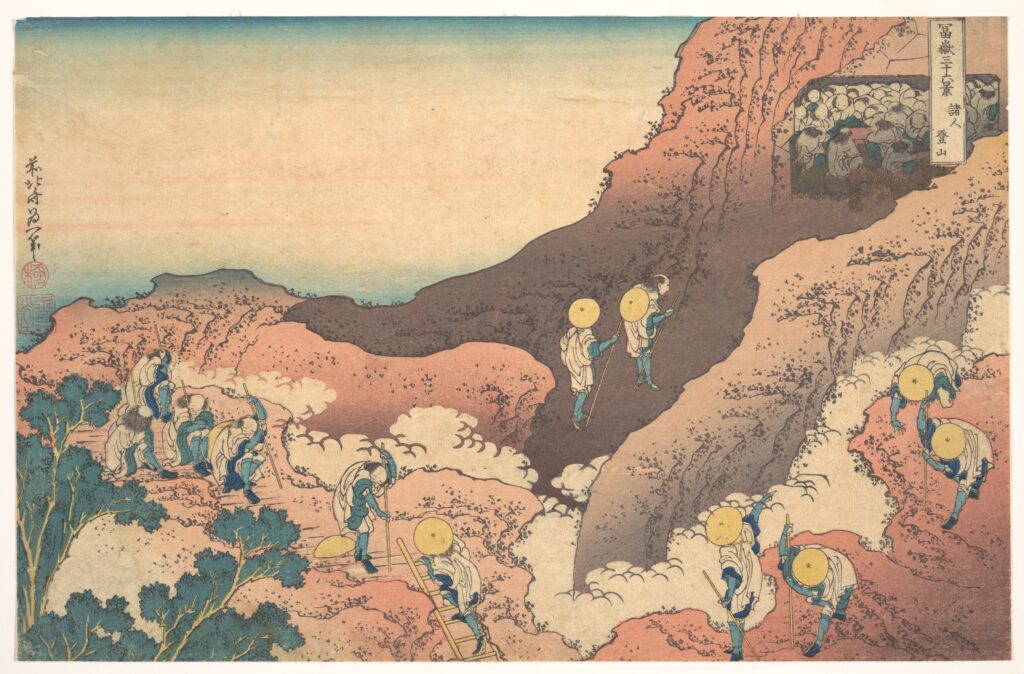
Hokusai in 10 Artworks: Hokusai, Groups of Mountain Climbers (Shojin tozan), from the series Thirty-six Views of Mount Fuji (Fugaku sanjūrokkei), ca. 1830–1832, Metropolitan Museum of Art, New York City, NY, USA.
What must it be like to walk in the shoes of a pilgrim? Driven out from the comfort of your life to face the world in its barest forms: winding paths, marshlands, towering trees, rough stones, rushing rivers, deep lakes, sunlight, dust, and mist. The farther you leave behind the noise of society, the more you feel you’ve stepped back through time to glimpse nature in its primordial adolescence. Exhaustion perhaps becomes the familiar spirit that possesses you in your joints, hands, and feet but still you journey further because the need for wonder has taken seed in your heart and mind. Enlightenment will be your balm, eternity your prize.
The pilgrims of this final print lumber with great tiredness; they lean on their staffs and hunch with aching backs. They wind up the stony way. No longer is Mount Fuji their horizon. It is their temple they now tread. Inside its cavernous mist-crowned peak is rest for the weary pilgrim and immortal answers.
Writer’s Note: The Daily Climb
In Edo Japan, a cult around worshipping Mount Fuji, known as Fuji-kō, was a popular belief. There were smaller “Fuji Mounds” (Fujizuka) built for those who couldn’t climb Mount Fuji in order for them to still experience enlightenment. In the Fujizuka spirit, I assert that every good painting, well-written book, artful film, stirring musical composition, and other great art medium is a Fuji Mound easily accessible to us. I find that in our engagement with good art, we have the opportunity to empty ourselves of societal cares and be taken up to a place beyond the stagnation of routine living, a place reserved for the enlightenment of the human soul, where, even if for a few minutes, we are eternal.
Oh snail,
climb Mount Fuji,
but slowly, slowlyA Taste of Issa: Haiku.
P.S. If you would like to have some of the Japanese masterpieces for yourself, be sure to check out our Japanese Art and Animals in Japanese Art postcard sets. Both of them feature some of the most amazing Japanese artworks!