
The Cost of Devotion in Caravaggio’s Saint Jerome
Caravaggio, one of the most striking painters of the Baroque era, uses the figure of Saint Jerome to explore themes of devotion and mortality. In...
Frank Schildiner 13 September 2026
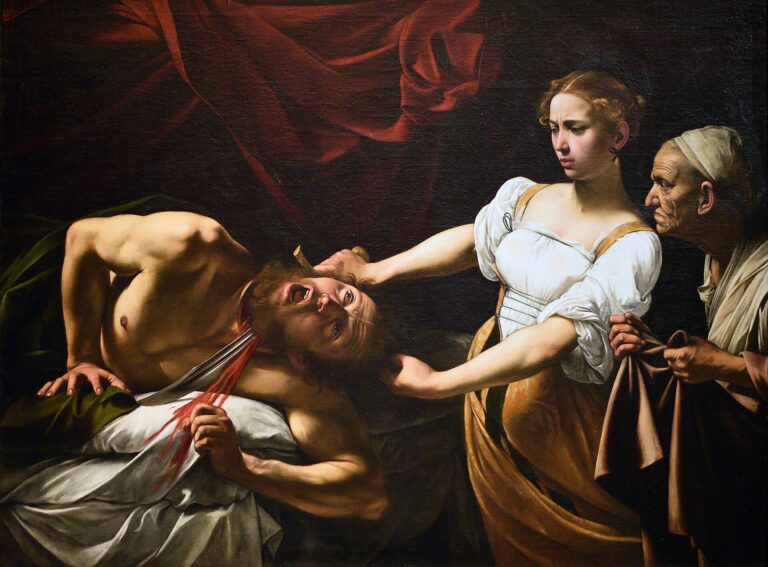
Caravaggio, Judith Beheading Holofernes, 1599, Galleria Nazionale d’Arte Antica, Rome, Italy.
Rome is not simply a city where you can see paintings by Caravaggio. It is the city where Michelangelo Merisi became Caravaggio. He arrived as an unknown young painter, found powerful patrons, and developed a style that would make him one of the most recognizable artists in Western art. His rise was as turbulent as it was brilliant. Repeatedly involved in fights and arrested on several occasions, his Roman years came to an abrupt end when he killed a man and fled the city. More than four centuries later, many of the masterpieces from those years are still here, scattered across Rome. Put on a comfortable pair of shoes. We are going looking for Caravaggios in Rome.
We begin at the Galleria Borghese, home to a painting that is essential to understanding Caravaggio’s early years in Rome: Sick Bacchus. Around 1592, a young Lombard in his early 20s arrives in Rome, penniless and unknown. He gets by working in the workshop of the Cavalier d’Arpino, painting flowers and fruit to order. It does not last long: he falls ill and ends up in the hospital of Santa Maria della Consolazione.
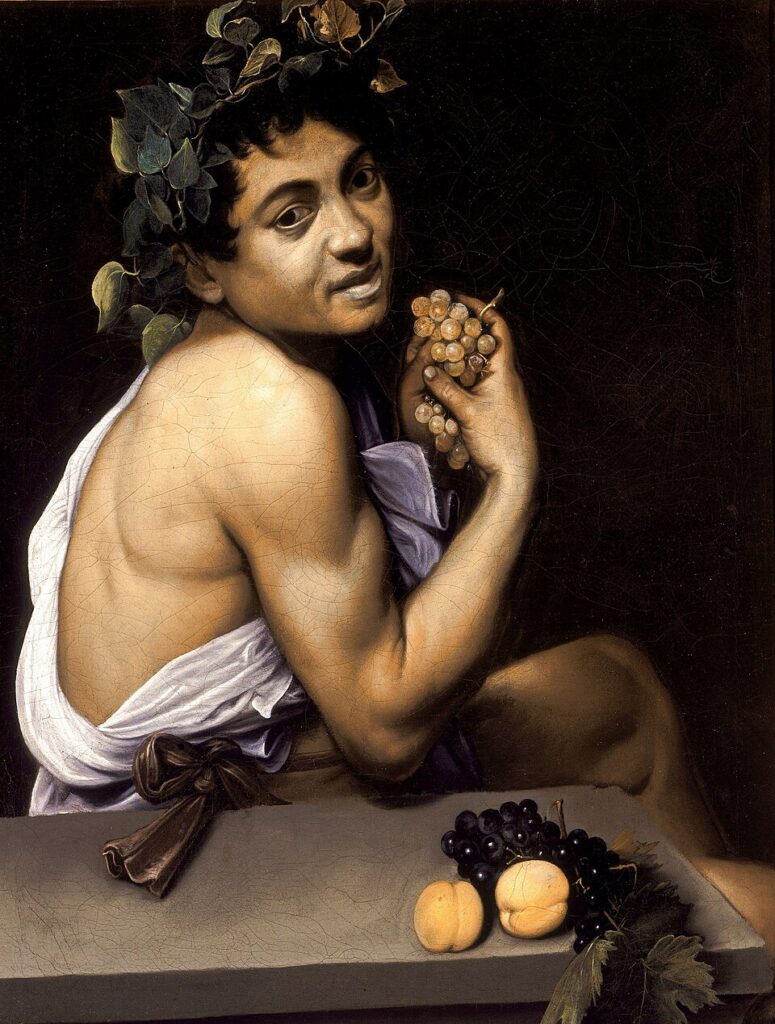
Caravaggio, Sick Bacchus, 1595, Galleria Borghese, Rome, Italy.
This Bacchus comes from that time, with its sallow skin and pale lips, a crooked wreath of leaves and grapes nobody feels like eating anymore. It is believed to be a self-portrait: a god turned into a feverish boy. It is a curious choice for someone who has spent weeks in bed. Perhaps Caravaggio saw himself in the god of wine and festivity, of drunkenness, madness, and disorder, exactly what would end up defining his own life.
We cross the city to the Palazzo Barberini, home of the Galleria Nazionale d’Arte Antica. The boy who got by painting fruit has found a protector. His name is Francesco Maria del Monte; he is a cardinal, and he is passionate about music, science, and painting. He takes Caravaggio into his palace and opens the doors to the Rome of collectors, bankers, and prelates with money and a taste for showing it off.
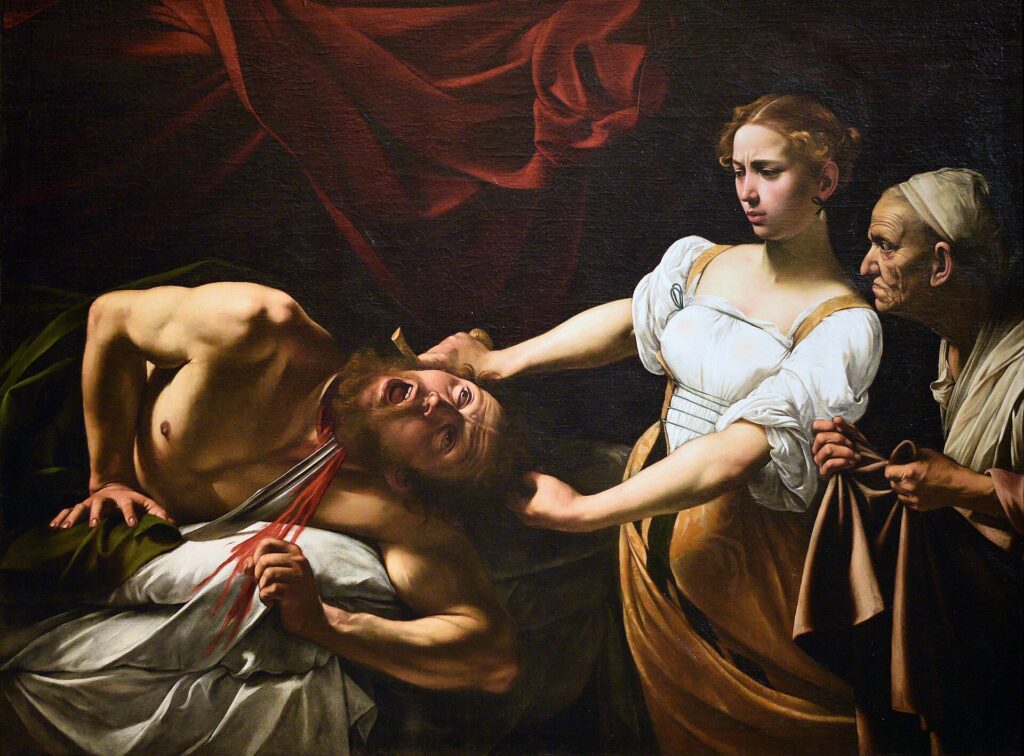
Caravaggio, Judith Beheading Holofernes, 1599, Galleria Nazionale d’Arte Antica, Rome, Italy.
Such is the case of Ottavio Costa, a Genoese banker who would become one of Caravaggio’s greatest collectors and who commissioned the painting we have come to see, Judith Beheading Holofernes. Caravaggio turns this biblical episode into a scene so bloody and realistic that it shocked the first visitors who came to see it. Holofernes, still alive, screams in agony as Judith beheads him. Caravaggio’s mastery of light and chiaroscuro turns the scene into a kind of photograph that captures the exact instant. His version would go on to inspire the ones Artemisia Gentileschi painted later.
The next stop is a few steps from Piazza Navona, in the church of San Luigi dei Francesi. Head to the Contarelli Chapel at the end of the left aisle, and bring some coins to switch on the lights. In 1599, with the support of Cardinal Francesco Maria del Monte, Caravaggio was commissioned to paint three large canvases for the chapel, his first major public commission.
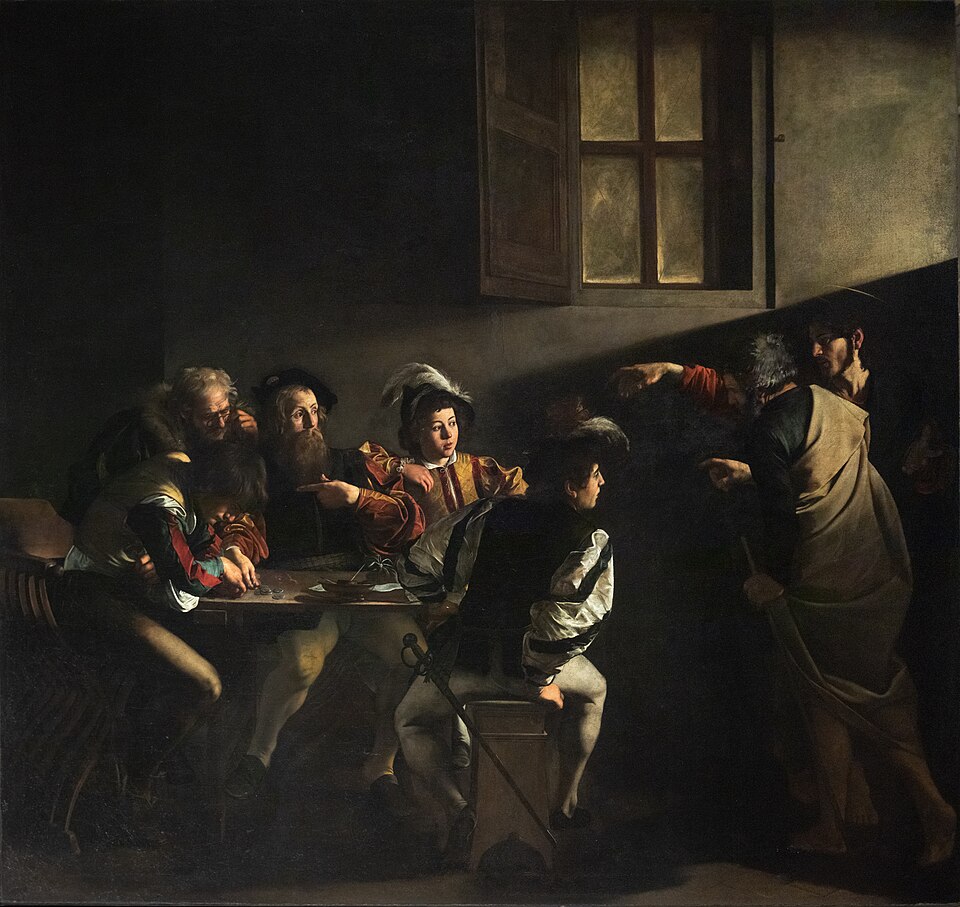
Caravaggio, The Calling of Saint Matthew, 1599–1600, San Luigi dei Francesi, Rome, Italy.
The chapel is dedicated to Saint Matthew and holds three paintings from his story. The one that deserves our attention is The Calling of Saint Matthew. Christ enters a dark room where men sit around a table counting money, and points at Matthew. Look closely at his hand: doesn’t it remind you of the hand in Michelangelo’s Creation of Adam? The tax collectors wear the clothes of Caravaggio’s own time, and the room could easily be a Roman tavern. A sharp beam of light follows the direction of Christ’s gesture, turning an ordinary scene into a moment of divine revelation. And which one is Matthew? The bearded man pointing at himself, or the younger man still absorbed in the coins? Caravaggio leaves the answer open.
It was an immediate success, and the unknown boy of the Galleria Borghese was now one of the most talked-about painters in Rome.
Our next stop is Santa Maria del Popolo, on the edge of the piazza of the same name. After the first Contarelli canvases, Caravaggio was in demand. In the Cerasi Chapel, to the left of the high altar, two paintings by Caravaggio face each other: The Conversion of Saint Paul and The Crucifixion of Saint Peter. Look at the second one.
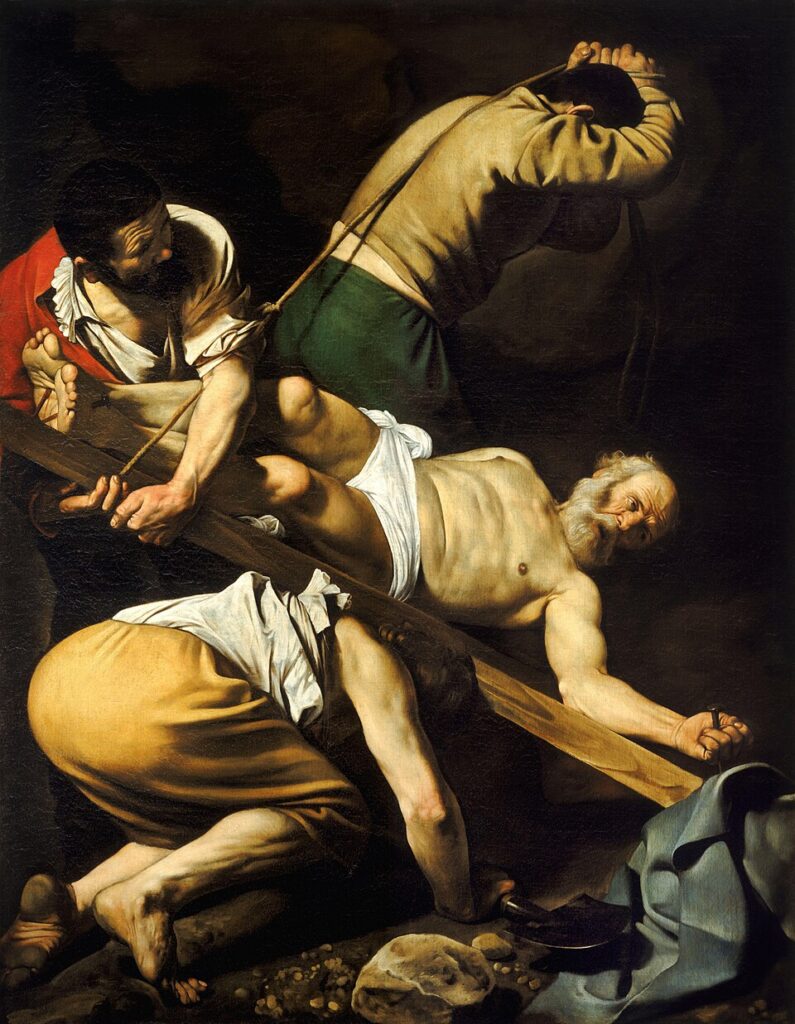
Caravaggio, The Crucifixion of Saint Peter, 1601, Santa Maria del Popolo, Rome, Italy.
There is no glory here. Three men struggle to raise the cross with the elderly apostle upside down because, according to tradition, Peter did not consider himself worthy of dying like Christ. We cannot see the executioners’ faces, only their backs, their bare feet, and the effort. The background almost disappears into darkness, while the light picks out the bodies and the cross. The scene is not particularly bloody, but pain is everywhere.
By now Caravaggio was the painter everyone wanted. He was also a man who could not stay out of trouble, and Rome was beginning to notice.
Inside the Vatican Museums, in the Pinacoteca, hangs the painting that many consider the summit of Caravaggio’s Roman years: The Entombment of Christ. Nothing in this painting is shouted. A group of mourners lowers Christ’s body onto a stone slab, and the whole scene seems to slide downwards: from the old man holding his legs to the lifeless hand that almost touches the stone. Look at that hand. Look also at the faces of the Virgin, Mary Magdalene, and the other women, grieving with a restraint that is far harder to paint than any scream. The composition echoes Michelangelo’s Pietà, which you can see a short walk away in St. Peter’s.
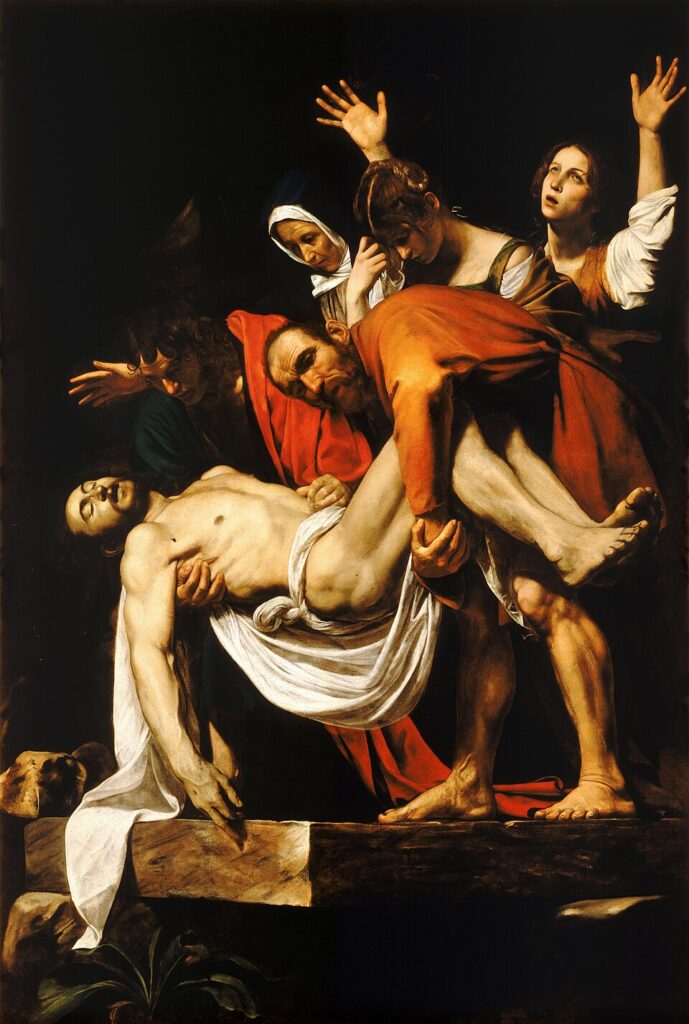
Caravaggio, The Entombment of Christ, 1602–1604, Vatican Museums, Vatican City.
This is Caravaggio at the height of his powers. Here there is no scandal, no rejected version, no one raising a fist. Almost two centuries later, Napoleon’s troops seemed to agree: they carried the painting off to Paris, and it came back to Rome only after his fall. For a moment, the painter of the moment was simply the best painter in Rome. But once you reach the top, there is nowhere to go but down.
Let’s continue along our path. We head to Sant’Agostino, where the Caravaggio waiting inside is a very different one. In the first chapel on the left hangs the Madonna di Loreto, also known as the Madonna dei Pellegrini.
This Virgin is no queen. She is a woman standing barefoot in a doorway, holding a child, while two pilgrims kneel at her feet. Look at them: their backs are bent, their clothes are worn, and the soles of their feet, filthy, are the first thing you see. When the painting was unveiled, it caused an uproar. It did not help that popular rumor held the Virgin was modeled on a well-known Roman courtesan.
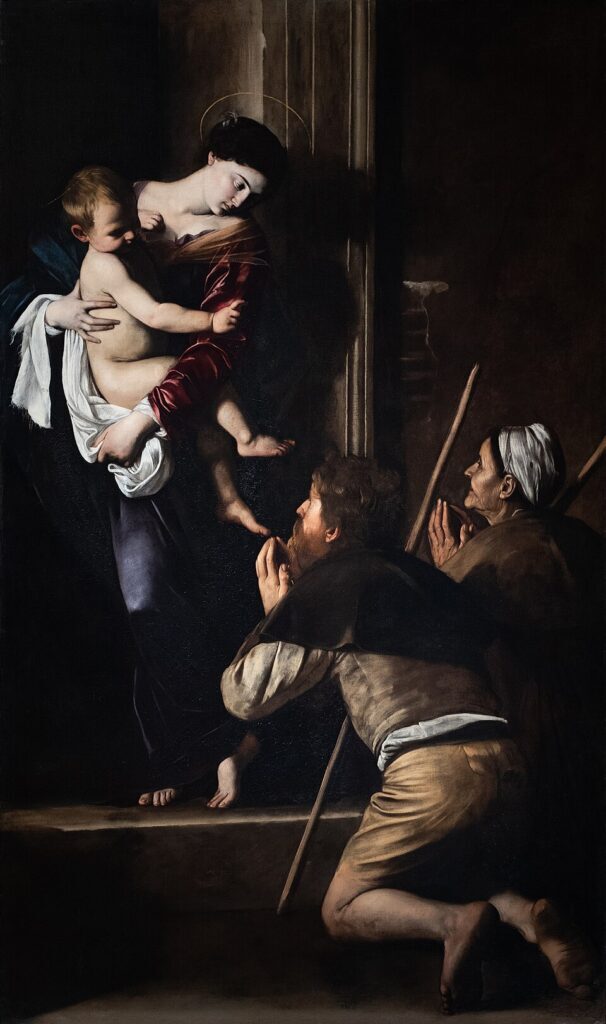
Caravaggio, Madonna di Loreto, c. 1604–1606, Sant’Agostino, Rome, Italy.
By now Caravaggio’s life was beginning to look like his paintings: dark, violent and dramatic. This would be his last major public commission in Rome. In May 1606, after a quarrel in the Campo Marzio, he killed a man named Ranuccio Tomassoni. With a death sentence hanging over him, Caravaggio left Rome within days.
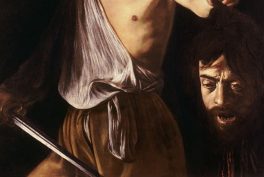
We end where we began, in the Galleria Borghese. In the same room as Sick Bacchus hangs David with the Head of Goliath. Caravaggio painted it in exile, around, after years on the run through Naples, Malta and Sicily. He sent it to Cardinal Scipione Borghese, the pope’s nephew and one of the most powerful men in Rome, hoping it would buy him a pardon.
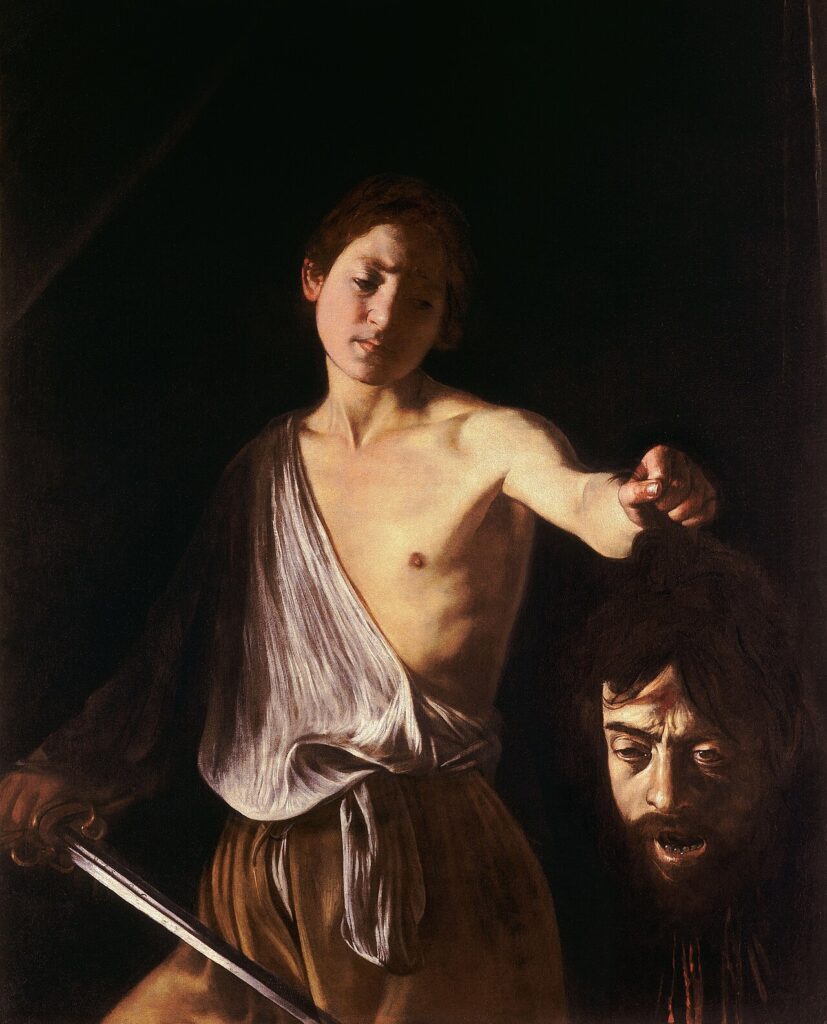
Caravaggio, David with the Head of Goliath, 1605, Galleria Borghese, Rome, Italy.
The painting is both a confession and a plea. Caravaggio seems to have painted himself twice: as a young man and as an old one. David is a street kid, wild and reckless. Goliath is a battered man, almost destroyed, undone by his younger self. And yet David does not look triumphant. He gazes at the severed head with sadness, and something like pity. Years of hard living and run-ins with the law have worn the painter down. It’s hard to believe the two faces belong to the same man. The boy who once lay feverish in a hospital bed had become a man offering his own head.
We have seen Caravaggio’s whole Roman life: the penniless boy, the cardinal’s protégé, the painter of the moment, the man who could not stay out of trouble. He died in July 1610 and never found out whether he had been forgiven. His paintings, though, are still here-in churches, palaces and museums across the city, waiting for anyone willing to go looking for him. Are there any other Caravaggio masterpieces in Rome that you think are an absolute must-see?
DailyArt Magazine needs your support. Every contribution, however big or small, is very valuable for our future. Thanks to it, we will be able to sustain and grow the Magazine. Thank you for your help!

Javier is a journalist and cultural manager with a passion for art and its history. In his free time he loves reading and researching the lives of artists and their works. He loves everything related to the Middle Ages, the Italian Renaissance and the mysteries behind lost works of art.

Leigh is a writer, reader, art lover, radio nerd and herbalist based in Nashville, TN.
Caravaggio, one of the most striking painters of the Baroque era, uses the figure of Saint Jerome to explore themes of devotion and mortality. In...
Frank Schildiner 13 September 2026
In Caravaggio’s work, desire requires payment. The great baroque artist illuminates that impulses such as greed, desire, and sensual longing are...
Frank Schildiner 6 April 2026
Mount Olympus, Homeric Troy, Renaissance Venice, Golden Age Delft. At the outset, Western art history hardly bears any connections with its Eastern...
Guest Author 15 May 2025
Anthony van Dyck, a Flemish Baroque painter of remarkable skill, left an indelible mark on art history. His signature style of refined portraits and...
Jimena Aullet 17 August 2026