
Frida the Icon: Kahlo at Tate Modern in London
Very few artists can claim to be as ubiquitous and iconic as Frida Kahlo. This hotly anticipated exhibition at Tate Modern delves into how and why...
Edoardo Cesarino 6 July 2026
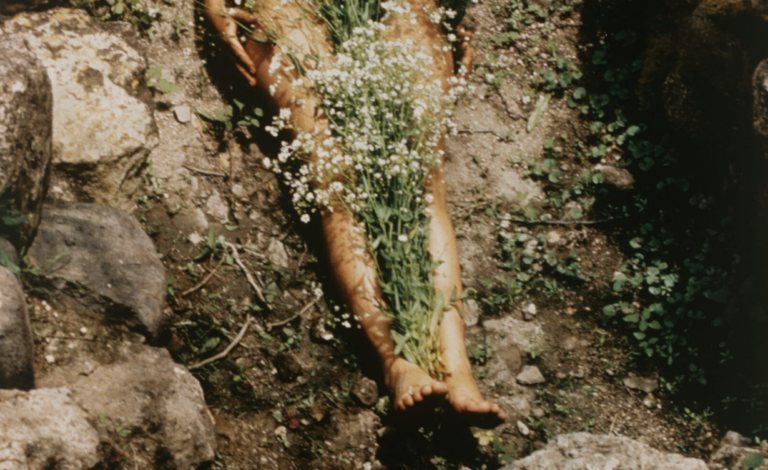
Ana Mendieta, Imágen de Yágul 1973. © The Estate of Ana Mendieta Collection, LLC. Licensed by Artist Rights Society (ARS), New York / DACS, 2026 / Courtesy Marian Goodman Gallery and Alison Jacques, London, UK. Detail.
It is not uncommon for an artist to become known primarily through the circumstances of their life rather than through the complexity of their work. This fate has arguably met the Cuban-American artist Ana Mendieta, whose tragic and controversial death in 1985 continues to shape discussions around her practice and, sometimes, overshadows it. The new exhibition at Tate Modern—the first major UK retrospective of the artist in over a decade—resists this tendency. Instead of prioritising the biographical narratives solely, the exhibition insists on returning to the artwork itself, revealing an artist whose practice fundamentally reshaped the relationship between the body, nature, and identity.
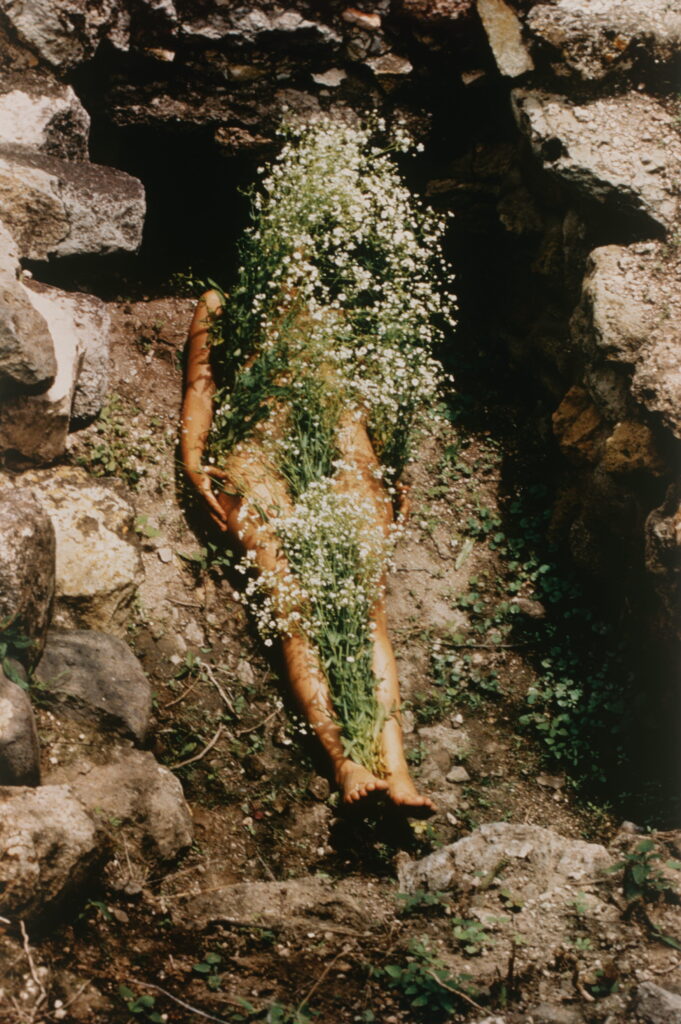
Ana Mendieta, Imágen de Yágul 1973. © The Estate of Ana Mendieta Collection, LLC. Licensed by Artist Rights Society (ARS), New York / DACS, 2026 / Courtesy Marian Goodman Gallery and Alison Jacques, London, UK.
Bringing together more than 80 works produced between the early 1970s and her death, the exhibition traces Mendieta’s remarkably consistent investigation into presence, absence, ritual, and belonging. The show spans sculpture, film, photography, drawing, painting, and archival material, revealing the breadth of a practice often reduced to a handful of iconic images. Running throughout is Mendieta’s sustained engagement with the relationship between the body and the earth.
Best known for the Silueta series (1973–1980), she created temporary interventions in landscapes by imprinting or outlining her body in sand, mud, grass, rock, flowers, blood, or fire. These works were intentionally ephemeral, disappearing almost immediately due to weather and erosion, surviving only through photography and film.
Born in Havana in 1948, Mendieta was sent to the United States at the age of 12 as part of Operation Peter Pan (Operación Pedro Pan), a US-sponsored program that relocated thousands of Cuban children following Fidel Castro’s rise to power. Separated from her family and raised in foster homes in Iowa, exile became a formative condition rather than a biographical footnote. Although critics have often interpreted the Silueta series primarily through the lens of displacement and the search for belonging, Tate avoids reducing the work to autobiography. Instead, exile emerges as one thread within a broader investigation into ritual, embodiment, and humanity’s relationship to the natural world. The exhibition demonstrates that while Mendieta’s biography undoubtedly shaped her artistic vocabulary, it does not exhaust its meanings.
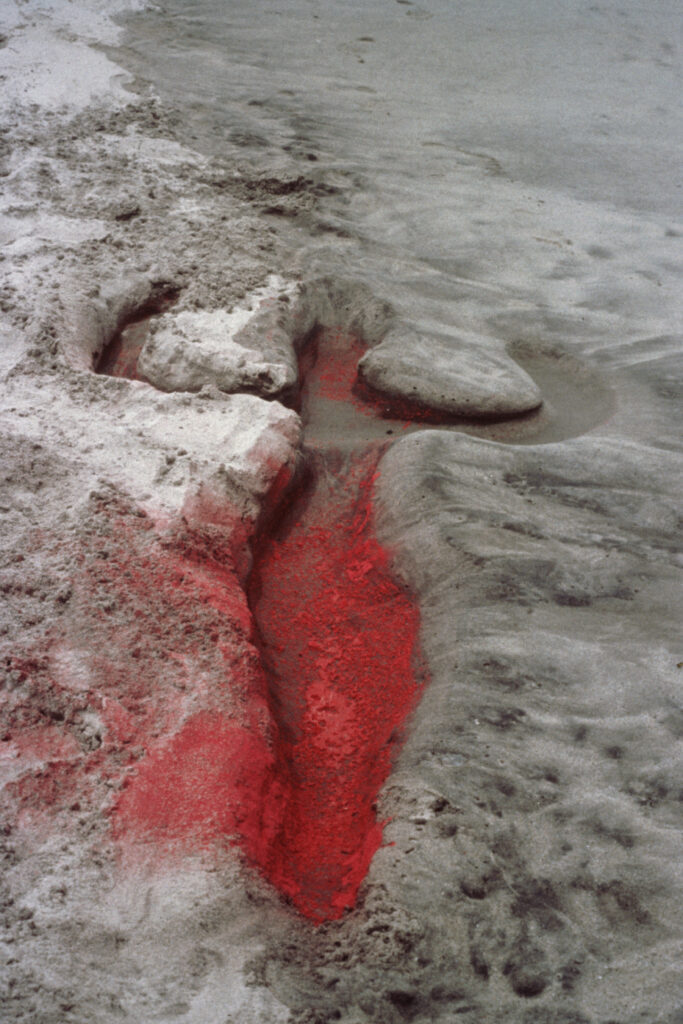
Ana Mendieta, Untitled: Silueta Series 1976. © The Estate of Ana Mendieta Collection, LLC. Licensed by Artist Rights Society (ARS), New York / DACS, 2026 / Courtesy Marian Goodman Gallery and Alison Jacques, London, UK.
In Untitled: Silueta from 1976, Mendieta’s body appears only as an outline formed from red pigment and an outline in sand, already dissolving into the surrounding ground. Elsewhere, silhouettes burn briefly in grass before extinguishing themselves, or emerge as shallow depressions carved into mud and rock. Throughout the exhibition, the body oscillates between presence and disappearance, becoming less a figure than a fleeting trace within the landscape.
It is precisely this relationship between performance and its documentation that continues to make Silueta so compelling. Performance has long been associated with disappearance, with what Peggy Phelan famously described as an art form that “becomes itself through disappearance.” Mendieta complicates this binary. Here, photography and video are not an integral component of the work itself. The photographs neither replace nor document the performance; instead, they prolong its conceptual life and allow it to be exhibited in the first place. The physical trace inevitably vanishes, yet the image simultaneously preserves and emphasises that disappearance. Documentation becomes a record not only of presence, but of loss.
This tension is heightened by the installation itself. Tate avoids overwhelming visitors with contextual material, allowing individual photographs and films to retain their own rhythm. Moving through the gallery rooms, one repeatedly encounters bodies that are no longer there and landscapes marked by an uncanny human absence. The exhibition unfolds almost archaeologically (following Mendieta’s own interests in archaeology), with each image operating like an index of an action that can never be fully recovered. Rather than depicting the body, many works present only its trace, asking viewers to imagine what has already disappeared.
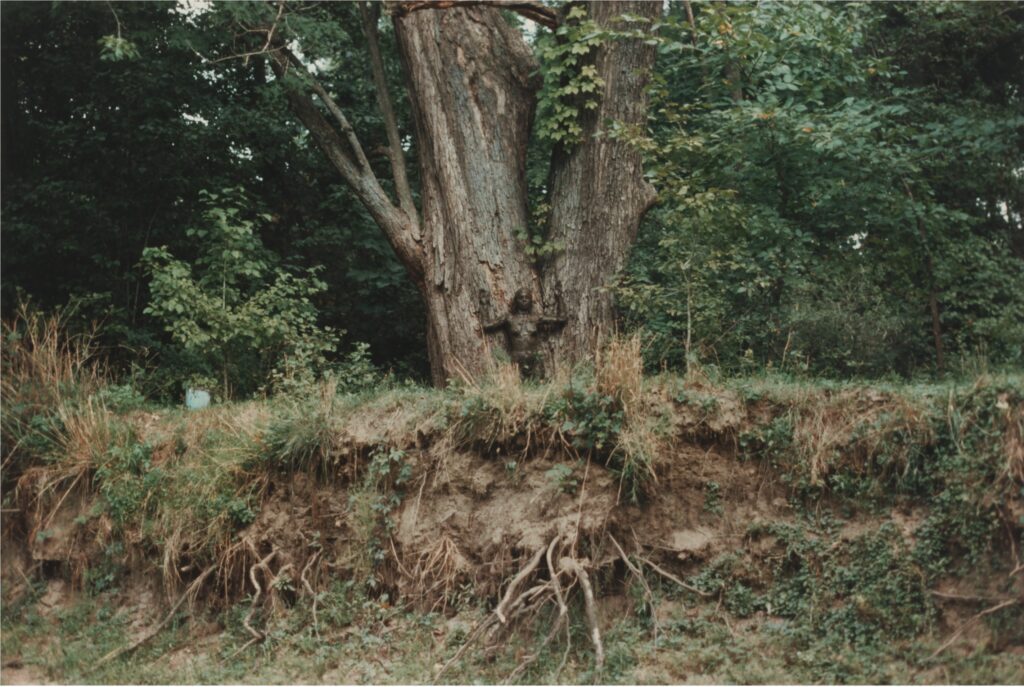
Ana Mendieta, Untitled: Silueta Series 1976 © The Estate of Ana Mendieta Collection, LLC. Licensed by Artist Rights Society (ARS), New York / DACS, 2026 / Courtesy Marian Goodman Gallery and Alison Jacques, London, UK.
What emerges most forcefully is Mendieta’s understanding of landscape and wider nature, as something far removed from passive scenery. Earth becomes collaborator, witness, archive, and eventually agent of disappearance. Her practice dissolves the distinction between human and environment, refusing to privilege one over the other. The body leaves its mark upon the landscape, yet the landscape ultimately reclaims it. In this sense, Silueta is less concerned with permanence than with transformation, revealing identity itself as something unstable and continuously negotiated.
Seen today, Silueta appears remarkably current, not because it offers clear political statements, but because it proposes a different way of thinking about the relationship between bodies and environments: one based on reciprocity rather than domination.
One of the exhibition’s most compelling curatorial decisions is its refusal to confine Mendieta’s work entirely within the gallery. Alongside films, photographs and sculptures, Tate has recreated two of her tree sculptures just outside its building, extending the exhibition beyond the institution’s walls. The gesture feels particularly apt. Much of Mendieta’s practice resists institutional containment: her works were conceived outdoors, exposed to weather, erosion, and time. By inviting visitors to move between gallery and landscape, the exhibition acknowledges that these works were never intended as static objects; they are more of an encounter with specific environments. The recreation inevitably raises familiar questions surrounding authenticity and reconstruction, yet these concerns seem secondary. Rather than attempting to reproduce an original event, the installation foregrounds process, ephemerality, and the impossibility of exact repetition—qualities that lie at the heart of Mendieta’s practice.

Ana Mendieta, Untitled 1972. © The Estate of Ana Mendieta Collection, LLC. Licensed by Artist Rights Society (ARS), New York / DACS, 2026 / Courtesy Marian Goodman Gallery and Alison Jacques, London, UK.
Tate’s retrospective ultimately succeeds because it allows Mendieta’s work to speak beyond the mythology that has long surrounded her. It neither ignores her biography nor allows it to determine the interpretation of the work. Instead, it restores attention to an artist who transformed photography from a tool of documentation into a medium capable of holding absence itself. In doing so, the exhibition reminds us why Mendieta remains foundational to contemporary understandings of performance and performance documentation, nature, and landscape, as spaces where disappearance continues to resonate.
Ana Mendieta is on view at Tate Modern, London, UK, until January 17, 2027.
DailyArt Magazine needs your support. Every contribution, however big or small, is very valuable for our future. Thanks to it, we will be able to sustain and grow the Magazine. Thank you for your help!

Art historian and aspiring writer. Interested in contemporary art from Eastern Europe, Latin America and East Asia, transnational networks of artistic collaboration and exchange, and modernist architecture and design.

Univ. of New Orleans, Fine Arts and History; Fine Artist, Professional Graphic Designer, Art Historian, Historian, Musician, worked at the New Orleans Museum of Art and MS Museum of Art; learning enthusiast!
Very few artists can claim to be as ubiquitous and iconic as Frida Kahlo. This hotly anticipated exhibition at Tate Modern delves into how and why...
Edoardo Cesarino 6 July 2026
Few museums can trace their origins to an act of collective generosity. Fewer still continue to build their identity around that same principle...
Zuzanna Stańska 17 August 2026
Back in 1998, the Hayward Gallery was the first to host a major exhibition of Anish Kapoor’s work in the UK. Now, in the year of the Southbank...
Edoardo Cesarino 22 June 2026
A new exhibition at Kensington Palace, London, The Last Princesses of Punjab, is shedding light on the fascinating lives of three remarkable...
Edoardo Cesarino 4 June 2026