Summary
In the Middle Ages, pilgrimage was an important method of diffusing artistic ideas and revival. From the pilgrimage to Santiago de Compostela to Rome and Jerusalem, pilgrimage churches helped spark an artistic and intellectual revival in medieval Europe.
- Cluny Abbey—the Cluniac abbey was an important influence in medieval Europe, and its remains today are only fragments of its former grandeur.
- St. Pierre Abbey—an important stop on the Camino de Santiago, it features imaginative Romanesque cloister sculptures and influential early Last Judgement tympanum.
- Le Puy Cathedral—an eclectic church which shows distinct Islamic influences, reflecting a rare East–West artistic exchange in Romanesque Europe.
- Basilica of San Isidoro—its Pantheon of the Kings mausoleum is famed for the well-preserved 12th-century Romanesque fresco cycle and is often called the “Sistine Chapel of the Romanesque era.”
- Cathedral of Saint Lazarus of Autun—an important Camino church in France with tympanum sculpture by Gislebertus, one of the few named artists from the period.
- Vézelay Abbey—the church blends pilgrimage and martial character, with Moorish-influences.
- Basilica of Saint-Sernin—an important Cluniac pilgrimage church on the Camino de Santiago, noted for richly decorated True Cross reliquary.
- Church of the Holy Sepulchre—the holiest site in all Christendom, believed to have witnessed the crucifixion and resurrection of Christ. Rebuilt in the 12th century.
- Santiago de Compostela Cathedral—one of Europe’s most important pilgrimage churches, marking the final destination of the Camino de Santiago
- Abbey Church of Sainte-Foy—a key Camino site housing the reliquary of Saint Faith, and radiates medieval authenticity unmatched by other pilgrimage churches on the list.
The idea of pilgrimage is timeless across faiths and remains strongly rooted even in modern, secular times. From the great pilgrimages to Mecca, Jerusalem, to the secular equivalents of Graceland or Père Lachaise, it is astounding to witness the stubbornness of our nomadic ancestry that compels us to travel and pursue the otherworldly.
In the Middle Ages, however, pilgrimages across Europe and the Middle East served not only to inspire individual pilgrims, but to (finally) re-energize Western civilization after the fall of Rome. In Civilization, Kenneth Clark credits the nedieval pilgrimage as a great “diffusion of ideas from which western civilization derives part of its momentum.”
The millennial fears that occupied the medieval mind in the 10th century culminated in a moment of great communal relief when the year 1000 came and went and the long-feared apocalypse never arrived. As a result, the 11th century saw a boom in churches being built across Europe—leading the medieval chronicler Rodulfus Glaber to lyrically capture the moment by writing:
It was as if the whole world were shaking itself free, shrugging off the burden of the past, and cladding itself everywhere in a white mantle of churches.
Rodulfus Glaber, The Five Books of the Histories, ed. and trans. by John France, Oxford, 1989.
The pilgrimage arguably reached their peak with the preaching of the crusades in the same period (the First Crusade was declared in 1096). The idea of suffering on pilgrimage was typified by the crusader seeking martyrdom in the Holy War and there was no worthier relic than Jerusalem and its holy sites. The crusades also caused the migration of ideas and art of the period, this time from the West to the East, and (crucially) back again.
This list is a subjective one—as all art lists of this kind must be. We took into account not only the medieval significance of a church, but also its state of preservation. Therefore, churches like St. Peter’s Basilica, whilst one of the most significant pilgrimage churches in medieval times, is not included because it survives almost exclusively in its Baroque form.
10. Cluny Abbey, Cluny, France
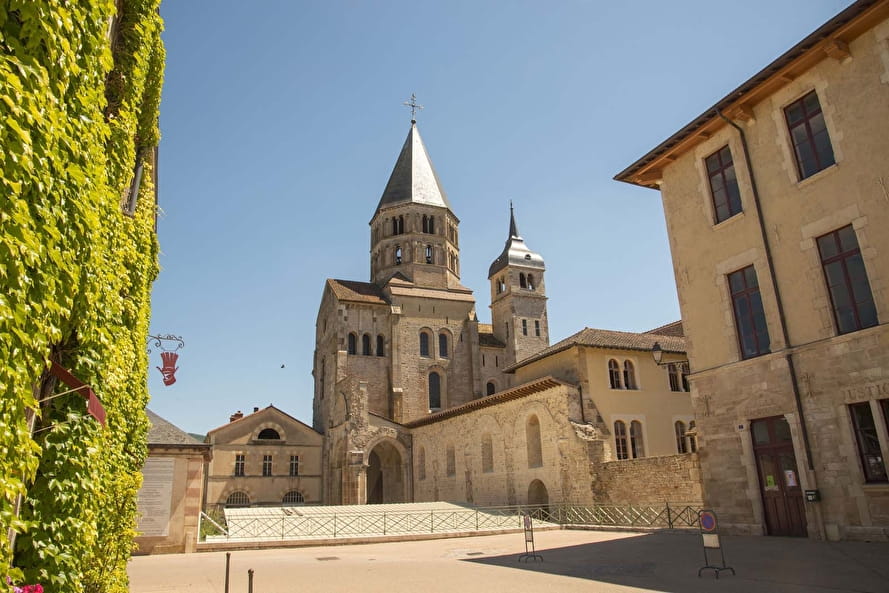
Cluny Abbey, Cluny, France. Photograph by Alain Doire/BFC Tourisme. Burgundy Tourism.
While the current abbey retains limited features from the Middle Ages, the importance of the Cluniac monks in the dissemination, sponsorship, and artistic direction of the Camino de Santiago is unmatched.
Founded in 910 by the Duke of Aquitaine, the abbey underwent several significant transformations, fragments of which can still be glimpsed today. A Benedictine Order, the Cluniac monks, whilst advocating important monastic reforms and care of the poor, also conceived and disseminated an aesthetics of thrilling imagination that made its way to the cloisters and churches of the Cluniac churches all along the Camino de Santiago.
Three important iterations of the abbey were constructed, culminating in the so-called Cluny III, built in the late 11th century by the highly influential Abbot Hugh. This abbey was at the time—until the reconstruction of St. Peter’s Basilica—the largest church in the world. Its ribbed barrel vault created impressive acoustics which reflected the order’s adherence to music.
9. St. Pierre Abbey, Moissac, France
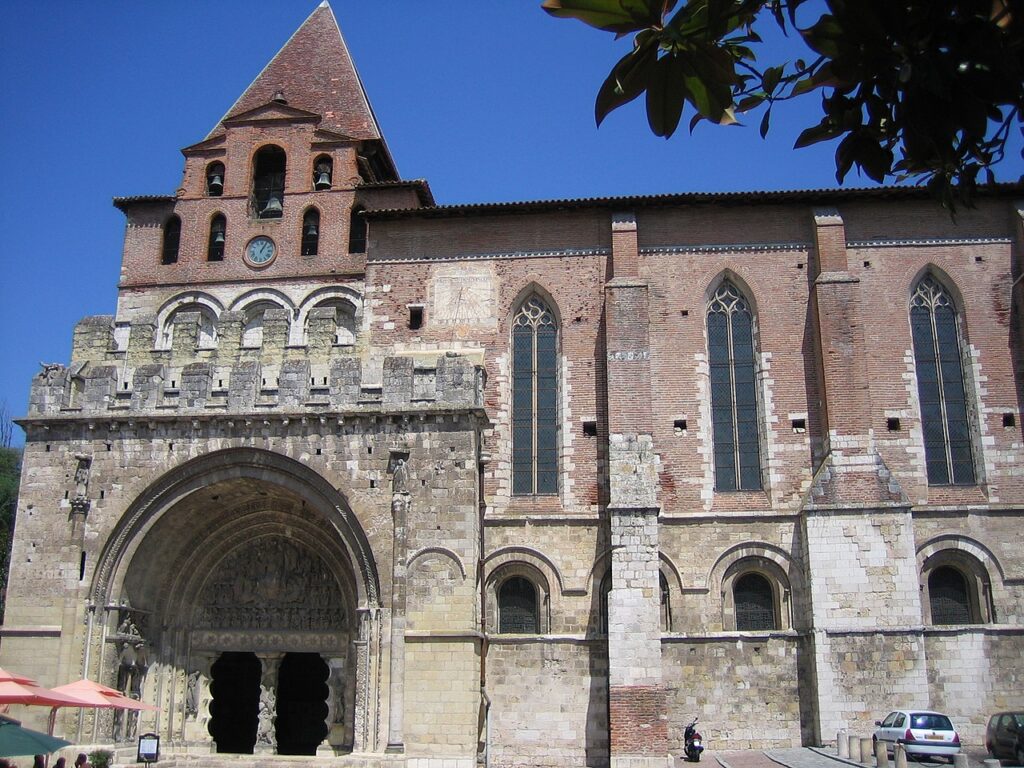
St. Pierre Abbey, Moissac, France. Photograph by Membeth via Wikimedia Commons (public domain).
The abbey church of St. Pierre in Moissac, France, was an important stop on the Camino de Santiago, as well as a key outpost of the Cluniac Order. It came under the leadership of Abbot Durand de Bredons from about 1047 to 1071, who reformed it along the Cluniac lines, and a marble slab from 1100 still survives in the church cloister bearing his effigy.
The capitals in Moissac’s cloisters, are an exercise in wondrous medieval imagination. The capitals tell a continuous story from the Old Testament in a sequential manner that echo the narrative art of medieval illuminated manuscripts. The entablature of the capitals is also teeming with wild and fantastical beasts which not even the authors of pseudo-medieval fantasies like Game of Thrones or The Witcher could have conceived.
Another art-historical wonder is the south portal tympanum, which represents a similarly wild Last Judgement scene that greeted worshippers and pilgrims alike into the church. One of the earliest depictions of the Last Judgement in Western art, the Moissac sculptures here would be disseminated all across the Camino, not least in the church of Santiago de Compostela itself—and with good reason. Here we find figures in energetic movement, dynamic zigzags, abstracted lines of such intricacies that capture a unique moment in Western art history.
8. Le Puy Cathedral, Le Puy-en-Velay, France
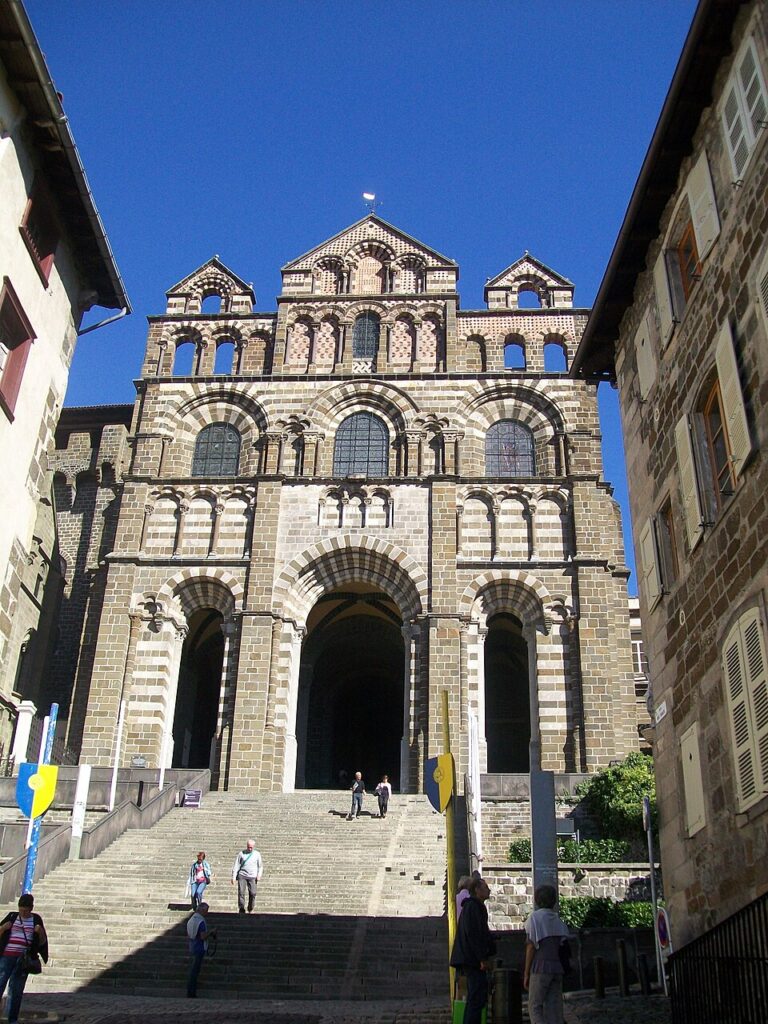
Le Puy Cathedral, Le Puy-en-Velay, France. Photograph by Elliesram13 via Wikimedia Commons (CC BY-SA 3.0).
The cathedral of Le Puy, further north in France, in Auvergne, is a beautifully confusing concatenation of influences. If pilgrimages and crusades were weaponized by Christianity to inspire Holy War against Islam, why then do we find here a Christian pilgrimage cathedral that looks like a mosque?
Another important Moorish extraction in the nave is the pointed arch in Le Puy. Something still relatively rare in Romanesque architecture but which would come to typify the Gothic in a few centuries’ time. And to drive home the point of Islamic influence, there are still visible inscriptions in Kufic to be found in certain locations.
These Islamic influences, extracted from the hated neighbor, is an example not of hybrid or revivalist art, the kind that would become rampant in Victorian Britain, but rather, a symbiotic art, of West and East blending together, through a willingness to learn and mutual respect, that transcended the socio-religious realities of the time. Thinking in these terms, Le Puy is a special site.
7. Basilica of San Isidoro, León, Spain
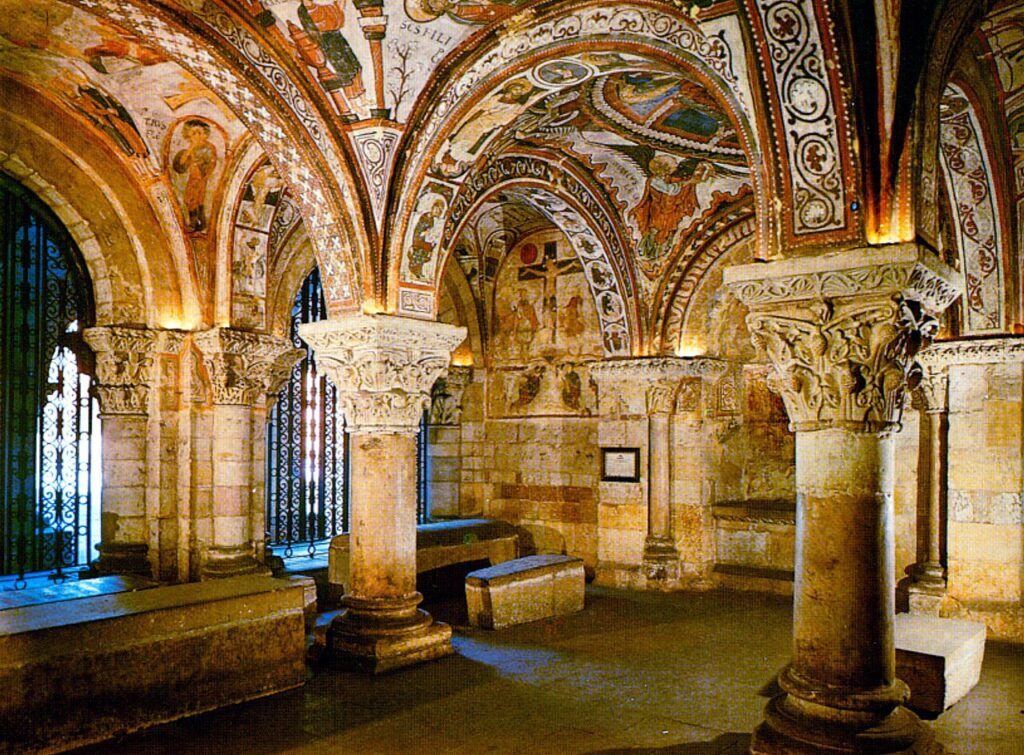
Royal Pantheon, Basilica of San Isidoro, León, Spain. Photograph by Megginede via Wikimedia Commons CC BY-SA 4.0).
Built on an ancient site which housed a Roman temple of Mercury, this important church in the province of León, Spain, is a vital pilgrimage site for the Camino de Santiago. Besides the structure of the church itself, which dates to the 11th century, the site hosts arguably the most important and impressive nodes of Romanesque painting.
The mausoleum dedicated to the Pantheon of the Kings of León has been referred to as the “Sistine Chapel of the Romanesque Era.” The frescoes date to the 1160s and can be traced to the French and Catalan school of Romanesque painting. The vast fresco cycle is rich in Biblical episodes, from the Apocalypse to a Byzantinesque depiction of Christ Pantocrator.
The survival of Romanesque painting is usually only fragmentary (except in illuminated manuscripts), so the frescoes in León make the Basilica of San Isidro one of the most unique and revered churches on the Camino.
6. Cathedral of Saint Lazarus of Autun, Autun, France
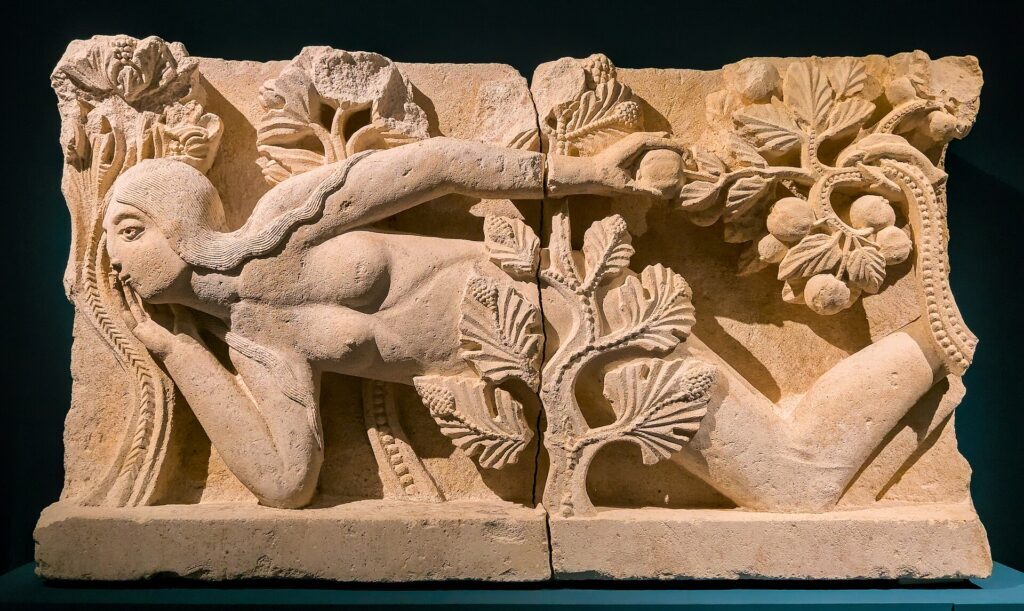
Temptation of Eve, lintel from the Cathedral of Saint Lazarus of Autun, Musée Rolin, Autun, France. Photograph by Benjamin Smith via Wikimedia Commons (CC BY-SA 4.0).
A Cluniac church built during the peak of church-building fever sweeping across France at the beginning of the 12th century. Its construction was the result of the determination of bishop Etienne de Bage (Stephen of Autun) to build a shrine worthy of housing the relics of Lazarus of Bethany.
The tympanum of Autun Cathedral is another Romanesque masterpiece and, uniquely, it is signed. The scene of the Last Judgement bears the signature of Gislebertus. It was unusual for artisans to sign their work during this period and for many centuries after, and little is known of Gislebertus’ life.
His Eve on the tympanum of Autun Cathedral, however, is a carving any artisan would be proud to put his name on. A rare example of nudity in Romanesque art, Eve (the figure of Adam is now missing) is seen reaching out for the apple, her figure elongated and her hair edifying. This Eve alone makes Autun Cathedral worth the hardships of the long Camino.
5. Vézelay Abbey, Vézelay, France
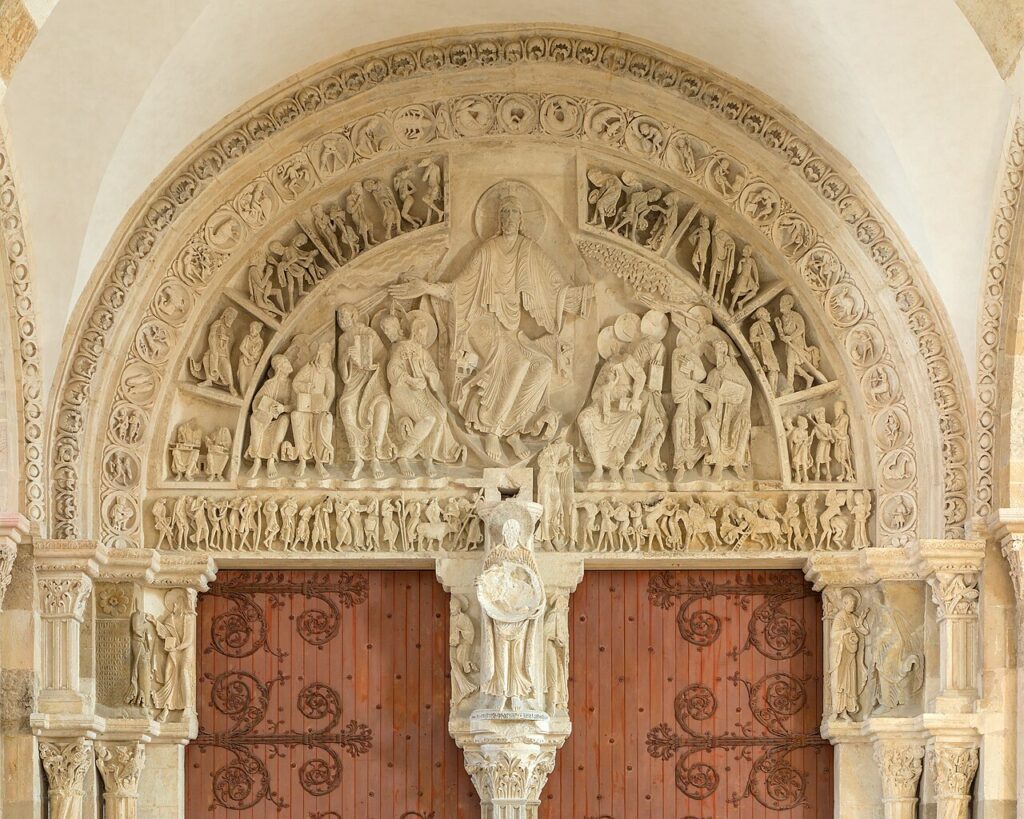
Tympanum of the central portal, Vézelay Abbey, Vézelay, France. Photograph by Benjamin Smith via Wikimedia Commons (CC BY-SA 4.0).
Although a pilgrimage church, Basilica of Sainte-Marie-Madeleine in Vézelay, France, has a somewhat martial character. Built by a community of warlike burghers on a harsh hill spur, it was also here that Bernard of Clairvaux preached and announced the Second Crusade in 1145.
The relatively austere interior features fascinating horseshoe arches with multi-colored stone that are a Moorish influence. The tympanum here is a remarkable portrayal of the Pentecost, which is intimately linked with the preaching of Christianity (another link with the crusades), and also depicts the Zodiac and individuals of different races, symbolizing the dominance of Christianity over the races of the Earth.
The Christ figure dominating this scene is characteristically terrifying, with a contorted posture and elongated fingers typical for the iconography of the period. Positioned at the entrance of the church, it further reinforces the militant identity of this exceptional pilgrimage church.
4. Basilica of Saint-Sernin, Toulouse, France
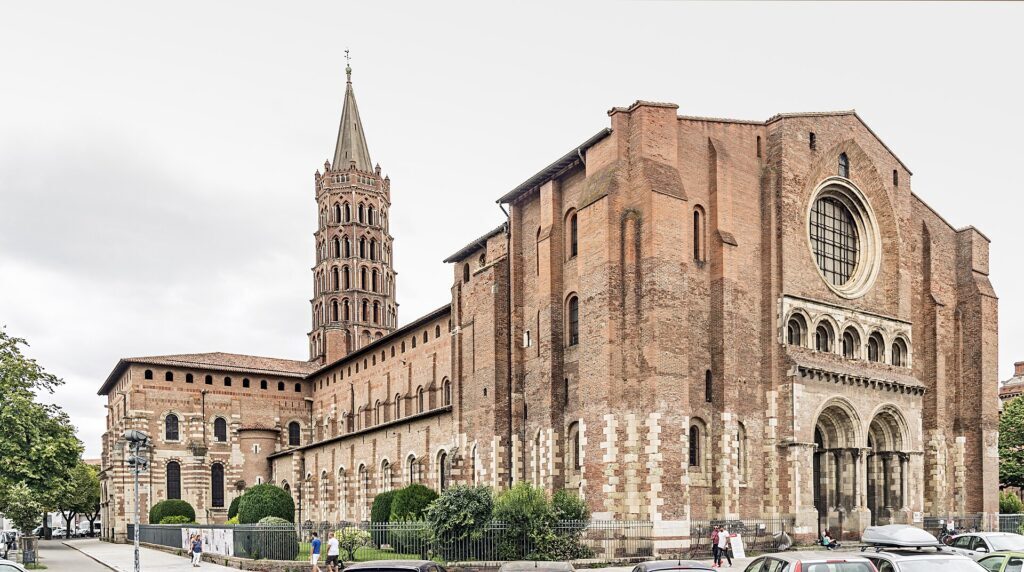
Basilica of Saint-Sernin, Toulouse, France. Photograph by Didier Descouens via Wikimedia Commons (CC BY-SA 4.0).
The primacy of the basilica of Saint-Sernin on the Camino de Santiago is rivaled only by Santiago de Compostela itself. Nestled in the heart of the Languedoc, in the city of Toulouse, the church occupies a vital point at the border between France and Spain.
The Romanesque church had its high altar consecrated by the Cluniac pope Urban II in 1096, a year after he launched the First Crusade. The remarkable eastern end of the church, completed two years later and attributed to Raymond Gayrard, is an excellent example of its type. Together with the large ambulatory, it establishes Saint-Sernin as on of the most important Cluniac pilgrimage church.
Whilst the building has suffered later accretions, and its suburban setting has also changed, Saint-Sernin still contains important Romanesque artworks within. The ambulatory is rich with marble slabs, and the high altar has one bordered by beautiful small carved figures, believed to commemorate Pope Urban II’s consecration.
Saint-Sernin holds an intricate reliquary built to house a piece of the True Cross. The reliquary is decorated with images narrating the relic’s journey from the east to Saint-Sernin, crowned by a Christ in Glory. The piece is all the more exciting for its enamelwork, which utilizes a technique known as champlevé, in which forms and lines are engraved into the metal surface and filled with colored glass powder, which is then heated until it fuses, producing a glass-like surface.
3. Church of the Holy Sepulchre, Jerusalem, Israel
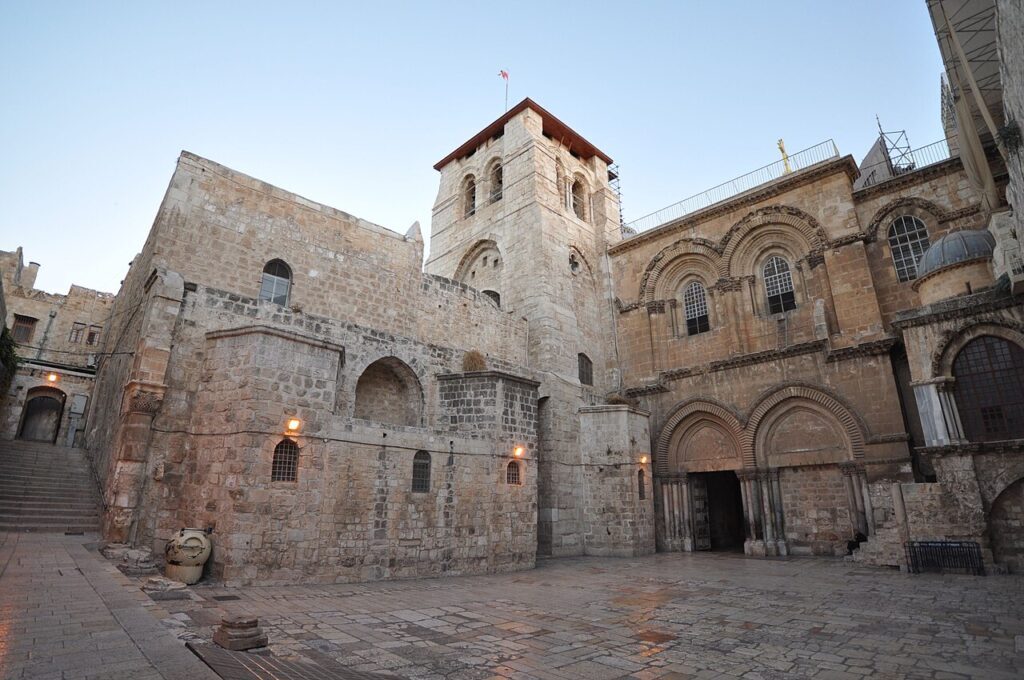
Church of Holy Sepulchre, Jerusalem, Israel. Photograph by Jorge Láscar via Wikimedia Commons (CC BY 2.0).
Thus far, we’ve engaged with the Camino de Santiago, which was a relatively safe pilgrimage for devotees to undertake through largely Christian lands. The pinnacle of all medieval Christian pilgrimage, however, was Jerusalem and its Church of the Holy Sepulchre.
The church is the holiest site in Christendom, and is believed to be the location of Christ’s crucifixion and burial (and subsequent resurrection). Whilst little remains of the 4th-century church enough of the medieval reconstruction is still visible and known to appreciate the holy site’s troubled history.
After being demolished in 1009 on the orders of Sultan Hakim, the church was reconstructed by the Byzantine imperial court, with the permission of the Muslim authorities in Cairo. The Byzantine Emperor Constantine IX Monomachus significantly expanded the church’s rotunda in the 11th century, without significantly altering the church’s original, 4th-century architecture.
50 years later, with the city under Crusader control, a new church was built, which borrowed from architectural developments in Saint-Sernin and St. Foy. The style of facade, high vaulting, and pointed arches are all features that had previously made appearances in Western pilgrimage churches.
To get an impression of what kind of impact the church left on medieval pilgrims, here is a 14th-century description by an English pilgrim: “When the Saracens had called our names, which they had written down, and had opened the doors of the church, just the eight of us entered, and then the doors were closed again; four Minorites and four Greek monks, who remain in the church and do not leave, greeted us with chanting, and led us at once to the Holy Sepulchre, which is enclosed within a small house, standing in the middle of that round church, which is a church of awesome scale, and is round, with high columns and apses, and I believe that it is of comparable scale to Santa Maria Rotunda in Rome (formerly called the Pantheon), which is 180 feet across.”
2. Santiago de Compostela Cathedral, Santiago de Compostela, Spain
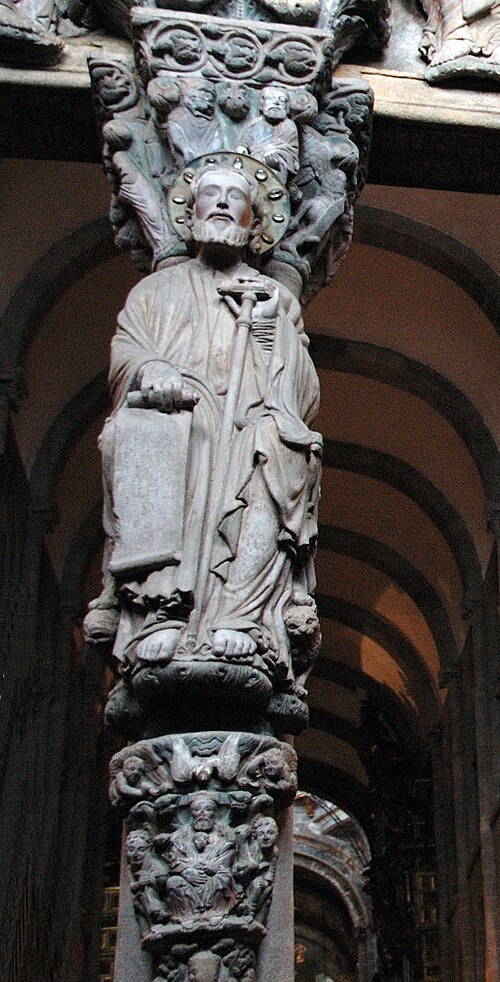
Master Mateo, Saint James mullion, Santiago de Compostela Cathedral, Santiago de Compostela, Spain. Photograph by MarisaLR via Wikimedia Commons (CC BY-SA 3.0).
The shrine of Santiago de Compostela, on the fringes of Northern Spain, became one of Europe’s most venerated pilgrimage sites during the heat of the Reconquista. Said to house the remains of Saint James (Santiago in Spanish), the church was at the confluence of pilgrimage and crusade.
The current site has seen several accretions and reconstructions throughout the centuries, most prominently Ferro Caaveiro’s Baroque redesign in 1757–1770. The Romanesque period is still strongly represented in the aptly named Portico of Glory—the entrance to the church for the pilgrims.
The Portico was the work of Master Mateo who created an edifying assemblage of saints embedded in the portal. A standout figure is that of Saint James located on the central column blessing pilgrims as they finally enter the holy shrine upon completion of their Camino.
A 12th-century manuscript, the Codex Calixtinus, includes a guide for French pilgrims to Santiago and the author (possibly Pope Calixtus himself) describes the shrine with the kind of adulation that modern pilgrims still feel upon entering this timeless site: “In this church, in truth, one cannot find a single crack or defect: it is admirably built, large, spacious, luminous of becoming dimensions, well proportioned in width, length, and height, of incredibly marvelous workmanship and even built on two levels as a royal palace.”
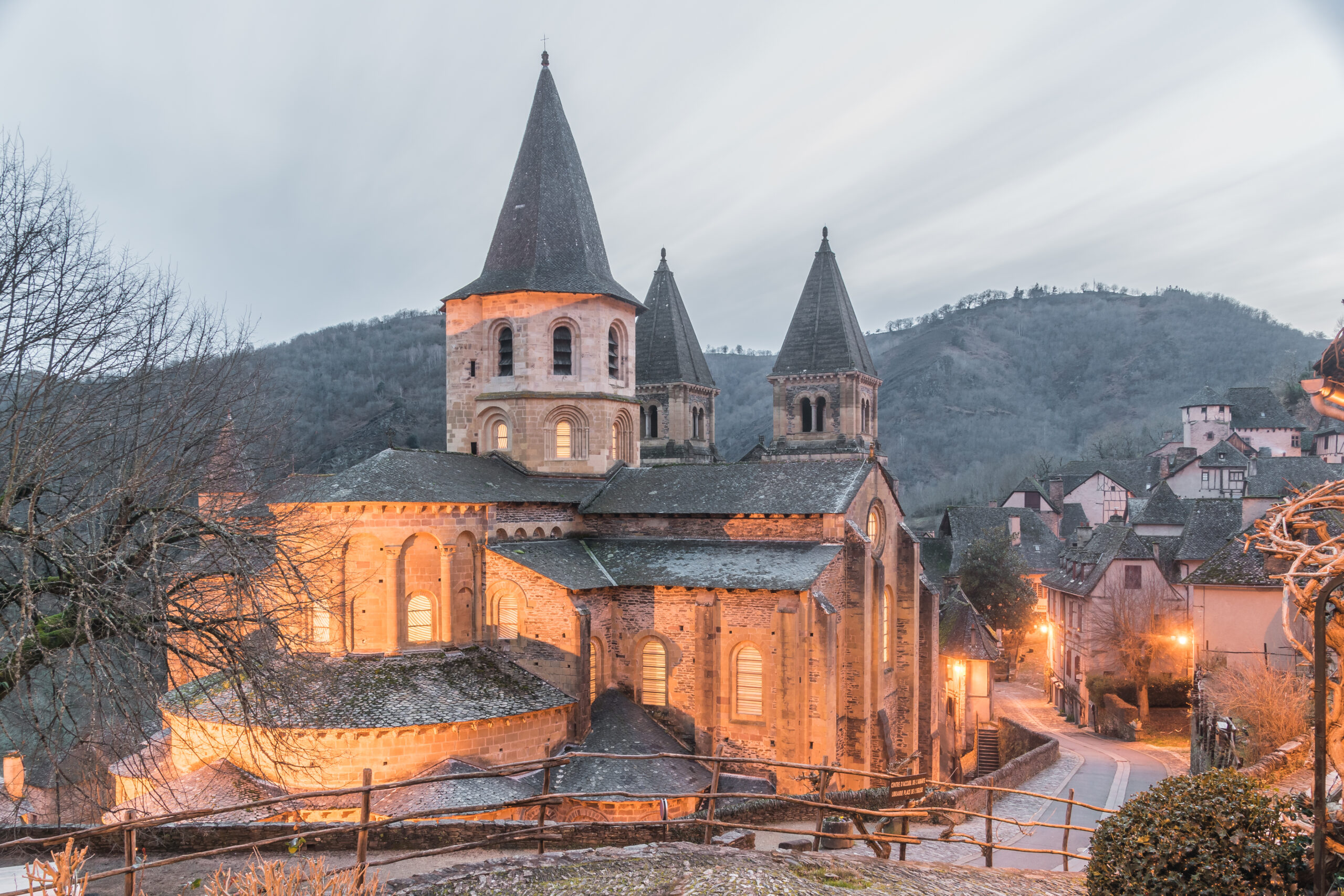
1. Abbey Church of Sainte-Foy, Conques, France
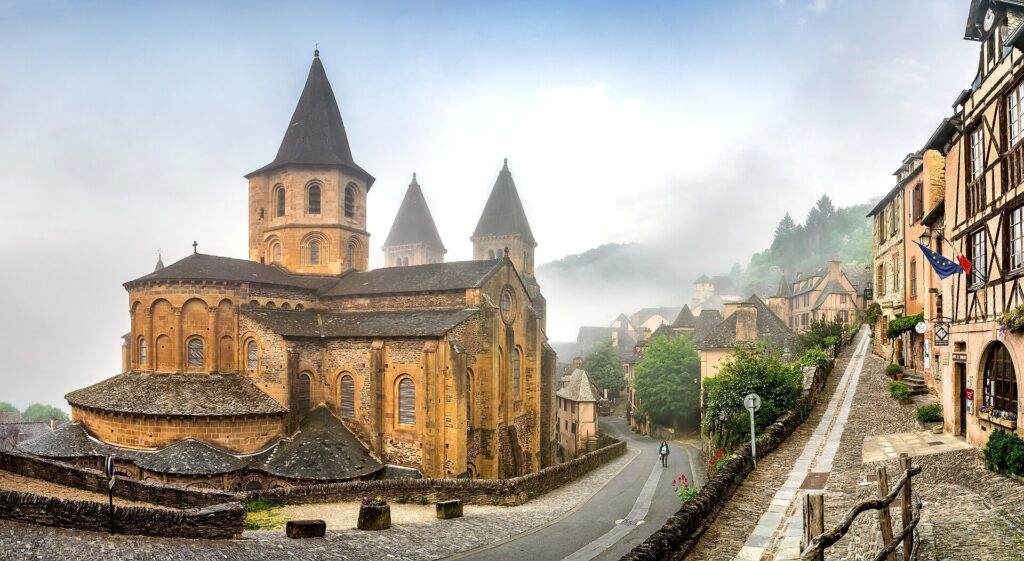
Abbey Church of Sainte-Foy, Conques, France. Photograph by Krzysztof Golik via Wikimedia Commons (CC BY-SA 4.0).
There are larger churches than Sainte-Foy, as there are more theologically and artistically significant churches. But arguably no church in Europe can match the setting of this pilgrimage church. Unlike the shrine of Santiago, the Holy Sepulchre and all the others, Sainte-Foy retains a setting that is as close as is humanly possible to time traveling to the Middle Ages.
Located in the hills of Occitania in the south of France, the church was built on the plans of Abbot Odolric circa 1050 to house the relics of Saint Faith (Sainte Foy). She was a young girl who was tortured and executed during the Roman persecution of Christianity in the 3rd century. Her remains are housed in a unique medieval reliquary, with gold sheeting over a wooden core, which uses a repurposed Roman head and is studded with jewels and filigree work. The expression on the face in the reliquary is stoic and primitive, reminiscent of an Egyptian sarcophagus. Devotion to Saint Faith helped make this church an important destination along the route of the Camino.
The elegant abbey also displays a typical tympanum on its west portal which shows a Last Judgement scene. It retained traces of its original polychromy. The interior has a high and nave that makes it feel as if the church is larger than it actually is; and this sums up the allure of Sainte Foy—it is a platform for the imagination, for devotion, as well as fantasy, and no other pilgrimage churches remain with such authentic, untouched power.





.jpg)


.jpg)