
10 Alphonse Mucha Artworks You Need to Know
Czech Alphonse Mucha is a legend of the art world, a pioneer in Art Nouveau whose work still lives on through his larger-than-life artworks, mostly...
Frank Schildiner 20 August 2026
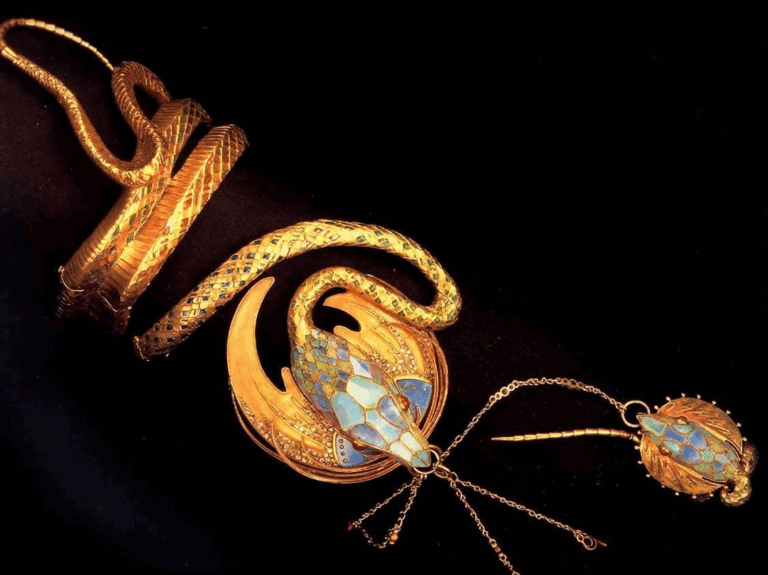
Alphonse Mucha and Georges Fouquet, Snake Bracelet with a Ring, 1899, Sakai Alphonse Mucha Museum, Sakai City, Japan.
A dragonfly woman, a golden serpent of opals and rubies, and a woman waiting for an octopus are three short descriptions of authentic Art Nouveau jewelry. Its designers defied convention to create the most exquisite jewelry pieces ever made. Here are 10 pieces that exhibit their creators’ imagination and skill.
There is simply nothing like Art Nouveau jewelry. But why? At the turn of the 20th century, Art Nouveau emerged in France as a response against the Academic tradition and industrialization. On the one hand, the mass production of objects made them more accessible to middle and lower classes; on the other, artists and designers felt that the process lacked the hard and creative work of craftspeople. This feeling was not much different from contemporary complaints about minimalism and capitalism, which create items so basic (though affordable) that they have no personality.
Art Nouveau designers drew inspiration from nature, Japanese and Symbolist art, medieval imagery, literature, and fantastical creatures. Moreover, they experimented with new shapes and lines, like volutes and scrolls, which gave their pieces a natural look.
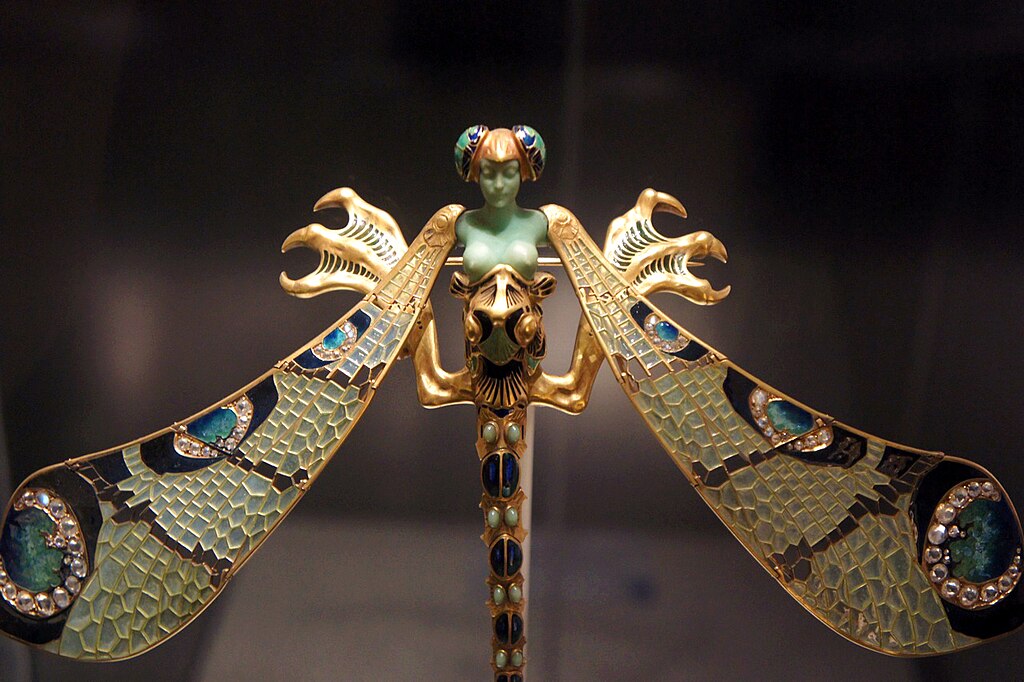
René Lalique, Dragonfly-Woman corsage ornament, c. 1897–1898, Calouste Gulbenkian Museum, Lisbon, Portugal.
This magnificent corsage ornament is one of René Lalique’s (1860–1945) masterpieces, made up of gold, enamel, chrysoprase, chalcedony, diamonds, opals, and moonstones. Lalique spent two years training to become a jeweler in London, where he learned about the ideas of John Ruskin, William Morris, and the Arts and Crafts Movement. He returned to France ready to break from tradition and create a new kind of jewelry.
His Art Nouveau pieces, inspired by Symbolist art, often feature hybrids of women and insects, such as this dragonfly-woman. This is also quite a daring piece because it shows a woman with her breasts bare, a total scandal. Lalique was the first jeweler to show nude women in his pieces.
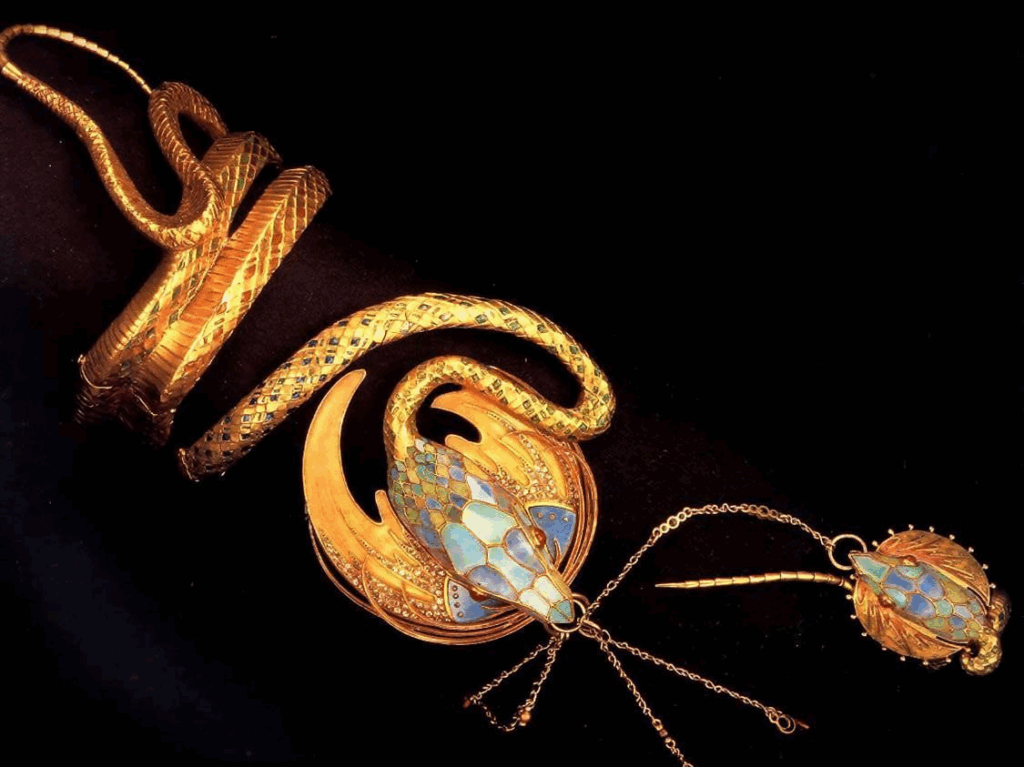
Alphonse Mucha and Georges Fouquet, Snake Bracelet with a Ring, 1899, Sakai Alphonse Mucha Museum, Sakai City, Japan. A Bit of History.
Serpents were a common motif in Art Nouveau jewelry. They had associations with religious, historical, and mythological women, such as Eve, Cleopatra, and Medusa. In 1899, Georges Fouquet (1862–1957) and Alphonse Mucha (1860–1939) collaborated to create this bracelet-ring for Sarah Bernhardt (1844–1923), a famous actress and Mucha’s favorite muse. They used gold, diamonds, opals, rubies, and enamel to assemble the piece. The symbolism of life and sexuality associated with this reptile made it a perfect complement for her costumes for the role of Medea.
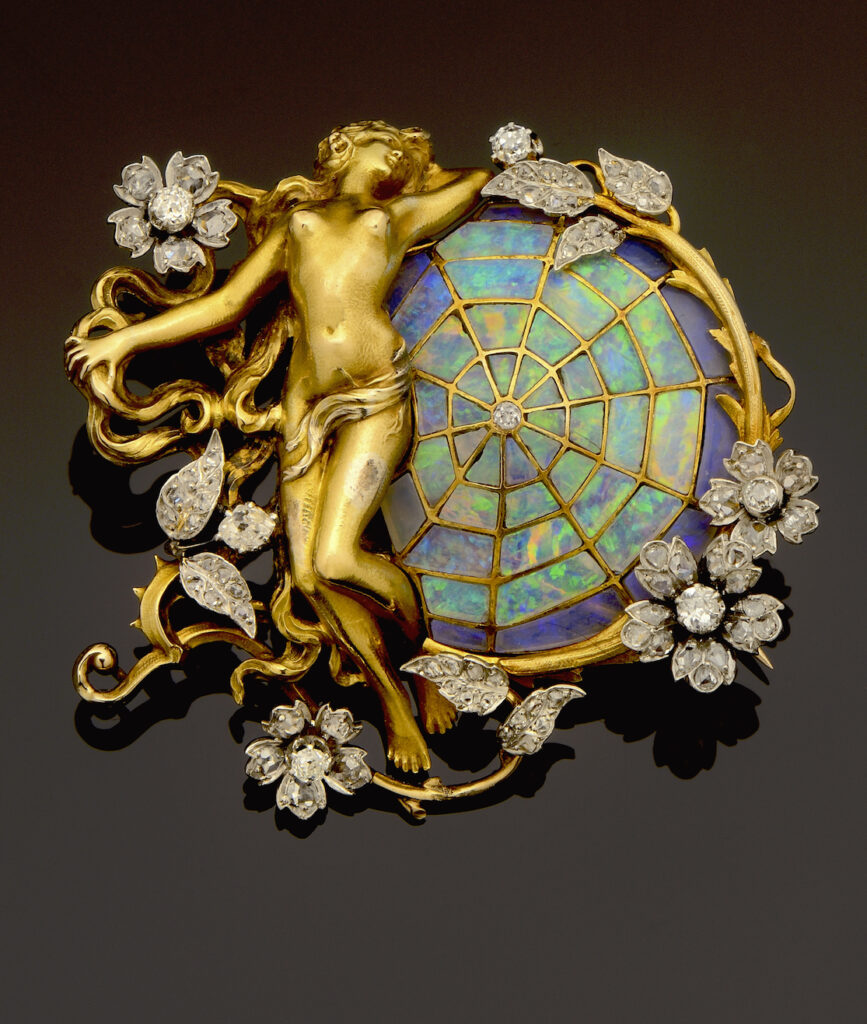
Henri-Auguste Solié, Brooch, c. 1900. Maison Riondet.
At the end of the 19th century, the image of women went through a transformation. Feminist demands for more rights, such as education and the vote, sparked contradictory sentiments of fear and admiration. A woman could either be a femme fleur, innocent and admired, or a femme fatale—a dangerous temptress.
This Art Nouveau brooch shows a golden woman, barely covered by a thin fabric. The twisted pose and display of her naked body allude to her erotic nature. Once again, the opal brings its iridescent nature to create greens, blues, and purples that contrast with the gold of the woman and the branches.
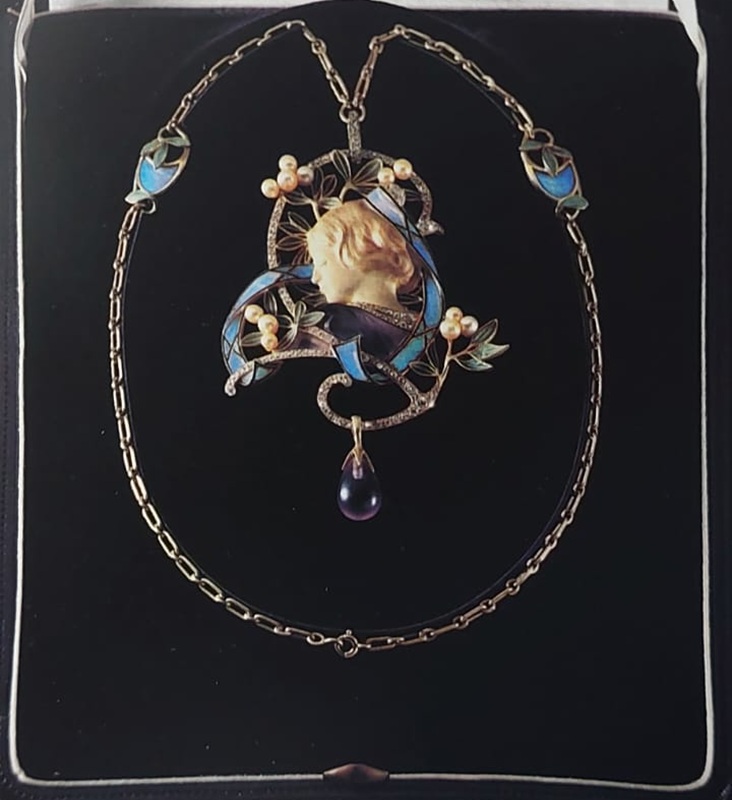
Henri and Paul Vever, Necklace with Breton Woman Pendant, c. 1900. Photo taken by the author from the 1997 Sotheby’s catalogue.
Henri (1854–1942) and Paul (1850–1915) Vever ran the family company located in Rue de la Paix in Paris. Breton women, meaning women from the northwestern French region of Brittany, were constantly featured in French art of the second half of the 19th century.
If Henri-Auguste Solié’s brooch depicted the femme fatale, this one represented the opposite. This was the image of the women of the countryside, traditional and modest. In this pendant, the skin and hair of the girl are made of enamel, and the blue ribbon that flows around her consists of opals. We can see the classic volutes and curved lines, so characteristic of Art Nouveau. Moreover, a carved amethyst forms her dress, enriched by the diamonds in the collar. And why not? The Vever jewelers added pearls to the piece.
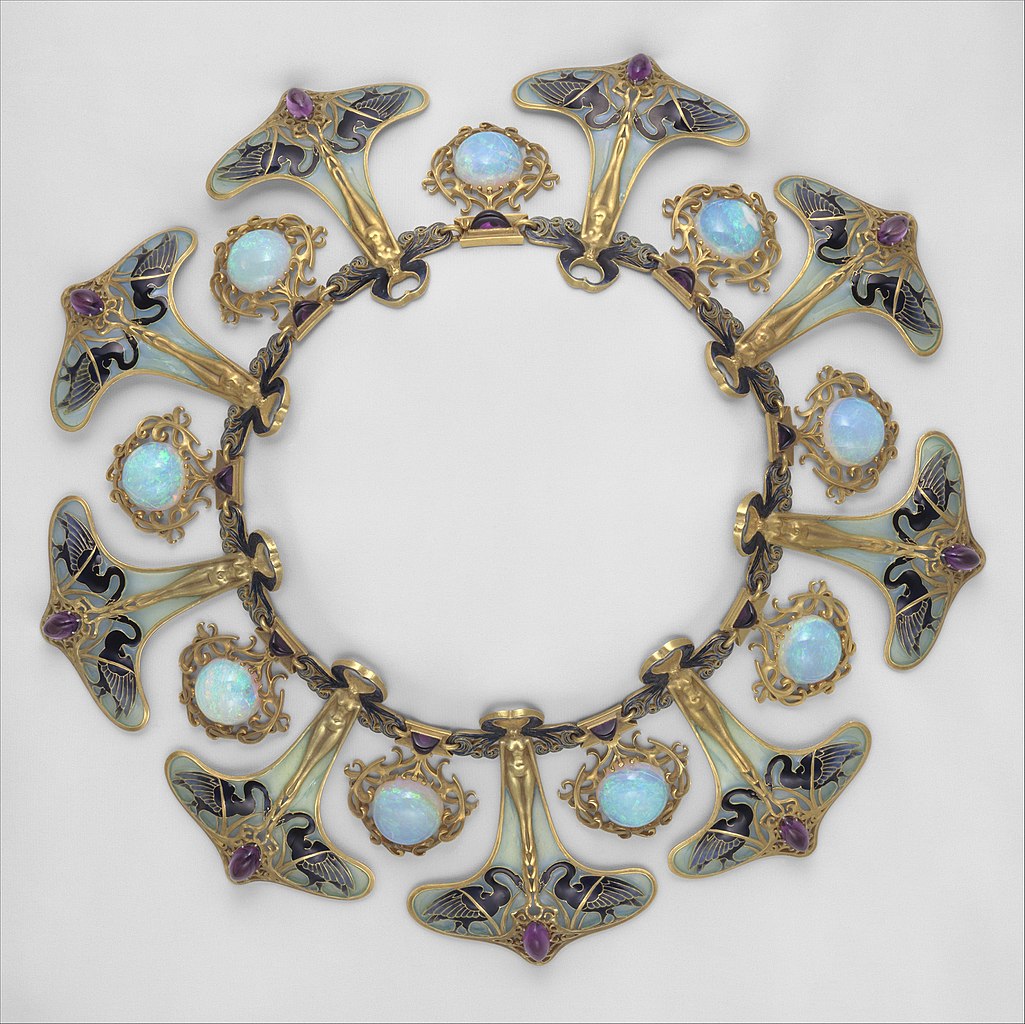
René Lalique, Swan Necklace, c. 1897–1899, Metropolitan Museum of Art, New York City, NY, USA.
How many women have received a necklace designed by their own husband and composed of multiple semi-precious stones? Augustine-Alice Ledru, René Lalique’s second wife, did. One characteristic of Lalique’s jewels was his use of semi-precious stones, like the opals and amethysts in this necklace. In the past, designers only used precious stones in their work. This necklace is not only a gorgeous piece, but also a good opportunity to talk about colonization and jewelry.
During the second half of the 19th century, there was a surge in the exploitation of diamond mines in South Africa, which raised the demand for the stone. This was referred to as the “tyranny of the diamond.” However, Lalique and his contemporaries valued the aesthetic qualities over the stones’ economic value. Opals from Australia became their favorites. Although they were less valuable, their iridescent quality made them more attractive.
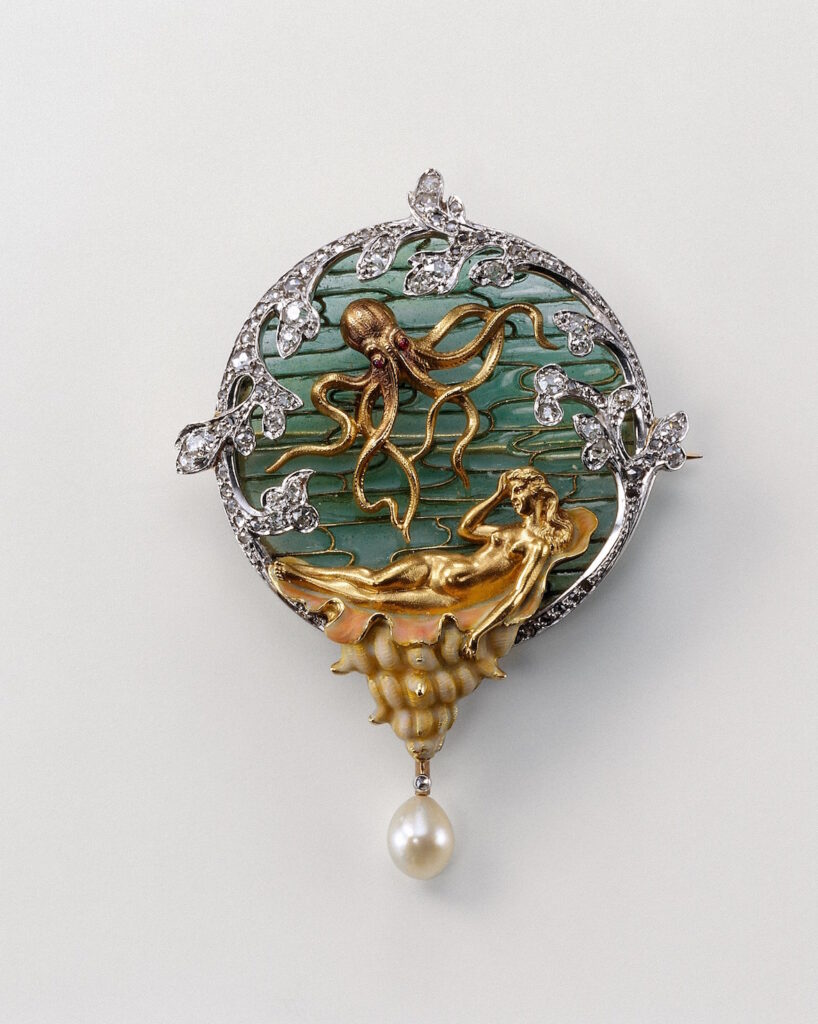
Louis Aucoc, Woman and Octopus Brooch, c. 1898, Pforzheim Jewellery Museum, Pforzheim, Germany. Collector’s Weekly.
Louis Aucoc (1850–1932) was a member of a highly esteemed family of French goldsmithers and Lalique’s teacher. Around 1898, he made this brooch using gold, enamel, diamonds, rubies, and pearls. Here we can see the deep influence of Japanese art that swept Western Europe in the 19th century, called Japonisme. Octopusses were often featured in scandalous positions with women in the art of shunga prints—Japan’s erotic art that left very little to the imagination. The animal’s tentacles gave opportunity for the jeweler to create flowy lines, characteristic of Art Nouveau.
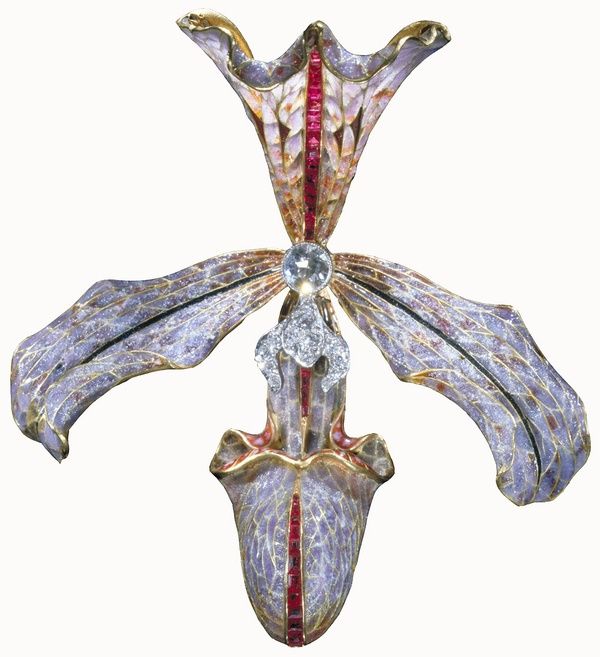
Philippe Wolfers, Hair Ornament with the Shape of an Orchid, 1905–1907, Victoria and Albert Museum, London, UK.
This is one of Philippe Wolfers’ (1858–1929) most astonishing pieces. The Belgian jeweler used gold, enamel, diamonds, and rubies with a technique called plique-à-jour. Olga Barmina, from The Crucible in Oakland, California, explains that it is like stained glass in enamel. Essentially, the golden pattern over the orchid served as the structure to which Wolfers added enamel powder mixed with a type of glue to fill the spaces in between. In this case, he used enamel of red and purple tones. This technique was very popular among Art Nouveau jewelers. The result of this ornament is nothing short of magnificent.
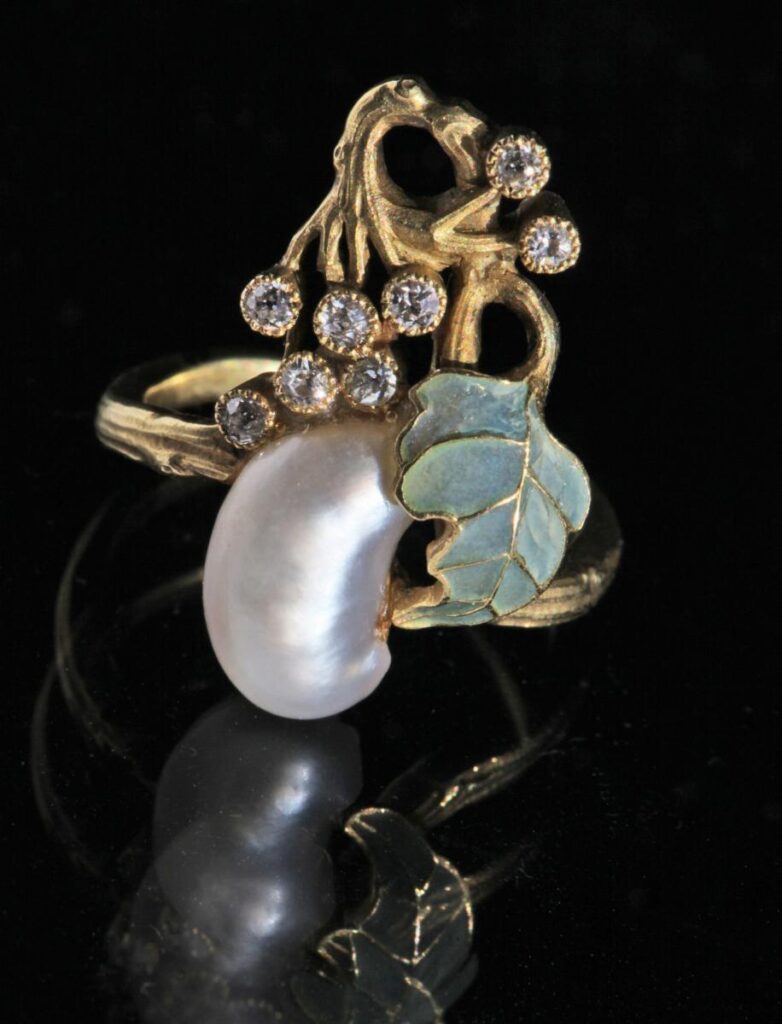
Georges Le Turcq, Ring, c. 1900. BADA.
This ring by Georges le Turcq (1859–1940) shows the beauty of imperfection. Art Nouveau jewelers sought imperfect or “baroque” pearls and stones, despite the lesser value they had on the market. The choice relates to the liberation from tradition and a return to nature.
Notice how, although there are diamonds in this ring, they are not the stars of the show; the weirdly-shaped pearl is. In this case, as in other examples in this list, diamonds are mostly used to add sparkle. Another quality of this imperfect pearl is that it contributes to the asymmetrical design of the ring, something common in Art Nouveau jewelry.
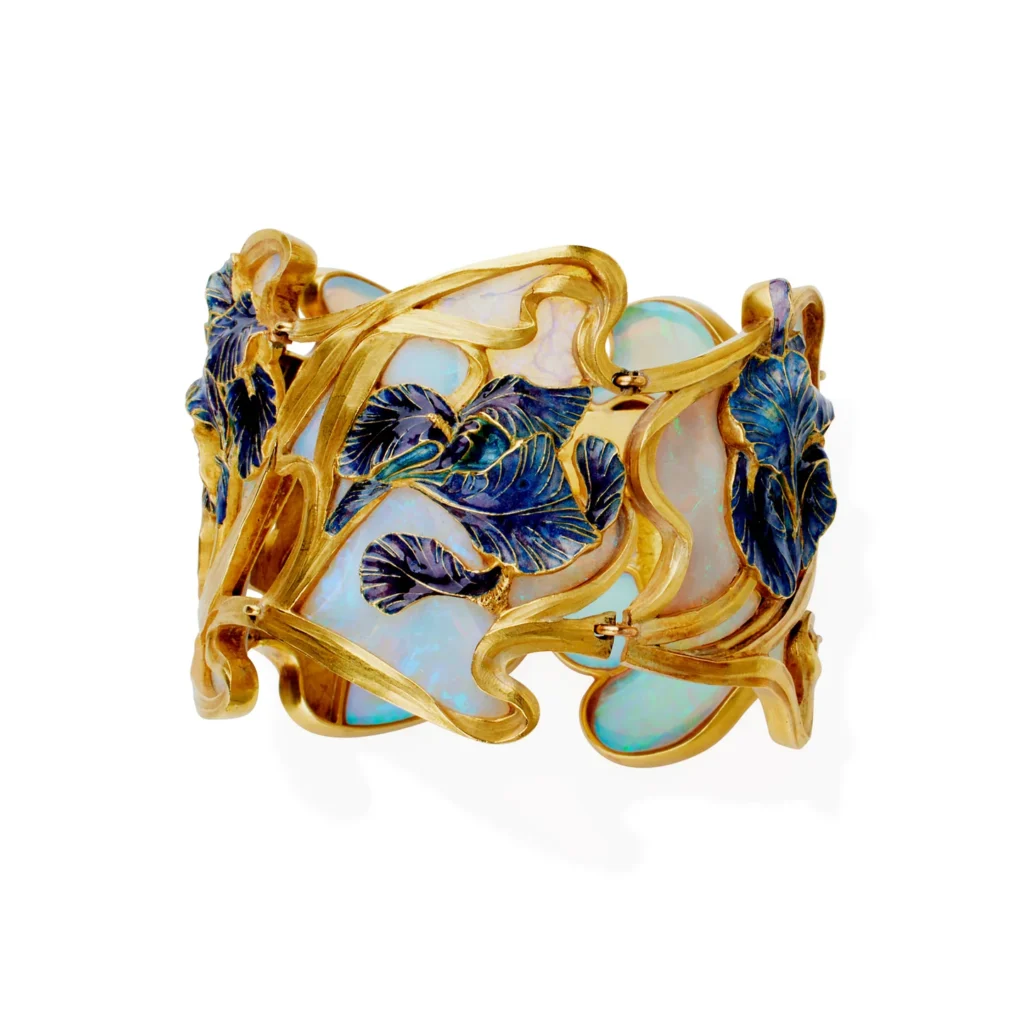
René Lalique, Iris Bracelet, 1897, Macklowe Gallery, New York City, NY, USA.
René Lalique created this bracelet in 1897, when he exhibited it in the Champs-Élysees salons. It consists of five reliefs of opals and enamel. Each relief is different, creating an asymmetrical and dynamic design. The enameled irises of dark purple contrast beautifully with the lighter tones of blue and green from the opals and the golden structure.
Flowers were one of Art Nouveau’s most recurrent motifs. They had everything the designers loved: nature, beauty, and flowy lines. Specifically, irises represent a fusion of Japanese and French imagery. They often appeared in Japanese art, but they were also related to the figure of the Virgin Mary in the Catholic faith.
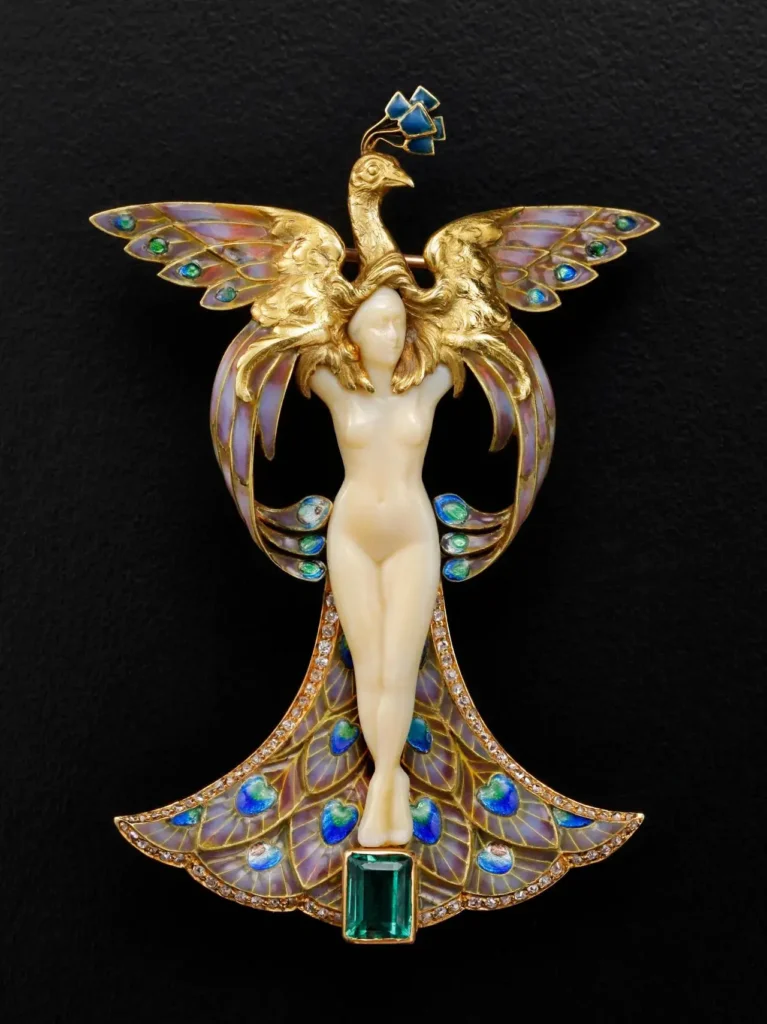
Philippe Wolfers, The Maiden and the Peacock, 1900–1902. Pinterest.
Once again, metamorphosis and hybrid creatures are subjects of an Art Nouveau piece. Peacocks had fascinated cultures for millennia. At the turn of the century in France, they symbolized resurrection and pride, but also protection against the “evil eye”. Given the associations, it is not strange that people wanted to carry them as jewelry. Peacocks are also a Japanese influence in Art Nouveau jewelry, as these birds were common elements of Japanese art. Their colorful feathers were a wonderful opportunity to exploit the diversity of the opals and enamels.
This selection was not easy. Examples abound of extraordinary pieces of Art Nouveau jewelry that leave one breathless. The turn of the century was a fascinating time for designers, albeit a short one, where their creativity took them to unimaginable places. As World War I approached, the style began to fade and make way for Art Deco, a new movement that went back to straight lines and symmetry. However, Art Nouveau would remain the most exciting time for jewelry history enthusiasts.
“Art Nouveau Jewelry in France” in Trewin Copplestone, Art Nouveau Jewellery and Metalwork, 1998, Internet Archive. Accessed: Nov. 21, 2025.
Masterpieces of Art Nouveau jewelry, 1997, Sotheby’s.
Objects of Beauty: Art Nouveau Glass and Jewellery, Victoria & Albert Museum. Accessed: Nov. 21, 2025.
Yvonne J. Markowitz: Imperishable Beauty: Art Nouveau Jewelry, 2008, Internet Archive. Accessed: Nov. 21, 2025.
DailyArt Magazine needs your support. Every contribution, however big or small, is very valuable for our future. Thanks to it, we will be able to sustain and grow the Magazine. Thank you for your help!

An International Relations graduate and an art lover. I prefer art prior to the 20th century, in general. I'm interested in art from Mexico and by female artists.
Czech Alphonse Mucha is a legend of the art world, a pioneer in Art Nouveau whose work still lives on through his larger-than-life artworks, mostly...
Frank Schildiner 20 August 2026
Gustav Klimt’s lavish gold motifs, intricate patterns, and sensuous nudes were as innovative as they were controversial. Breaking from his...
Theodore Carter, 2 July 2026
Ephraim Moses Lilien was an Art Nouveau artist who reimagined traditional Jewish motifs for the modern day. He was also an early supporter of the...
Bec Brownstone 9 October 2026
Aubrey Beardsley’s legacy endures, etched into the contours of the Art Nouveau movement. His distinctive style, marked by grotesque imagery and...
Lisa Scalone 14 December 2025