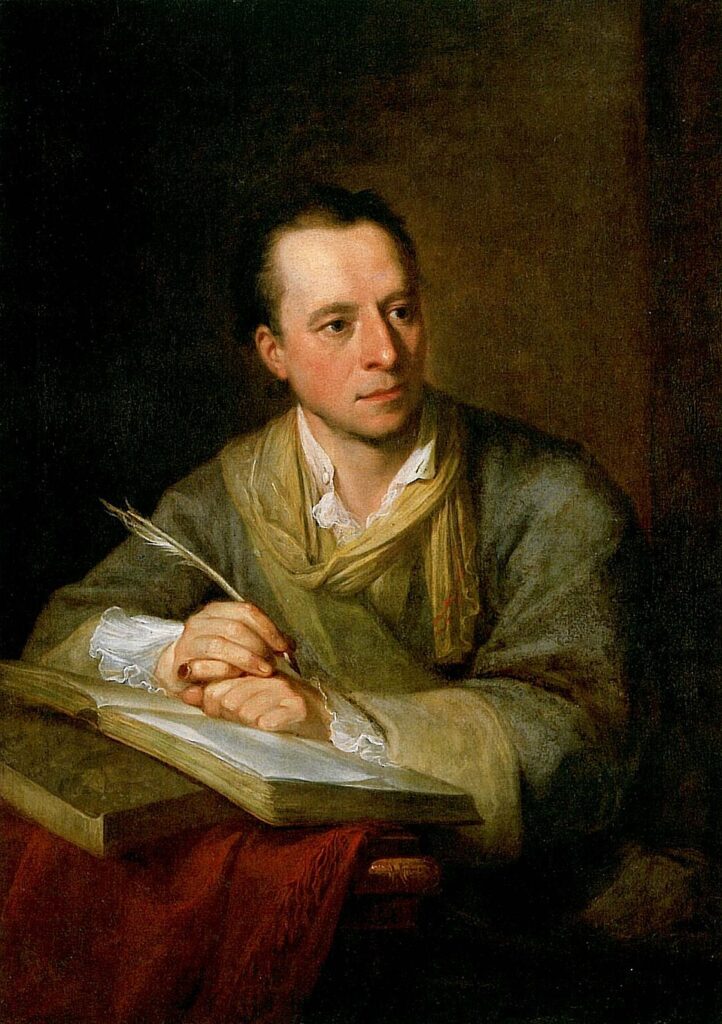
1. Portrait of Johann Joachim Winckelmann, 1764
The first painting is a portrait of one of the most influential figures in Angelica Kauffman’s career. Johann Joachim Winckelmann (1717–1768) is an essential figure in Western art history. He upheld the superiority of Greek art and contributed to the rise of Neoclassicism, which encouraged artists to appreciate Classicism and imitate Greek and Roman art forms. Kauffman met him through a mutual acquaintance in Italy in 1764. At the time, he worked as the superintendent of antiquities in Rome. He published The History of the Art of Antiquity in the same year. Thanks to a letter, we know his opinion of the portrait and the price:
Winckelmann praised not only her artistic talent, but also her multilingual and singing abilities (Kauffman spoke German, French, Italian, and English). Because of this, he claimed, every Englishman wanted his portrait painted by Kauffman.
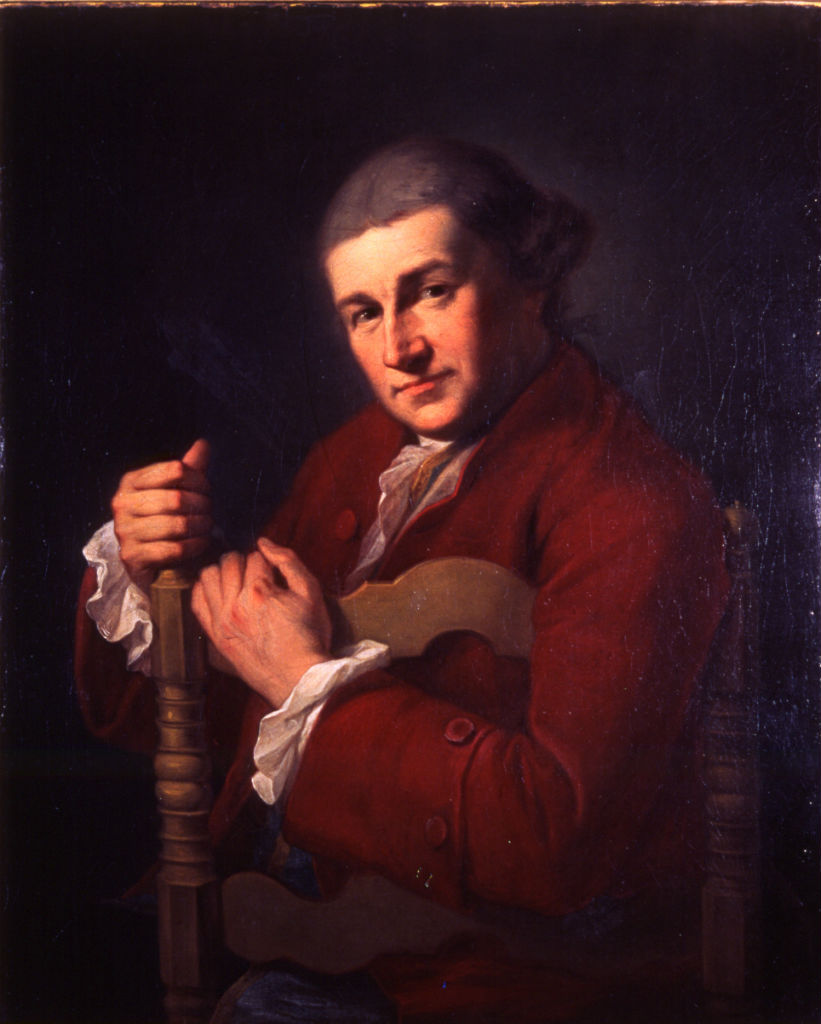
2. Portrait of David Garrick, 1764
David Garrick (1716–1779) was a renowned English actor, which is hard to tell from this portrait. You’ll find him sitting in a chair, holding firmly the backrest with his gaze directed toward the viewer, as if he overheard something and turned around to know more. The background is a solid block of black painted in a Neoclassical fashion. The light comes from the left of the canvas and hits his face and hands. The rest of the palette is simple, dominated by brown tones on the chair and overcoat, with white details for the shirt and a touch of blue from a small glimpse of the coat underneath.
Famous artists often preferred to be depicted as gentlemen or ladies without references to their profession to elevate their status and to gain respect in high society. Garrick achieved fame after his performance as the lead in Shakespeare’s Richard III. Kauffman painted him in Naples when she was only 23. She already enjoyed recognition for her talent and received commissions from aristocrats and celebrities. She sent this portrait to the exhibition of the Free Society of Artists in London in 1765. It helped her establish her reputation in the UK before her arrival the following year.
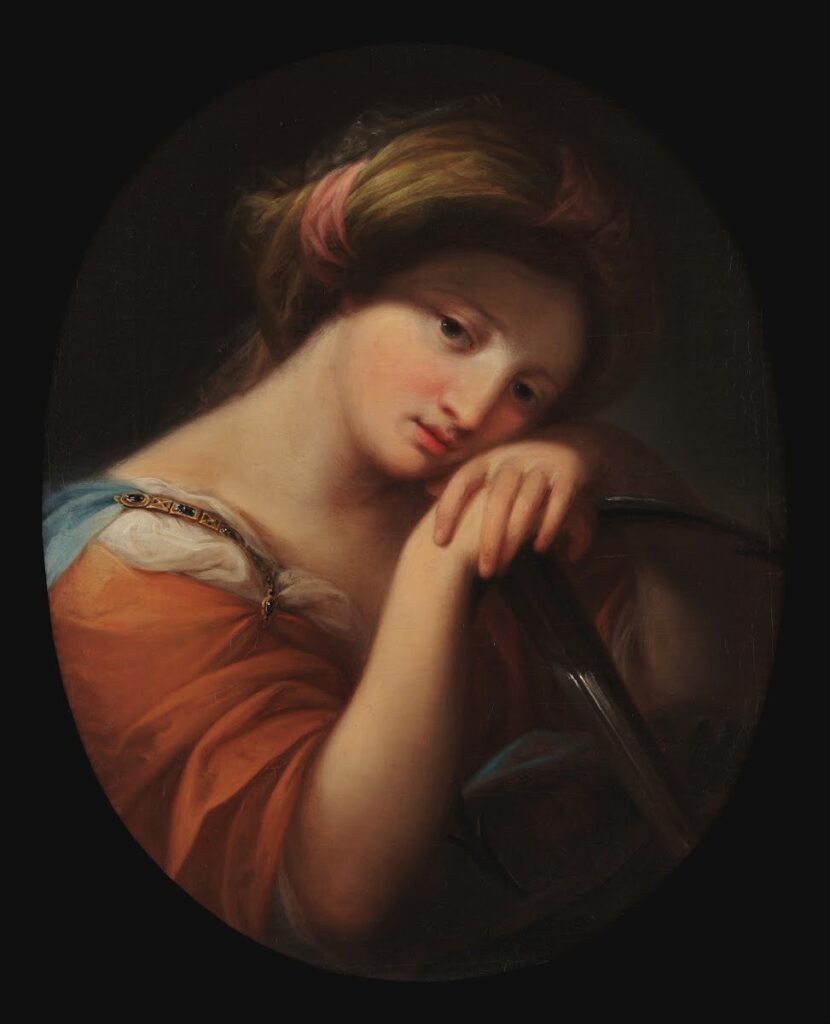
3. Allegory of Hope, 1765
Winckelmann’s ideas inspired Kauffman to turn her focus to the study of ancient art and the great Italian history painters. At the time, history painting was the most prestigious genre of art because mastering the visual narratives required solid knowledge of male anatomy, perspective, literary sources, history, and mythology. The artist had to know how to paint a bit of everything and, most importantly, how to paint human figures.
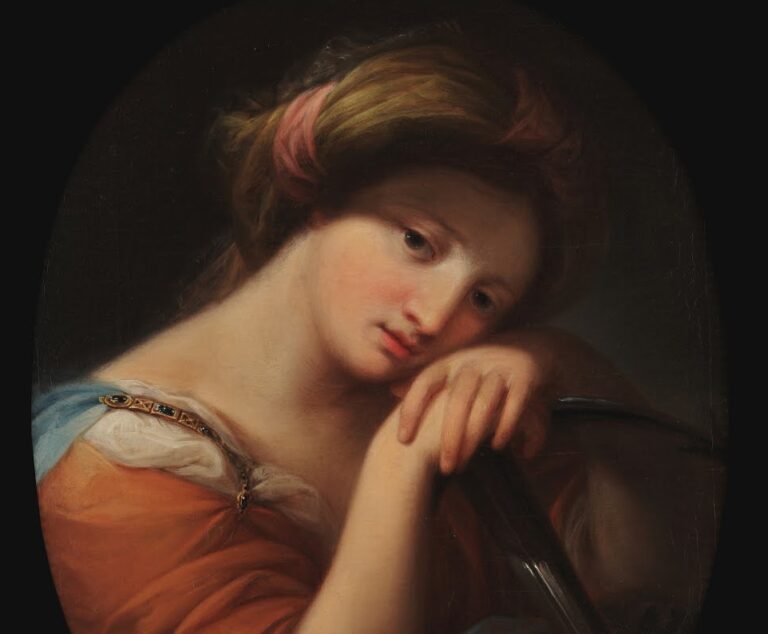
Unfortunately, though not surprisingly, women were considered incapable of mastering such an “intellectual” genre. Nevertheless, Kauffman earned a membership in the Accademia di San Luca with a history painting. She presented Allegory of Hope as her reception piece, which she later donated to the academy. Following convention, Kauffman turned Hope into a melancholic young woman leaning on an anchor, a symbol of Christian hope. Not only does this painting represent her achievement in Italy, but also her ambitions.
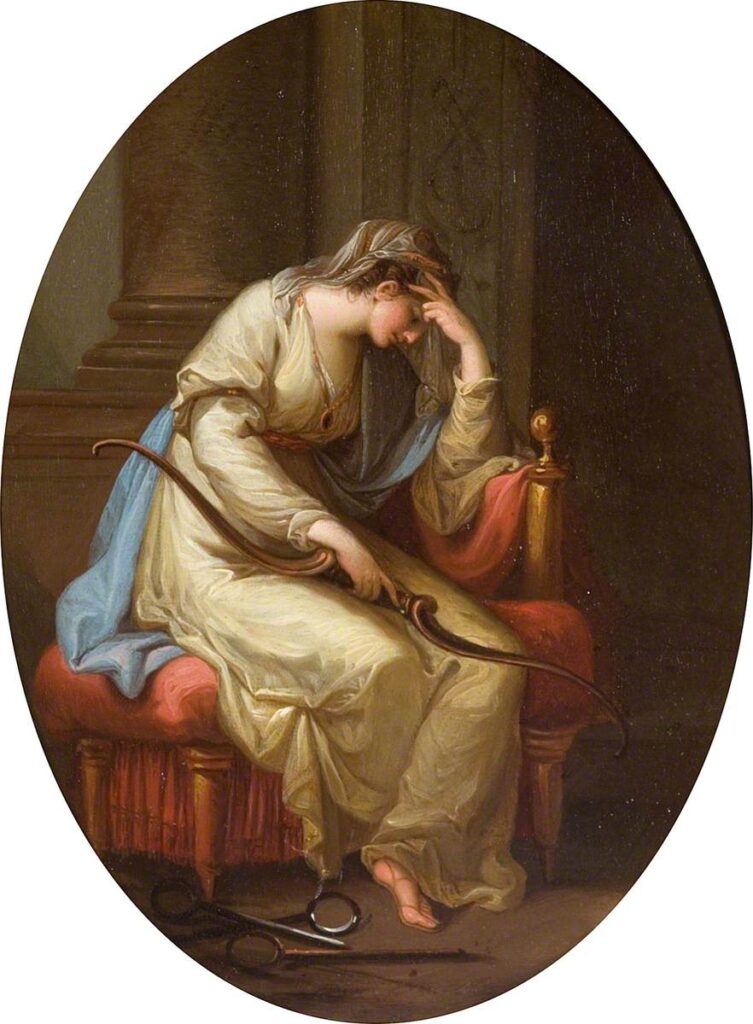
4. Penelope Weeping over the Bow of Ulysses, c. 1779
Kauffman painted Penelope frequently. Around 1779, she depicted the Queen of Ithaca in anguish over her missing husband and the suitors invading her home. The specific moment occurs in Book XXI of the Odyssey when Athena inspires Penelope to start the trial of the bow. Whoever shoots an arrow from Odysseus’ bow through twelve axes can ask for her hand in marriage.
Penelope fetches the bow, but before coming down, she takes a moment to weep. She does not want to marry anyone. But Odysseus has been gone for years, and she feels pressured by her family and suitors. Unaware that Odysseus has returned disguised as a beggar, she feels pessimistic about life as she knows it. This is the moment Kauffman captures in this painting, right before Penelope composes herself and meets the suitors with resolve. It is not a moment of weakness, but of grief.
5. Design, 1778–1780
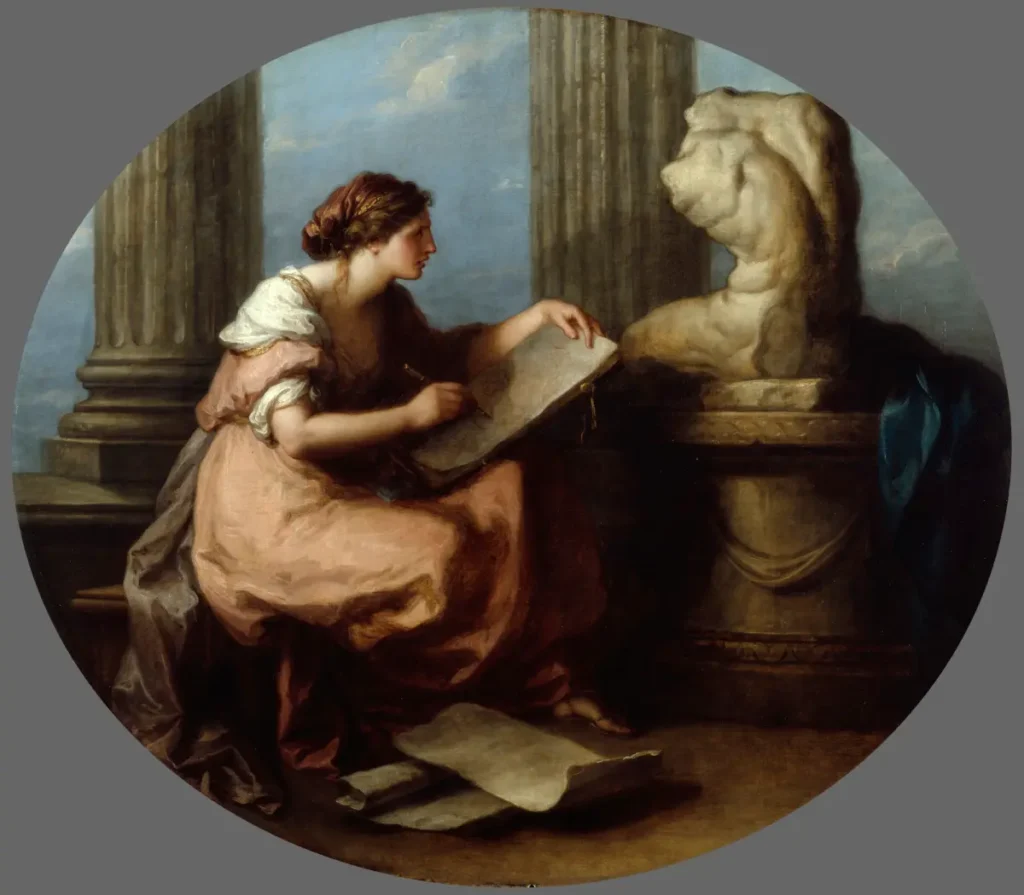
In 1780, the Royal Academy of Arts in London opened the Council Room in New Somerset House. Angelica Kauffman was commissioned to paint a series of four paintings depicting personifications related to art making. Design appears in the form of a female figure seated with a pencil and paper. She observes the Belvedere Torso in front of her. This ancient sculpture embodies the principles of Neoclassical art and academic teaching, a nod to the great masters of Greece and Rome.
Design, or Drawing, held prominence in 18th-century art; it was the base of great masterpieces. Male students learned anatomy by copying casts of sculptures or life models. To accompany this work, Kauffman painted three other allegories: Composition, Invention, and Coloring. They all decorate the ceiling of the Council Room and are known as The Elements of Art.
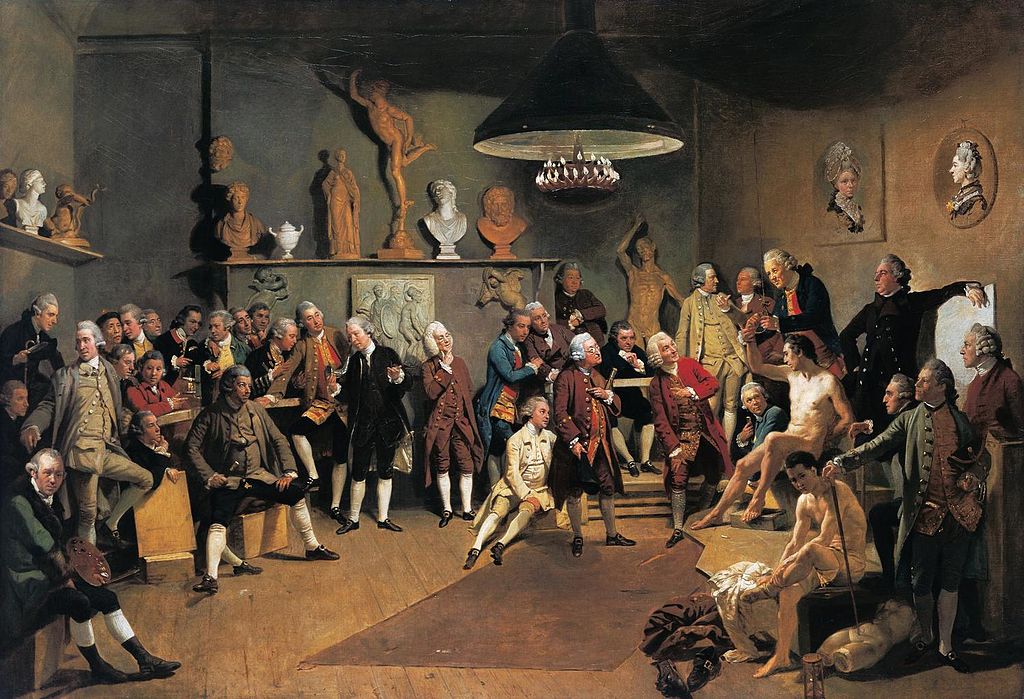
The irony of having a female personification of this idea is that women were prohibited from entering these classes, which is why she and Mary Moser could not be portrayed alongside their male colleagues and fellow founders of the Academy in Johan Zoffany’s The Academicians of the Royal Academy years prior. Moreover, there is an irony in an institution that excludes a woman artist from proper training and merit, but still commissions her to adorn its building.
6. Self-Portrait with a Bust of Minerva, 1780–1784
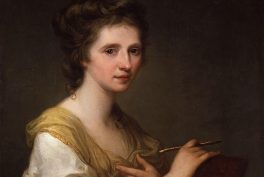
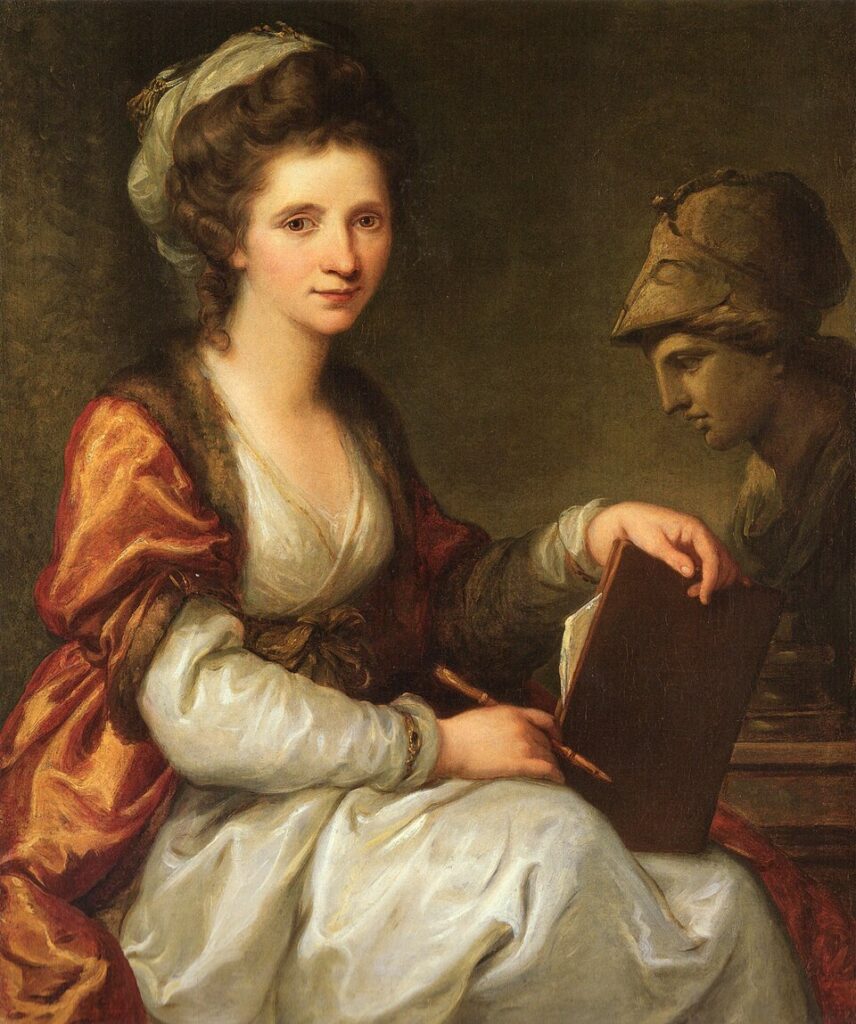
In the 18th century, women artists like Kauffman co-opted Minerva (or Athena), the goddess of wisdom, craftsmanship, and arts, as their own symbol, a recurring motif for their paintings. In this Self-Portrait with a Bust of Minerva, Kauffman appears dressed in a white dress and orange robe. She looks at the viewer while she rests her drawing pad on her leg and holds her pencil with her right hand. Next to her, a bust of Minerva stands over the table, perhaps her drawing subject. The goddess has her characteristic helmet, a symbol of her warlike character.
This is Angelica Kauffman during her mid-career years, when she already became an established history painter in England, founder of an academy, and portraitist of distinguished members of society.
7. Christ and the Samaritan Woman at the Well, 1796
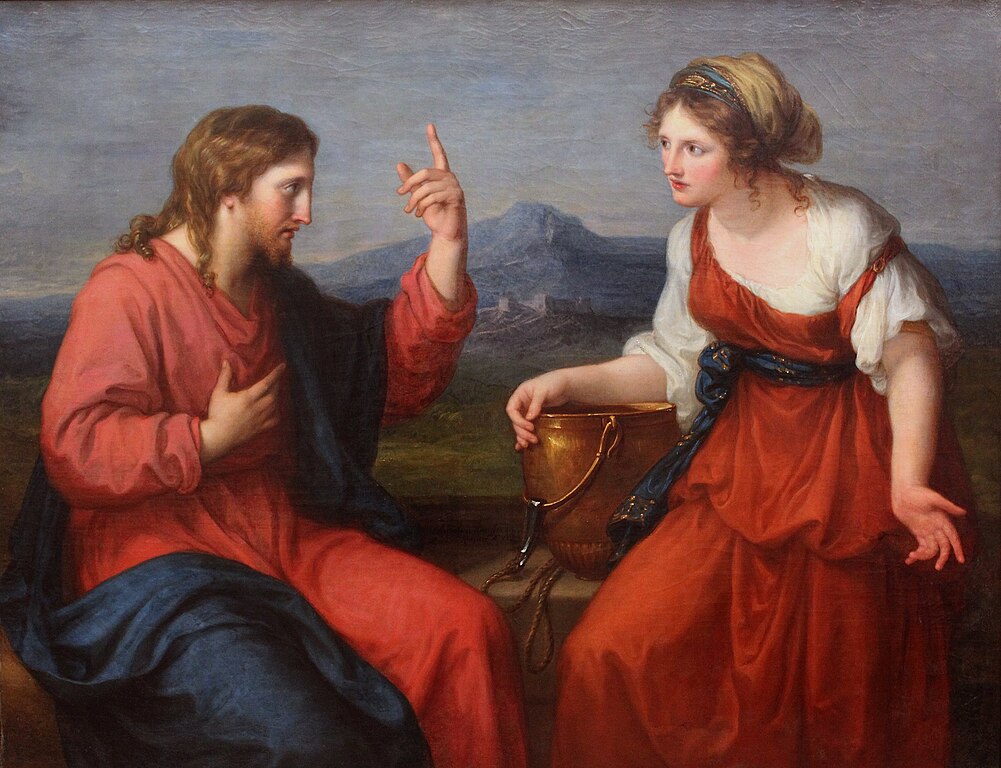
This is one of the few religious paintings Angelica Kauffman did. She depicted a passage in John’s gospel where Christ encounters a Samaritan woman at Jacob’s well. The woman reacts in surprise at Christ’s request for water, given the hostility between Jews and Samaritans. The figures fill most of the canvas, giving the painting an intimate feeling, as if the audience were intruding in a private conversation.
In the center, Kauffman added Mount Gerizim and a city below it. The woman tells Jesus that Jews claim they should worship in Jerusalem. Christ points to the sky with one hand and touches his chest with the other. He may be telling her that, one day, neither this nor the mountain in Jerusalem will be a place of worship, or that he is the “Messiah,” the son of God.
8. Venus Persuading Helen to Love Paris, 1790
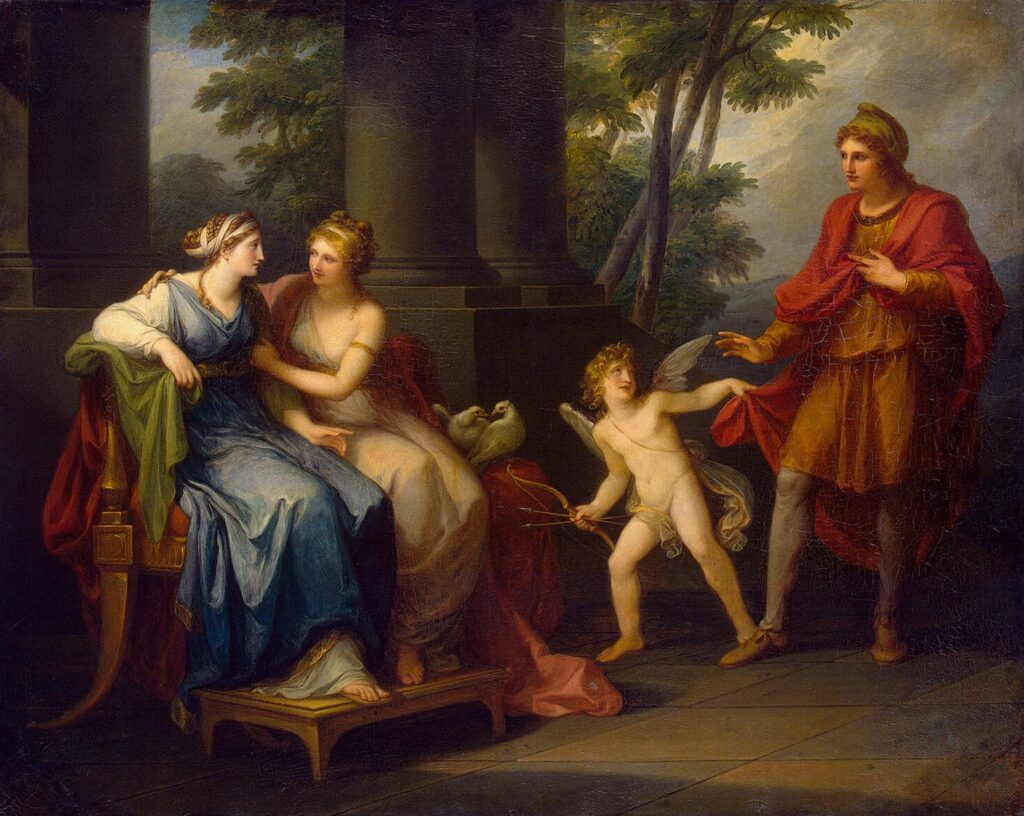
Helen of Troy is another recurring mythological character in Kauffman’s portfolio. The “woman who launched a thousand ships” wears a classical blue dress and sits with Venus. The goddess puts her arms around her to pull her closer and convince her to take Paris. Kauffman located the scene outside a Greek building, as it was customary in Neoclassical paintings.
Although Paris and Helen’s love story appears in hundreds of paintings, Angelica Kauffman depicted a moment where Helen is the one making a choice. Paris has already chosen her in the Judgment of Paris, but now he has to wait for her approval. Her expression denotes confusion and indecisiveness. It is not an easy decision to make. Choosing Paris means abandoning her husband, Menelao, and her position as Queen of Sparta.
9. Self-Portrait of the Artist Hesitating Between the Arts of Music and Painting, 1794
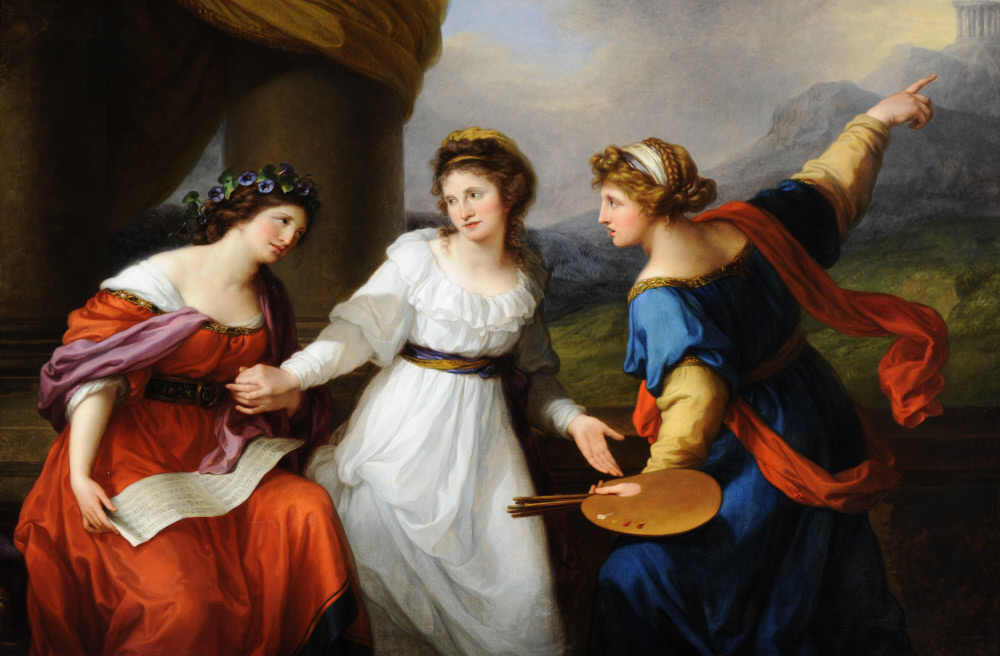
Kauffman painted several self-portraits during her career, depicting different facets of her life. This is a late one, but it represents an early personal conflict: music or art. Kauffman showed impressive talent for painting and music since she was a girl.
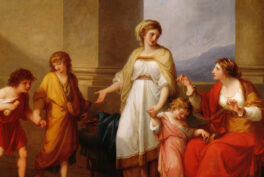
This self-portrait shows her in a white dress in the middle of two personifications. Music sits with her in a bright red gown, holding a music sheet as she looks at her pleadingly and takes her hand. Meanwhile, Painting stands with a much more determined look, pointing at the Greek temple at the top of a hill. It is a visual metaphor of the glory she could achieve during a long and demanding uphill journey. She gazes at Music with an apologetic expression, but her left hand reaches towards Painting. She made her decision. Who knows? If things had gone differently, Kauffman might have become a famous singer.
10. Zeuxis Selecting Models for Helen of Troy, ca. 1775–1780
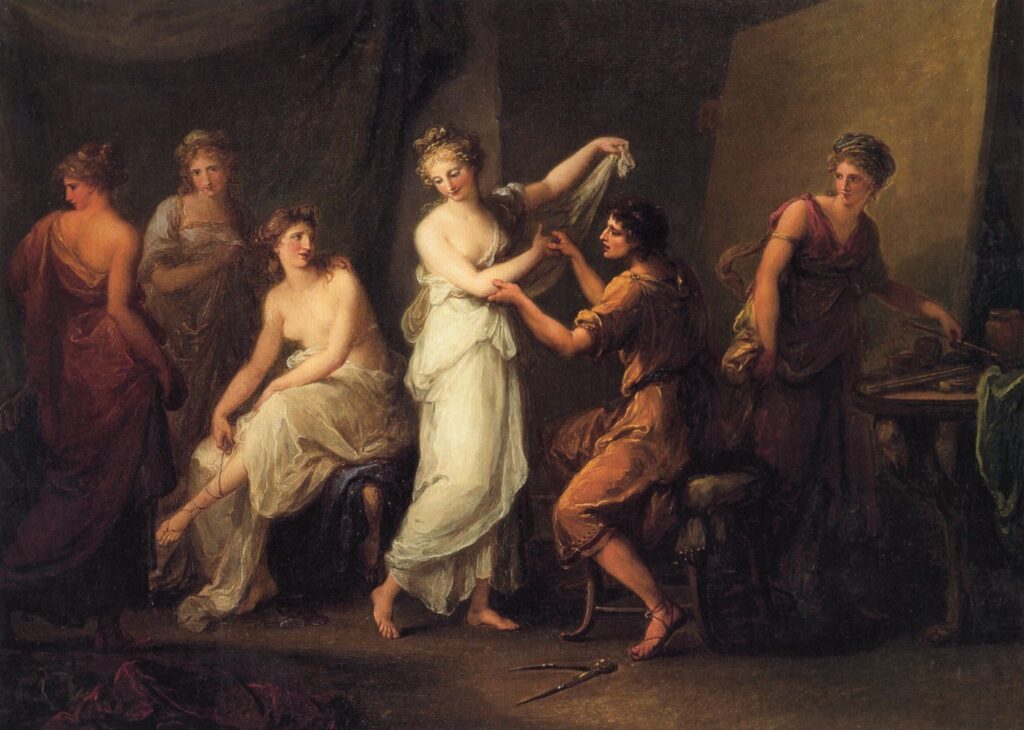
Zeuxis was a Greek painter famous for a portrait of Helen of Troy. Legend says that he chose five maidens as models because no one possessed all the qualities necessary by herself. The idea of selecting the best parts from each model is in agreement with the academic training since artists studied ancient and modern artworks to develop their own style. It also illustrated a philosophical discussion about nature and the role of art in perfecting it or imitating it.
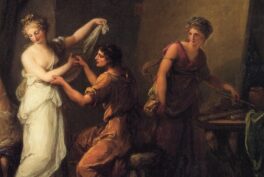
In the 18th century, male artists took Zeuxis as the embodiment of “masculine procreativity.” Kauffman decided to challenge this notion. At first glance, the scene she painted appears traditional. However, one figure does not behave like the rest. While Zeuxis examines a model, another one sneaks from behind and takes his working instruments. It is a daring message. Kauffman is asking, what if Helen’s painter were a woman?
Angelica Kauffman was a child prodigy, a woman who defied expectations and misogyny to achieve greatness. These ten paintings offer an overview of the most important moments in her career, but there is much more to explore.
P.S. If, like us, you admire art made by women, don’t miss our Women Artists postcard set, featuring 50 remarkable painters and engravers such as Artemisia Gentileschi, Élisabeth Vigée Le Brun, Berthe Morisot, Angelica Kauffman, and more!