

Masterpiece Story: Judith and Holofernes by Caravaggio
Judith and Holofernes is a Caravaggio masterpiece that captures Biblical murder and drama. Rarely has death been captured so intensely and violently...
James W Singer 13 September 2026
30 October 2025 min Read

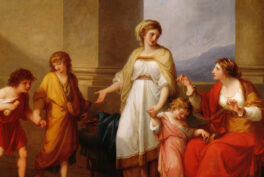
Angelica Kauffman, Zeuxis Selecting Models for Helen of Troy, ca. 1775–1780, Annmary Brown Memorial Collection, Brown University, Providence, RI, USA. Detail.
We’re all Angelicamad here! To celebrate the history painter extraordinaire Angelica Kauffman, let’s discuss her take on one of antiquity’s juiciest art stories: Zeuxis’s attempt to paint the most beautiful woman of ancient Greek myth.
Painting Helen of Troy is attempting to realize the impossible. As the paragon of female beauty in the Western tradition, Helen of Troy was an ethereal demi-goddess. She was celebrated for her femininity as much as she was criticized—demonized, even—for her threatening, seductive powers. After all, she launched the Trojan War through her elopement with Paris—or abduction, depending on the mythological account.
Unsurprisingly, the infamous, adulterous femme fatale is an aspirant subject for history painters. Helen of Troy’s portrayal and representation across art forms provokes passionate debate, regardless of the century. Artists and audiences alike have a history of publicly and privately criticizing any mortal summoned to embody this mythical woman.
Cicero tells us of Zeuxis, the 5th-century BCE Greek realist painter. The artist took on the task of painting Helen of Troy but quickly became disenchanted with the model’s imperfections. So, Zeuxis created a composite subject, pulling together individual limbs and body parts from a handful of women to create one ideal form.1
Amputating female models to build his own Helen empowered the artist to “rise above the copying of Nature’s imperfections.”2 Zeuxis’ painting does not survive. Yet, his scrupulous creative process has been reimagined by various history painters, both male and female, in subsequent centuries.

Angelica Kauffman, Self-Portrait with Bust of Minerva, c. 1784, Bündner Kunstmuseum, Chur, Switzerland.
Angelica Kauffman (1741–1807) was one such artist. The Swiss Neoclassical painter was inspired by the art and subjects of ancient Greece and Rome. She excelled not just in the domains of history painting and portraiture, but also in landscape and decorative painting.
Today, Kauffman is best remembered as one of two women, alongside Mary Moser, on the list of the 34 founders of Great Britain’s Royal Academy of Arts in 1768. The Royal Academy was an institution that otherwise largely discriminated against women artists until the first female academician, Annie Swynnerton, was elected in 1922.

Johan Joseph Zoffany, The Academicians of the Royal Academy, 1771–1772, Royal Collection Trust, London, UK.
In the years following this remarkable achievement, Kauffman chose Zeuxis and his quest to depict Helen’s perfection as the subject of her history painting. Completed by the early 1780s, Zeuxis Selecting Models for Helen of Troy depicts Zeuxis in the studio with five models. Zeuxis is busy adjusting and assessing one blonde beauty in the center of the composition. He fails to notice one of the models sneaking off to take control of the artist’s supplies.

Angelica Kauffman, Zeuxis Selecting Models for Helen of Troy, ca. 1775–1780, Annmary Brown Memorial Collection, Brown University, Providence, RI, USA.
Certainly, Kauffman was not the only painter to recreate this mythical scene. But her interpretation stands out so much that this painting is often cited in introductions to the artist’s oeuvre. Kauffman asks us to consider how our reading of the painting changes when we know it was produced by a woman.
Many scholars have read this painting as a form of self-portraiture. The artist makes an “openly subversive gesture” in the way that she, through the figure of the model wielding the paintbrush, “assume[s] artistic control.”3 Kauffman chooses not to identify with the central male artist but with a model-turned-creative agent. She articulates that painting, as a creative act, cannot be considered an exclusively male domain, existing far beyond the reach of his models and objects of study.
Evidently, Kauffman loved a challenge. This was not Kauffman’s only painting that referenced the beauty of Helen of Troy. Helen was a recurring subject in Kauffman’s history paintings, including Hector Summoning Paris to Battle (1775) and Venus Persuades Helen to Love Paris (1790).
Indeed, Zeuxis Selecting Models for Helen of Troy may be only one of the hundreds of paintings that made the world “Angelicamad.” Nevertheless, it certainly has much to teach us about the power and creativity of women history painters in the 18th century.
Elizabeth C. Mansfield, Too Beautiful to Picture: Zeuxis, Myth, and Mimesis, University of Minnesota Press, 2006.
Wendy Wassyng Roworth, “The Gentle Art of Persuasion: Angelica Kauffman’s Praxiteles and Phryne,” The Art Bulletin, 65, no. 3 (1983).
Tobias G. Natter, ed., Angelica Kauffman: A Woman of Immense Talent. Hajte Canz, 2007.
DailyArt Magazine needs your support. Every contribution, however big or small, is very valuable for our future. Thanks to it, we will be able to sustain and grow the Magazine. Thank you for your help!

Gabrielle Stecher (Ph.D., University of Georgia) writes about antiquity, Victorian visual culture, and the stories we tell about women artists.

Elizabeth Provost is a visual arts journalist, editor, and scholar of the Italian Renaissance based in New York City and Toronto. She is a PhD student at the Bard Graduate Center. Learn more about her on her website: www.elizabethprovost.com
Judith and Holofernes is a Caravaggio masterpiece that captures Biblical murder and drama. Rarely has death been captured so intensely and violently...
James W Singer 13 September 2026
Explore an astonishing 1915 nude self portrait by American modernist painter Florine Stettheimer.
Candy Bedworth 21 September 2026
Winslow Homer (1836–1910) was one of the leading American Realist painters. His painting The Veteran in a New Field is a masterpiece of late...
James W Singer 30 August 2026
At first glance, A Goldsmith in His Shop (1449) appears to depict an ordinary visit to a jeweller. Yet Petrus Christus transformed an ordinary...
Shivani Gupta 23 August 2026