
Masterpiece Story: Judith and Holofernes by Caravaggio
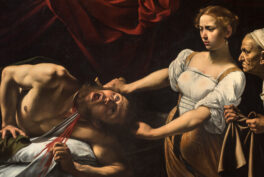
Judith and Holofernes is a Caravaggio masterpiece that captures Biblical murder and drama. Rarely has death been captured so intensely and violently...
James W Singer 13 September 2026
6 September 2026 min Read
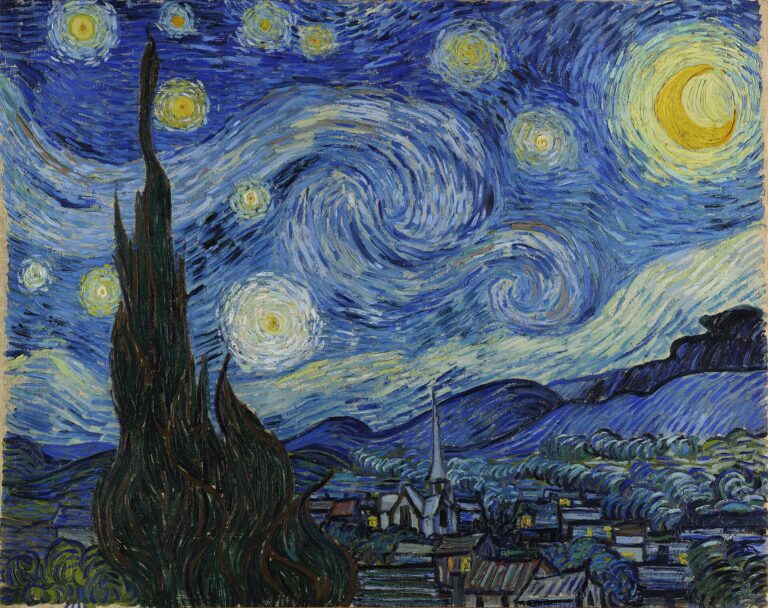
Vincent van Gogh, The Starry Night, 1889, Museum of Modern Art, New York City, NY, USA.
During his stay in the Saint-Rémy hospital in southern France, Vincent van Gogh created The Starry Night. It became one of his most recognizable paintings—The twinkling stars, bright moon, and sky in layered waves of blue possess emotional power captivating audiences for many years. This article will tell its story.
Painted by Vincent van Gogh in 1889, The Starry Night emerged during a transformative period in European culture. Art movements like Impressionism, Post-Impressionism, Symbolism, and Art Nouveau rose to prominence in the wake of scientific advancements. Meanwhile, Artists began to infuse their work with symbolic depth and personal emotion, as opposed to following academic conventions.
Van Gogh, the now-illustrious Post-Impressionist, embodied this shift in artistic expression. His masterpiece, The Starry Night, captures the essence of Post-Impressionism with its vibrant colors and emotive brushwork. The work was produced during Van Gogh’s stay at the mental hospital in the Monastery of Saint-Paul de Mausole in Provence, after a fight with friend and Post-Impressionist artist Paul Gauguin, followed by a nervous breakdown. Painted in one day based on the view from the window of Vincent’s room, The Starry Night presents a unique version of the world as seen through the artist’s eyes.
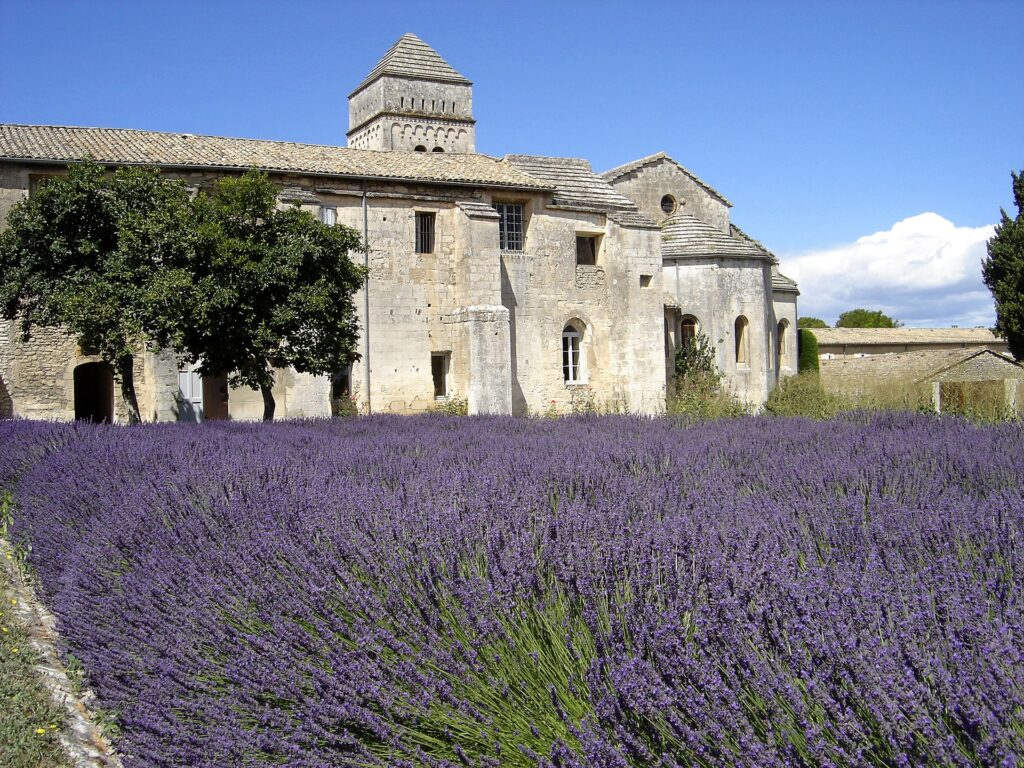
The Monastery of Saint-Paul de Mausole, Saint-Rémy-de-Provence, France. Wikipedia.
It is astonishing how Van Gogh wielded the emotional depth of artistic power and channeled his profound pain, loneliness, illness, and rejection into a wellspring of creativity. The confines of a hospital might break a person. Yet for Van Gogh, it was where he discovered within his imagination the resilience and fervor to create, where he got to express the nearly unbearable beauty of the world.
Interestingly, the depiction of the starry sky in The Starry Night isn’t Van Gogh’s only rendition. A year prior, in 1888, he painted Starry Night over the Rhone, yet The Starry Night remains notably more expressive.
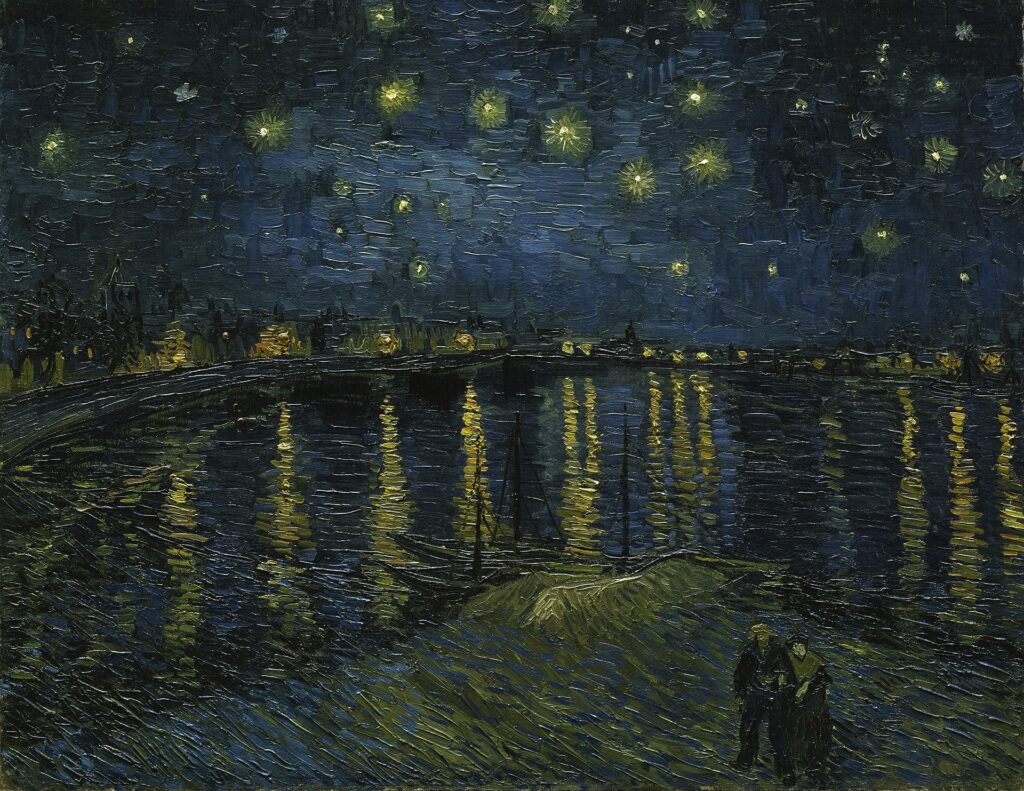
Vincent van Gogh, Starry Night over the Rhone, 1888, Musée d’Orsay, Paris, France.
The painting is a landscape with a village in the foreground, most of which is lit by the starry sky. The village likely stems from the artist’s imagination and recollections, as it resembles more of the Dutch architecture from Van Gogh’s homeland.
Additionally, the expansive sky is adorned with shimmering stars, with a radiant Venus positioned to the right of a cypress tree and the Moon gracing the upper right corner. Van Gogh rendered the sky with swirling strokes of blue in the shape of undulating waves. Perhaps he drew inspiration from Japanese woodblock prints, such as the iconic Great Wave off Kanagawa. After all, Van Gogh was an avid collector of Japanese prints, and some of his work demonstrates an influence from Japanese art.
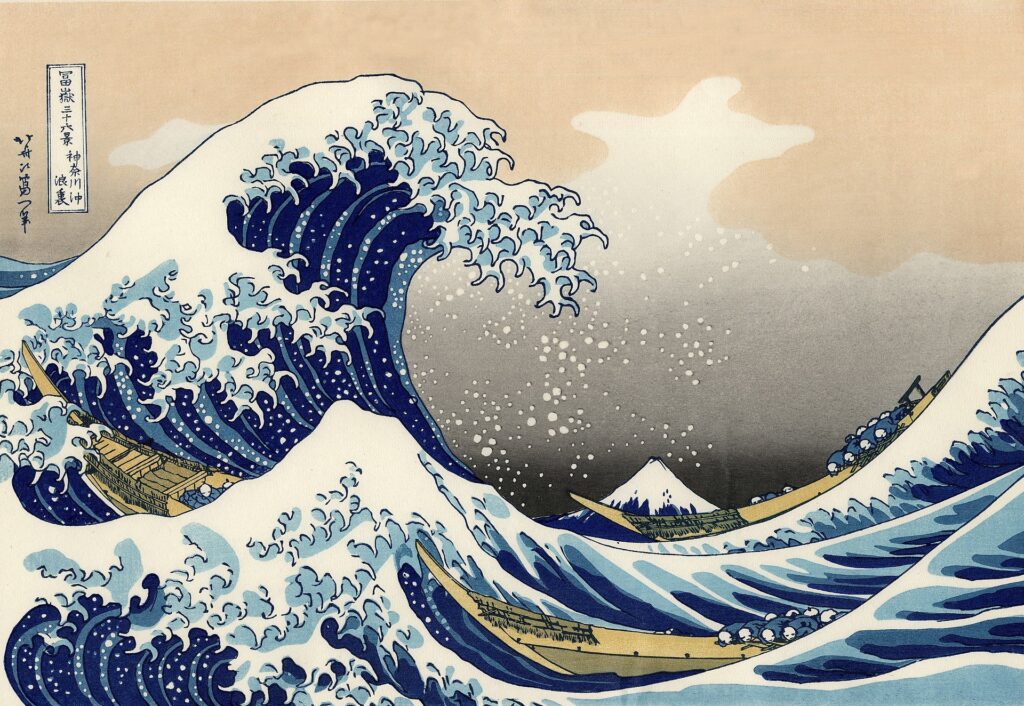
Katsushika Hokusai, The Great Wave of Kanagawa, 1831, Metropolitan Museum of Art, New York City, NY, USA.
Particular emphasis should be placed on the stars in “Starry Night.” These are not mere yellow dots but fiery orbs emanating radiance and light in all directions. Interestingly, their swirling patterns bear a striking resemblance to the depiction of the Whirlpool galaxy sketched by British astronomer William Parson in 1845.
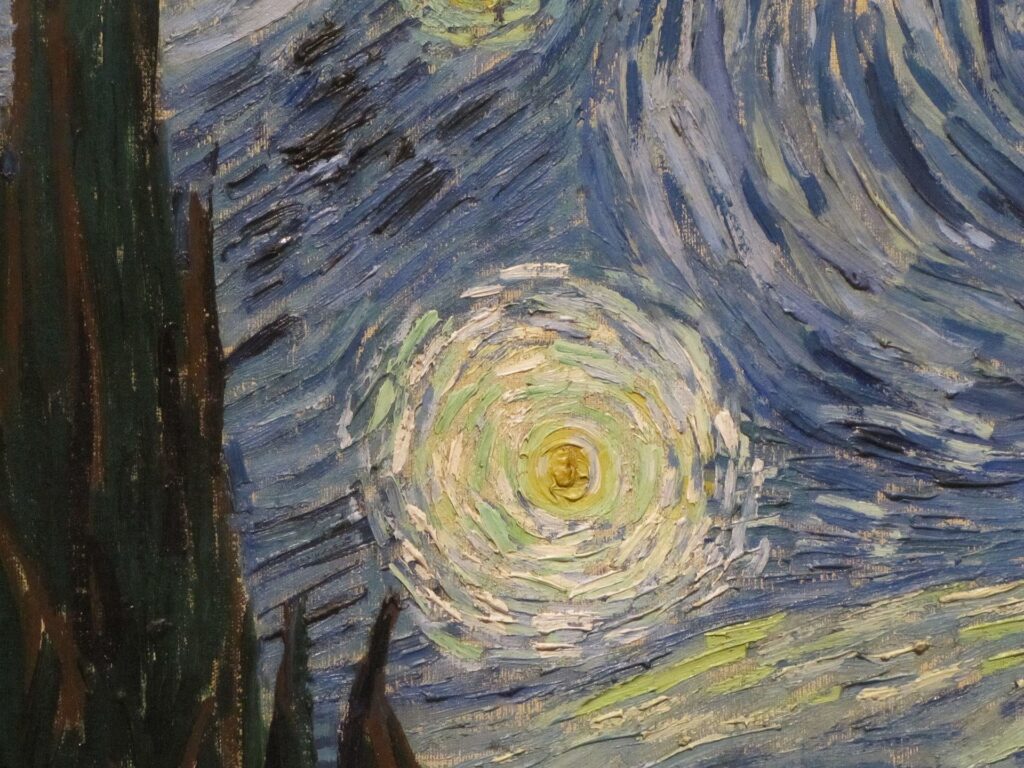
Vincent van Gogh, The Starry Night, 1889, Museum of Modern Art, New York City, NY, USA. Detail.
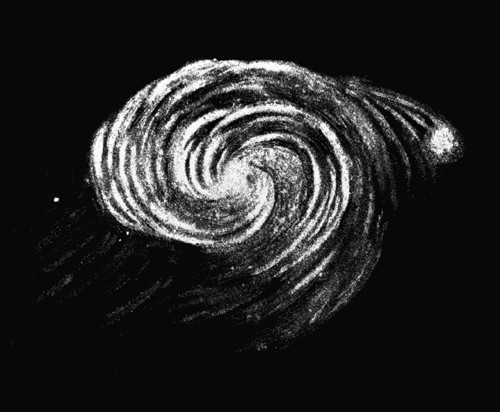
Sketch of M51 by William Parson in 1845. Wikipedia.
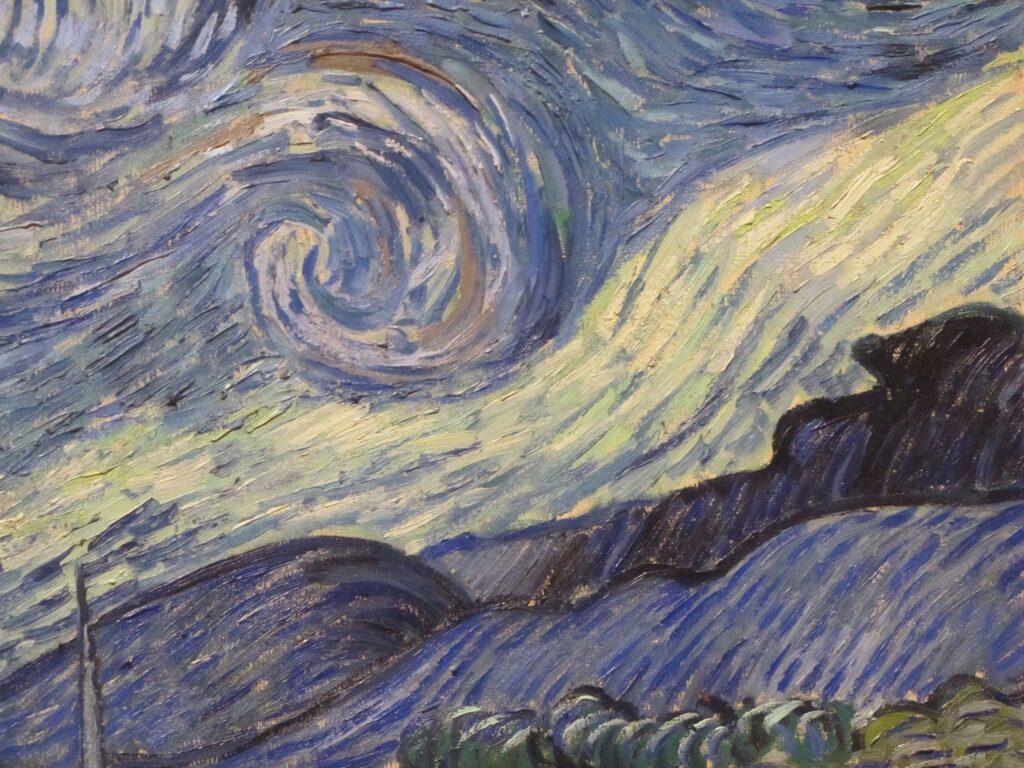
Vincent van Gogh, The Starry Night, 1889, Museum of Modern Art, New York City, NY, USA. Detail.


The most luminous star in the painting actually is the depiction of Venus.
William Parson made the sketch of the Whirlpool galaxy (M51) that was classified as a spiral galaxy.
Waves and spirals in the Starry Night resemble with the Whirlpool galaxy and the Great Wave of Kanagawa.
The cypress tree in the foreground on the left extends majestically into the night sky. It carries significant symbolism deeply rooted in European culture. Historically, the cypress has been revered as one of the oldest trees on Earth, with Mediterranean civilizations incorporating it into rituals surrounding death due to its dark green needles, which symbolize sorrow and its towering, pyramid-like form evoking candles, which is likened to the souls of the departed.
Conversely, in early Christian art, cypresses were emblematic of faith and the hope for eternal life. Van Gogh’s fascination with cypresses, evident in his frequent mentions of them in his letters, is reflected in his numerous paintings featuring the tree’s distinctive curved lines. In The Starry Night, the cypress bridges the earthly realm and the enigmatic heavens, their vibrant stars and galaxies. It can be seen as a metaphor for the human soul set against the infinite expanse of space and the distant celestial bodies—yearning for connection.
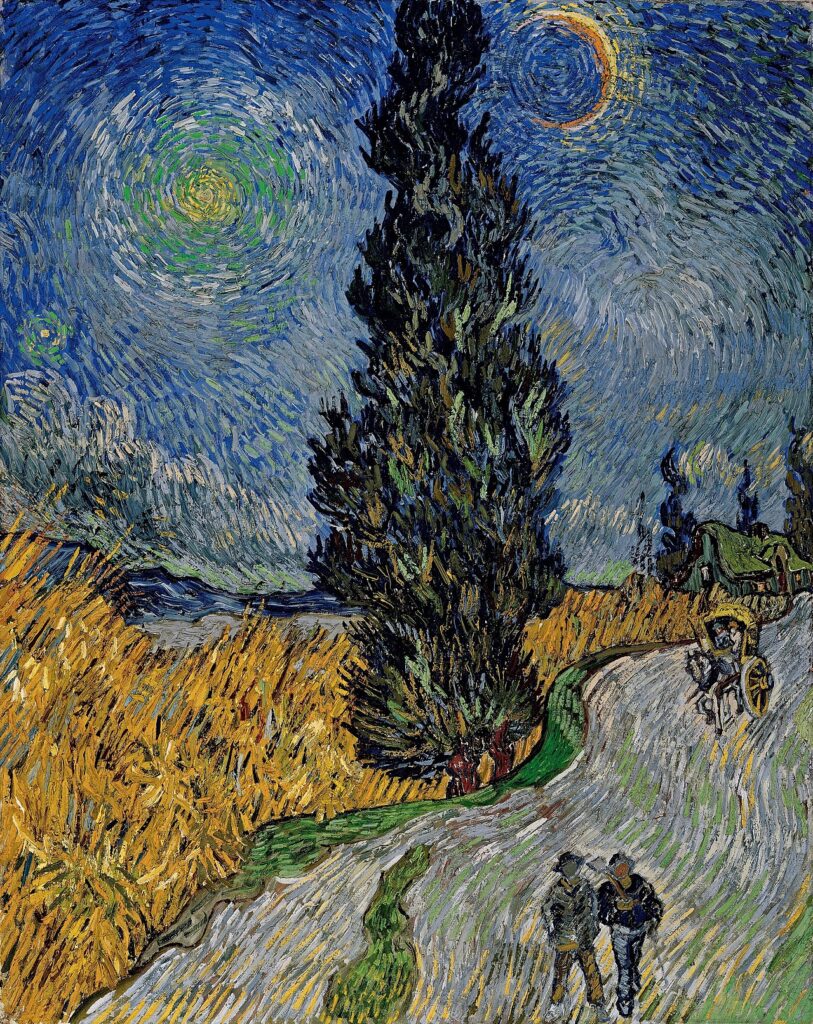
Vincent van Gogh, Road with Cypress and Star, 1890, Kröller-Müller Museum, Otterlo, Netherlands.
Be clearly aware of the stars and infinity on high. Then life seems almost enchanted after all.
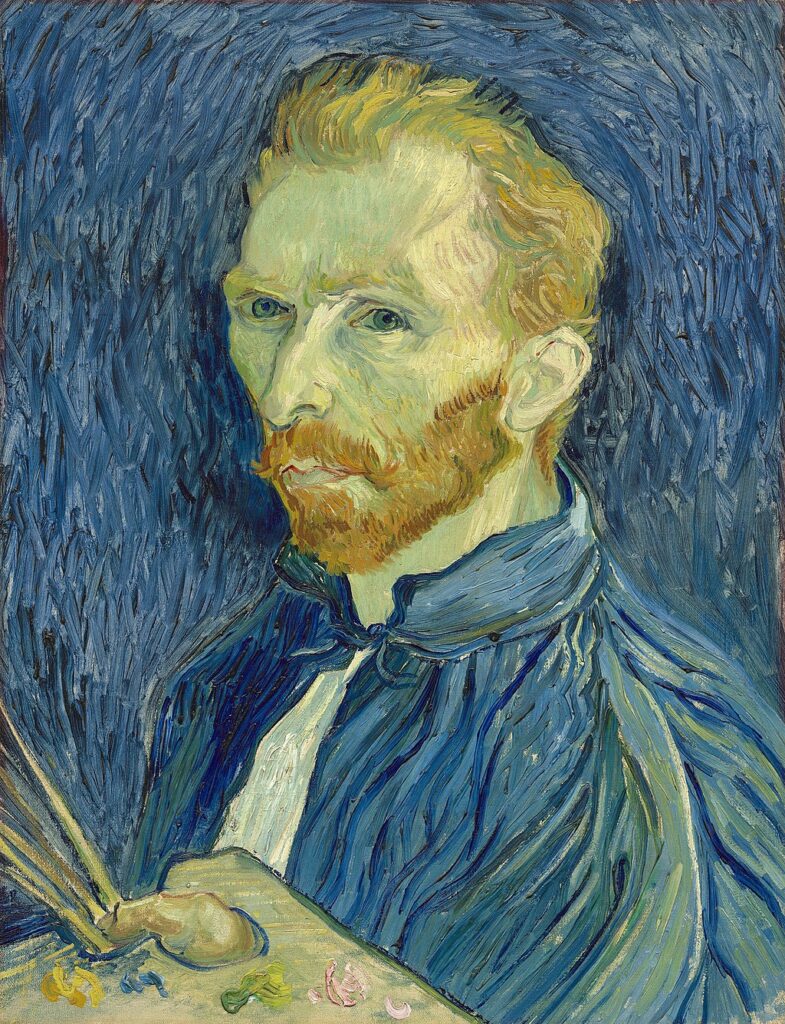
Voncet van Gogh, Self-Portrait, 1889, National Gallery of Art, Washington, D.C., USA.
DailyArt Magazine needs your support. Every contribution, however big or small, is very valuable for our future. Thanks to it, we will be able to sustain and grow the Magazine. Thank you for your help!

An art lover, a bookworm, a flaneur and a daydreamer from Moscow. She is obssesed with the period of la Belle Époque and Marcel Proust. She believes that The Fabulous Destiny of Amélie Poulain shaped her personality and probably she was born 100 years later.

Judith and Holofernes is a Caravaggio masterpiece that captures Biblical murder and drama. Rarely has death been captured so intensely and violently...
James W Singer 13 September 2026
Explore an astonishing 1915 nude self portrait by American modernist painter Florine Stettheimer.
Candy Bedworth 21 September 2026
Winslow Homer (1836–1910) was one of the leading American Realist painters. His painting The Veteran in a New Field is a masterpiece of late...
James W Singer 30 August 2026
At first glance, A Goldsmith in His Shop (1449) appears to depict an ordinary visit to a jeweller. Yet Petrus Christus transformed an ordinary...
Shivani Gupta 23 August 2026