
Masterpiece Story: Judith and Holofernes by Caravaggio
Judith and Holofernes is a Caravaggio masterpiece that captures Biblical murder and drama. Rarely has death been captured so intensely and violently...
James W Singer 13 September 2026
16 August 2026 min Read

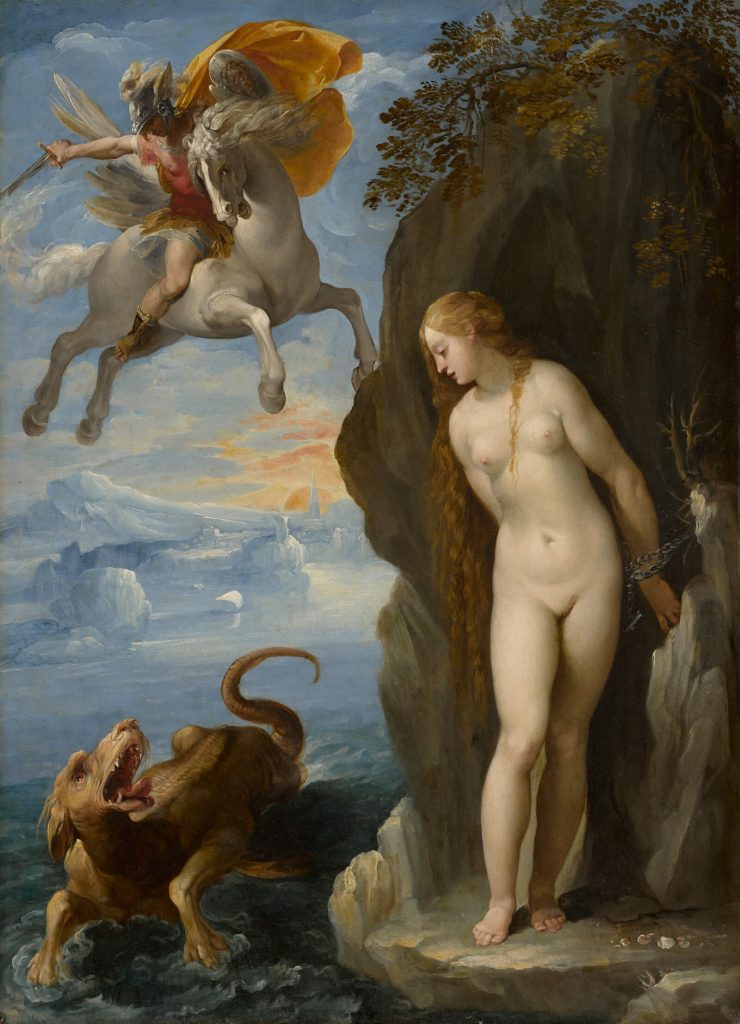
Cavaliere d’Arpino, Perseus Rescuing Andromeda, 1594-1595, Clark Art Institute, Williamstown, MA, USA. Detail.
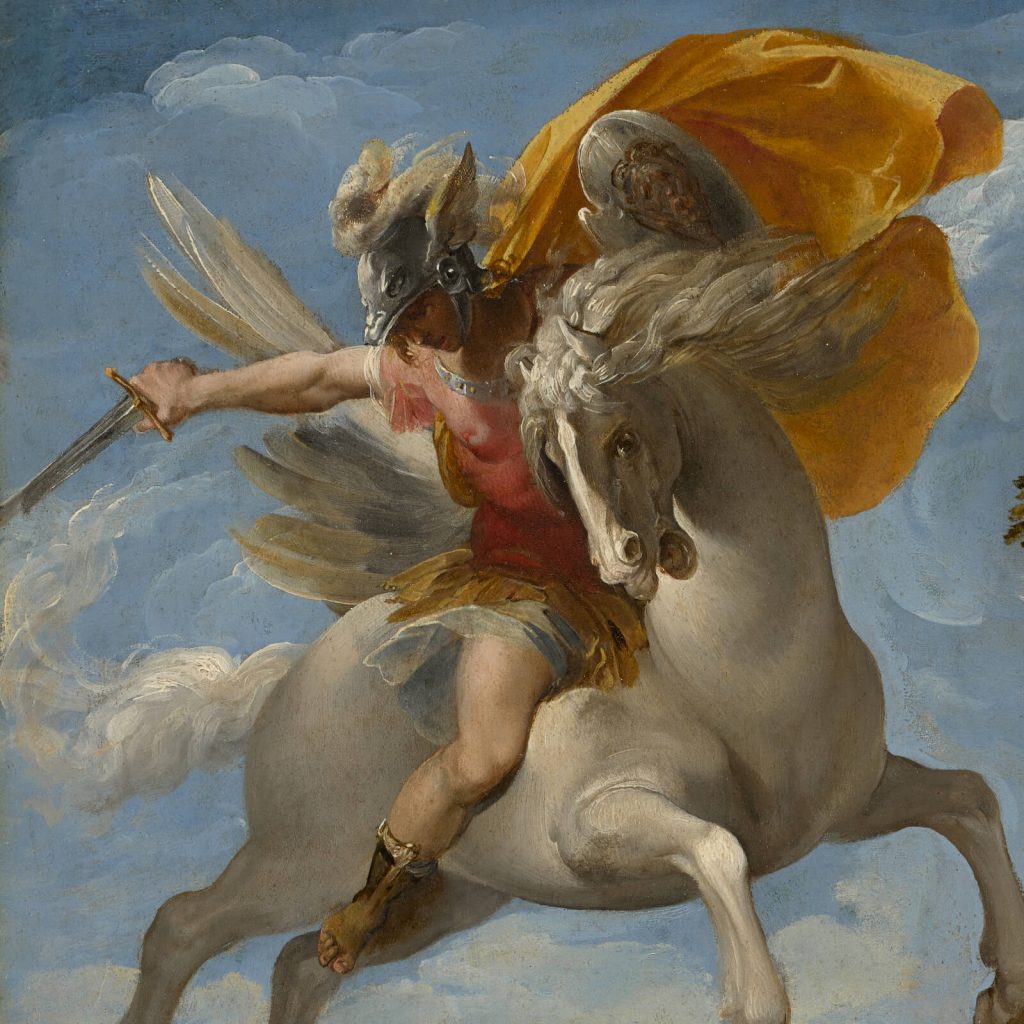
The roar of the sea monster blends with the screams of the scared princess! The chained beauty awaits her bloody death as the ugly beast lurches forward. Suddenly there is a flash of metal, the sound of wings, and the feeling of hope. A great hero comes flying down on his winged horse and slays the monster before it touches the princess. She is saved and falls in love with her savior. This dramatic story is captured in Cavaliere d’Arpino’s Perseus Rescuing Andromeda, painted in 1594-1595. It now hangs in the Clark Art Institute and showcases the mighty Greek myth through the lens of a great but forgotten Italian Baroque artist.
Cavaliere d’Arpino worked in Rome from the late 16th to mid-17th century. His contemporaries included the famous Caravaggio and Bernini. The works by these three artists were collected by the famous connoisseur and art patron, Cardinal Scipione Borghese. Cavaliere d’Arpino’s works hung alongside works by Raphael and Titian in the famous Borghese collection. Cavaliere d’Arpino was a man famous and lauded in his time but now is nearly forgotten. Why is that so? It is because painting Neoclassical mythological scenes has become outdated and is no longer appreciated. Modern audiences want to view and study earthly, human, and realistic subjects. They do not want heavenly, immortal, and unrealistic subjects. Perseus Rescuing Andromeda has fallen victim to this changing fashion in art appreciation, which is such a shame because this painting has such passion and artistic expertise that it merits recognition.
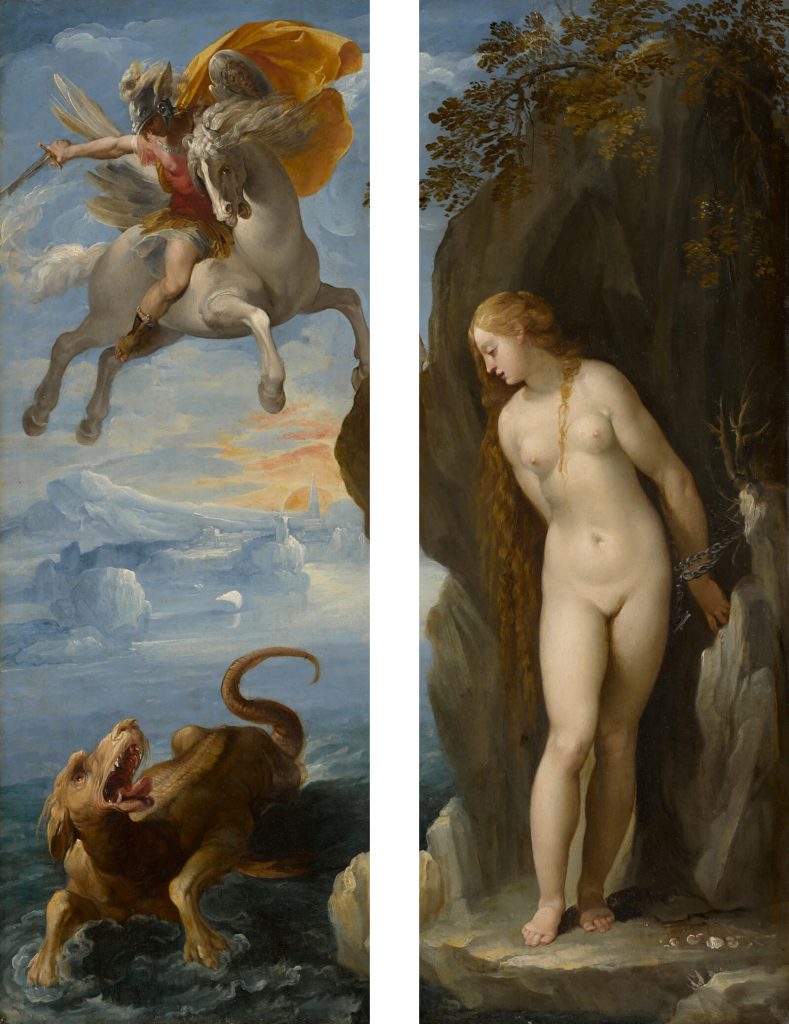
Cavaliere d’Arpino’s Perseus Rescuing Andromeda depicts the demigod Perseus and winged horse Pegasus saving Princess Andromeda from the sea monster Cetus. The painting’s composition is divided vertically in half. Princess Andromeda dominates the right half of the canvas, while Perseus, Pegasus, and Cetus dominate the left half. The two animals and Perseus are all male, while Andromeda is female. A division of the sexes correlates with the division of the action. Andromeda is languid and still, while the male figures are energetic and moving. Separated gender roles are portrayed in this painting. The female protagonist takes a passive role and is being saved, while the male protagonist takes an active role and is the savior.
Princess Andromeda finds herself chained and abandoned to the rocks because of her parents’ recklessness. Her mother, Queen Cassiopeia, boasted that Andromeda was more beautiful than the immortal Nereids, which offended them and Poseidon, god of the sea. Poseidon flooded the kingdom and sent the sea monster Cetus in revenge. Then King Cepheus was informed by an oracle that if he sacrificed his daughter, Princess Andromeda, to the sea monster, Poseidon would be pleased and would withdraw his wrath from the land. Hence, Andromeda is a victim of circumstance and is paying for her mother’s crime of hubris. Her sacrificial suffering is captured in Perseus Rescuing Andromeda.
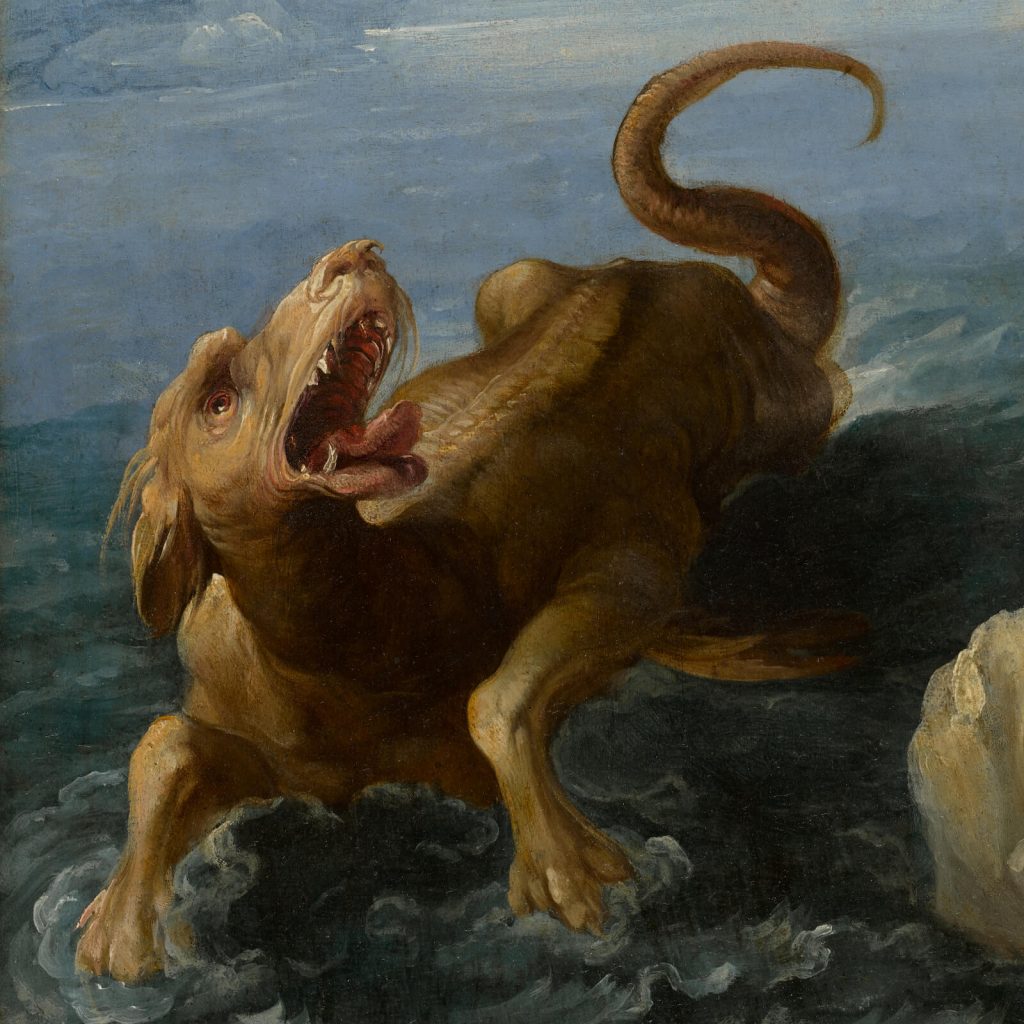
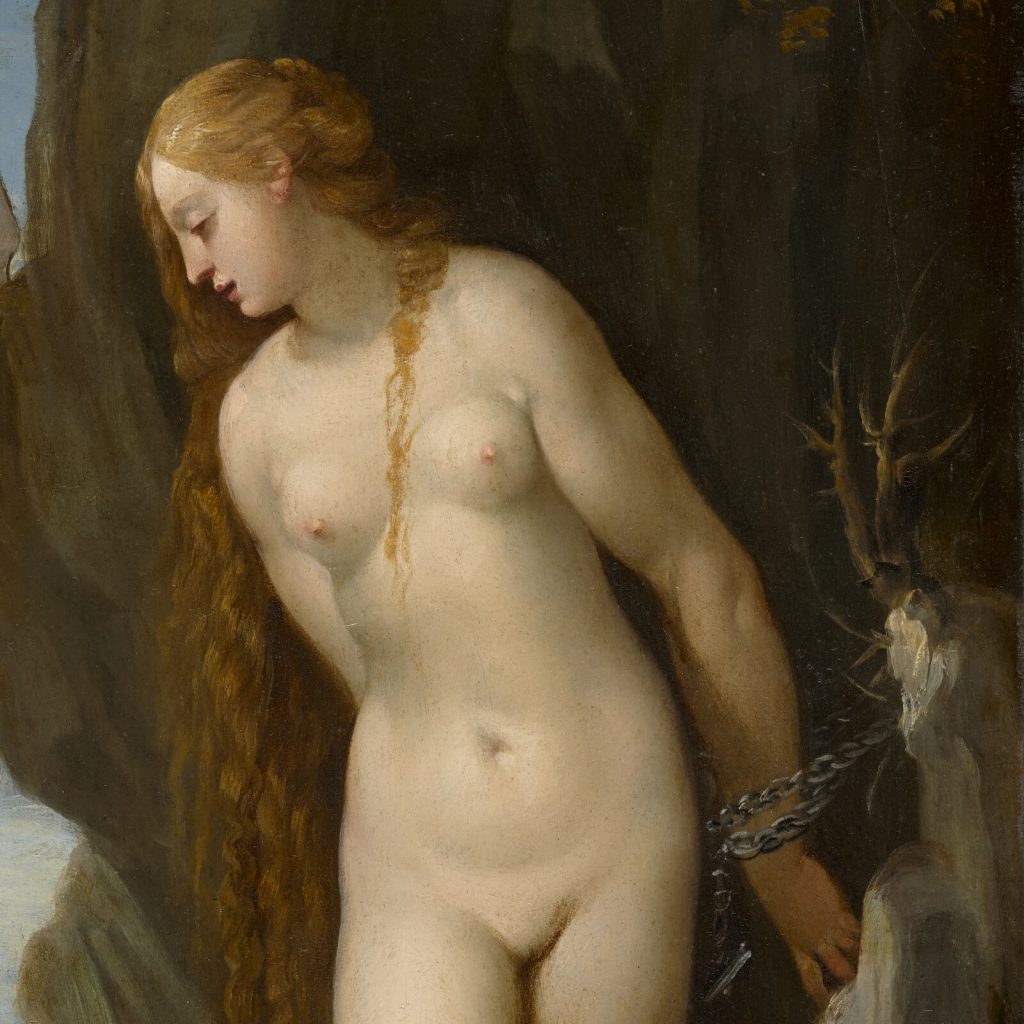
The timeless beauty of Perseus Rescuing Andromeda comes from the controlled use of a muted color scheme enhanced by bold flashes of color. Shades of brown, grey, and white dominate the foreground in the guise of rocks, Andromeda’s complexion, the monster’s skin, and Pegasus’s hide. Then gorgeous shades of blue dominate the sky and sea, with bright yellows found in the cape of Perseus and in the setting sun. The colors harmonize and create patterns of balance and contrast. The subtle shading on Andromeda’s thighs and stomach is exquisite, while the harsh shadows on the monster’s body are vivid and striking. More recognition should be given to Cavaliere d’Arpino’s Perseus Rescuing Andromeda. It has an understated charm equal to more famous paintings without the due credit.
Editors of Encyclopaedia Britannica. “Andromeda.” Greek Mythology. Encyclopædia Britannica, Inc., April 29, 2009.
Editors of Encyclopaedia Britannica. “Perseus.” Greek Mythology. Encyclopædia Britannica, Inc., August 28, 2019.
Wolfgang Jung. “Architecture and City in Italy from the Early Baroque to the Early Neo-Classical Period.” In Baroque: Architecture, Sculpture & Painting, edited by Rolf Toman, 12–76. Potsdam, Germany: h.f.ullmann, 2010.
“Perseus Rescuing Andromeda.” Museum Collections. Clark Art Institute. Accessed October 11, 2020.
DailyArt Magazine needs your support. Every contribution, however big or small, is very valuable for our future. Thanks to it, we will be able to sustain and grow the Magazine. Thank you for your help!

James W. Singer is an art historian and fine art photographer. He earned a Bachelor of Arts in Art History from the University of Florida. He later moved to Paris, France. He currently writes “Masterpiece” articles for DailyArt Magazine.
Judith and Holofernes is a Caravaggio masterpiece that captures Biblical murder and drama. Rarely has death been captured so intensely and violently...
James W Singer 13 September 2026
Explore an astonishing 1915 nude self portrait by American modernist painter Florine Stettheimer.
Candy Bedworth 21 September 2026
Winslow Homer (1836–1910) was one of the leading American Realist painters. His painting The Veteran in a New Field is a masterpiece of late...
James W Singer 30 August 2026
At first glance, A Goldsmith in His Shop (1449) appears to depict an ordinary visit to a jeweller. Yet Petrus Christus transformed an ordinary...
Shivani Gupta 23 August 2026