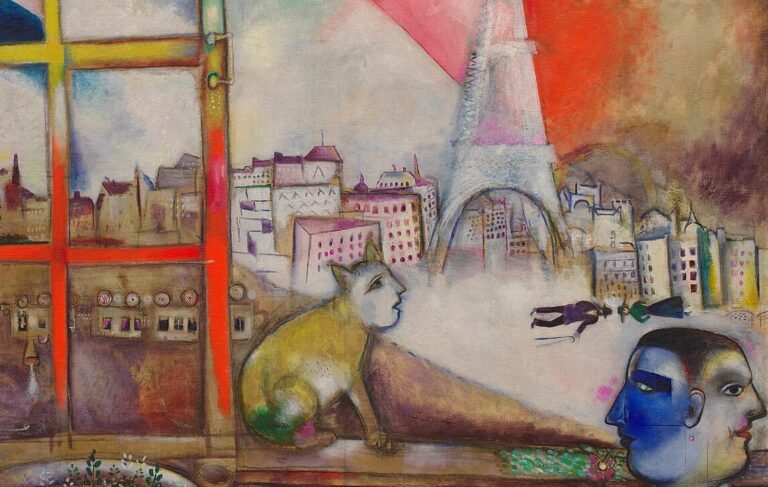
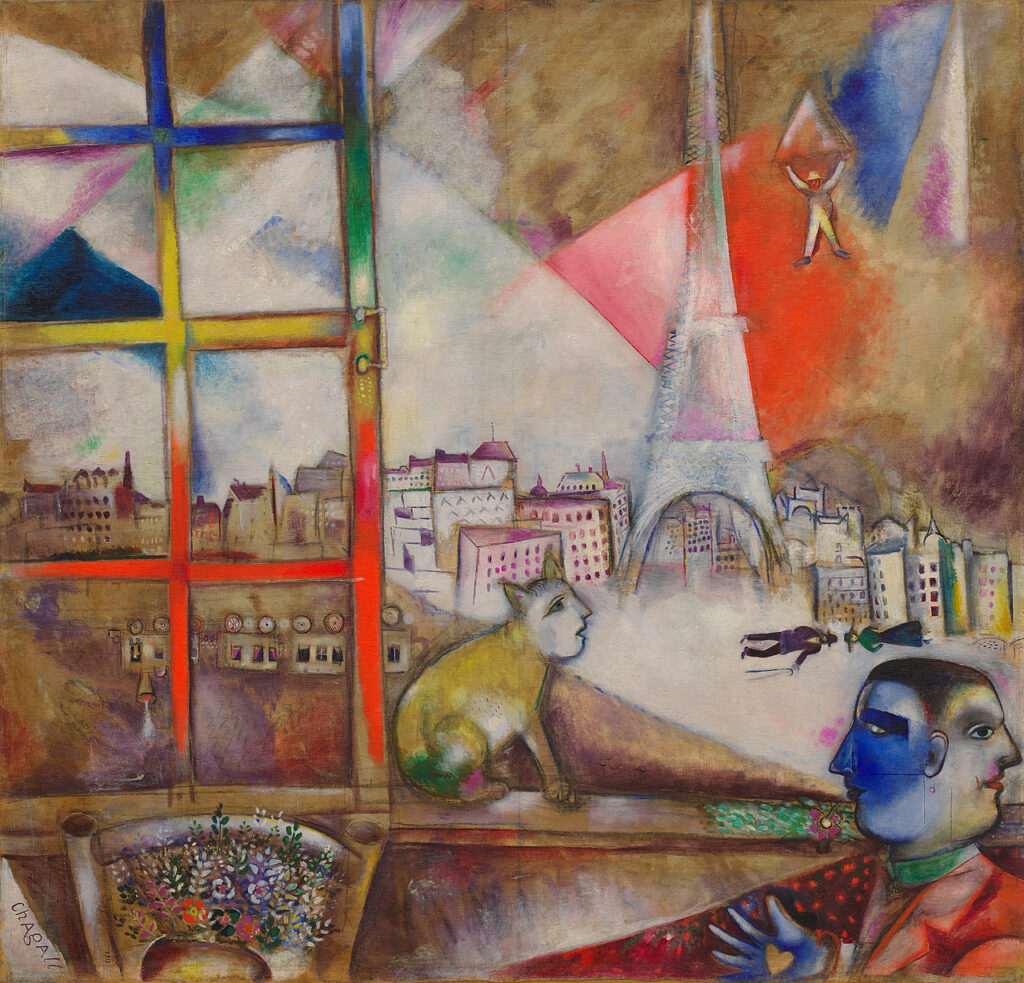
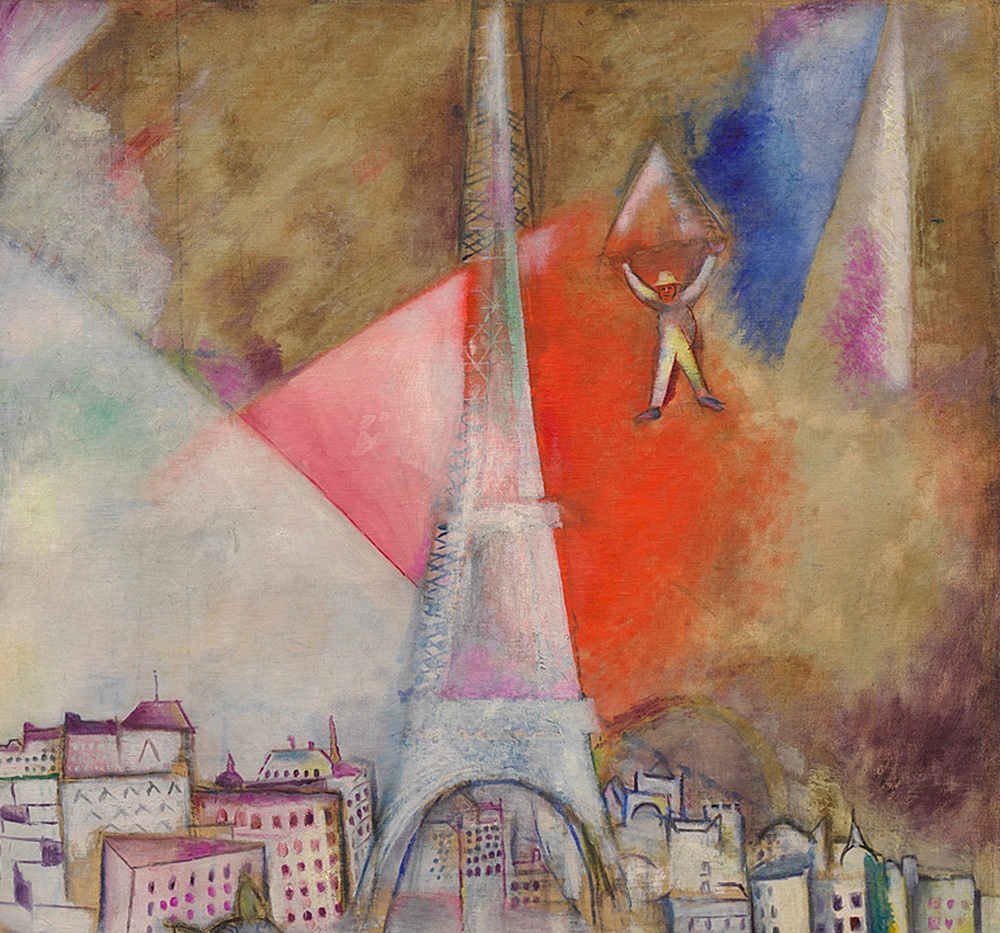
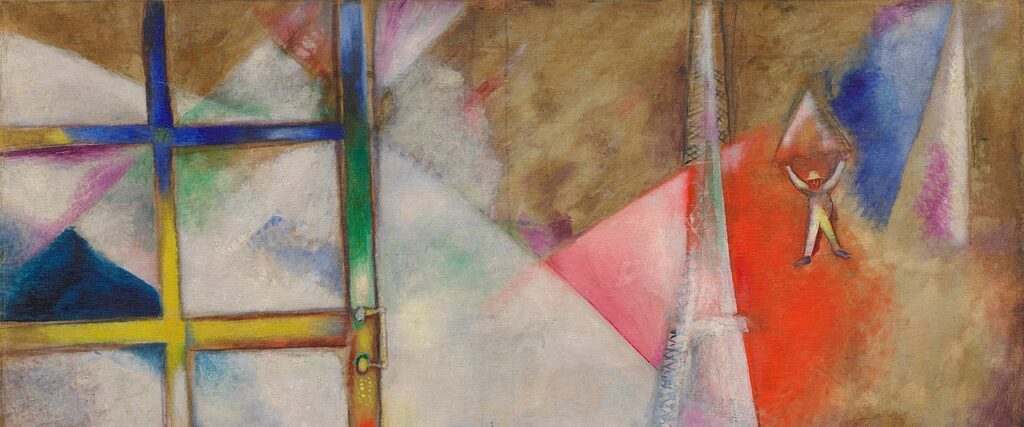
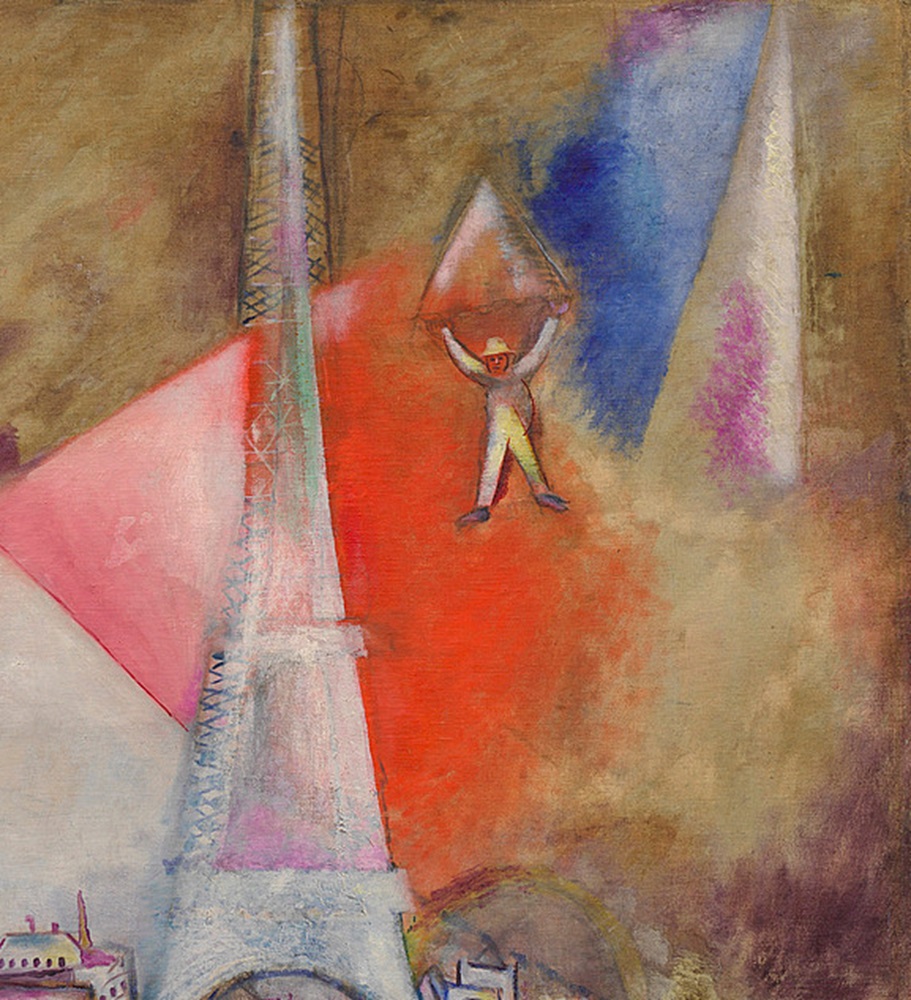
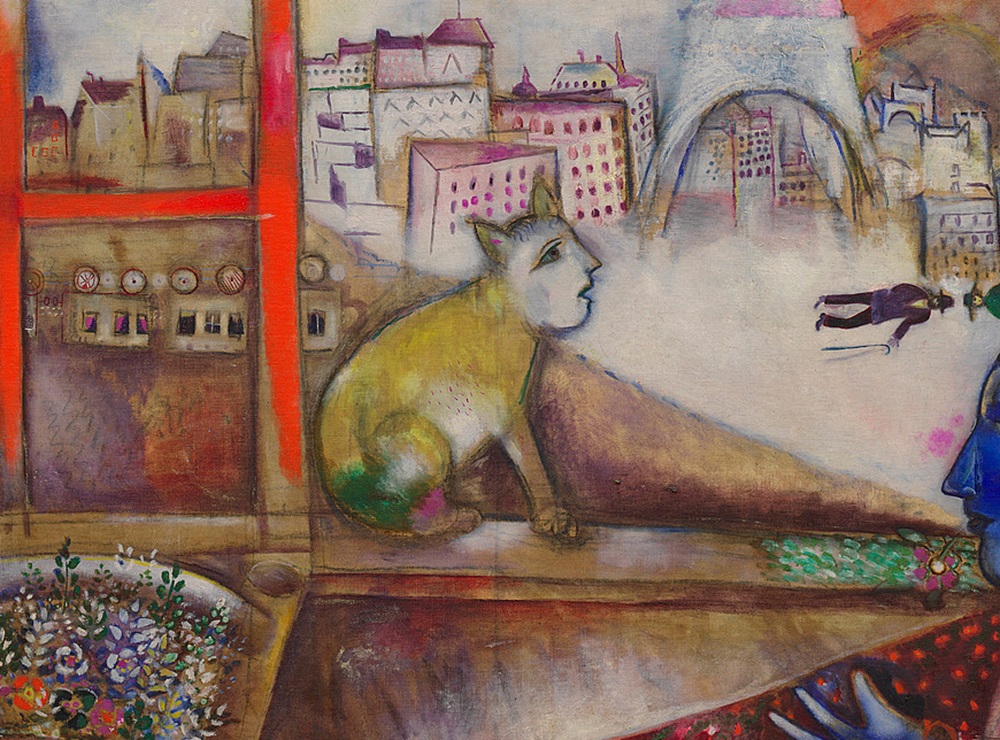
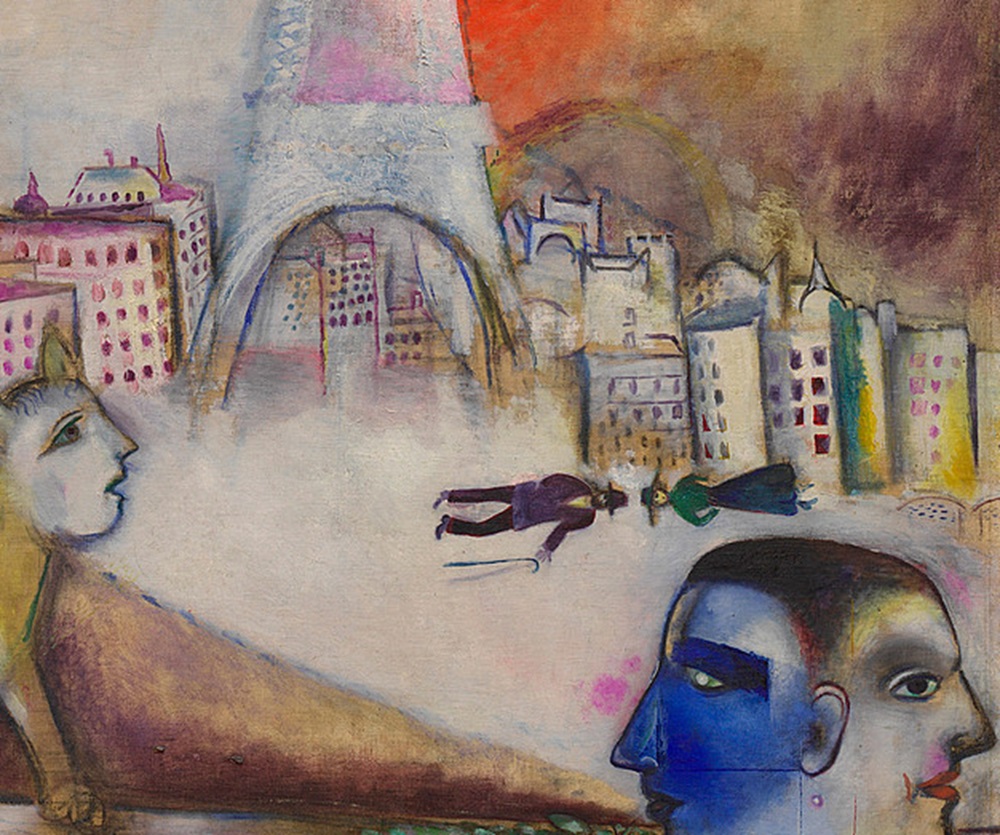
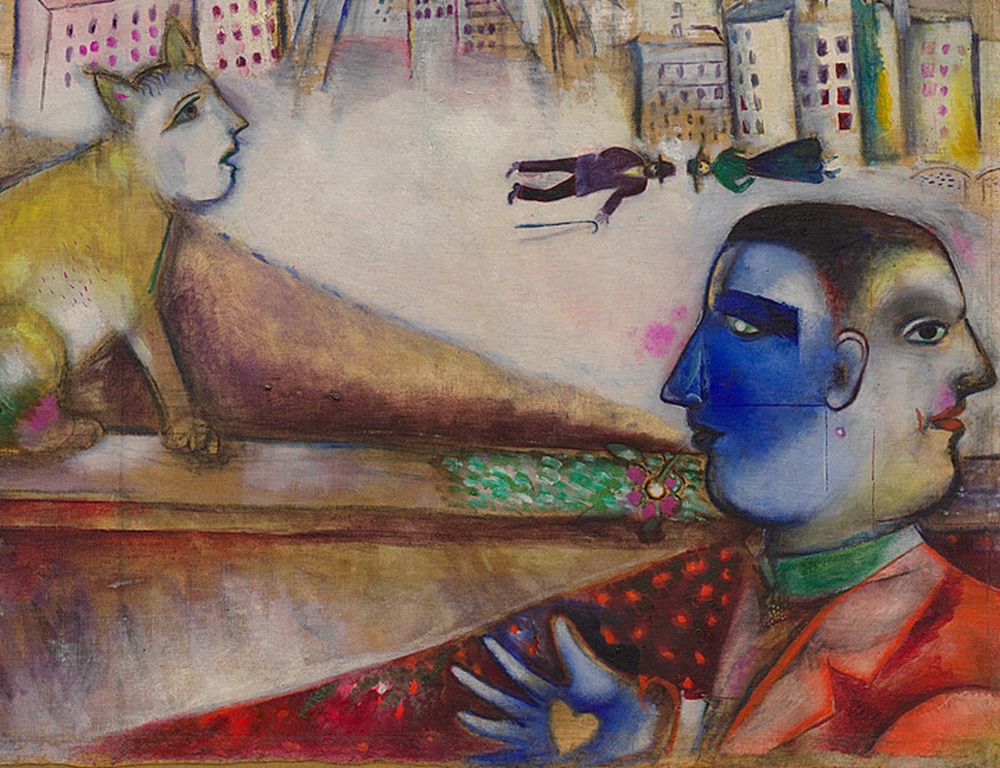
A two-headed figure, a Janus, appears in the bottom right corner, wearing a red suit with a green collar. The yellow head looks out of the canvas, while the blue one shows an ochre heart in the palm of his hand. In front of this figure, flowers rise from a bowl in front of a chair. Behind it, a colorful window and a cat with a humanoid face stand on the edge. Outside, the Eiffel Tower dwarfs the buildings nearby, being more than four times their height. But this is not the strangest part of the view. A man floats near the tower as if he were descending on a triangular parachute. Meanwhile, a couple floats below the tower, at the same level as the upside-down miniature train behind the window. Patches of blue, white, and red cover the ochre sky, with some purple touches around.
The unnatural colors and sizes, the floating figures, and the overlapping planes give the composition a dream-like atmosphere.
The Artist
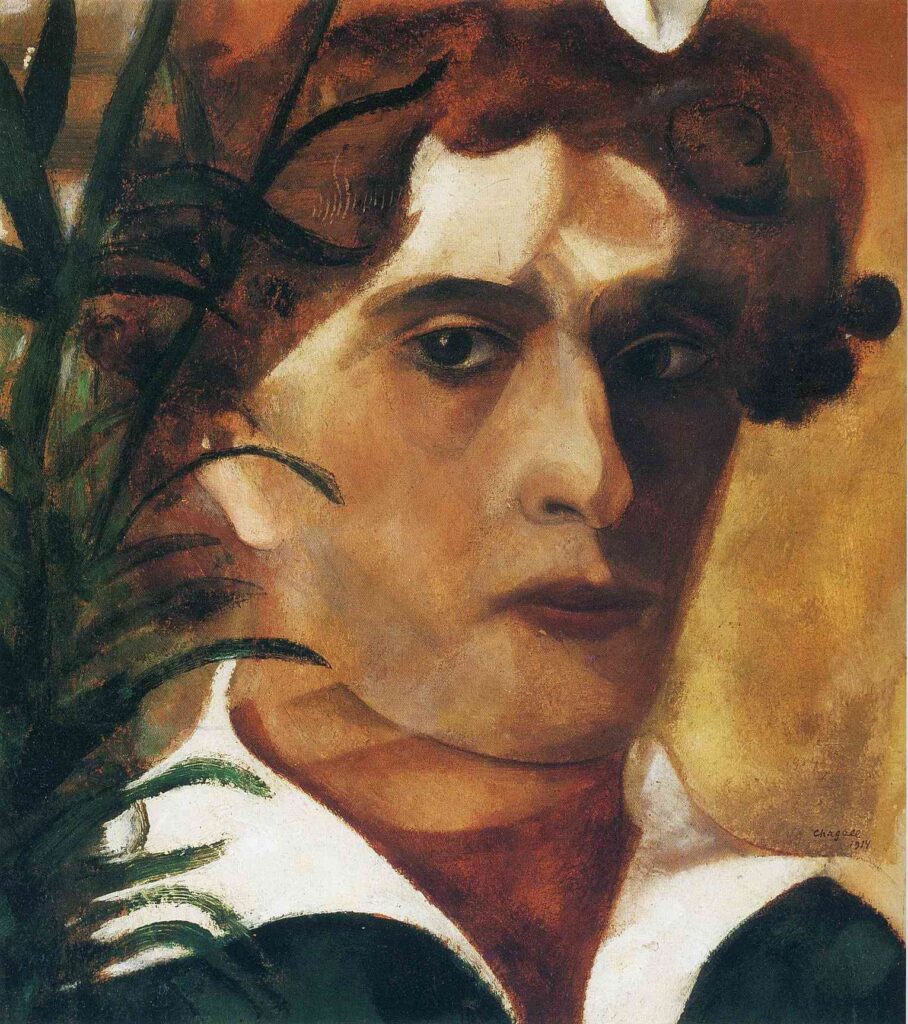
Marc Chagall (1887–1985) was a Jewish artist from the region of Vitebsk, then part of the Russian Empire (today Belarus). His artistic training and his faith led him through Europe and beyond. Along the way, he adopted various styles and ideas for his art, resulting in an eclectic body of work that spanned a range of media, including paintings, glasswork, scenography, textile art, and ceramics.
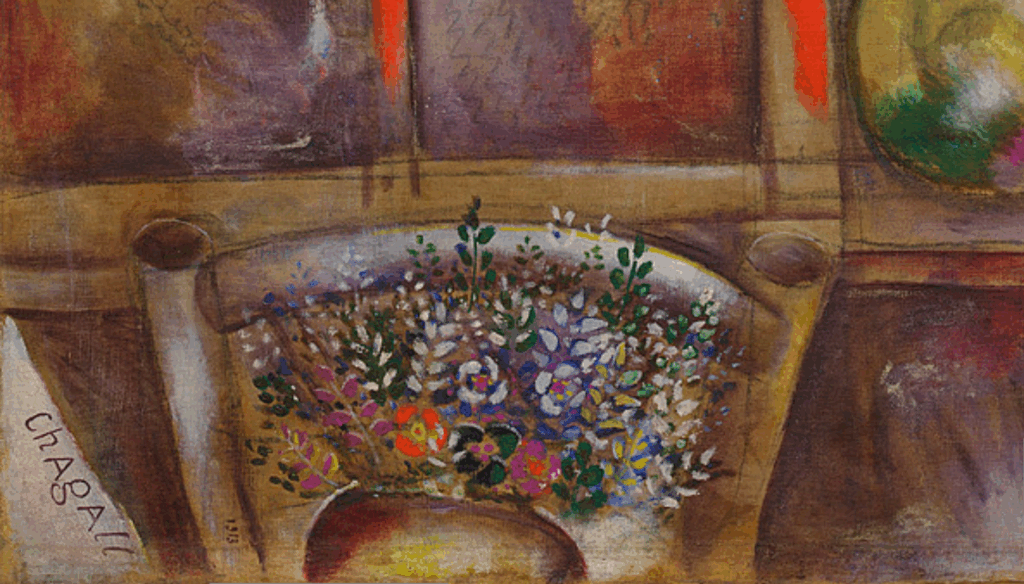
In 1910, Chagall traveled to Paris for the first time and quickly became acquainted with the modern innovations of artists such as Robert Delaunay (1885–1941), the Cubists, and the Fauvists. Three years later, he created Paris Through the Window, where he showcased his colorful and fantastical style. His signature appears in the bottom left corner of the painting alongside a tiny “1913” in the stile of the chair.
Paris
Chagall’s first trip to Paris lasted from 1910 to 1914, exciting years for the City of Light and for the artist himself. Like in many Hollywood movies, Chagall’s window looks straight at the Eiffel Tower (1889). Though criticized by some, its innovative design and engineering work transformed it into a symbol of modernity. The tower represented change and progress after the Industrial Revolution, values that Modernist artists highly appraised and reproduced in their works of art.
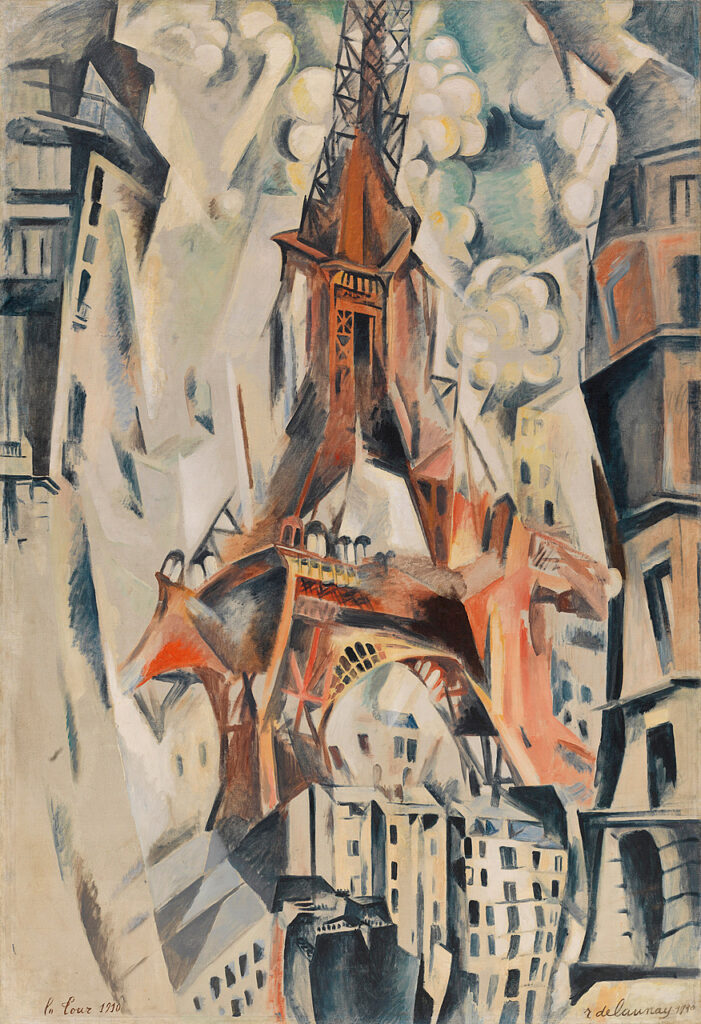
In particular, Chagall’s greatest influence was Robert Delaunay’s series of paintings of the tower. Chagall increased the tower’s size so that it appeared grander and more imposing in contrast to the rest of the cityscape. Additionally, the train could also serve as a reference to modernity. Why it is upside-down is a question with no definitive answer.
An Orphist Sky
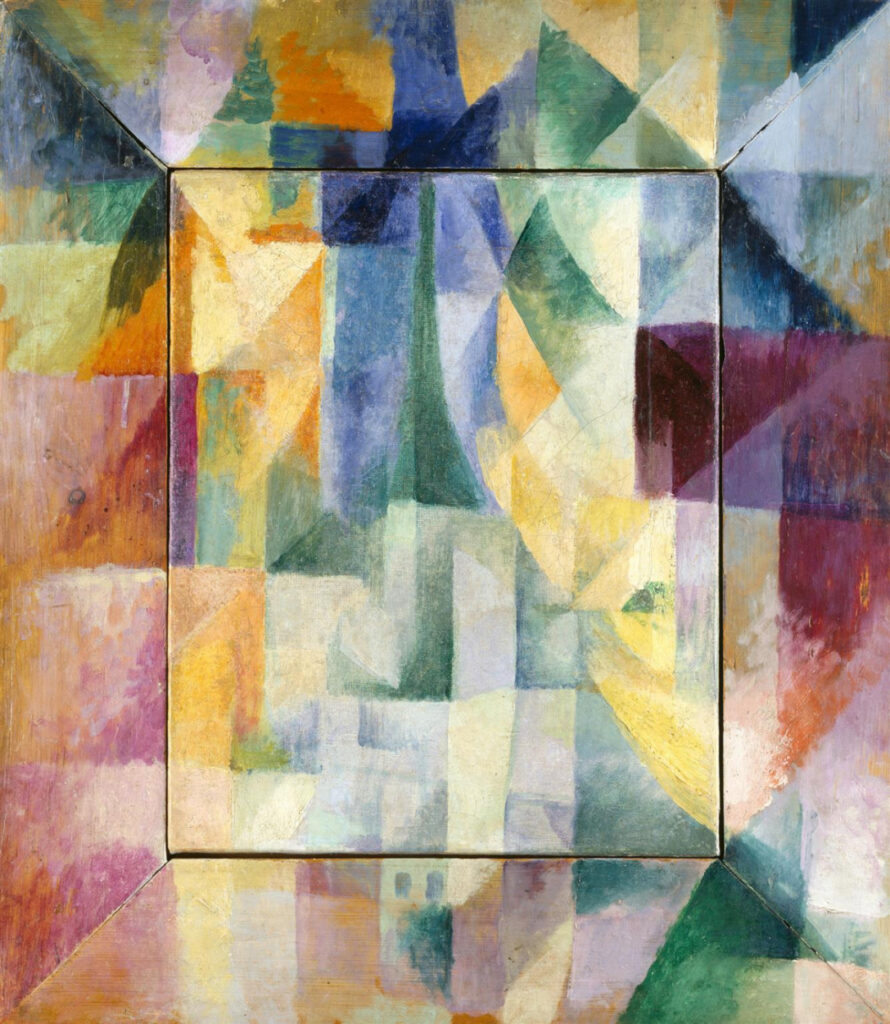
Chagall borrowed more elements from his colleague than his depictions of the Eiffel Tower. The overlapping panels of blue, white, and red—another reference to France—evidence the influence of Delaunay’s Orphism. This artistic movement combined aspects from several avant-garde styles, such as the simultaneity of Cubism, and the color of Fauvism and Neo-Impressionism.
Orphism pretended to reach abstraction through the harmony of colors. In comparison to Delaunay’s Simultaneous Windows on the City (1912), Chagall did not seek full abstraction in his painting. However, he did adopt the resource of a window for his own painting.
A Parachute Jump
The man descending with a parachute could reference historic events. On February 4th, 1912, Franz Reichelt jumped with a parachute from the Eiffel Tower. The Parisian landmark provided a higher launching point than those of his previous attempts. Inexplicably, Reichelt discarded the use of a dummy and jumped. Unfortunately, the parachute never opened fully, and he fell to his death. Not a month later, on March 1st, 1912, in St. Louis, Missouri, Captain Albert Berry achieved the first successful parachute jump from an airplane.
It is hard to say which, if any, man Chagall referenced in his painting. The closeness to the Eiffel Tower may lean towards Reichelt despite his tragic ending; however, Berry’s success seems a more laudable moment to celebrate in one’s painting. Perhaps Chagall’s intention focused not on a specific person but on humanity’s ambition to fly, a theme related to modernity, technology, and progress.
A Cat Lover
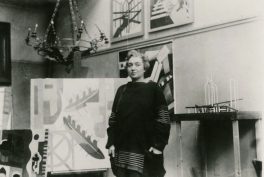
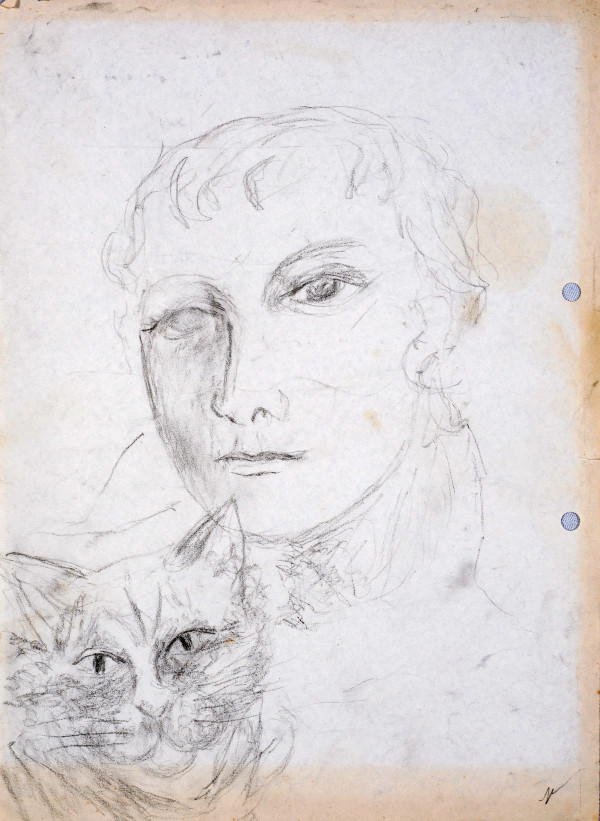
Animals feature heavily in Chagall’s works. Roosters, cows, bulls, horses, and other farm animals recalled his rural origins. Like many artists, Chagall was particularly fond of cats, as evidenced by the portrait below by his friend and fellow artist Marie Vorobieff-Stebelska (1892–1984). The cat in Paris Through the Window has a human face, and its fur is colored yellow and green, blending into the fantastical composition.
The Lovers
Marc Chagall and Bella Rosenfeld experienced love at first sight in 1909 when they met in Saint Petersburg. She stayed behind in their town in Vitebsk, while he went to Paris, but the separation was not easy. He thought of her constantly, which might explain the inclusion of the pair floating horizontally near the Eiffel Tower.
The woman wears a hat, a deep green shirt, and a blue skirt, while the bearded man in a purple suit carries a cane. Their heads encounter, as if coming from opposite directions, she from the east, he from the west. Could this be Chagall and Bella coming together? Is he speaking about the distance between them?
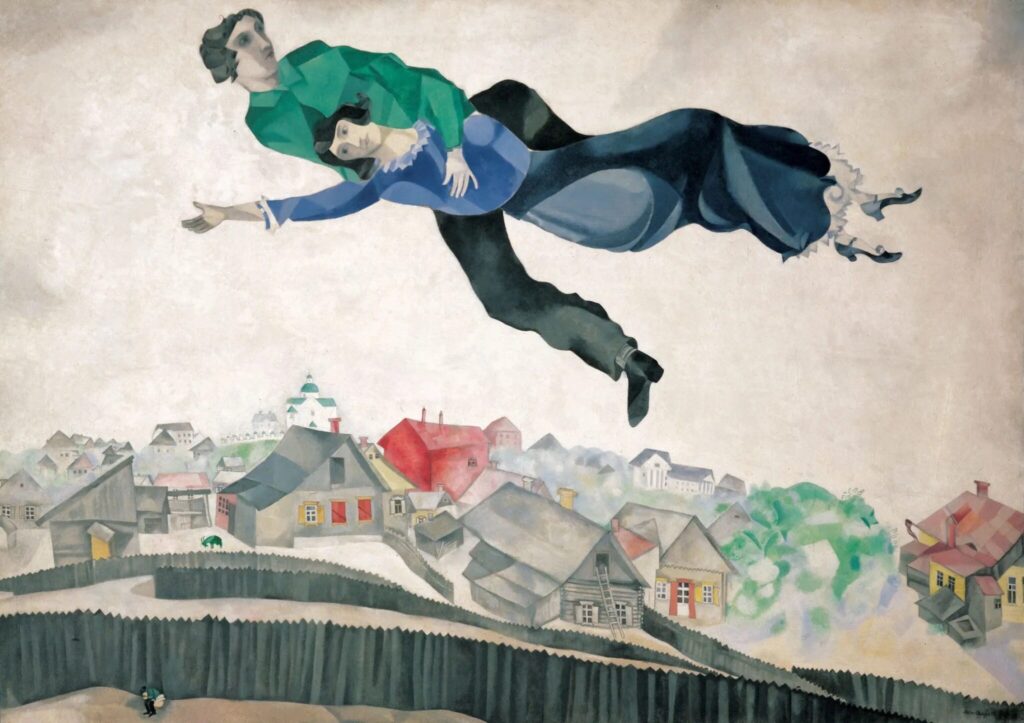
The image of lovers floating around, often a reference to his love story, has captivated viewers for decades.
Janus
Janus was a Roman god associated with archways and doors that symbolized transitions. His two heads allowed him to look to the past and the future, but they can mean other dualities, too. In the case of Chagall’s painting, interpretations suggest that he included this image as a call back to his past in the Russian Empire and his present and future in Paris.
Throughout his career, Chagall incorporated elements from his Jewish and Eastern European heritage, at the same time that he adopted and adapted the modernist styles from Western Europe. The figure peacefully contemplates the landscape outside the window. He looks at the Eiffel Tower, the man in the parachute, the couple floating, and the train.
Like Janus, Chagall was a man of dualities and transitions. Paris Through the Window gives us insight into his mind, experiences, and feelings.