Becoming an Artist in San Francisco
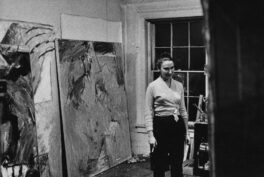
Joan Brown was born in San Francisco in 1938 and grew up in the city’s Marina District, close to the water that would later become such an important part of both her life and her art. She began studying at the California School of Fine Arts (later renamed the San Francisco Art Institute) where she completed both her BFA and MFA degrees. It was here that she met painter Elmer Bischoff, who became an important teacher and mentor.
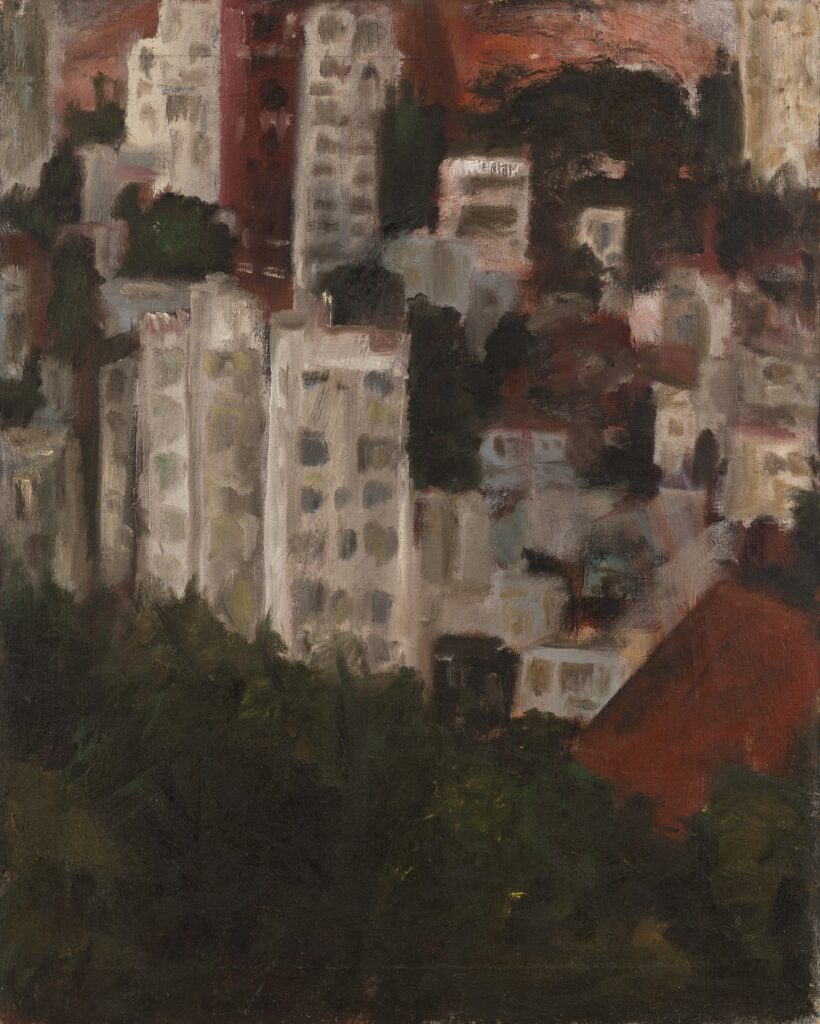
Bischoff was one of the leading figures of the Bay Area Figurative Movement. This group of artists brought the human figure and recognizable subjects back into painting after years dominated by Abstract Expressionism. Brown belonged to the movement’s younger, second generation, and her early work retained much relating to abstraction physically. For her paintings, she applied paint thickly and freely, as seen in Earthquake Weather (1956) for example, with figures and everyday objects emerging from layers of color and thick brushwork.
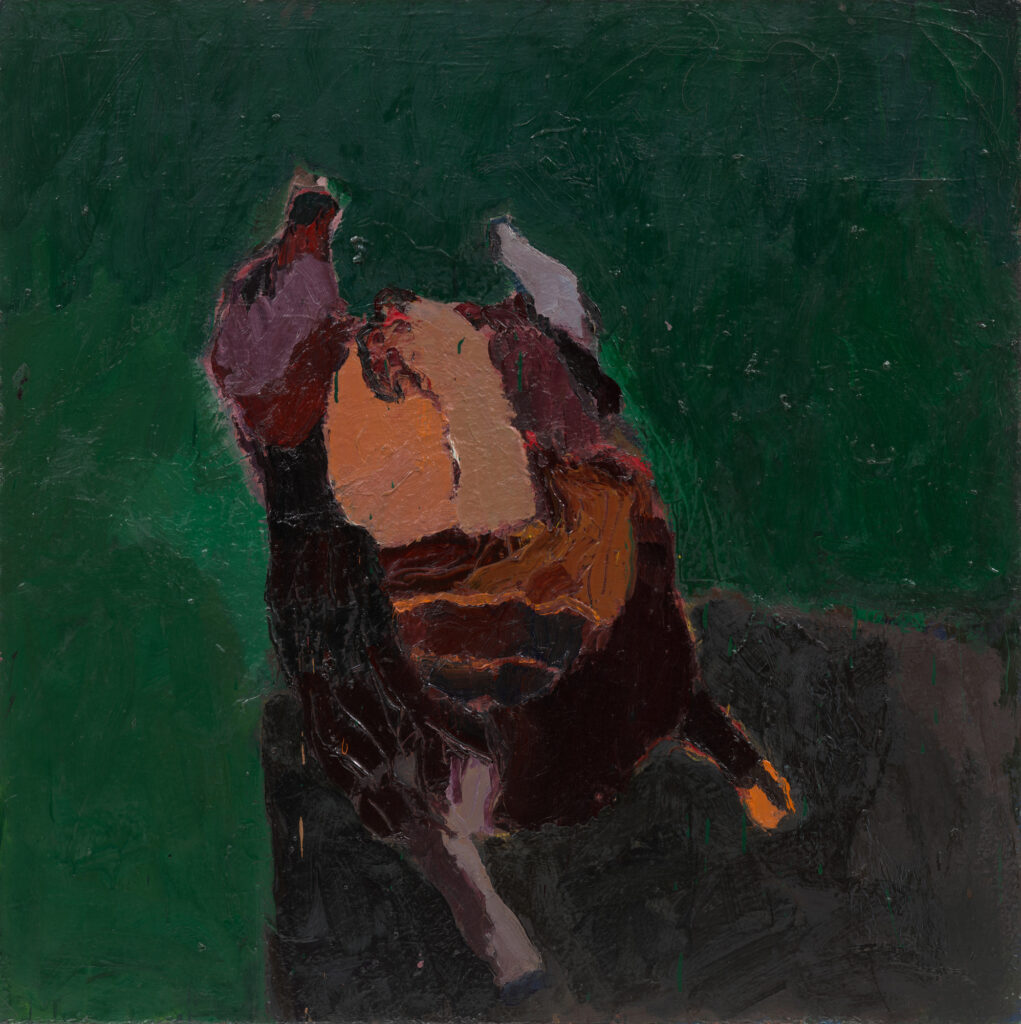
Success came remarkably quickly for Joan Brown. She was included in SFMOMA’s annual exhibitions in 1957 and 1958, and in 1960, aged just 22, she became the youngest artist included in the Whitney Museum’s Young America: Thirty American Painters Under Thirty-Six. That same year, New York’s MoMA acquired her 1959 painting Thanksgiving Turkey. Although she’d barely finished art school, she was already attracting attention far beyond San Francisco.
Painting Everyday Life
Looking through Joan Brown’s paintings, we can quickly begin to see the same cast of characters. There is Brown herself, alongside her son, husbands, friends, and an assortment of her favourite animals. There are also scenes of swimming and dancing, glimpses into her domestic life, and the landscape of her beloved San Francisco and its Bay.
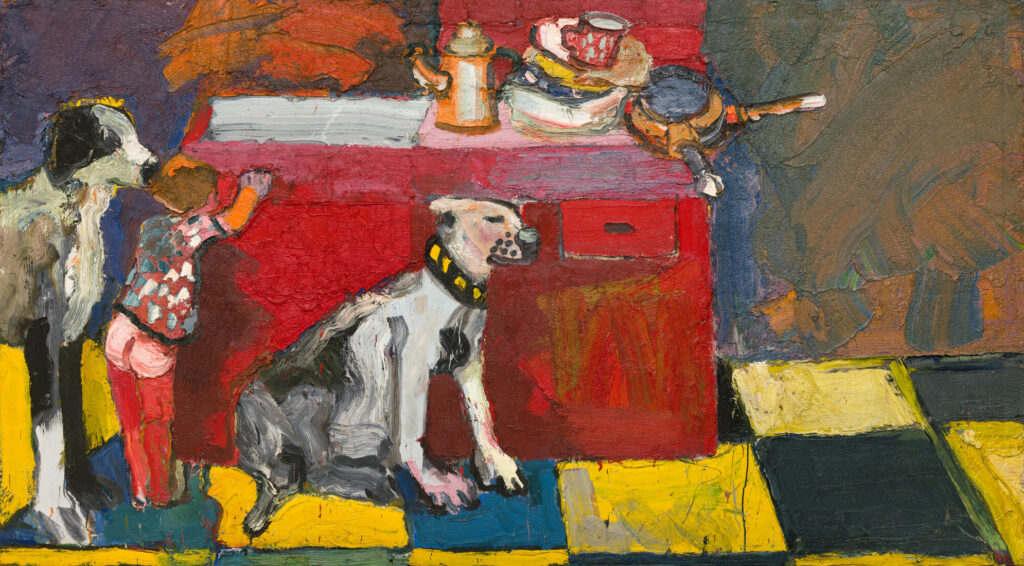
Her interest in painting the world she knew was already visible in Noel in the Kitchen (ca. 1964), which shows her young son standing between two dogs in a chaotic kitchen. Pots and dishes crowd the counter, one dog dominates the center of the canvas, and two-year-old Noel reaches upwards with his trousers slipping down behind him. It is an ordinary family moment that allows the viewer to peak into Brown’s inner world. This work also marked a turning point for the artist: it was among the last in which she used the thicker paint and brushstrokes of her early career.
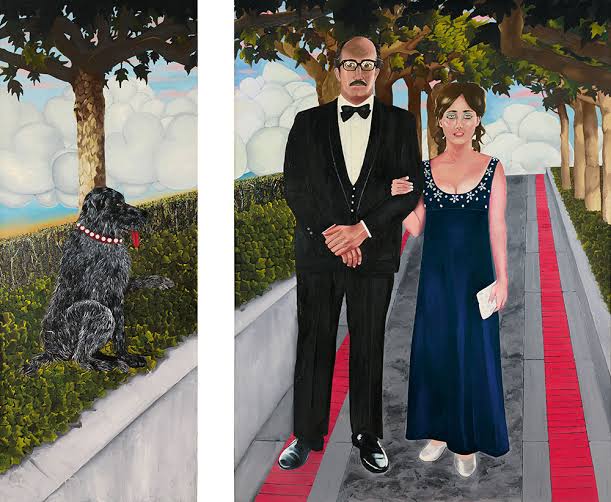
As her style became flatter and more graphic, the people and places around her came increasingly to the fore. In Gordon, Joan + Rufus in Front of S.F. Opera House (1969), she turns herself, her husband Gordon Cook, and their dog Rufus into the protagonists of a San Franciscan scene. In this way, her paintings begin to resemble a visual autobiography. Yet Brown was doing more than simply recording her life. She was consciously mixing her day-to-day reality with humor, exaggeration, and fantasy, turning her experiences into something unmistakably her own.
Joan Brown’s Self-Portraits
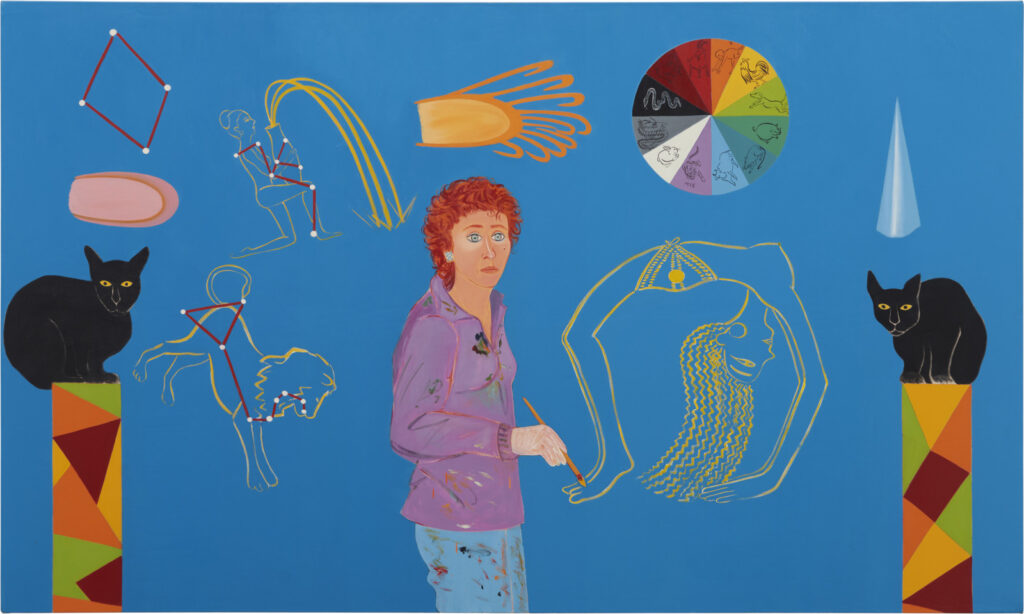
Of all the people who appear in Joan Brown’s paintings, none appears more often than Brown herself. From the late 1960s onwards, self-portraiture became an important part of her work, but rather than feeling like attempts to record her appearance, they seem to be continually trying to express different versions of herself.
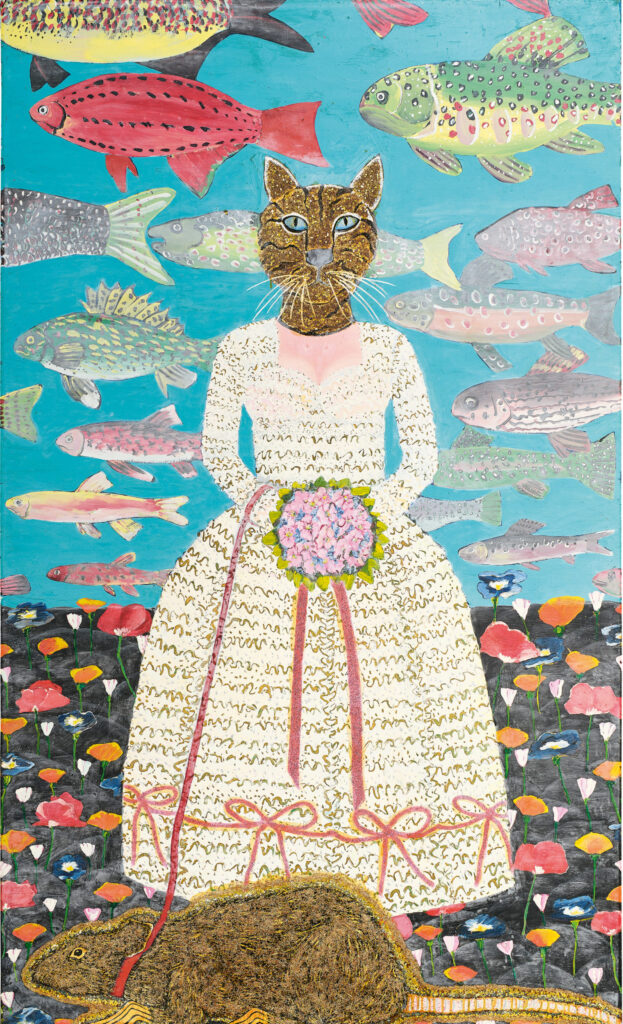
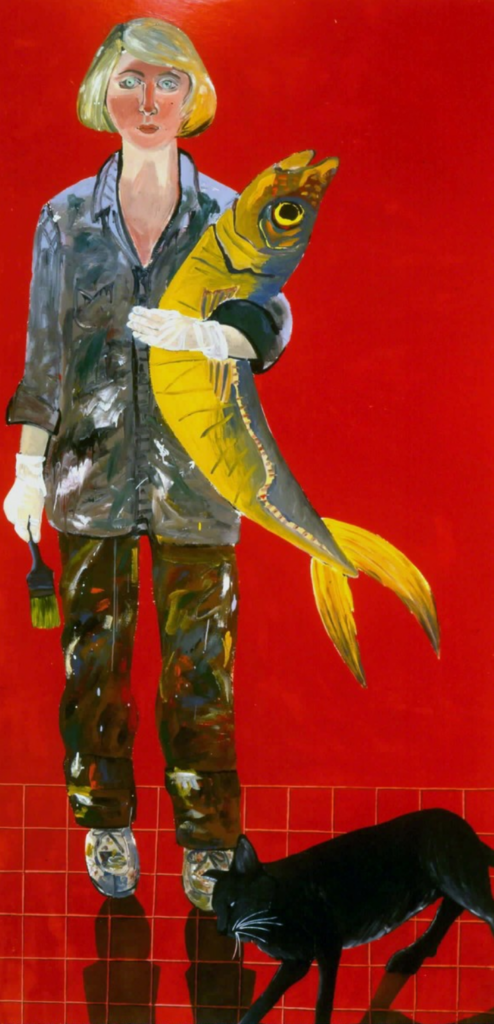
In The Bride (1970), painted shortly after her marriage to the artist Gordon Cook, Brown transforms herself into a strange cat-woman hybrid, surrounded by fish, flowers, and symbols connected to marriage and her past. In Self-Portrait with Fish and Cat (1970), on the other hand, she presents herself quite differently. Here she is dressed in her working clothes and gloves; she is first and foremost an artist in her studio.
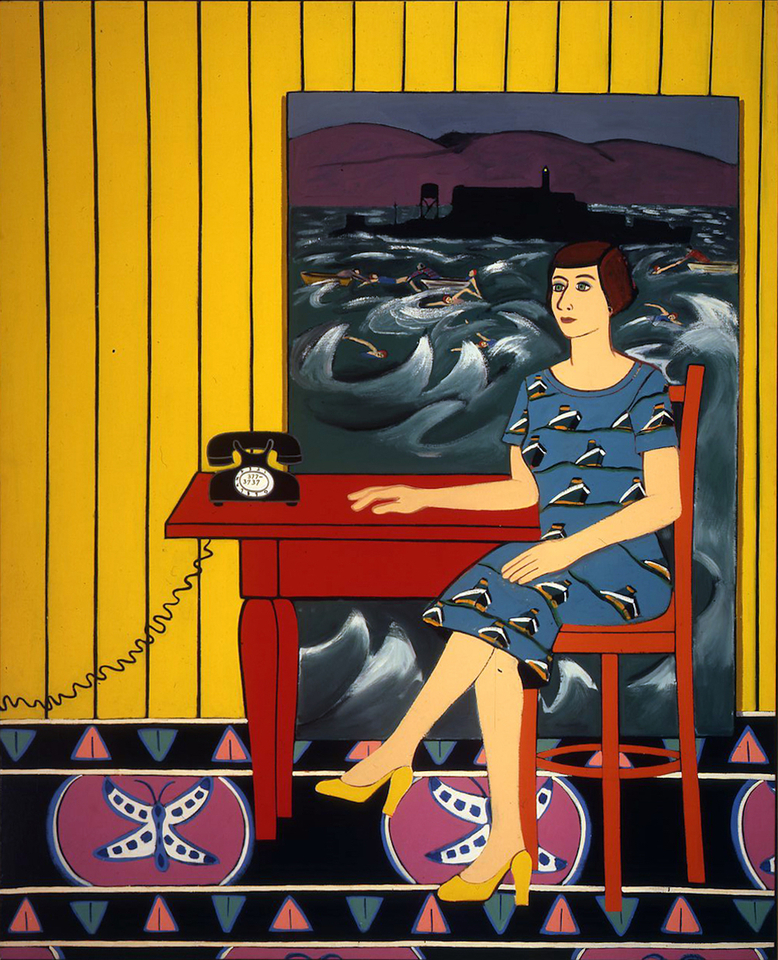
These shifting identities became part of her visual language. She could be glamorous in one painting and practical in another, a wife, an artist, or an athlete. After nearly drowning during an Alcatraz 1.5-mile swim in 1975, she even used a series of self-portraits to work through the experience, placing images of the Bay and struggling swimmers within the paintings.
The painting, After the Alcatraz Swim #3 (1976), shows her appearing calm and composed in the foreground, while tiny figures struggle in the choppy Bay behind. For Brown, the self-portrait was not simply about showing what she looked like. It offered a way of exploring the many different parts of herself and her experience.
Joan Brown’s Paintings of Swimming, Animals, and the Bay
Among the most important topics to appear in Joan Brown’s paintings were swimming, San Francisco Bay, and animals—all of which were closely connected to her life outside the studio. Brown was a committed swimmer, and in the 1970s she began training with the Dolphin Swimming and Boating Foundation at San Francisco’s Aquatic Park. The Bay soon became a recurring presence in her works.
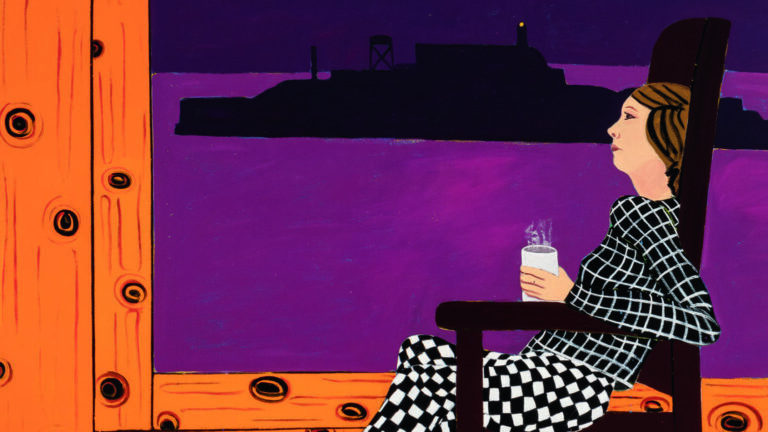
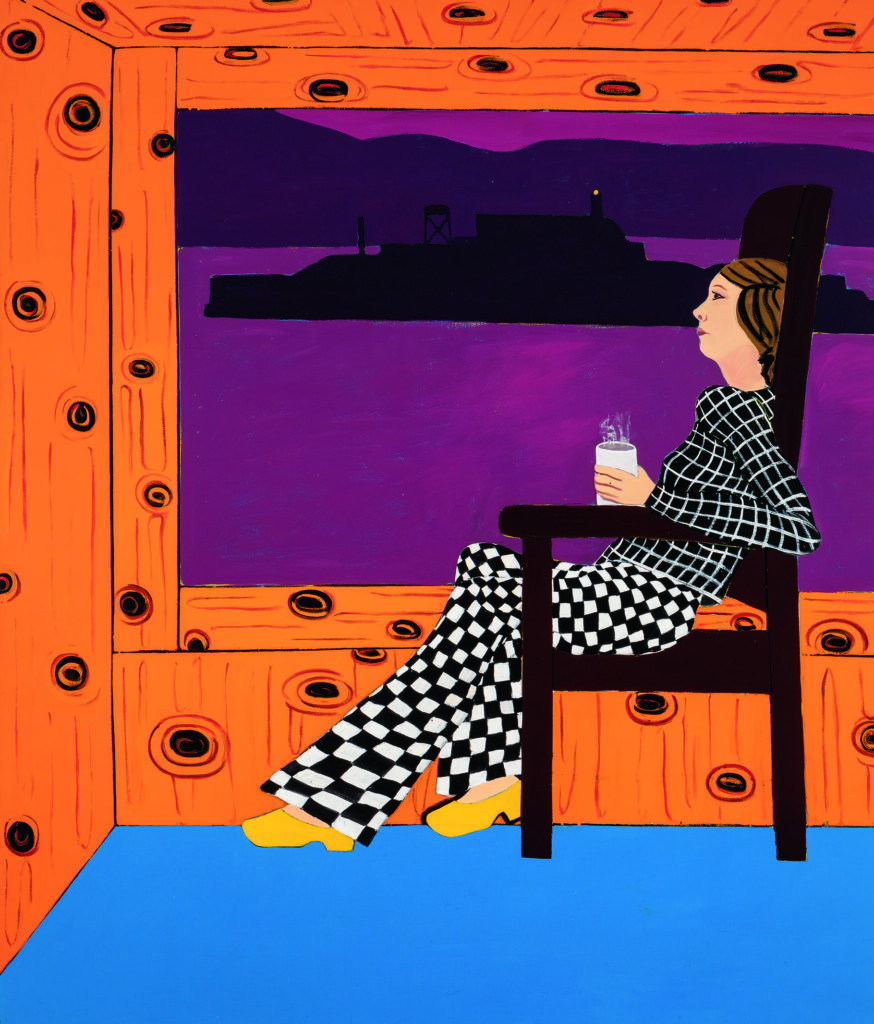
In The Night Before the Alcatraz Swim (1975), the artist depicts herself sitting with a hot drink, taking a quiet moment to herself before her challenging swim across San Francisco Bay. It turns an everyday scene into a personal record of anticipation of what is to come. Swimming could also represent freedom and pleasure. In The Bicentennial Champion (1976), she presents herself triumphantly after winning an amateur swimming event. Her paintings turn an activity she loved into part of the story she told about herself.
Animals occupied a similarly important place in Brown’s world. Cats and dogs appear throughout her work, sometimes alongside members of her family and sometimes taking center stage themselves. She had a particularly strong identification with cats, occasionally even combining human and feline characteristics in her paintings. Shown above in The Bride, for example, she gives her own face distinctly feline features, while the cat beside her appears almost like a companion or alter ego. Elsewhere, animals simply become part of the family. In works such as Noel and Bob (1964), she paints the relationships between her son and the animals around him.
These recurring subjects make Brown’s work feel intensely personal. The Bay, swimmers, and animals are not simply motifs chosen for their visual appeal, but pieces of her everyday world, returned to so often that they gradually become symbols of Brown herself.
Exploring Spirituality through Painting
By the late 1970s, the world of Joan Brown’s paintings was beginning to change. The familiar people, animals, and experiences of her everyday life didn’t disappear, but they were increasingly joined by another set of interests. She had become very curious about spirituality, meditation, and different religious traditions. This search for meaning began to find its way onto the canvas.
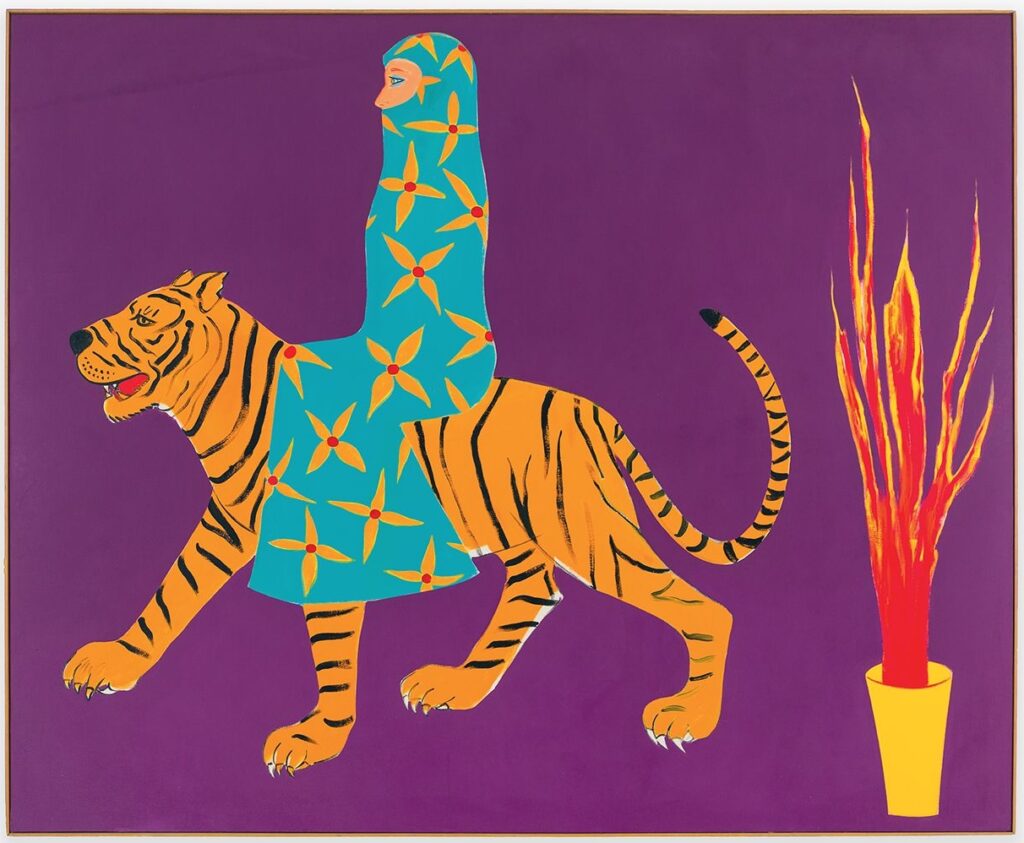
Brown visited India several times and explored Hinduism and the teachings of the spiritual teacher Sathya Sai Baba. She also looked towards ancient Egyptian beliefs and imagery, as well as other spiritual and philosophical traditions. Her paintings became more symbolic, featuring animals, gods, temples, and mysterious figures, which were often arranged in dreamlike scenes.
Yet, like her early work, she still placed herself at the center of many of these paintings. In The Long Journey (1981), Brown depicts a female figure travelling across a body of water towards a distant pyramid, accompanied by an animal. The journey feels both physical and spiritual, turning the kind of personal narrative Brown had painted for years into something more symbolic. In Year of the Tiger (1983), she again draws on animals and symbolic imagery, this time looking to the Chinese zodiac. The tiger becomes more than simply an animal in the scene. Rather, it forms part of a mixture of different beliefs, symbols, and traditions through which Brown was exploring ideas of identity and spiritual transformation.
Her later work increasingly explored ideas of mortality and what might exist beyond the material world. Her earlier paintings had recorded the people, places, and experiences that made up her life. Now, she was using painting to ask what that life might mean and where it might ultimately lead.
Joan Brown’s Life in Paint
Joan Brown’s style changed vastly over the course of her career, from the thick and expressive surfaces of her early paintings to the flatter figures and bold patterns of her later work. She swapped out scenes of domestic life for increasingly spiritual and symbolic imagery. Yet throughout these changes, one thing remained consistent, and that is that she painted the world as she experienced it.