
Discovering the Netherlands with James McNeill Whistler
American artist James Abbott McNeill Whistler trained in Paris, lived in London, and fled to Venice after his infamous libel trial. He is much less...
Catriona Miller 16 October 2026
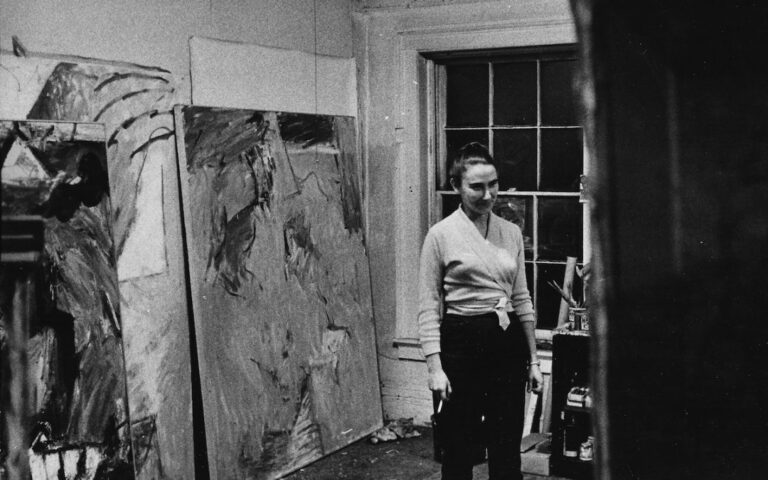
Pat Passlof (1928–2011) occupies a distinctive place in the history of postwar American painting. A member of the downtown New York art world that coalesced around Abstract Expressionism, she studied with Willem de Kooning at Black Mountain College and later privately in New York while developing a painting practice that remained markedly her own.
Passlof’s importance lies not only in her paintings; she was an organizer, teacher, writer, editor, and advocate for other artists. She repeatedly created situations in which artists could meet, argue, exhibit, and be heard. Her career offers another way of understanding the postwar New York art world—not simply as a succession of celebrated painters and movements, but as a network sustained by conversation, cooperation, and spaces for artists who were not always at its center.
Born in Brunswick, Georgia, in 1928 and raised in New York, Passlof began her artistic education in the late 1940s. In the summer of 1948, she went to Black Mountain College in North Carolina, where she studied with Willem de Kooning. The experience was transformative. After returning to New York, she continued to study with de Kooning privately and became immersed in the community of artists surrounding him.
Black Mountain exposed Passlof to an environment that was at once intellectual and artistic, while New York introduced her to the intense debates surrounding the emerging language of Abstract Expressionism. Her early paintings absorbed aspects of the period’s biomorphic and gestural abstraction, but Passlof resisted settling into a single formula. Across six decades, she continually changed her handling of color, form, scale, and surface. Her independence from any single stylistic identity would become one of the defining characteristics of her career.
…push back the limits – be willing to risk or sacrifice what you have – throw the cards to the winds and see where they come down. Look for new and unexpected combinations.
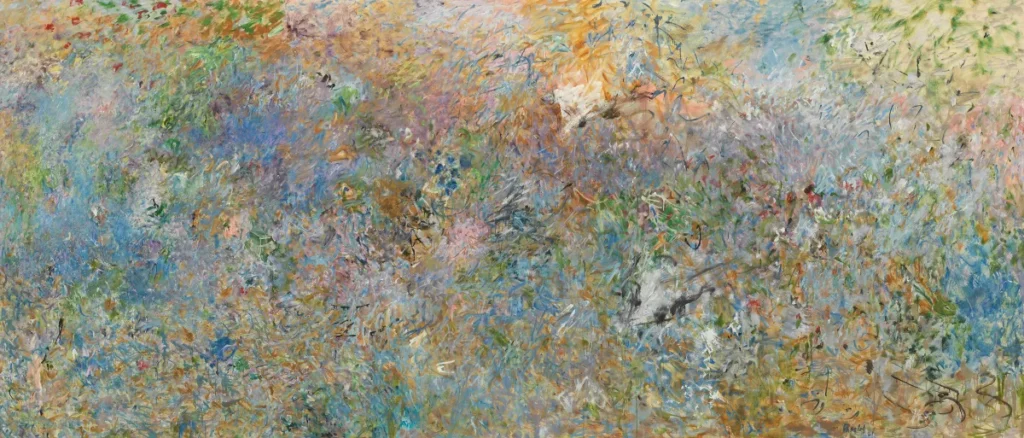
Pat Passlof, Sky Pasture, 1961. Two Coats of Paint.
By the late 1940s, Passlof was living on East 10th Street, in the center of a rapidly developing downtown art community. The neighborhood’s lofts, bars, cooperative galleries, and informal gatherings provided an alternative infrastructure to the established museums and commercial galleries uptown.
In 1949, Passlof helped renovate the Eighth Street loft that became the first location of the Artists’ Club, generally known as “The Club.” She attended its talks and panels, absorbing the debates through which a generation of artists defined—and contested—the meaning of contemporary art.
But Passlof noticed something about The Club that troubled her: many of the younger artists who attended rarely spoke. The problem was not necessarily a lack of ideas. Rather, the structure of the gathering seemed to reproduce a hierarchy in which certain established voices dominated the discussions. Her response was practical: she created another forum.
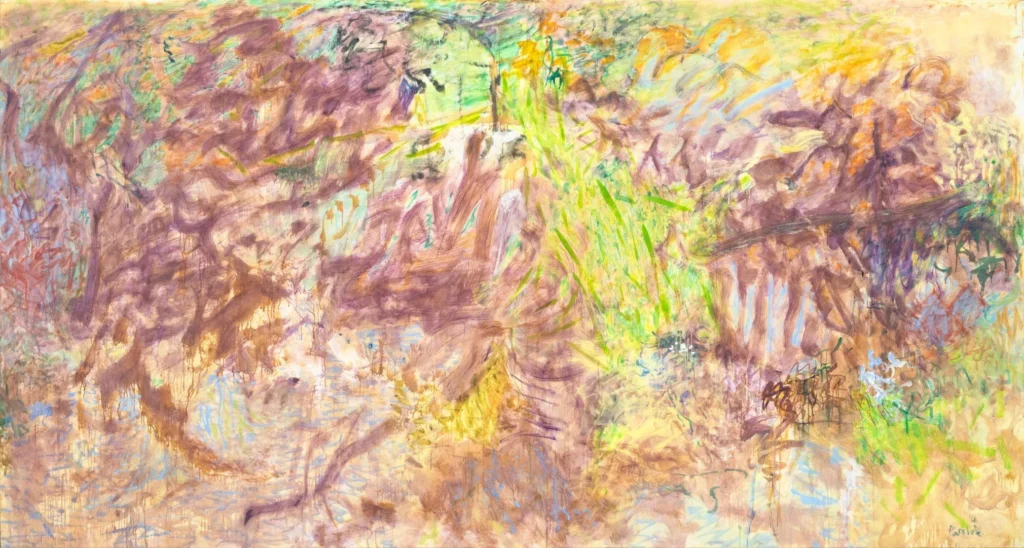
Pat Passlof, Atheneum, 1960–1961. Milton Resnick and Pat Passlof Foundation.
Passlof organized what became known as the Wednesday Night Club, conceived as an alternative to the established Artists’ Club. She described it as a place where artists who had less access to the dominant conversation could participate more fully. Contemporary accounts describe it as particularly open to younger artists and women.
Passlof’s own work makes it difficult to place her neatly inside a single account of Abstract Expressionism. Her early paintings engage with the biomorphic forms and gestural vocabulary associated with the New York School, yet her work developed in numerous directions over subsequent decades. She exhibited at galleries including the Green Gallery, Globe Gallery, Feiner Gallery, and Landmark Gallery, while maintaining a long-term commitment to experimentation. Her paintings could become increasingly atmospheric, luminous, rhythmic, and spatial, without abandoning the physicality of paint.
Painting is inconvenient. It is slow and may require a whole life.
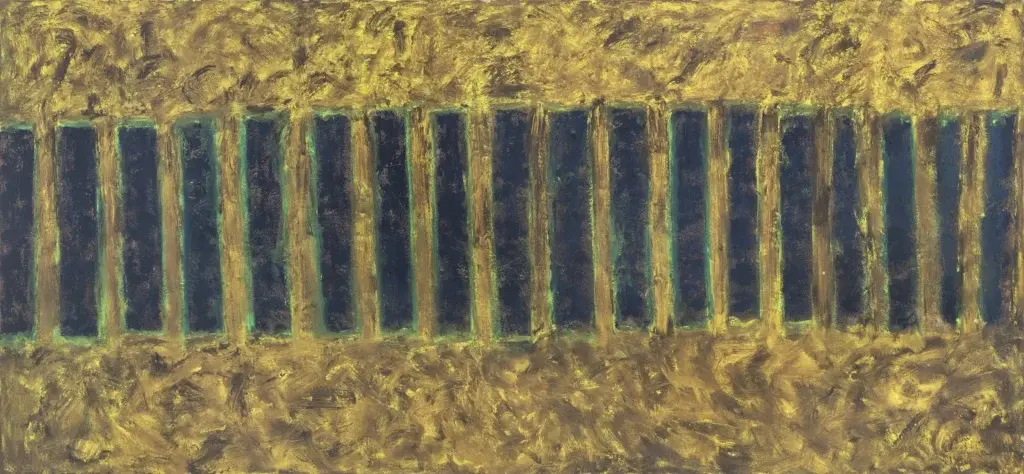
Pat Passlof, Gertrude Stein, 1999. Milton Resnick and Pat Passlof Foundation.
Passlof’s concern with women’s position in the art world became increasingly explicit in the 1970s. She was involved with the organization Women in the Arts, contributing reviews of panels and lectures to its magazine. In 1975, she became co-founder and features editor of Women Artists Newsletter, later Women Artists News, a publication that circulated information about exhibitions, events, books, and feminist issues among women artists. She also participated in the landmark 1973 exhibition Women Choose Women, alongside artists such as Sylvia Sleigh and Ce Roser.
Passlof’s commitment to artistic community extended into education. She taught at Richmond College and subsequently at the College of Staten Island/CUNY, where she remained for decades. Teaching offered her another way to work against the idea of art history as something handed down from a fixed canon. The classroom could instead become a place for sustained looking, discussion, experimentation, and the development of independent judgment. In this respect, the teacher, organizer, and painter were not separate identities. They were different expressions of the same commitment to artistic independence.
The paintbrush is the finger of the brain.
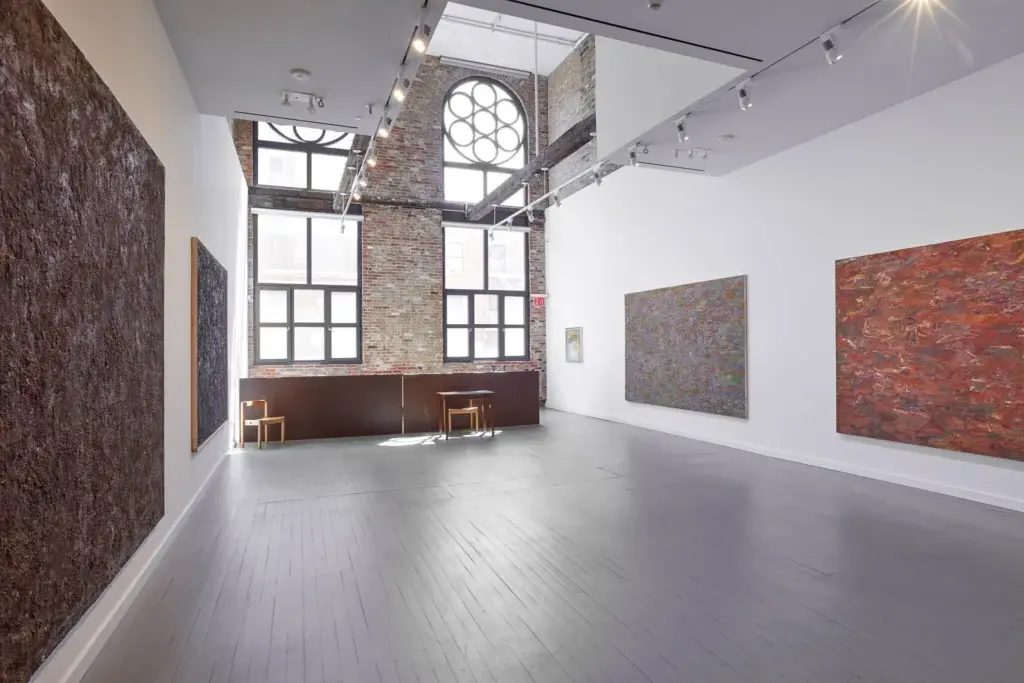
The Milton Resnick and Pat Passlof Foundation, 87 Eldridge Street, New York City, NY, USA. Milton Resnick and Pat Passlof Foundation.
Passlof died in New York in 2011 at the age of 83. Since then, her work has received renewed institutional and scholarly attention. Retrospectives and exhibitions have reconsidered her career, including Making Space: Women Artists and Postwar Abstraction at the Museum of Modern Art in 2017 and exhibitions devoted specifically to her work at the Black Mountain College Museum and the Milton Resnick and Pat Passlof Foundation.
Passlof painted seriously for more than six decades. She participated in the central debates of the New York School without allowing them to define her completely. She helped establish galleries, organized discussions, supported feminist initiatives, edited publications, and taught generations of students. And when she noticed that some artists were present in the room but not being heard, she responded by opening another room.
That impulse—to make space for the emerging, the overlooked, and particularly women artists—may be one of the most enduring ways to understand Pat Passlof.
DailyArt Magazine needs your support. Every contribution, however big or small, is very valuable for our future. Thanks to it, we will be able to sustain and grow the Magazine. Thank you for your help!

Natalia is an author and Italian language translator of art history, theory, and criticism. She works with museums and galleries across Europe to bring exhibitions to anglophone audiences. She has translated for the International Venice Biennale and the Uffizi Gallery in Florence, Italy.

Coffee-fueled writer, artist, and daydreamer.
American artist James Abbott McNeill Whistler trained in Paris, lived in London, and fled to Venice after his infamous libel trial. He is much less...
Catriona Miller 16 October 2026
The gavel falls, and the Sotheby’s auction room in New York explodes into applause. Gustav Klimt’s Portrait of Elisabeth Lederer has just shaken...
Javier Abel Miguel 11 June 2026
Three figures hover in the air, their bodies angled downward as they descend upon a limp man below. His arms stretch outward, his body slack, as if...
Frank Schildiner 28 May 2026
Every Old Master canvas speaks in two registers at once: one for the eye, one for those who know how to read the flowers. Artists used flower...
Errika Gerakiti 18 May 2026