

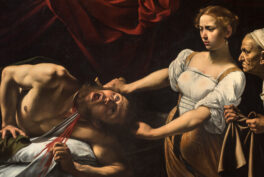
Masterpiece Story: Judith and Holofernes by Caravaggio
Judith and Holofernes is a Caravaggio masterpiece that captures Biblical murder and drama. Rarely has death been captured so intensely and violently...
James W Singer 13 September 2026
18 June 2026 min Read
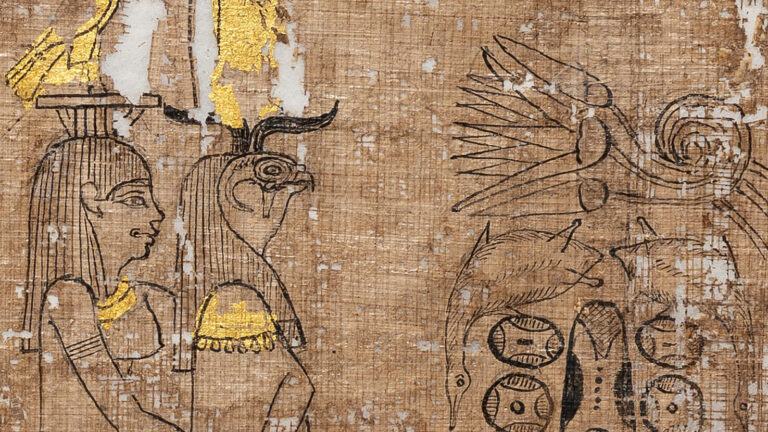
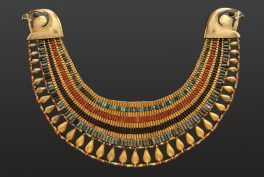
Book of the Dead of Ankhmerwer, 305–30 BCE, Brooklyn Museum, New York City, NY, USA. Detail.
What kind of measures do you take when the stakes are real? When you have to get it right the first time? You can’t improvise. You triple-check, run through every detail, make sure you have exactly what you need. Put that level of preparation into a situation where the outcome depends on what you say and how you say it, maybe in a courtroom or a career-changing interview. One wrong response can change everything.
Now up the ante. Not a case. Not a job. The fate of your immortal soul. Those are the stakes at play in the ancient Egyptian funerary texts we now call the Book of the Dead. And the Brooklyn Museum has two extraordinary versions on display; one of them with the bling turned all the way up.
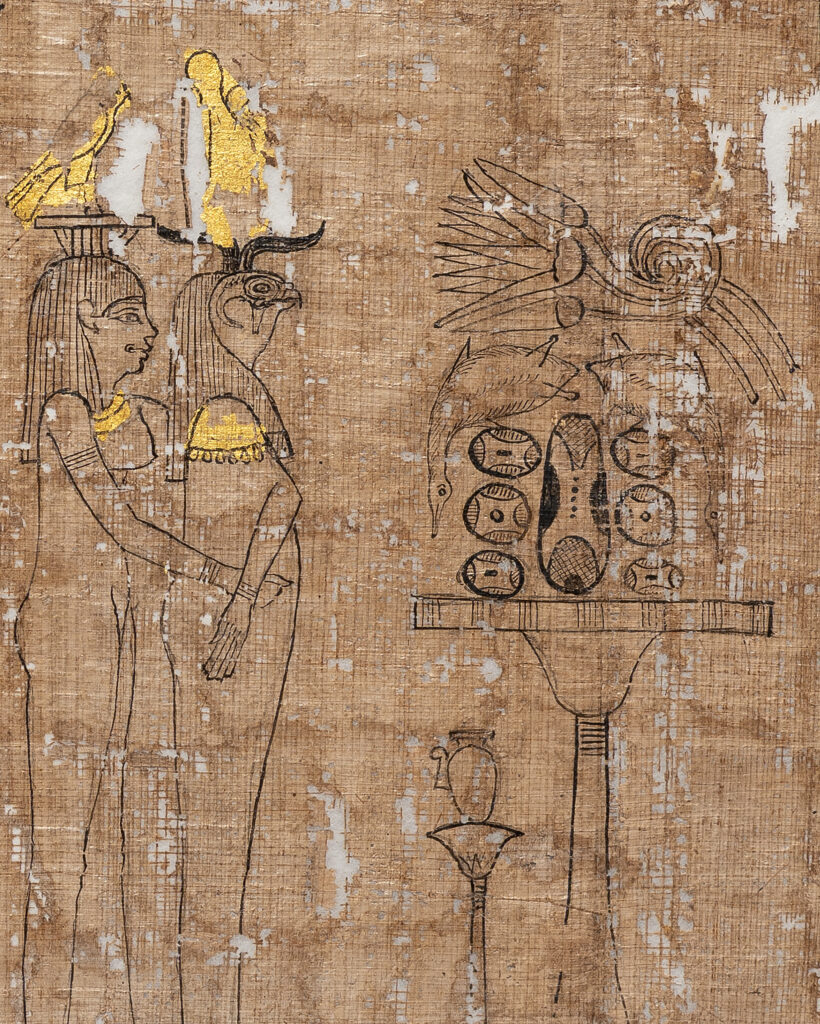
Book of the Dead of Ankhmerwer, 305–30 BCE, Brooklyn Museum, New York City, NY, USA. Detail.
“Book of the Dead” is sexy modern terminology. There has never been a single book and there is no King James-standard version. Think of it more as a customizable instruction manual for your eternal soul, where you chose the spells, had someone illustrate them—and hoped you picked correctly.
“Ultimately, all of it was intended to help [a person] transition into the afterlife and survive there,” explained Egyptologist Yekaterina Barbash to DailyArt Magazine.
Barbash added, “All Books of the Dead are distinct in subtle and not-so-subtle ways. The length of each book and the selection and sequence of texts were likely decided upon by the owner or their family and the workshop or scribe producing each manuscript.”
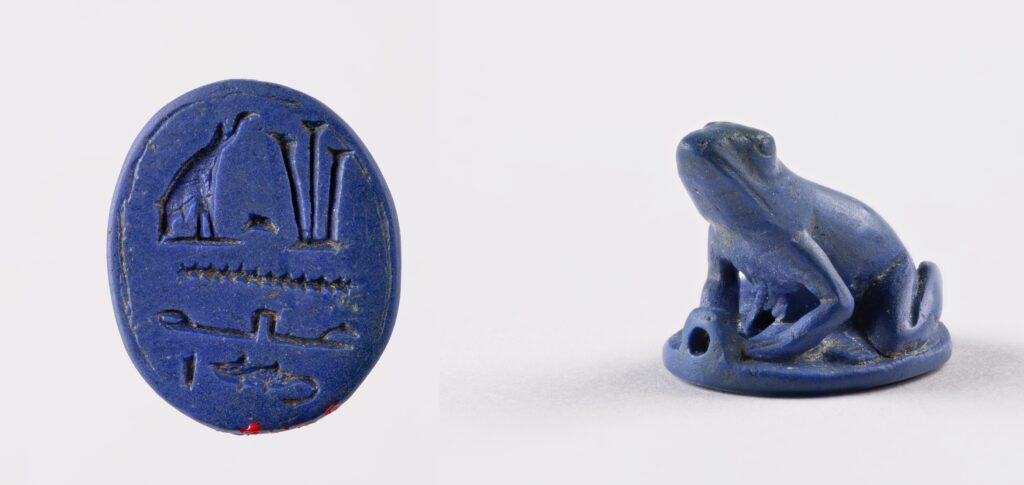
Frog Amulet, ca. 1390–1295 BCE, Brooklyn Museum, New York City, NY, USA.
People chose the spells according to what they believed in or simply what they could afford. With roughly 190 spells across the entire tradition, the possibilities were endless. Spells were not only written but also recited in temples or over amulets placed directly on the body. The amulets were not decorative objects, but, in the simplest possible sense, protective gear for the afterlife.
It was an afterlife that was not peaceful or passive; Game of Thrones had nothing on the ancient Egyptians. There were gates to pass through, dangers to avoid, beings to confront, and getting it wrong had grave consequences.
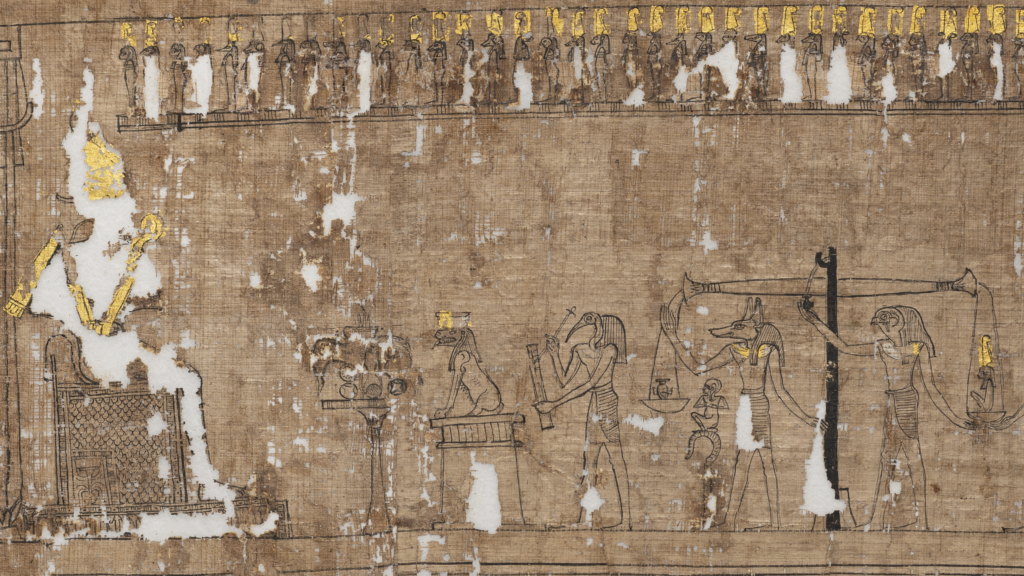
Osiris presides, while his 42 judges—each marked with a golden Ma’at feather—stand above. Spell 125: Ankhmerwer Comes Before Osiris in the Judgment Hall of the Two Truths from Book of the Dead of Ankhmerwer, 305–30 BCE, Brooklyn Museum, New York City, NY, USA. Detail.
The spells predate the manuscripts by centuries. Many spells began as oral tradition or amulet inscriptions before they were written down, which means the Book of the Dead has the unusual distinction of being ancient even when it was new.
Spell 125 tends to be the one western audiences recognize most. “The text includes a declaration of innocence, or the so-called Negative Confession, in which the person lists transgressions that they have not done during life,” Barbash explained.
“I have not stolen. I have not done evil in place of Truth. I have not caused grief. I have not added to the balance of the scale…”
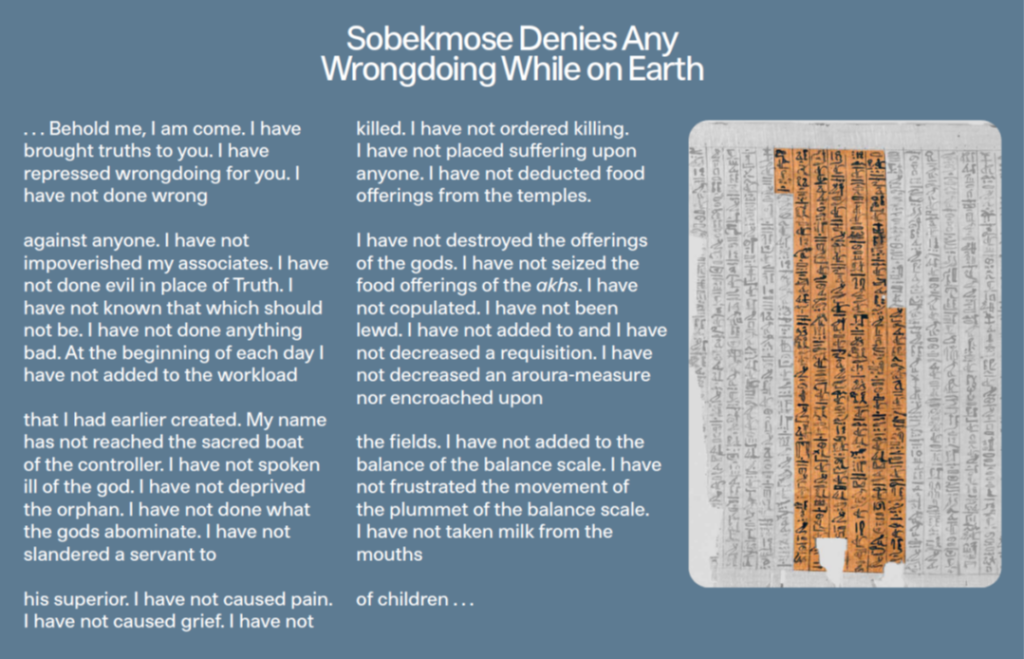
Sobekmose’s Book of the Dead dates to approximately 1500 BCE; inscribed on both sides, it is an exceptional rarity.
Those are versions of the Negative Confessions as recited in Spell 125, which might be the most poetic, but it’s also the most misinterpreted. Don’t confuse it with a list of mea culpas. This is a formal statement of innocence before a panel of divine judges, 42 of them, led by Osiris, lord of the underworld.
Then your heart, the center of intelligence and emotion, is weighed. Not metaphorically. Your actual heart is placed on a scale against the feather of Ma’at, the principle of truth and cosmic order against which a life is judged.
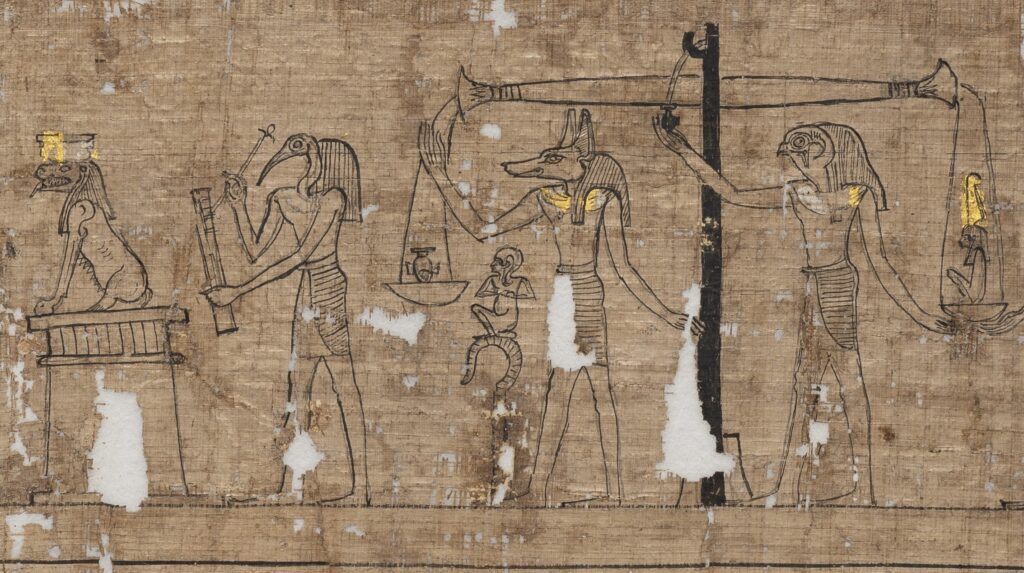
The jackal-headed god of embalming, Anubis (center), checks the balance of the scale; to his left, the divine scribe Thoth records the outcome. Scene from Book of the Dead of Ankhmerwer, 305–30 BCE, Brooklyn Museum, New York City, NY, USA. Detail.
“The spirit of the deceased finally makes it to the court of Osiris, where their consciousness, their heart, which was the seat of intellect, is weighed against the feather of truth, and ideally it should be in balance,” Barbash said. “It’s not about being lighter or heavier, it should be in balance, it should be in harmony. That judgment hall, it’s called the Hall of the Two Truths. Isn’t that beautiful?”
If the scales balance, you continue into the afterlife. If not, Ammut the Devourer, part hippopotamus, part lion, part crocodile, eats your heart and you die forever.
The weighing of the heart scene has become the iconic image of the entire tradition. And few Books of the Dead are more ornate than the one on display in Brooklyn.
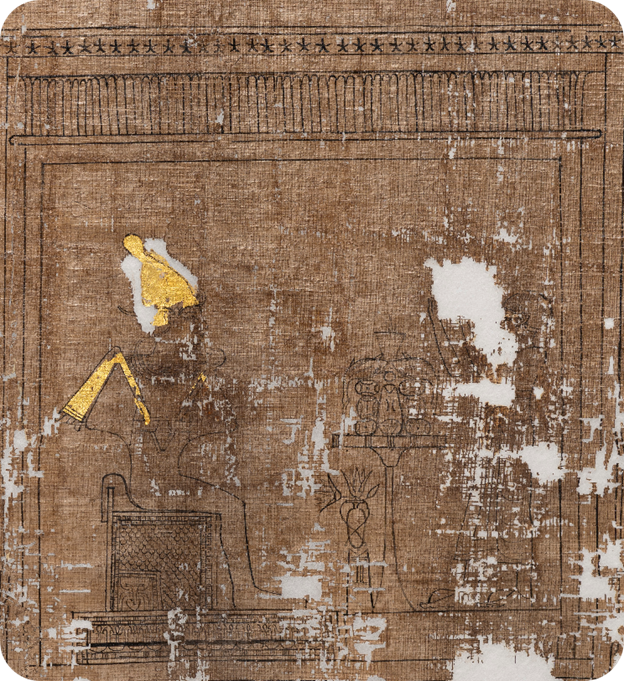
The manuscript opens with an image of Ankhmerwer standing before the Egyptian god of the dead, Osiris. Scene from Book of the Dead of Ankhmerwer, 305–30 BCE, Brooklyn Museum, New York City, NY, USA. Detail.
The Brooklyn Museum holds two remarkable Books of the Dead, separated by roughly 1,200 years: one of the earliest known examples, made for Sobekmose around 1500 BCE, and the recently unveiled gilded manuscript produced for Ankhmerwer. Ankhmerwer’s Book of the Dead is one of the most complete and finest gilded examples known today, the product of a three-year conservation effort spearheaded by Barbash and Ahmed Tarek, an Egyptian conservation scholar with a specialization in papyri.
Tarek interprets the unique gilding on Ankhmerwer’s manuscript not only as an upgrade for an elite owner, but also as a statement of its uniqueness. “If you are a person with money, you do a pigment. This person uses gold; it’s very uncommon,” Tarek explained. “[Ankhmerwer] didn’t have it painted, he just used gold. That means that he wanted to be very unique. Like, ‘I am here, you can see me now.’”
Ankhmerwer’s manuscript reveals the name of the owner and his mother, Taneferher. Barbash said that the latter translates to “She of Beautiful Face.”
“Because no titles are listed, we know nothing about Ankhmerwer’s profession and cannot estimate his age. It appears that he was still alive when the document was commissioned,” Barbash elaborated. “The length and quality of his document, as well as the gilding, suggest that he belonged to the upper echelons of society. There are only about 10 known surviving papyri with gilding, and most of them are very fragmentary.”
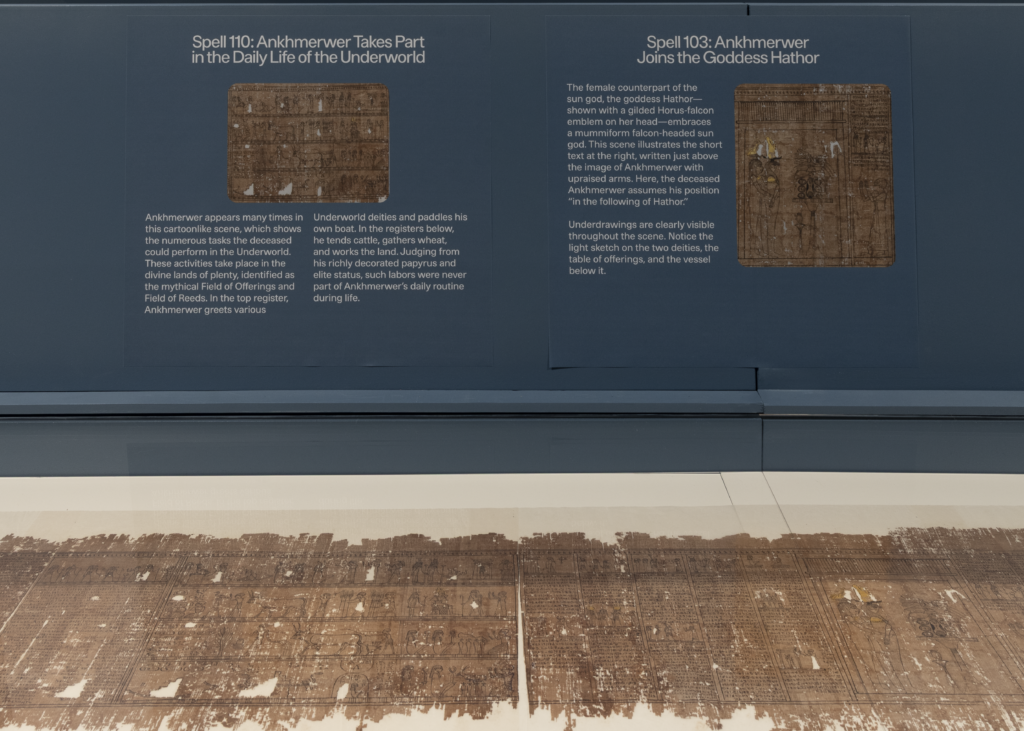
Installation view of Unrolling Eternity: The Brooklyn Books of the Dead, 2026, Brooklyn Museum, New York City, NY, USA. Photo: Paula Abreu Pita. Detail.
The fragility and complexity of a lengthy papyrus dating to the Ptolemaic Period (332–30 BCE) meant that every stage of treatment had to begin with careful documentation and technical examination before conservation. The project was not for the impatient or lacking in creativity. The team had to adapt standard papyrus conservation methods throughout the process, and even took a turn as furniture designers in devising a new workstation.
“Working on a 21-foot papyrus meant that normal table setups were not sufficient. The object needed continuous support, controlled access, and a system that reduced stress on the fibers and decorated surfaces,” Tarek clarified.
Barbash was aware of the existence of the ancient scroll since her arrival at the museum almost two decades earlier, but had only seen about six inches of the manuscript before conservation. “I swear I fell to my knees and crawled around it,” Barbash recalled of unveiling the manuscript, which included an 11-foot segment. “To make sure that it would fit, it was [unrolled] on the floor of the photo studio, on a protective cover, but I was crawling around it for hours.”
Tarek characterized the process of conserving ancient Egyptian papyri as “extremely detailed, slow, and methodical.” Somehow, that was an understatement. The treatment was not a heroic before-and-after operation. Just removing the 19th-century acidic backing paper took 18 months.
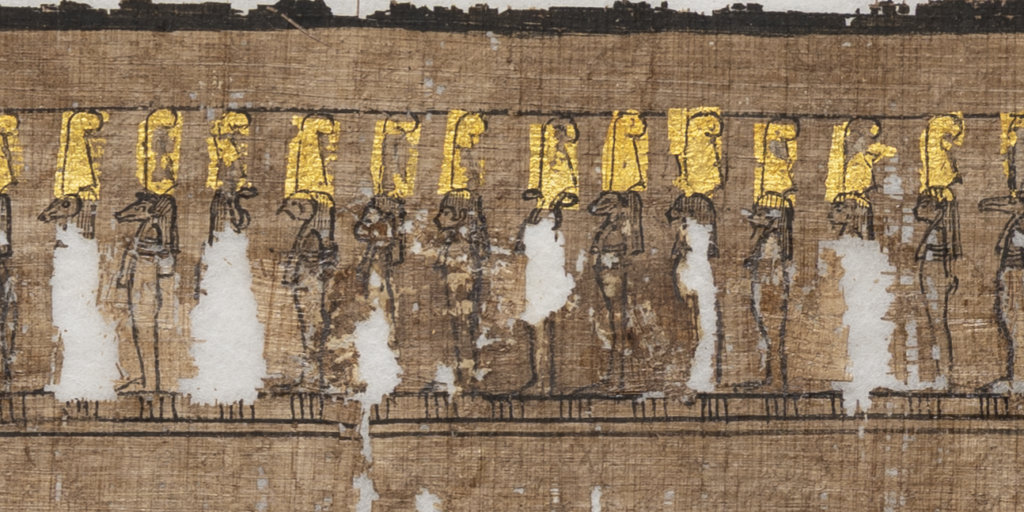
It could take conservators days to work on a piece of the funerary manuscript as small as the detail on your screen. Book of the Dead of Ankhmerwer, 305–30 BCE, Brooklyn Museum, New York City, NY, USA. Detail.
Tarek’s methods drew on traditional Japanese-style conservation techniques. The papyrus was lined using Japanese paper and Klucel G, a clear flexible gel used as adhesive because it does not turn yellow over time. Tarek employed tengujo paper, one of the thinnest (virtually transparent) and strongest papers in the world.
“I received a diploma in Japan on how to use this tissue paper,” Tarek said. “It’s 100% kōzo (mulberry) fibers and has very long strains. It cannot be cut easily and offers good penetration for the glue. Also, it’s easily reversible and has very strong support for all surfaces. The most important challenge was to make the papyrus stable and readable without over-treating it or changing its historical character.”
In order to preserve the scroll’s structural integrity and historical authenticity, the conservation team had to innovate by combining traditional conservation skills with modern analytical tools. The techniques went on to be presented at the 2024 Papyrus Curatorial and Conservation Meeting in the Netherlands.
“We are not cleaning, we are studying the object,” Tarek said of a common misconception of conservation. “I have worked for more than 15 years with these materials, and I’m very respectful. It’s about this person and his life and journey after death into another life. That’s why we have to conserve [funerary materials] very carefully. It has value beyond its physical value. We are taking care of what he thought was important to pass to another life. If we lost it, he would lose his way.”
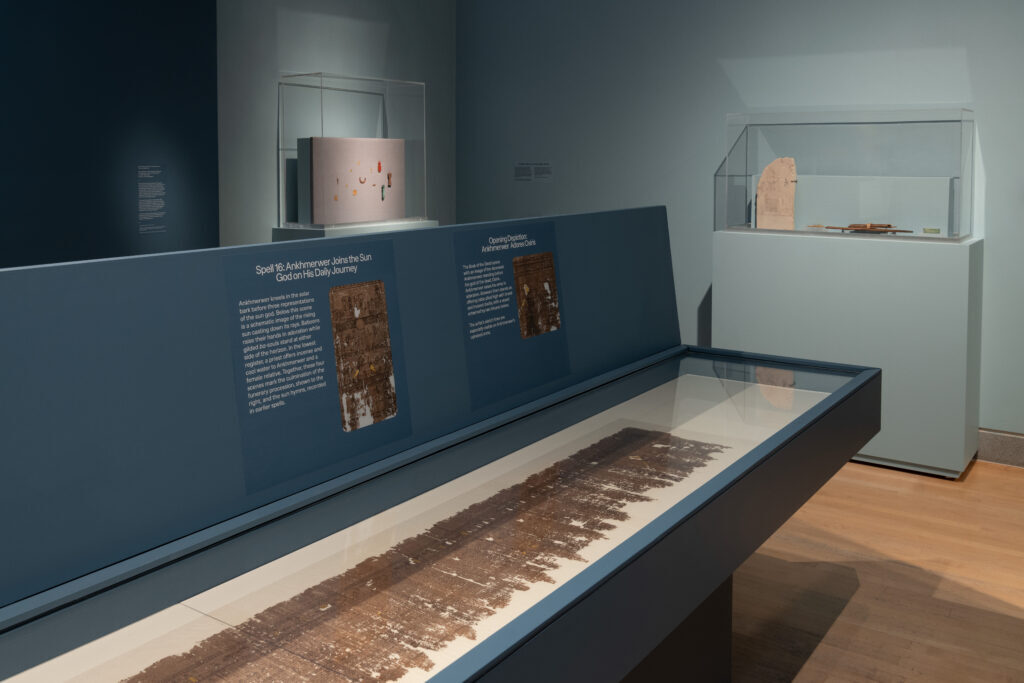
Installation view of Unrolling Eternity: The Brooklyn Books of the Dead, 2026, Brooklyn Museum, New York City, NY, USA. Photo: Paula Abreu Pita.
The Egyptians had a completely different idea of what it meant to be alive. For us, you’re alive if your heart is beating. For them, you were alive if other people acknowledged you. If being alive is a social status maintained by others naming you, then the worst thing that can happen to you is not physical death but being forgotten. Real death was when nobody spoke your name anymore.
“The most important information that we learn about Sobekmose and Ankhmerwer is that they existed. Neither one is otherwise attested in the historical record. Without these Books of the Dead, they would have been forgotten,” Barbash said. “The Egyptians themselves tell us that they wanted to have their names remembered. As a curator, I’m in charge of caring for the remains. I know they wanted their name remembered, so I will do that as much as possible. I pronounce their names.”
The conservation efforts by the Brooklyn Museum have allowed us to appreciate these manuscripts not as generic artifacts behind glass, but as unique objects for a specific purpose and a specific person. Sobekmose and Ankhmerwer were revealed as the owners of these Books of the Dead. Their hearts may have held in balance with a feather after all.
DailyArt Magazine needs your support. Every contribution, however big or small, is very valuable for our future. Thanks to it, we will be able to sustain and grow the Magazine. Thank you for your help!
Rivera is a New York City–based journalist with more than two decades of experience, known for thriving in a media capital that tests endurance as much as talent. Reporting has taken her from the World Cup to the Louvre. Her wide-ranging interests in art history have been shaped by years of independent study and research in New York’s major museums and many leading art institutions around the world.

As an educator, writer, and neurodivergent creative, I enjoy learning and sharing through nature, the arts and novel experiences.
Judith and Holofernes is a Caravaggio masterpiece that captures Biblical murder and drama. Rarely has death been captured so intensely and violently...
James W Singer 13 September 2026
Explore an astonishing 1915 nude self portrait by American modernist painter Florine Stettheimer.
Candy Bedworth 21 September 2026
Winslow Homer (1836–1910) was one of the leading American Realist painters. His painting The Veteran in a New Field is a masterpiece of late...
James W Singer 30 August 2026
At first glance, A Goldsmith in His Shop (1449) appears to depict an ordinary visit to a jeweller. Yet Petrus Christus transformed an ordinary...
Shivani Gupta 23 August 2026