


Everything You Need to Know About the Art of Aztec Civilization
The Aztec civilization, a dynamic Mesoamerican culture that thrived in central Mexico between 1300 and 1521, continues to fascinate us today. Aztec...
Jimena Aullet 22 July 2024
28 September 2026 min Read
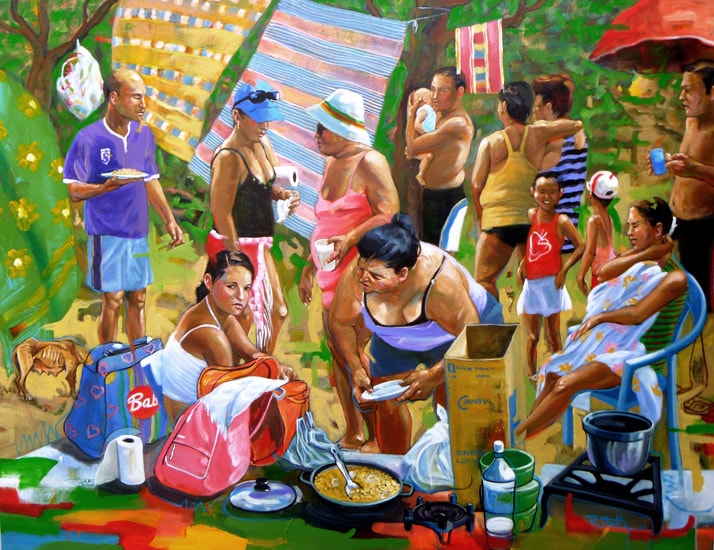
Rodolfo Stanley, Los Comegüevos #15, 2011. Artist’s website.
I had never heard of Rodolfo Stanley until I wandered into one of his exhibitions in Costa Rica and wondered what exactly I was looking at. His crowded beaches, dance halls, parks, and parties are full of people, food, sex, laughter, and drinking… They looked like snapshots of everyday Costa Rican life, but something about them felt unmistakably theatrical. People were not simply going about their lives but seemed to be performing them.
Rodolfo Stanley (1950–2021) was a self-taught Costa Rican painter whose work transformed everyday life into scenes rife with humor, irony, and social observation. Originally trained in advertising, Stanley brought an eye for critical storytelling to his paintings, which often blur the line between observation and participation. Stanley stated that art served an important purpose, and he was not afraid to step into more controversial territory: “It’s not that I create controversial work for money; in fact, the more controversial a piece is, the harder it is to sell. That’s not the main point. The idea is to talk about the issues that need to be addressed.” As the Museo de Arte Costarricense has noted, Stanley was both observer and participant but also a character within it. And that is what he does with us, the viewers, as well.
Parallels between his work and carnival have been drawn before by news outlets in Costa Rica, but they can be pushed a bit further. Stanley is known for his series diving deeply into specific themes, and we’ll focus on three of them in particular. At first, they appear to present entirely different subjects: a beach day, a night of dancing, and a masked party. Stanley begins with some direct reference to a carnival and gradually reveals carnival as a way of seeing. Eventually, the masks aren’t necessary because everyday life already contains the performance, excess, judgment, and spectacle that carnival reveals.
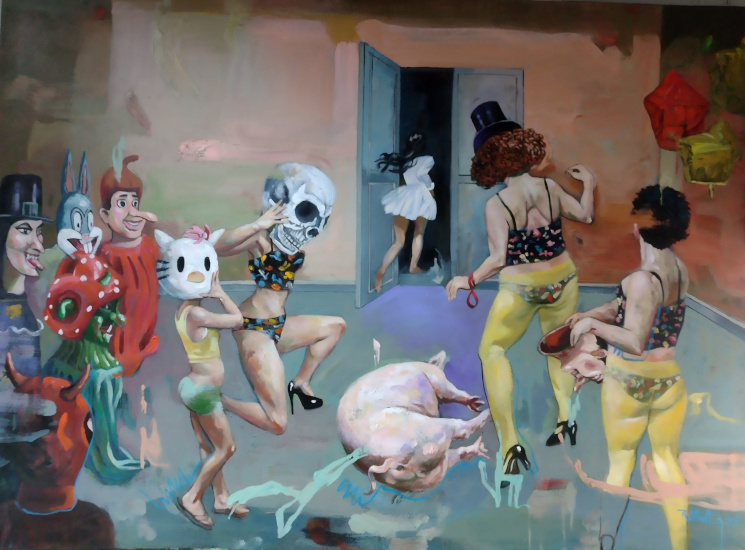
Rodolfo Stanley, Chicharrón infartado, 2019. Artist’s Facebook.
Let’s start by looking at some of Stanley’s more literal encounters with carnival. The paintings show explosions of bodies, costumes, food, and movement, but beneath it all, something slightly unsettling is always lurking. In Chicharrón infartado, a party appears to have reached a moment of crisis. A dead pig lies at the center of the room, and a woman is rushing toward the door. Masked figures surround the corpse in various states of panic or fascination. A woman bent over the pig has the face of Death, while a child in the foreground looks directly toward us and, in doing so, changes our position entirely. We are no longer simply looking at a scene but have been noticed.
Stanley has made us a spectator of the disastrous party. Chicharrón (fried pork) is a common Costa Rican food, and Stanley turns it into something almost absurdly symbolic. Food, pleasure, excess, the body, and death are all occupying the same space, almost making the party a still life of consumption.
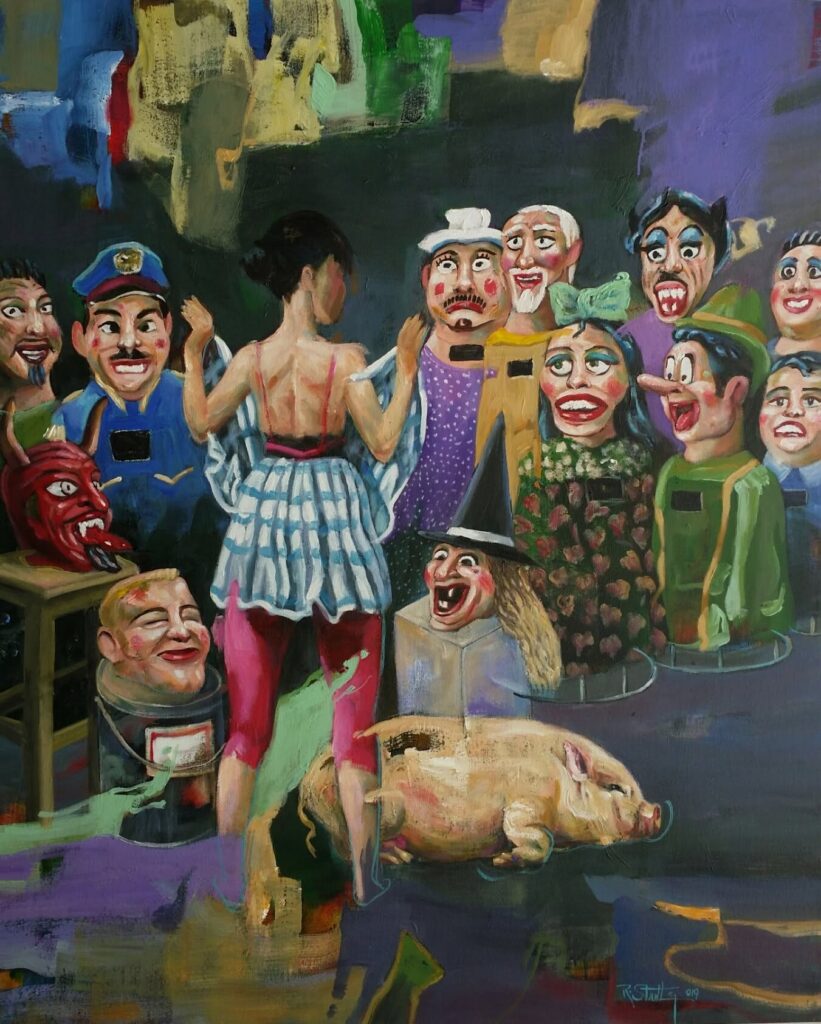
Rodolfo Stanley, ¡Mamma mía!, 2019. Artist’s Facebook.
In ¡Mamma mía!, the same pig appears on the floor while a collection of masks and carnival costumes watch a woman lift her skirt. Some of the masks appear concerned or disgusted, while others, including a police officer, seem more than happy to enjoy the performance. These masks do not conceal people beneath them, but they have personalities of their own.
This idea is not entirely foreign to Costa Rican cultural commentary. In his essay “Los ticos y la máscara,” Mario Alberto Jiménez Quesada discusses a caricature of Costa Rican Carnival to suggest something broader: carnival is not simply something that happens at a particular time of year, but something that can describe the performances of public life itself. Football, civic parades, beauty contests, folklore, and even the colorful image of Costa Rica presented to foreigners can all become forms of performance. “¡Aquí todo el tiempo es carnaval!” (“It’s carnival here all the time!”)
Beyond the literal mask, Stanley also explores what happens when the body itself becomes a mask. He turns our attention to dancing, nightlife, eroticism, drunkenness, and sex work. Men and women dance with abandon. Others have collapsed at the end of the night in decidedly unglamorous positions, and couples have moved beyond the stage of seduction.
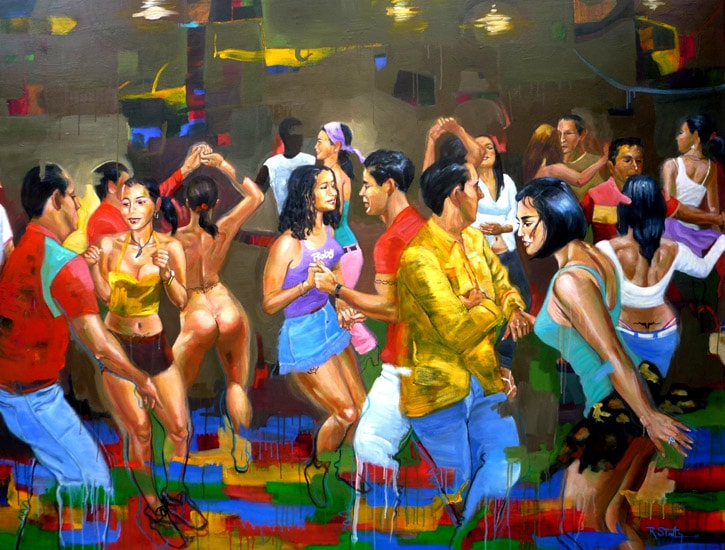
Rodolfo Stanley, Swing Tico, 2010. Artist’s website.
Stanley visited the dance halls himself to observe the people who populate his work, establishing the dance hall as a space of collective performance and spectacle. The paintings are massive orgies of color and movement. In Swing Tico, the dance becomes something almost collective and trance-like, while in Las niñas, sexuality and performance become much harder to separate. Stanley is not simply documenting nightlife but is interested in what nightlife permits. Carnival and the night both permit people to behave differently. For a few hours, we can become the dancer, the seducer, the voyeur. True to form, the artist invites us into the painting, and we feel watched, uncomfortable, or perhaps eager to join and see what our own bodies will want to transform us into tonight.
Russian literary theorist Mikhail Bakhtin’s observations on carnival add some useful depth here. He explained that medieval and Renaissance carnivals created a world where, for some time, normal social rules were flipped upside down. Stanley takes his carnival further. Bakhtin’s carnival is temporary, while Stanley’s is permanent. He brings together things that so-called polite society normally keeps apart: eating and excess, sexuality and embarrassment, pleasure and exhaustion, and laughter and death.
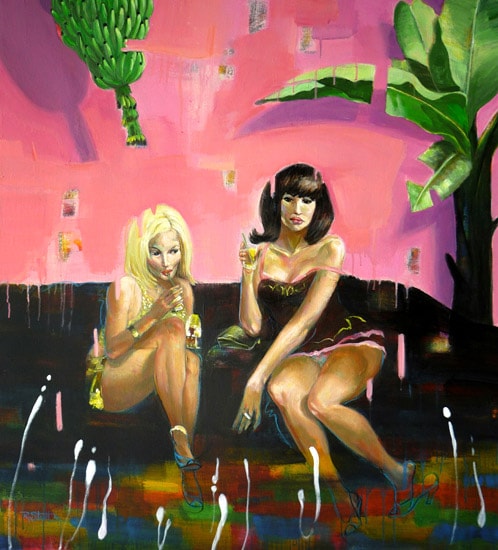
Rodolfo Stanley, Las niñas #10, 2008. Artist’s website.
Stanley is not alone in finding something theatrical in ordinary life, and the fact that his paintings have such a cinematic quality brings one particular artist to mind. Federico Fellini (1920–1993) did something remarkably similar in cinema. In films such as La Dolce Vita and Amarcord, everyday Italian life becomes a procession of bodies, rituals, sexual encounters, parties, and eccentricity. His characters are also not necessarily attending a carnival, but the world around them always seems on the cusp of becoming one.
Fellini’s contribution to the carnivalesque is the transformation of ordinary life into spectacle, and Stanley’s dance halls work in much the same way. The dancers, lovers, sex workers, and spectators are not subjects being documented but become performers in the theater of everyday life. Then morning comes, the party ends, and the masks can be removed, or perhaps they are simply replaced by different ones.
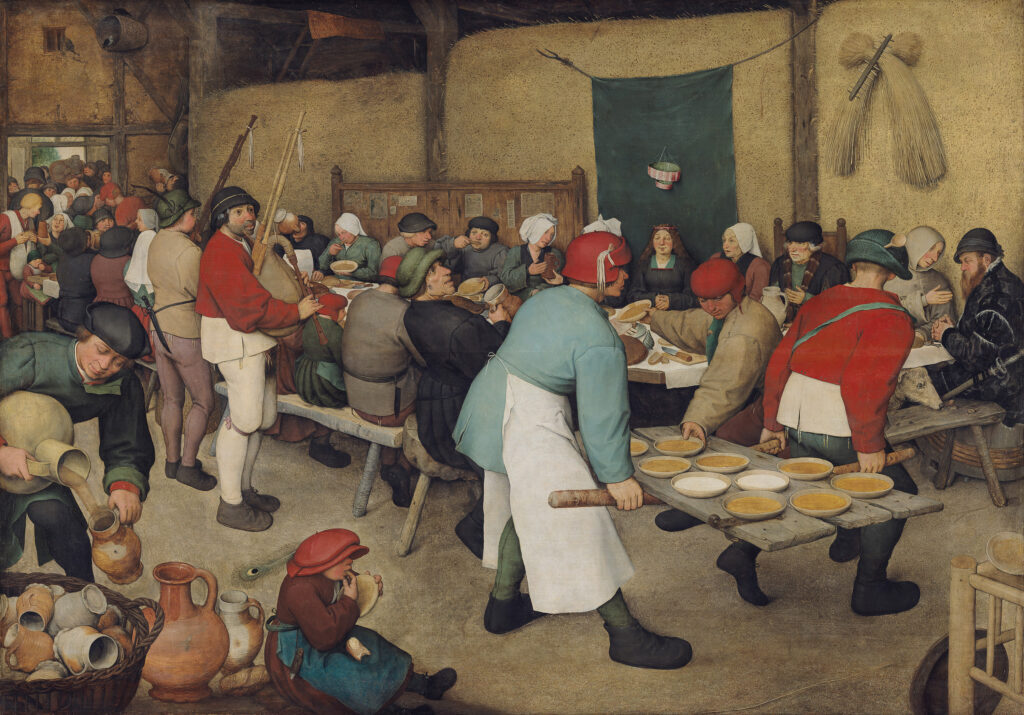
Pieter Bruegel the Elder, The Peasant Wedding, 1568, Kunsthistorisches Museum, Vienna, Austria.
When it comes to creative expression of everyday life with a bit of a twist and a moral lesson, Pieter Bruegel the Elder (c. 1525–1569) immediately comes to mind. Bruegel repeatedly turns ordinary life into something enormous, chaotic, and absurd. The key isn’t simply that he depicts public events, but that there is no distinction between everyday life and spectacle. Eating, drinking, dancing, working, fighting, sex, religion, and commerce—everything happens simultaneously, and with it come layers of observation and social criticism.
In many of Stanley’s works too, everybody is doing something, and the accumulation of tiny activities produces the real sense of carnival, but also the sense that a deeply complex story is being told at the same time.
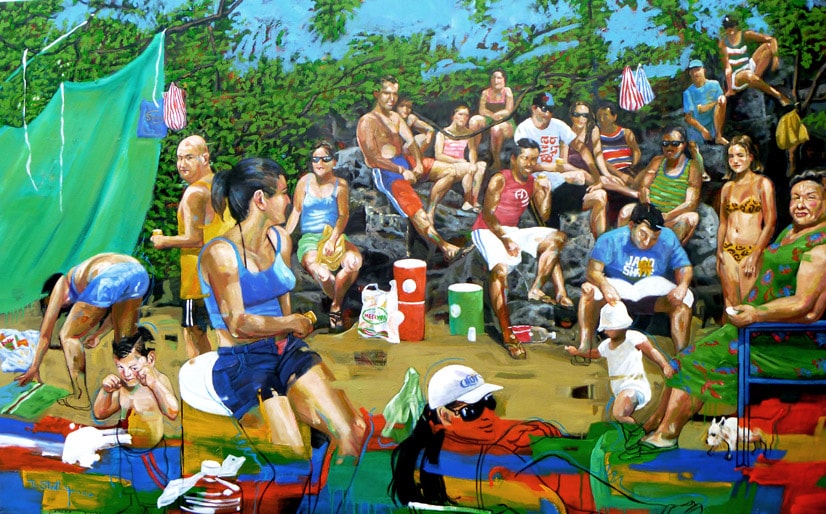
Rodolfo Stanley, Los Comegüevos #24, 2012. Artist’s website.
Los Comegüevos may be the most revealing of Stanley’s carnivals precisely because there are no obvious masks. We find Costa Ricans enjoying a day at the beach. The nearest public beach offers an affordable escape, and they bring the comforts of home with them.
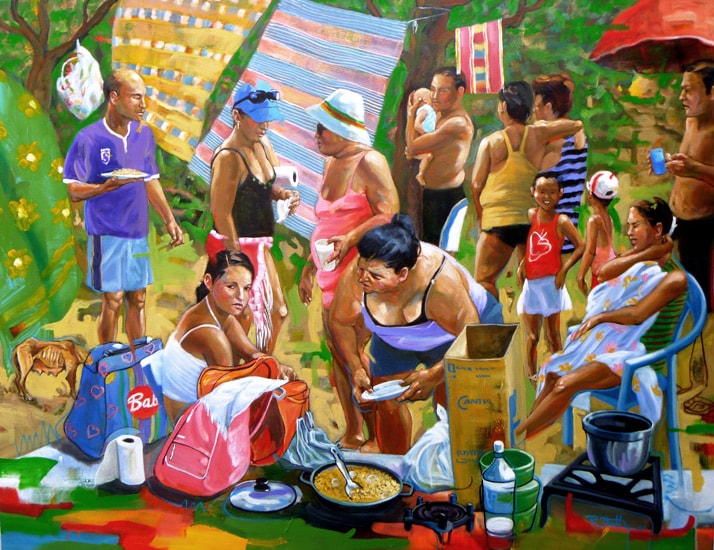
Rodolfo Stanley, Los Comegüevos #15, 2011. Artist’s website.
Under the shade of the trees, entire kitchens and living rooms materialize. Colorful towels mark imaginary walls, loud music is there for everyone to enjoy, children and dogs wander freely, trash is scattered around, and adults settle in for a long day of sun, food, beer, conversation, and sleep. The title of the series Los Comegüevos itself is a joke, playing on come huevos, “eat eggs,” and the way the phrase is pronounced. Hard-boiled eggs, beer, dogs, plastic bottles, towels, sun, and sleep—the homey ingredients of a Costa Rican beach day become Stanley’s carnival props.
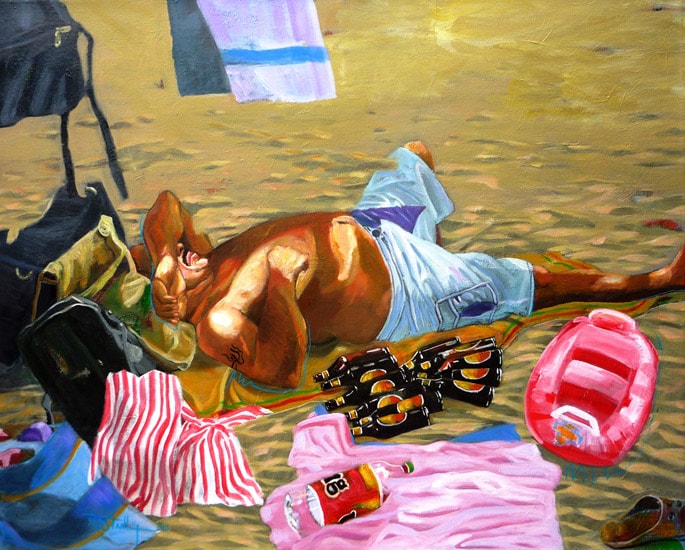
Rodolfo Stanley, Los Comegüevos #3, 2010. Artist’s website.
Stanley turns us into another beachgoer. We are there with them, observing them, even when it feels as though we shouldn’t be. As beachgoers turned voyeurs, we may even catch ourselves passing judgment. Stanley explains:
Within the mirror, I want to reflect society through these paintings; for example, I’m talking about the series Los Comegüevos, one of my favorites. I’m showing that man who isn’t the everyday man. The one who carries appearances on his shoulders; I expose that inner, dark, ugly, selfish, judgmental part of the human being.
El Observador. Translated by the author. Accessed: September 15, 2026.
In other words, Stanley isn’t only asking us to look at the people on the beach. He is asking us to look at ourselves, looking at them.
But this carnival at a Costa Rican beach goes a bit further, inviting us to contemplate class in a country that increasingly suffers from a widening gap between the privileged and the poor. María Lourdes Cortés, a historian of Costa Rican and Central American cinema and a professor at the University of Costa Rica, explains that Los Comegüevos offers a glimpse into the lives of Costa Rica’s working class: “People of limited means make the most of their meager vacations to join this carnival-like ritual, with its grotesque aesthetic and hybrid nature. Here, consumption is defined not by the refined gourmet pleasures of the elite, but by what is popularly known as the ‘egg-eaters’ picnic—a humble spread of hard-boiled eggs, refried beans, tuna sandwiches, and fried plantains.”
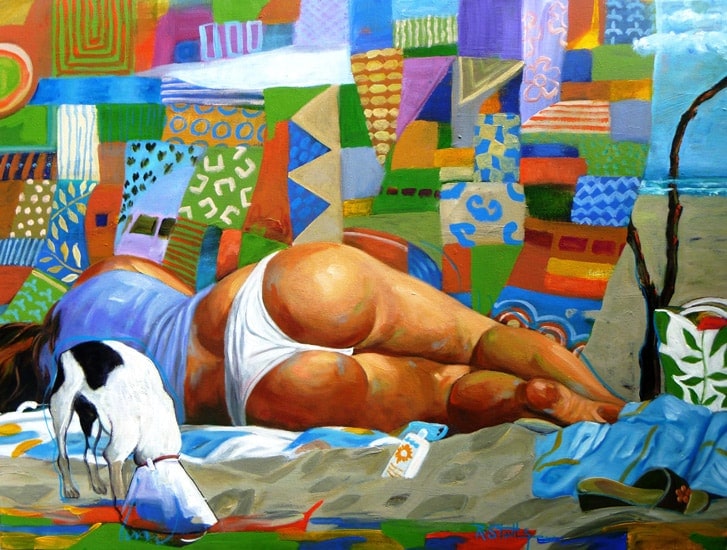
Rodolfo Stanley, Los Comegüevos #19, 2011. Artist’s website.
Cortés’ reading is crucial because it prevents the series from becoming a humorous portrait of “Costa Rican beach culture.” The carnival has a class dimension because what looks like leisure is also a reminder that not everyone experiences leisure in the same way. The beach may be a shared public space, but the food we eat and the ways we find comfort are not equal.
In Rodolfo Stanley’s paintings, food is rarely just food, sex is rarely just sex, and the body is rarely simply beautiful. Everything is capable of becoming excessive, comical, embarrassing, or disturbing. The three themes can therefore be read almost as three stages of the same carnival: the mask, the body, and finally the everyday. The carnivalesque has escaped the boundaries of carnival itself. And if “¡Aquí todo el tiempo es carnaval!” is more than a joke, then Stanley may be one of the artists who truly understood what that means.
DailyArt Magazine needs your support. Every contribution, however big or small, is very valuable for our future. Thanks to it, we will be able to sustain and grow the Magazine. Thank you for your help!

Mieke Leenders is an art historian (MA) specializing in iconology. She embraces an interdisciplinary approach in her research into how art shapes, reflects, and challenges our world.

The Aztec civilization, a dynamic Mesoamerican culture that thrived in central Mexico between 1300 and 1521, continues to fascinate us today. Aztec...
Jimena Aullet 22 July 2024
The National Autonomous University of Mexico (UNAM) is situated in Ciudad Universitaria, a beautiful complex of modernist buildings planned by a...
Alicja Gluszek 27 June 2025
How do you get 10,000 people to visit an art museum on opening day during the Great Depression? You create a controversy, or at lease encourage one.
Rachel Istvan 27 June 2025