


Gustav Klimt in 10 Paintings
Gustav Klimt’s lavish gold motifs, intricate patterns, and sensuous nudes were as innovative as they were controversial. Breaking from his...
Theodore Carter, 2 July 2026
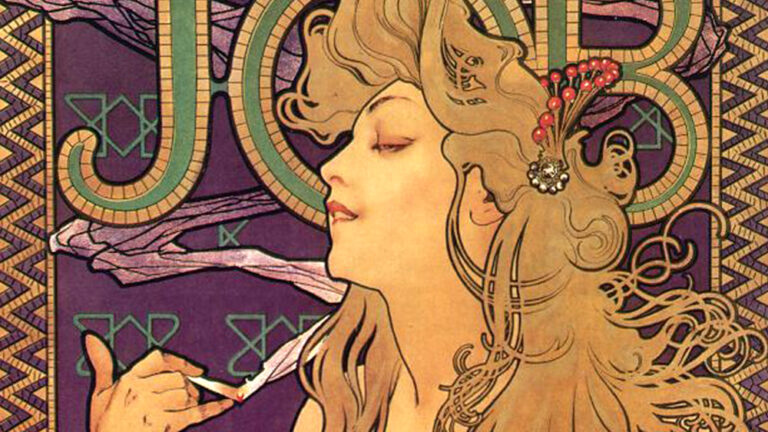
Alphonse Mucha, JOB Cigarette Papers Advertisement (La femme blonde), 1897. Wikimedia Commons (public domain). Detail.
Czech Alphonse Mucha is a legend of the art world, a pioneer in Art Nouveau whose work still lives on through his larger-than-life artworks, mostly advertising. Yet few fans of his art know the depth of his career which encompasses deeply religious icons, epic historical images, as well as jewelry designs. Here are some of his best and least known works throughout his life.
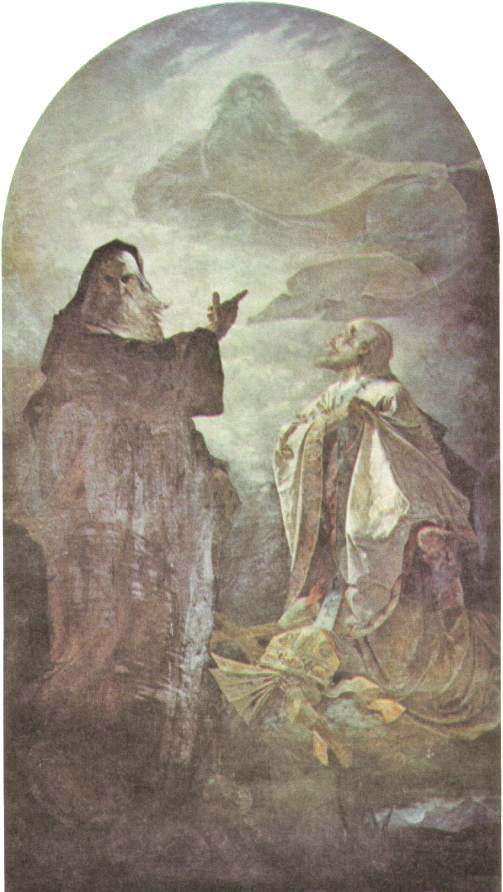
Alphonse Mucha, Portraits of Saints Cyril and Methodius, 1887, St. John Nepomucene Catholic Church in Pisek, ND, USA. Rumreich Museum.
Though his work in the Art Nouveau style is considered the height of his career, few art lovers know that Alphonse Mucha’s earliest work reflected his deeply held religious convictions. His portrait of patron saints of the Slavic people, Cyril and Methodius, was a powerful demonstration of his beliefs. This tableau was created for the Roman Catholic church in Pisek, North Dakota, USA, and the somber images reflect his classic training in the Munich Academy of Fine Arts.
In opposition to Alphonse Mucha’s later flamboyant colors and production for commercial products, this painting uses greys, muddy browns, dull ochres, misty greens, and tinted whites. It feels as if the colors present were drained from the image, focusing the viewer upon the holy figures.
Comparing this painting to his later work, few would believe they were produced by the same artist. It is not decorative, but rather devotional, and an important, lesser-known work in the career of the artist.
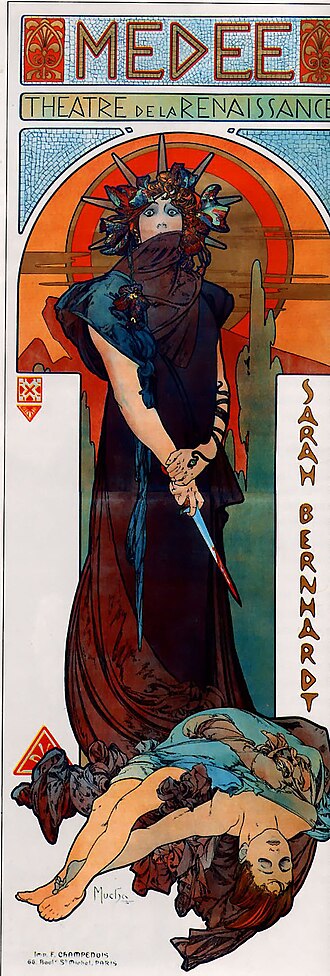
Alphonse Mucha, Médée (Medea), 1898, private collection. Wikimedia Commons (public domain).
In 1894, Alphonse Mucha was hired by legendary French stage actress Sarah Bernhardt to design a poster for her play Gismonda. The final design exceeded all expectations and caused a sensation among viewers. Pleased with the result, Bernhardt commissioned another work for her upcoming play Médée.
The presentation of the actress is powerful and reminiscent of neoclassical artwork of the demi-goddess Medea. Garbed in black and red, her face partially hidden by a fold of her cloak and her head surrounded by an ancient priestess crown, Bernhardt is a forbidding and overwhelming icon. Clutching a bloody dagger over the bodies of Medea’s children, murdered by her own hand, the poster is both horrifying and beautiful at the same time.
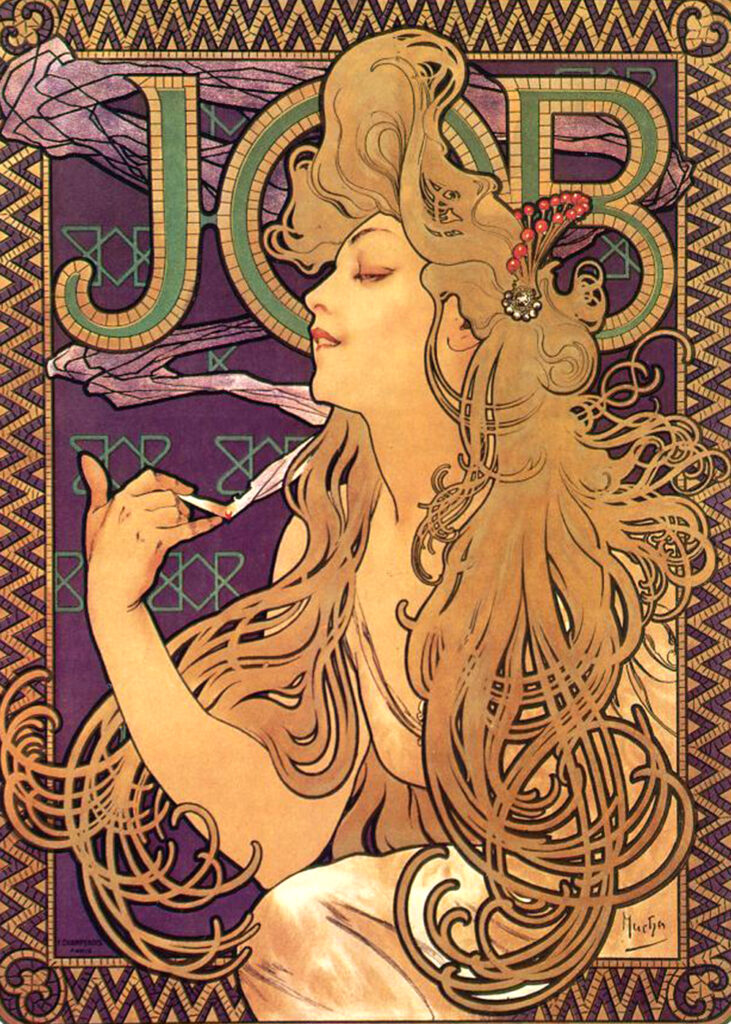
Alphonse Mucha, JOB Cigarette Papers Advertisement (La femme blonde), 1897. Wikimedia Commons (public domain).
Alphonse Mucha is best known for his commercial advertising posters that defined Art Nouveau and remain some of his most reproduced artworks. Each featured stunningly beautiful women with flowing hair, smiling faces, and floral or mosaic style backgrounds. They presented unique views of commercial work and are still studied for their excellent illustrations.
Among these many achievements, the pair of tableaus for the JOB Cigarette Paper Company is easily the best-known. The prints, known as La femme blonde and La femme brune, depict 2 gorgeous women, blond and brunette, holding cigarettes as they look away from the viewer. Their expressions are content and the company’s name appears above them, the letters partially obscured by their flowing coiffures. These prints are considered foundational works in the establishment of graphic and commercial arts and highly prized by collectors.
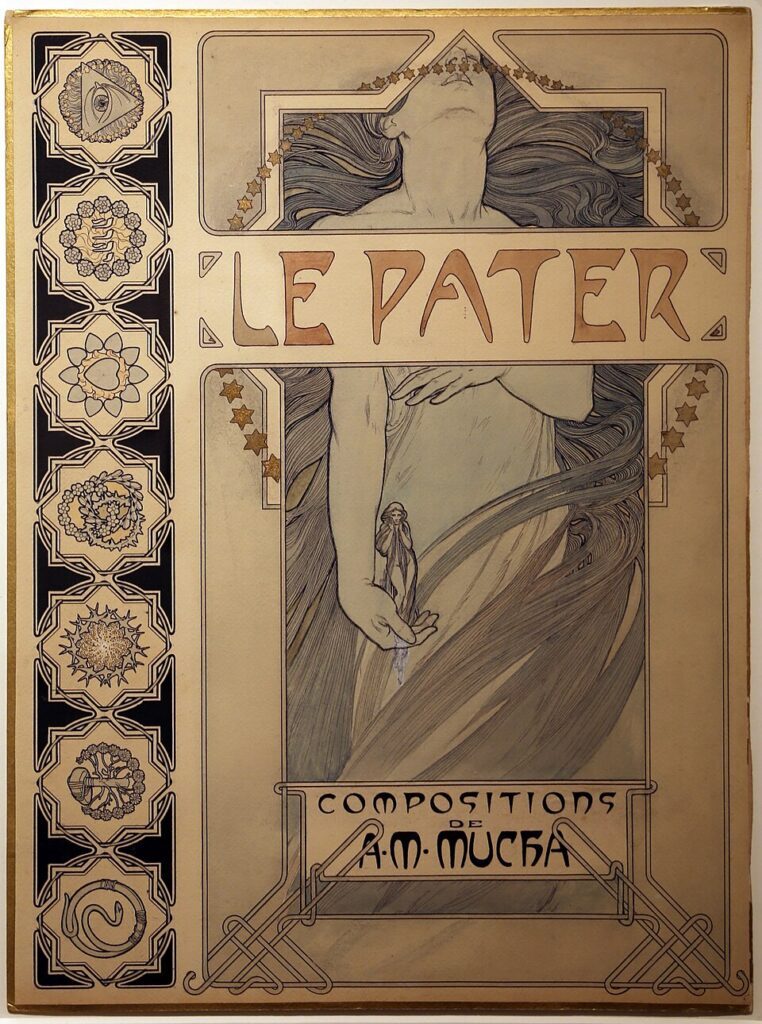
Alphonse Mucha, Cover of Le Pater, 1899. Photograph by Sailko via Wikimedia Commons (CC BY-SA 4.0).
Enjoying success thanks to his work for Sarah Benhardt and his advertising posters, Alphonse Mucha sought recognition not only as a serious artist, but also a devoted member of the Catholic Church. He chose a unique route: an illustrated book devoted to the Pater Noster (Lord’s Prayer). The book, known as Le Pater, of which only 510 copies were produced, contained images corresponding to each line of the invocation, presented in stylized calligraphy.
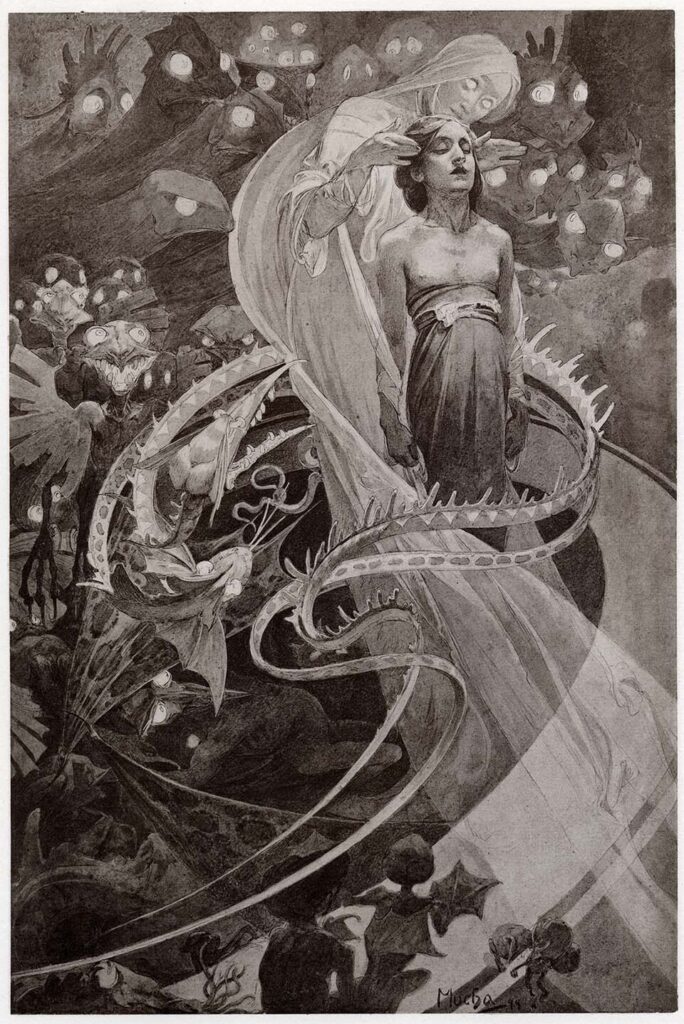
Alphonse Mucha, Illustration for “Lead us not into temptation but deliver us from evil” in Le Pater, 1899. Photograph by Sailko via Wikimedia Commons (CC BY-SA 4.0).
Among them, the illustration of the line “Lead us not into temptation but deliver us from evil” is an imaginative vision, blending Christian symbolism with mystical imagery. Mucha places before us a richly dressed woman with her eyes closed surrounded by thorny vines, serpentine creatures, and demonic visages. Hovering to her rear and caressing her temples is a ghostly female figure reminiscent of Renaissance depictions of the Virgin Mary.
Each page of Le Pater combined the power of the prayer with exquisite etchings that merged metaphysical depth with mystical imagery—a result of Mucha’s religious beliefs and his interest in Kabbalah and Masonic philosophy. Though in opposition to his imaginative ads, Le Pater is one of the best demonstrations of Mucha’s genius that remained mostly forgotten until recently.
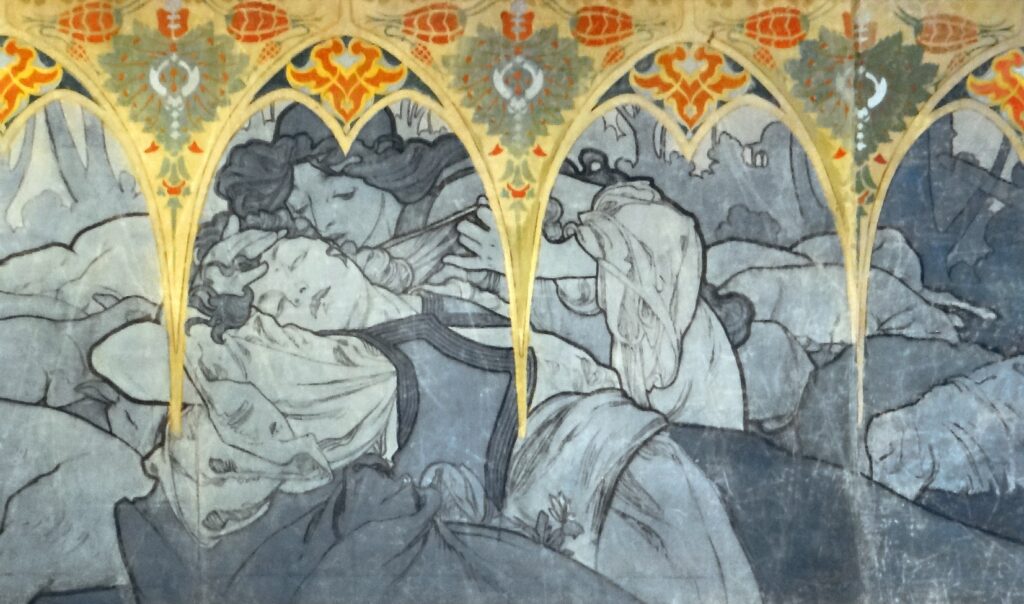
Alphonse Mucha, Fragment of a decorative frieze of the Bosnia and Herzegovina Pavilion, 1900, Musée d’Orsay, Paris, France.
In 1900, Alphonse Mucha received a commission from the Austrian government to create murals for the Bosnia and Herzegovina Pavilion for the Exposition Universelle in Paris. The structure he worked in had 40-foot-high ceilings and natural light from skylights in the roof. Alphonse Mucha’s background in large scale theatrical artworks proved beneficial in creating such huge paintings in a short time.
Originally suggesting a series of images devoted to the suffering of the Slavic people under foreign powers, he yielded to the Austrian government’s concerns of the pessimistic nature of that presentation. Instead, Mucha produced murals of a future society in which the many types of Balkan people: Catholics, Orthodox Christians, and Muslims, reside and work in harmony. The serenity of the murals was both symbolic of the theme as well as a manifestation of the Art Nouveau style.
Mucha’s work was considered so exquisite he was awarded the title of Knight of the Order of Franz Joseph from the Austrian government and the Legion of Honor from the French government. He was also among those who suggested the Eiffel Tower, originally intended as a temporary structure for the Exposition, remain after the event concluded.
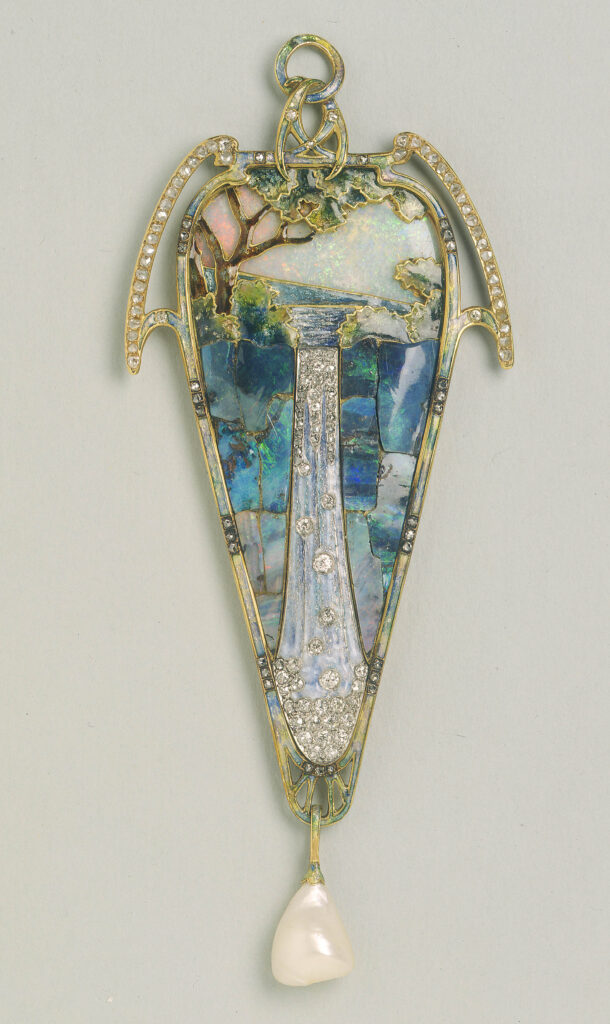
Alphonse Mucha, Georges Fouquet, Cascade pendant, c. 1900, Petit Palais, Paris, France. Museum’s website.
One of Alphonse Mucha’s lesser-known artistic endeavors was jewelry design. This was included in his syllabus in the classes he taught at Academy Colarossi starting in 1900. Earlier in his career, he designed several costume jewelry pieces for Sarah Bernhardt. His most important project was a bracelet made from gold and enamel, inspired by Bernhardt’s costume jewelry in Médée. Created with jeweler Georges Fouquet, it spiraled around Bernhardt’s wrist and was said to have hidden her arthritis from the viewing public.
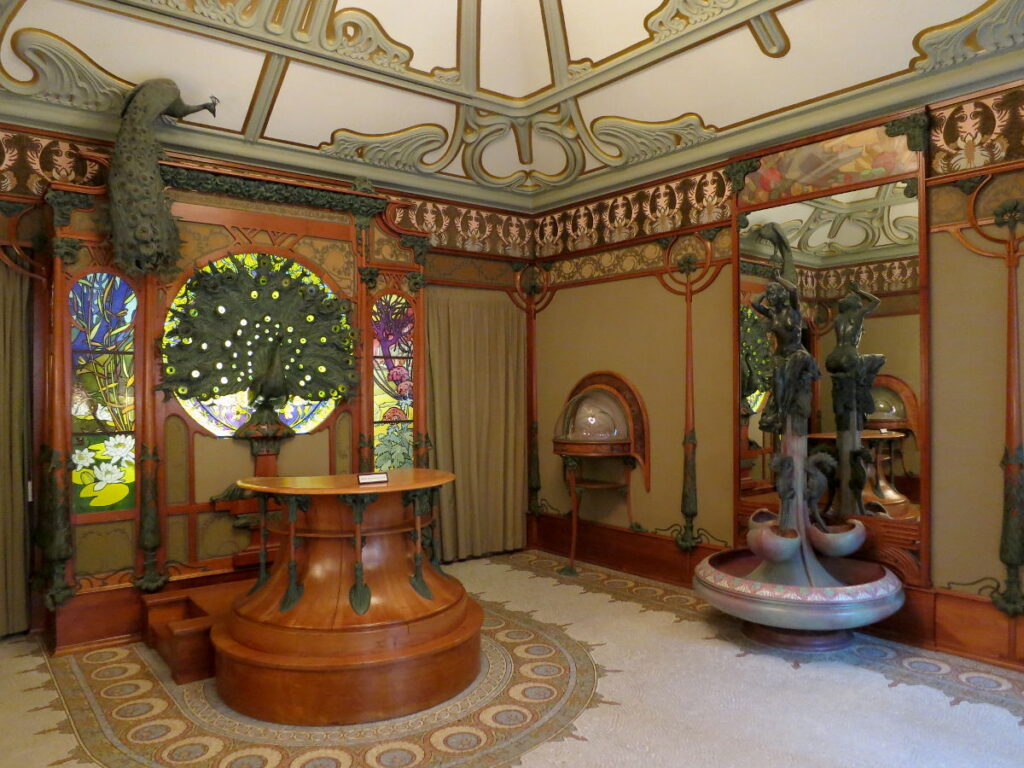
Alphonse Mucha, Georges Fouquet jewelry boutique, 1900–1901, Musée Carnavalet, Paris, France. Photograph by O.Taris via Wikimedia Commons (CC BY-SA 3.0).
Mucha also designed an Art Nouveau jewelry shop for Georges Fouquet, complete with a shell-shaped fountain, bronze peacocks, and 3 gargoyles. The interior was removed in 1923 when artistic tastes changed, but it can currently be found at the Musée Carnavalet in Paris. His best-known jewelry design with Fouquet was the Cascade pendant. This item, in the shape of a waterfall, held a misshapen pearl, tiny diamonds, opals, gold, and enamel.
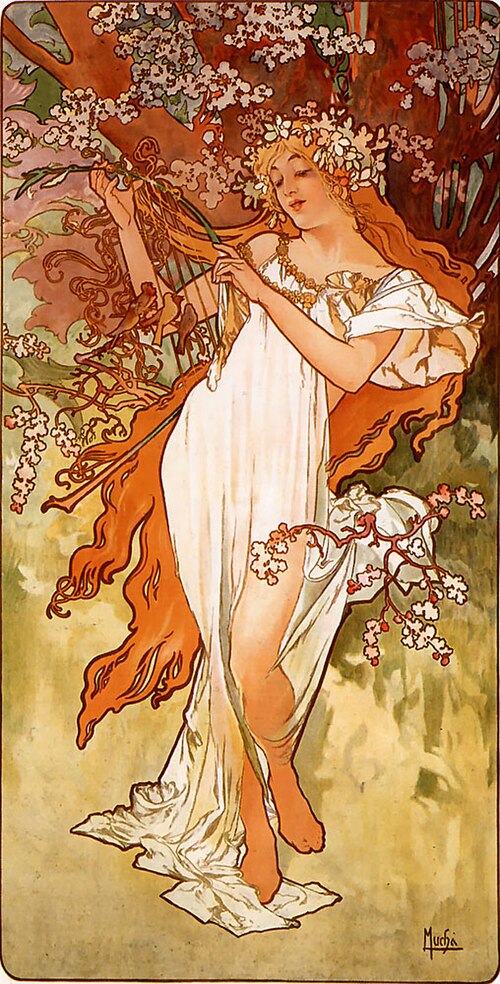
Alphonse Mucha, The Seasons: Spring, 1896, private collection. Wikimedia Commons (public domain).
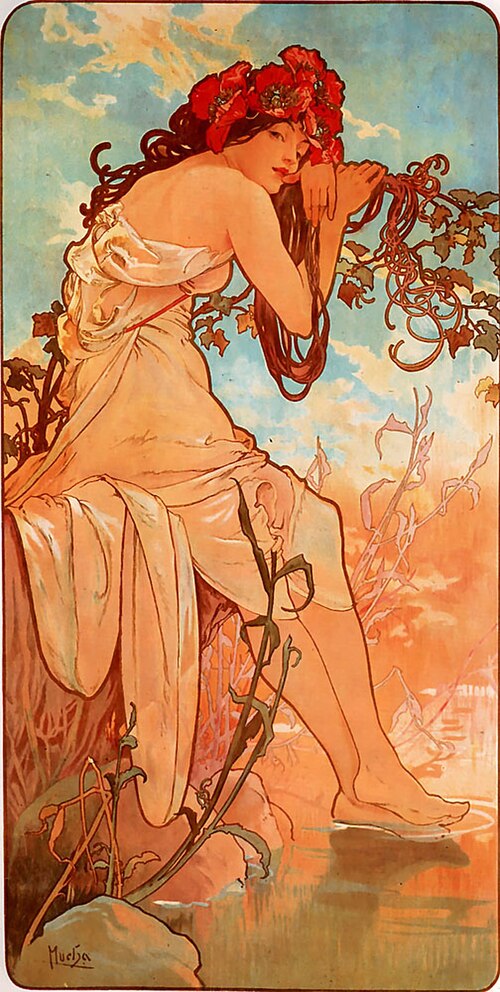
Alphonse Mucha, The Seasons: Summer, 1896, private collection. Wikimedia Commons (public domain).
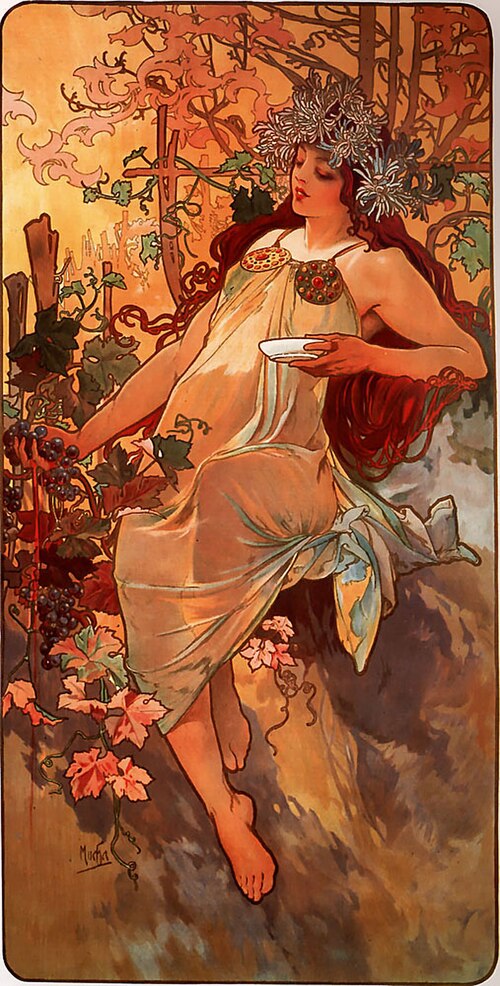
Alphonse Mucha, The Seasons: Autumn, 1896, private collection. Wikimedia Commons (public domain).
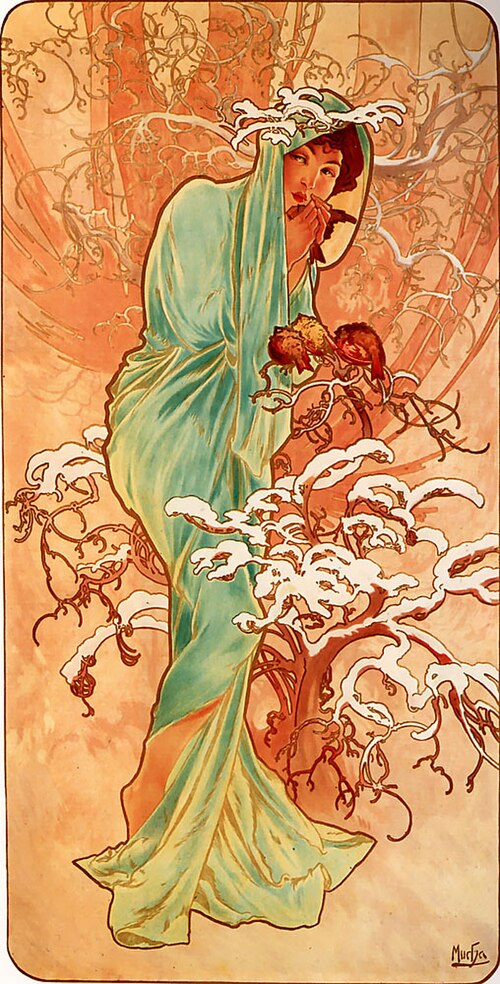
Alphonse Mucha, The Seasons: Winter, 1896, private collection. Wikimedia Commons (public domain).


Every season of the series is represented by a different woman. Summer features a blond woman with a lyre.
Leaning on a branch of grapevine, Summer sports red poppies in her hair.
Autumn wears a wreath of chrysanthemums.
Winter, in green, is wrapped against the cold.
After Alphonse Mucha’s artworks designed for Bernhardt became a sensation in Paris, the artist received an offer from a printer known as F. Champenois. Champenois sought to produce a new type of image, without text, using the Art Nouveau style solely for the art alone. The results were three series of lithographs known as The Seasons. Mucha produced panels using fanciful images of women to represent each season. The paintings carried clear influences from Japanese woodcuts and were very sensual.
Commencing in 1896, the series presented allegorical images of yearly seasons, each portrayed by a beautiful woman. The result was was four distinct portrayals: the innocent gentleness of Summer, the enticing feline expression of Autumn, the smoldering sensuality of Spring, and the amused aloofness of Winter.
A second set with even greater details and bolder colors appeared in 1897 and a third more muted series was offered for sale in 1900. The Seasons are popular to this day, they emerge in prints, books, and designs of various contemporary products. Many who own these uncanny images never learn the full story behind them or about the Art Nouveau master who created them for the joy of the Parisian masses.
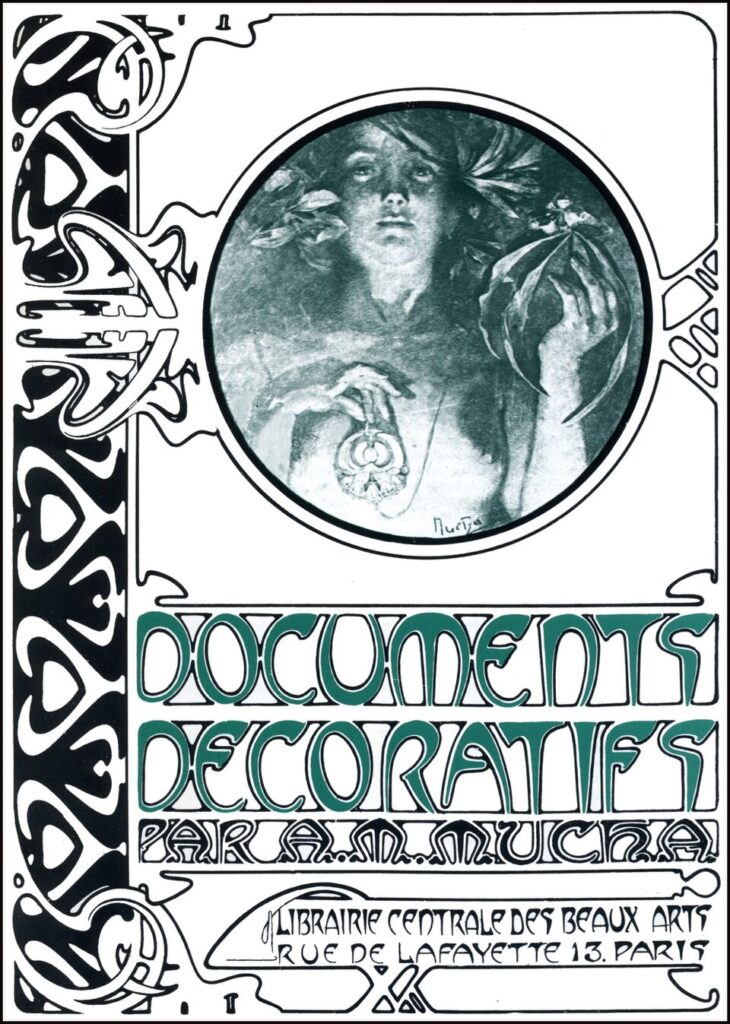
Alphonse Mucha, Cover of Documents Decoratifs 1902. Wikimedia Commons (public domain).
Another lesser-known series by Alphonse Mucha returns to his work as an art teacher. In his life, Mucha taught at prestigious locations such as Musée Carnavalet in Paris, the New York School of Applied Design for Women, the Philadelphia School of Art, and the Art Institute of Chicago. In 1902, he produced a book called Documents Decoratifs.
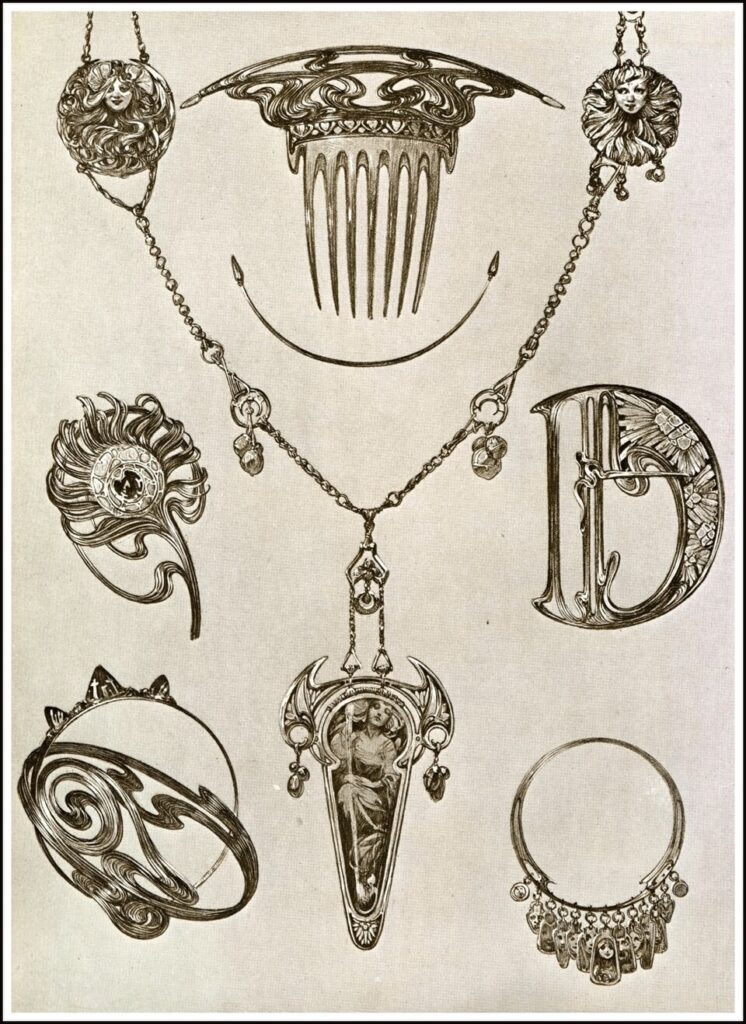
Alphonse Mucha, Page from Documents Decoratifs, 1902. Wikimedia Commons (public domain).
The result was 72 watercolor print plates which held detailed designs for jewelry such as necklaces, brooches, and combs. It featured floral and nature-inspired designs which, at the time, were often overlooked in decoration. In many of them, Mucha incorporated the female form, blending it with the natural elements.
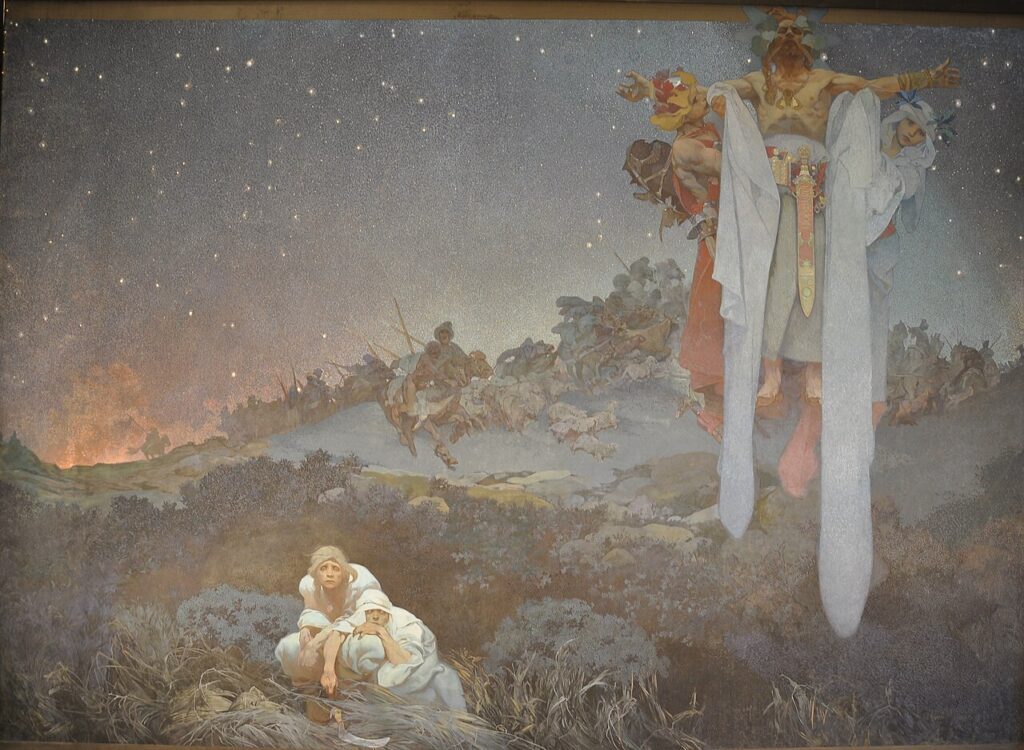
Alphonse Mucha, The Slavs in Their Original Homeland from The Slav Epic cycle, 1912, Prague City Gallery, Prague, Czech Republic.
Alphonse Mucha considered his most important artworks to be the 20-painting series known as The Slav Epic. He painted these detailed images between 1912 and 1926, despite canvas shortages during World War I. Mucha planned each tableau intensely, traveling across the Slavic countries and taking photographs of models dressed in period costumes to ensure a heightened sense of connection between the art and the viewer.
The cycle begins in the “Dark Ages” with the 26-foot tall painting, Slavs in their Original Homeland, subtitled, Between the Turanian Whip and the Sword of the Goths. Mucha presented a dark, semi-occult scene of frightened Slavic people hiding from the invading tribe. Above them loom the hostile warriors and a burning village they left behind in ruins. Floating to the right is a white-robed pagan priest, a symbolic image of war and peace that will come once the Slavs are freed from the oppressors. He concluded the series with Apotheosis of the Slav. This Pan-Slavic work showed the past, present, and future people of these nations united in harmony before Christly images bearing wreaths of peace.
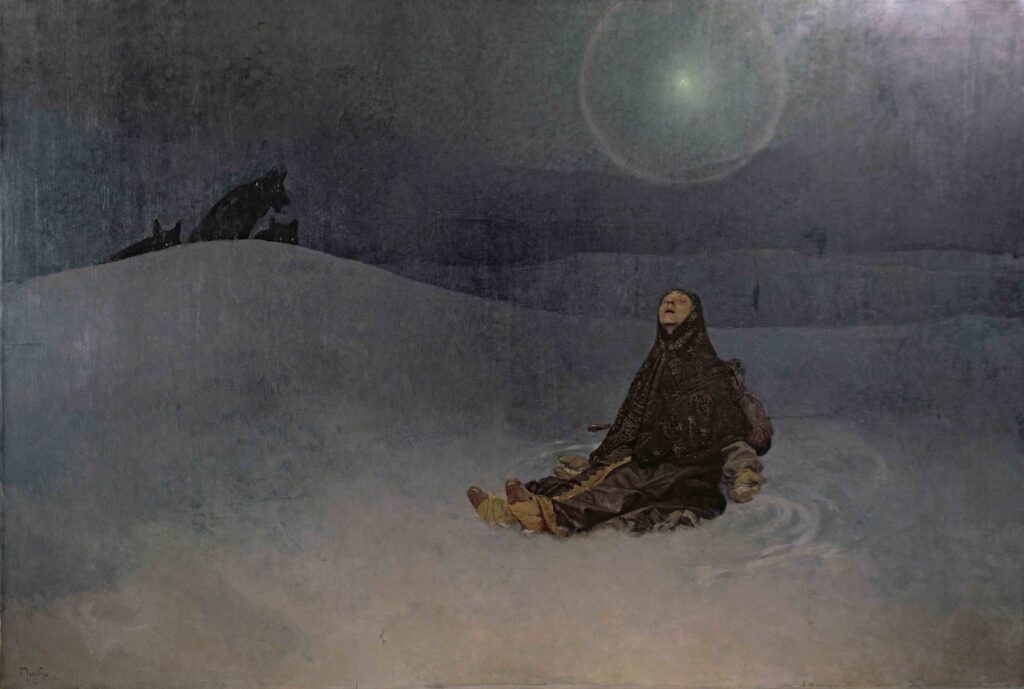
Alphonse Mucha, Woman in the Wilderness 1923, Mucha Museum, Prague, Czech Republic.
One of the most powerful of Alphonse Mucha’s artworks held no connection to his Art Nouveau work nor The Slav Epic. In Woman in the Wilderness, also titled Star or Siberia, the artist presents a peasant woman sitting, mournfully dying in the snow, her eyes closed as if accepting her fate. To her left on a hill, a wolf pack arrives, signaling her inevitable fate. But hovering to her rear is a shining star, suggesting some hope for salvation.
This work emerged from Alphonse Mucha’s sorrow over the fate of the Russian people under the rule of the Bolsheviks. The terrible 1921 Great Famine killed between four and five million Russians in that period and there were widespread outbreaks of cholera and typhus. As a dedicated Pan-Slavic believer, Alphonse Mucha painted Woman in the Wilderness as a way of supporting the starving populace and giving them hope for a better future.
DailyArt Magazine needs your support. Every contribution, however big or small, is very valuable for our future. Thanks to it, we will be able to sustain and grow the Magazine. Thank you for your help!

As an educator, writer, and neurodivergent creative, I enjoy learning and sharing through nature, the arts and novel experiences.
Gustav Klimt’s lavish gold motifs, intricate patterns, and sensuous nudes were as innovative as they were controversial. Breaking from his...
Theodore Carter, 2 July 2026
Ephraim Moses Lilien was an Art Nouveau artist who reimagined traditional Jewish motifs for the modern day. He was also an early supporter of the...
Bec Brownstone 15 December 2025
A dragonfly woman, a golden serpent of opals and rubies, and a woman waiting for an octopus are three short descriptions of authentic Art Nouveau...
Jimena Escoto 24 July 2026
Aubrey Beardsley’s legacy endures, etched into the contours of the Art Nouveau movement. His distinctive style, marked by grotesque imagery and...
Lisa Scalone 14 December 2025



#/media/File:Alfons_Mucha_-_1896_-_Spring.jpg)
#/media/File:Alfons_Mucha_-_1896_-_Summer.jpg)
#/media/File:Alfons_Mucha_-_1896_-_Autumn.jpg)
#/media/File:Alfons_Mucha_-_1896_-_Winter.jpg)

