Summary
- James Abbott McNeill Whistler’s Wapping reflects his shift from Paris to London, blending influences from Old Masters and modern art to depict the everyday life of the 19th-century city.
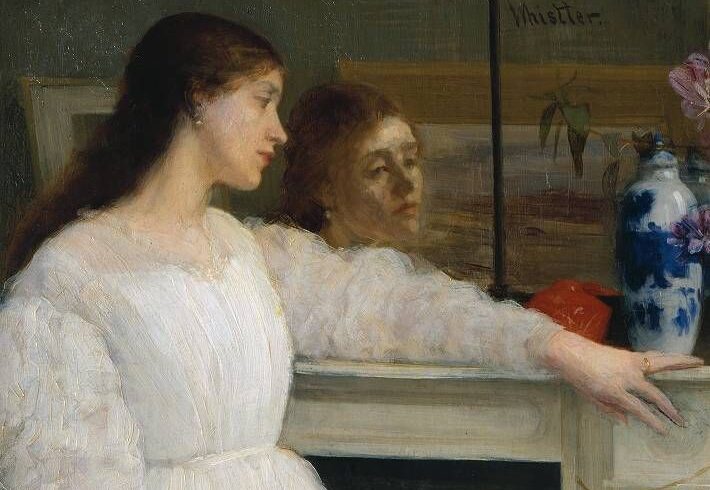
- Symphony in White No. 2 reflects the artist’s “Art for Art’s Sake” approach, portraying Joanna Hiffernan in an interior shaped by Ingres and Pre-Raphaelite influences.
- Three Figures: Pink and Grey reveals Whistler’s fascination with Japonisme and Classical antiquity.
- The Peacock Room demonstrates Whistler’s Aestheticism; the artist transformed a dining room into an immersive blue-and-gold environment where beauty overrides function.
- In Nocturne in Blue and Silver: Cremorne Lights, musical titling emphasizes formal, almost abstract qualities over subject matter, which led to controversy and criticism from John Ruskin.
- Arrangement in Black and Brown: The Fur Jacket showcases Whistler’s experimental technique, with thin paint and loose brushwork creating a tonal surface shaped by texture and accidental effects.
- Sunset, Red and Gold: Salute reflects his Venetian period, when he reinvented his practice through atmospheric, reduced depictions of overlooked city views.
- Whistler devoted himself to printmaking, embracing monochrome tonal effects and subtle abstraction, reflecting the contradiction between his precise draughtsmanship in prints and his desire to eliminate line in painting.
- His later works, including A Shop with a Balcony, anticipate modernism by merging realist motifs with formal experimentation.
- A frequent self-portraitist, Whistler presents in The Artist in His Studio a layered, Japanese-influenced scene of ambiguity, in which dissolving forms and visual illusion blur the boundary between reality and representation.
1. Whistler the Realist
In 1855, West Point dropout James Abbott McNeill Whistler (1834–1903) arrived in Paris in search of a bohemian artist’s lifestyle. American by birth, he had already traveled widely and trained in St. Petersburg. In France, he quickly fell in with Gustave Courbet, Édouard Manet, and others inspired by Charles Baudelaire’s call for a “Painter of Modern Life.”
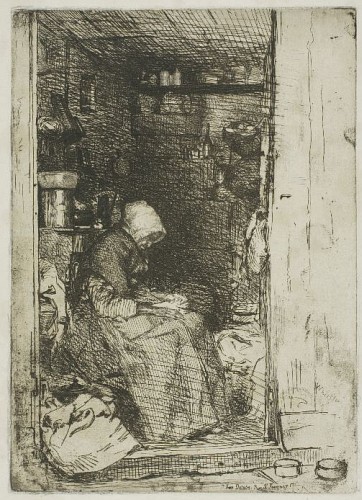
Influenced by 17th-century artists like Rembrandt and Velázquez, Whistler’s early works, like Mère Gérard, were small-scale, roughly painted figures, utilizing a palette of browns, blacks, and creams. He frequently worked on oils and etchings alongside each other: Mère Gérard was a flower seller in the area where he lived, whom Whistler also represented in his French Set prints.
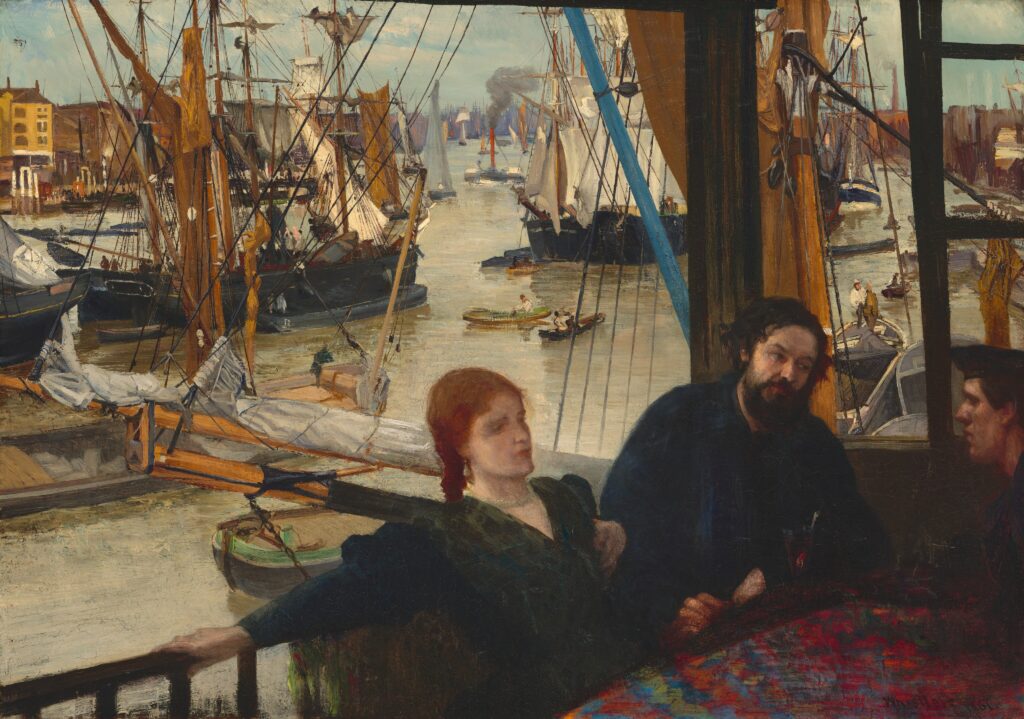
James Abbott McNeill Whistler, Wapping, 1860–1864, National Gallery of Art, Washington DC, USA.
Moving to London in 1859, Whistler was attracted to the working bustle of the Thames. Over an extended period, and in a series of etchings and paintings, he worked on Wapping, which featured the river as a backdrop. Originally intended as a narrative about a prostitute and her pimp, the figures were reworked to become indistinct and incidental. Whistler instead draws our eye out across the water to the warehouses on the far bank and the steam tugs and sailing ships in between.
This was London’s dirty underbelly: the reality of a busy port and polluted river. Whistler was painting from life—he rented a room overlooking the river and explained that his boats would be considered unfinished because they were in reality constantly moving. However, he was also making compositional choices, like the Impressionist-influenced angled, cut-off foreground. The palette, too, was deliberately low-key, with cool blues and greys and slightly sickly yellows. As in Paris, he continued to work on etchings alongside oils: Rotherhithe, part of the Thames Set, mirrors the composition of Wapping, but in portrait format.
2. Whistler and Rossetti
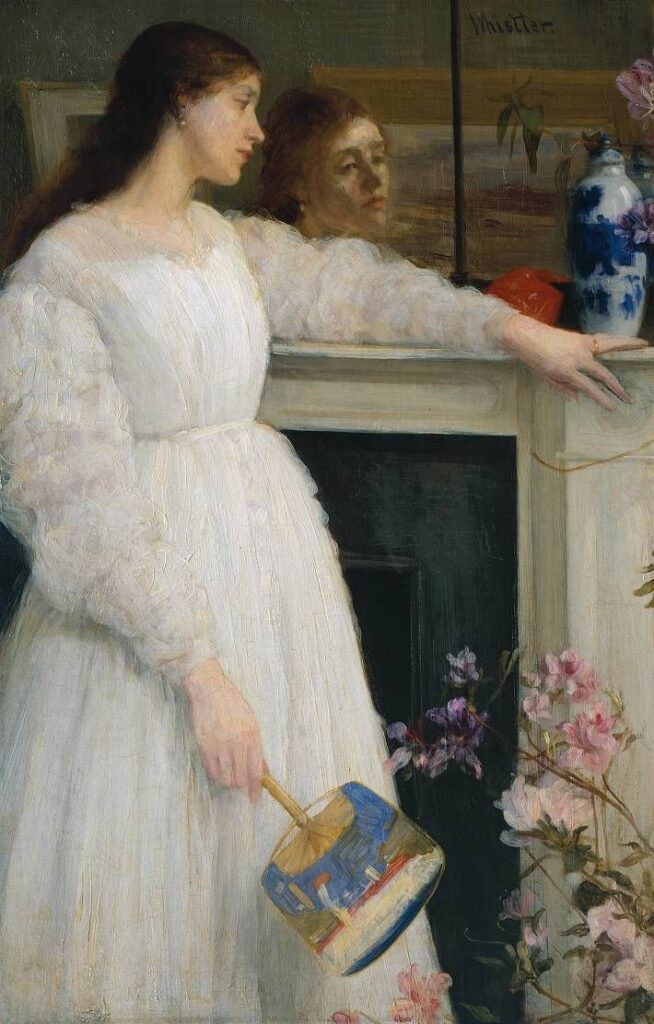
James Abbott McNeill Whistler, Symphony in White, No. 2: The Little White Girl, 1864, Tate, London, UK.
In London, Whistler became a friend and neighbor of Pre-Raphaelite Dante Gabriel Rossetti, who was gaining a reputation for dreamily beautiful images of “stunners.” The two artists were both drawn to the idea of Art for Art’s Sake, that a painting did not need to justify its existence with a narrative subject. Whistler now claimed that Jean-Auguste-Dominique Ingres, known for his sumptuous and erotic odalisques, was an inspiration.
The Little White Girl, later renamed Symphony in White No. 2, was exhibited at the Royal Academy in 1864. The model, Joanna Hiffernan, was the same sitter as in Wapping, but here she dons a wedding ring, Japanese accessories, and stands in a very middle-class interior. Lines from a Swinburne poem, which the painting inspired, were inscribed on the frame, just as Rossetti often attached his sonnets to create “double works of art.” The mirror seemed an homage to Ingres’ portraits, like that of Madame Moitessier.
Critics were convinced this was a wistful or melancholy image of a bride with regrets. Whistler was adamant it was simply a painting.
3. Greece and Japan
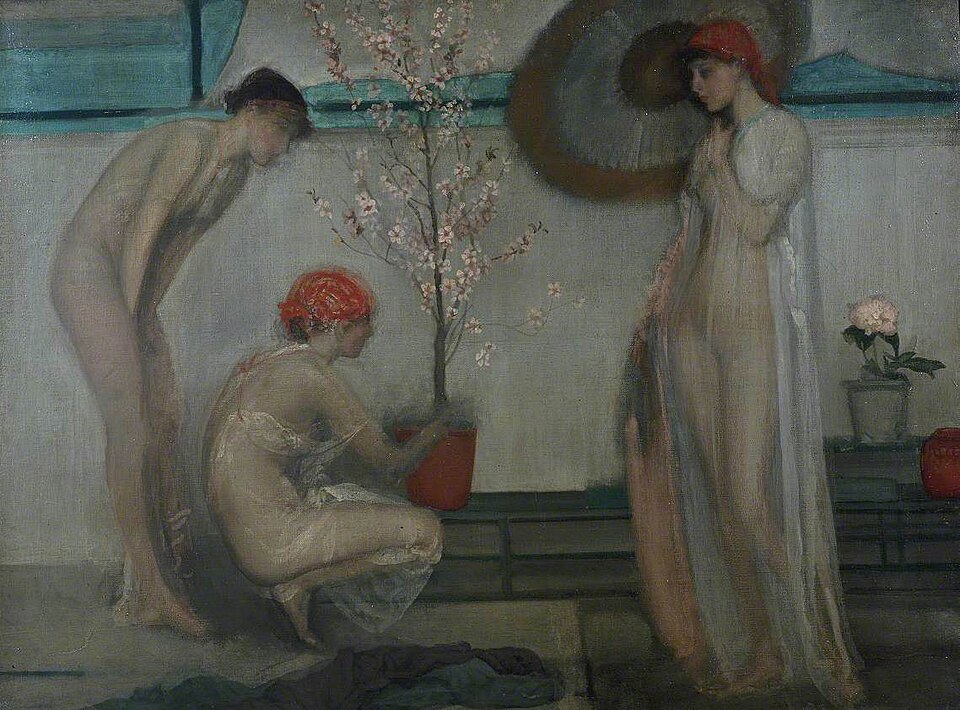
James Abbott McNeill Whistler, Three Figures: Pink and Grey, c. 1868–1878, Tate Britain, London, UK.
Like many artists of the time, Whistler became fascinated by Japanese art and design. Initially, his interest led him to collect objects that were later incorporated into his work, such as the fan and jar in Symphony No 2. Paintings like Princess from the Land of Porcelain, featuring a model in a kimono in front of a Japanese screen, take this interest further than any of his contemporaries. However, the European model and exoticized title suggest Whistler was interested in fantasy rather than authenticity.
He then became more interested in Japanese prints themselves, integrating their flattened sense of space and strong sense of design into works like Nocturne in Blue and Gold: Old Battersea Bridge, which exaggerates a section of the bridge into an abstracted silhouette. Three Figures, which remained unfinished, illustrates both Japanese accessories and flattened stylization, but also encapsulates another of Whistler’s influences. Through his friendship with Albert Moore, he was increasingly interested in classical art, particularly Greek Tanagra figures. For Whistler, both Japonisme and Classicism were ways of creating otherworldly moods in which the subject was secondary to beauty.
4. Whistler the Designer
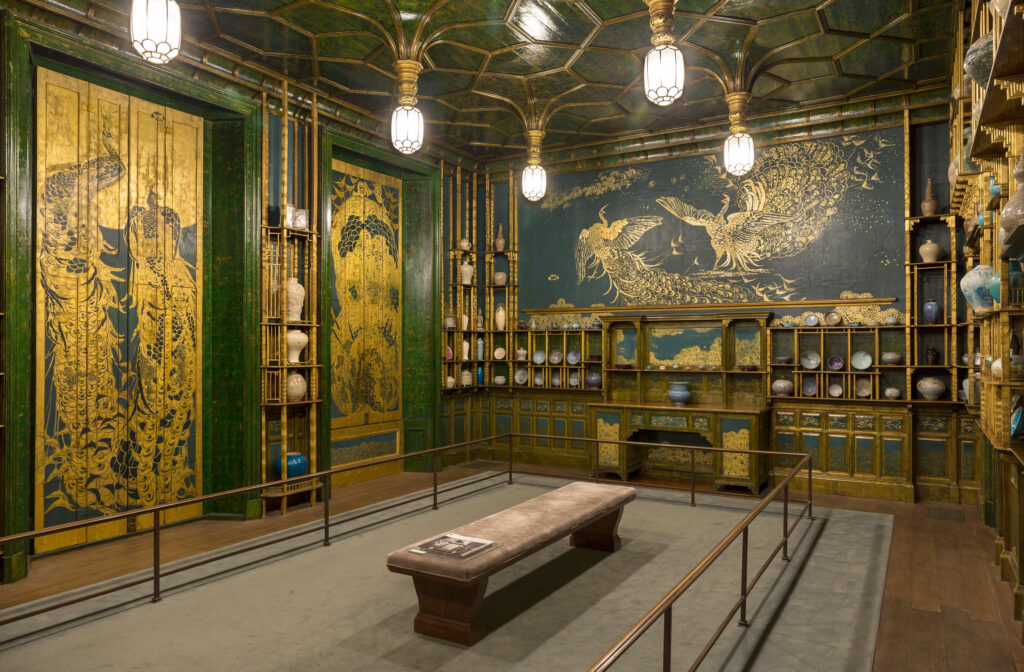
James McNeill Whistler, The Peacock Room, 1876–1877, Freer Gallery of Art, Washington, DC, USA. Photo by Smithsonian’s Freer and Sackler Galleries via Wikimedia Commons (CC BY-SA 2.0).
Art for Art’s Sake or Aestheticism promoted beauty in all aspects of life and encouraged a holistic approach to art. Whistler created his own frames and, in his later career, gave strict instructions about how his works should be hung. For portraits like Symphony in Flesh Color and Pink, he even designed the dress worn by Mrs. Leyland. He spent far too much money creating a perfect studio-house designed by his friend Edward William Godwin. The White House, now lost, had plain walls in grey, green, and blue, matting instead of rugs, and simple, often Japanese-inspired furniture.
Whistler’s best-known piece of design, however, is the Peacock Room, a remodeling of the dining room at Frederick Leyland’s home. It was intended to showcase Leyland’s blue and white porcelain collection and Whistler’s Princess from the Land of Porcelain, which Leyland owned. Whistler took over the remodeling midway through and, without consulting Leyland, spectacularly exceeded the scope of the commission, creating a sumptuous, immersive environment of blue and gold. This led to a falling-out with one of his most significant patrons, but the room remains an exemplar of Aesthetic style.
5. Painted Music
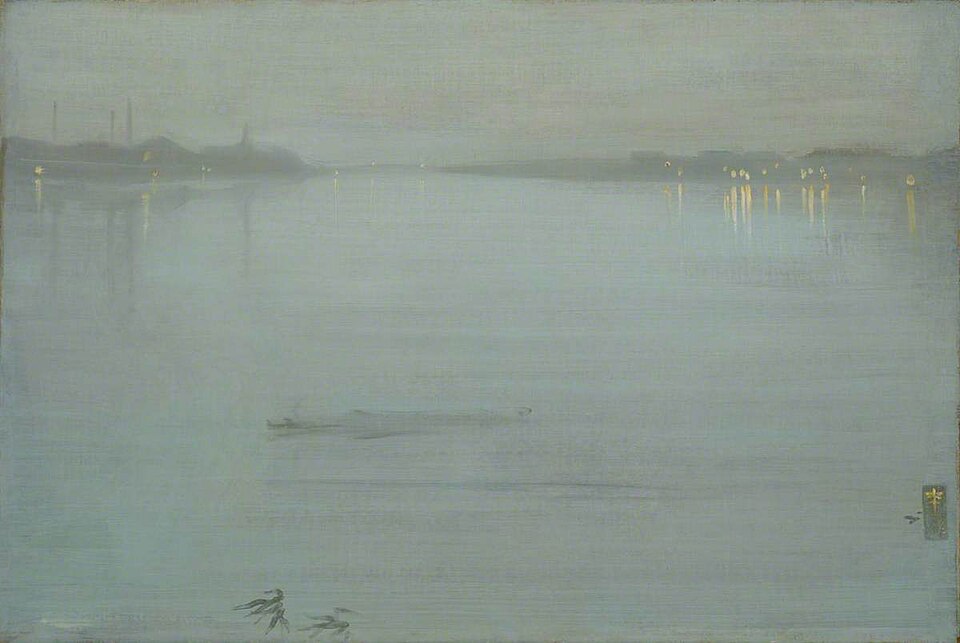
James Abbott McNeill Whistler, Nocturne in Blue and Silver: Cremorne Lights, 1872, Tate Britain, London, UK.
Whistler’s Symphonies in White are just one example of his use of musical descriptors in his titles. His portrait of his mother was an “arrangement”; that of Miss Cicely Alexander was “a harmony”; and during the 1870s, he produced a series of “nocturnes” of the Thames. These titles allowed Whistler to emphasize the formal qualities of his work (color, composition) over subject matter. They also followed Aestheticism’s interest in blurring boundaries between art forms to increase the audience’s experience and engagement. Whistler himself wrote of painting as “the poetry of sight.”
Cremorne Lights, like the Nocturnes in general, pushed the boundaries of artistic acceptability. The view of the Thames, painted from memory, is abstracted and reduced to almost the point of being unrecognizable. This is a world away from the bustling realism of Wapping. London here is dreamy, eerily empty, and timeless.
Exhibited at the Grosvenor Gallery in 1877, the Nocturnes were subject to a scathing review by critic John Ruskin. Whistler sued him for libel, and the subsequent trial bankrupted the artist (he won but was awarded derisory damages).
6. Whistler’s Technique
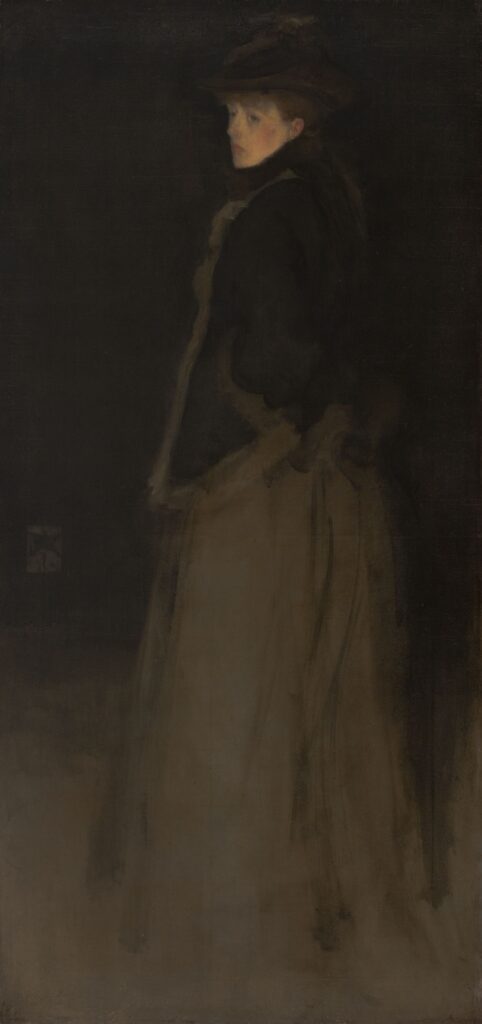
James Abbott McNeill Whistler, Arrangement in Black and Brown: The Fur Jacket, 1876–1877, Worcester Art Museum, Worcester, MA, USA.
It was not just Whistler’s approach to the subject that was radical. He was also experimental in his use of paint. Working with thinned-down pigments on an unprimed canvas, his colors soaked into the weave, leaving its texture visible as an integral part of the final effect. Sweeping brushstrokes and translucent paint give his oils an almost watercolor appearance. In works like The Fur Jacket, it is possible to see where the thin paint has dribbled down the canvas—and Whistler was happy to leave it as part of the finished work.
Whistler also used long-handled brushes, which allowed him to stand further back from his canvas and lessened his precision. His works were often considered unfinished by contemporaries, with figures emerging from the shadows, their outlines barely defined, their feet and hands melting away. Yet, unlike the Impressionists’ interest in contrasting color and light, he employed a tonal approach, working with a limited palette to give his work a mood-inducing cohesion.
These uncontrolled elements, however, were balanced by his painstakingly slow approach. Whistler worked on paintings, including portraits, for months, often scraping down and reapplying details. Falling Rocket, criticized as “flinging” paint, was actually reworked several times to position the firework dots exactly as he wanted. Whistler was a perfectionist who wanted to give the impression of careless immediacy.
7. Whistler in Venice
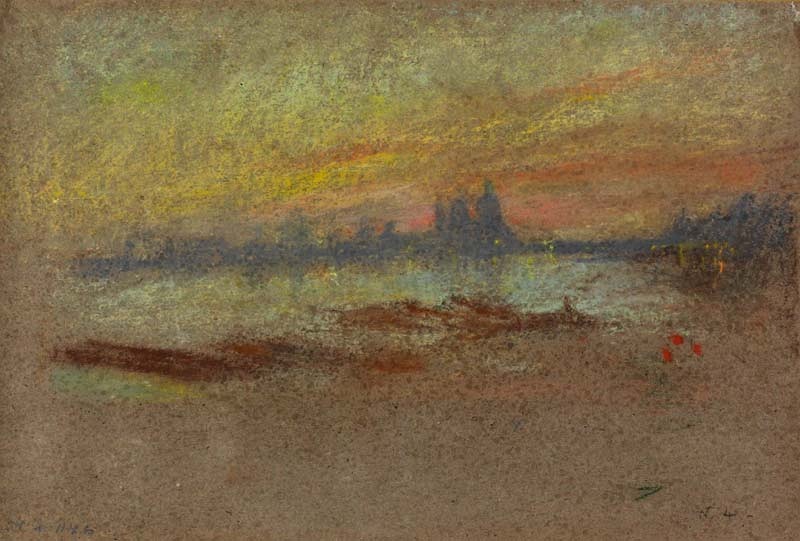
James Abbott McNeill Whistler, Sunset, Red and Gold: Salute, 1880, The Hunterian, University of Glasgow, Glasgow, UK.
Effectively driven into exile by his bankruptcy following the Ruskin libel trial, Whistler was thrown a lifeline by the commission to produce 12 etchings of Venice. He stayed in the city far longer than he intended, producing over 50 prints and hundreds of other drawings. Whistler reinvented himself in Venice, working on a much smaller scale, often outdoors, often in pastel, chalk, or watercolor. His representations were the barest of sketches, hints of color and form.
If Whistler reinvented himself, he also reinvented the way Venice was represented. The city had been a magnet for artists since the 18th century, but they had consistently depicted the grand sights—like St. Mark’s or the Bridge of Sighs. Whistler largely ignored these, and when he did show them, as in Santa Maria della Salute in Sunset, they became incidental and unrecognizable.
Most of the Venice works show backstreets and courtyards. It was almost as if Whistler was going back to his realist roots, although mundane life, dirt, and grime were given an ethereal, unfinished magic.
8. Whistler the Printmaker
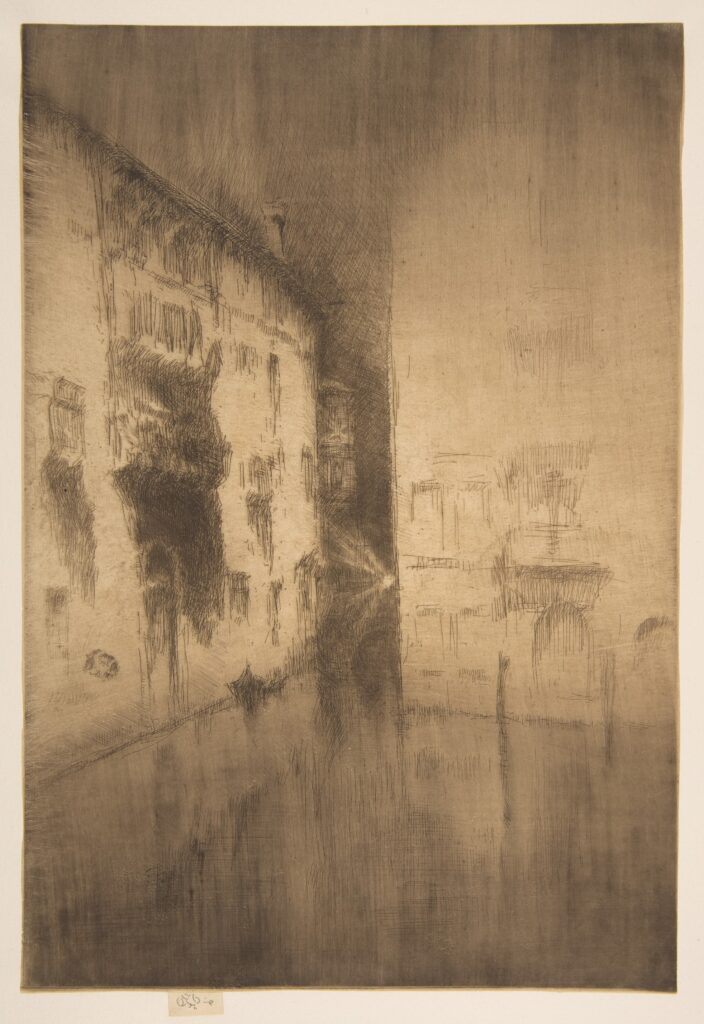
James Abbott McNeill Whistler, Nocturne: Palaces, 1878–1880, National Gallery of Art, Washington, DC, USA.
Whistler trained as a topographical draughtsman and printmaker, first at West Point, then with the U.S. Coast and Geodetic Survey. His brother-in-law, Francis Seymour Haden, was a keen amateur printmaker with whom Whistler worked in the mid-1850s. The period also saw a general revival of interest in printmaking, and arguably, there was a commercial imperative: prints sold easily, and Whistler was often in need of money.
However, Whistler’s well over 600 prints, many made with innovative techniques, were more than just jumping on a bandwagon or mirroring his experiments in paint. They ranged from detailed realist etchings of Paris and London, often worked directly outside onto the copper plate, to the Pre-Raphaelite-influenced Weary and later flirtations with Impressionism. He increasingly used lithography, lithotint, and drypoint to create subtle indistinctness: in Palaces, insubstantial buildings appear to dissolve into the Venetian canal.
It is one of Whistler’s many contradictions that he was such an enthusiastic draughtsman in print but sought to eliminate line in his painting. Yet for an artist interested in tonalism, the attraction of working in monochrome was obvious.
9. Whistler the Modernist?
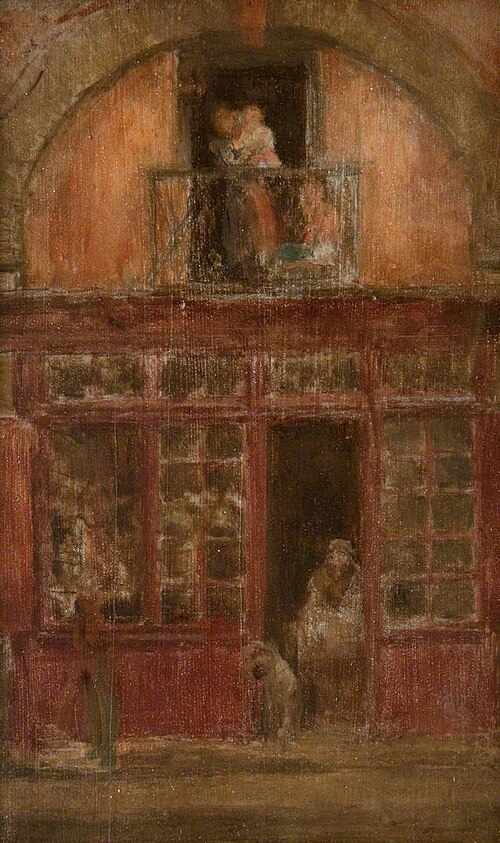
James Abbott McNeill Whistler, A Shop with a Balcony, c. 1899, The Hunterian, University of Glasgow, Glasgow, UK.
With the controversy and proto-abstraction of the Nocturnes, it is tempting to see Whistler as a forerunner of modernism. He knew the Impressionists, although like Manet, he refused to exhibit with them. He had contacts in radical groups like Les XX in Brussels and the Vienna Secession. In linking art and music, he prefigured Wassily Kandinsky. By the end of his life, he was influencing the next generation, like Walter Sickert and Gwen John. Like many 20th-century practitioners, he was a showman who publicized himself and his ideas.
Whistler’s later work, like A Shop with a Balcony, at first glance seems like a return to his realist roots, with dirty buildings and street children. On closer inspection, however, reality is just a convenient vehicle for artistic experimentation. The building is decontextualized, flattened into a formal pattern, as the Nabis did with their interiors and the Post-Impressionists did with landscape. The materiality of the work dominates, with its scraped-back paint surface and pencil underdrawing.
10. Whistler the Butterfly
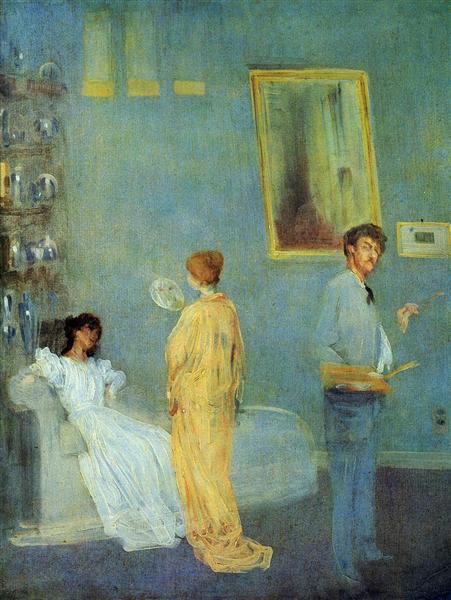
James Abbott McNeill Whistler, The Artist in His Studio, 1865–1866, Art Institute of Chicago, Chicago, IL, USA.
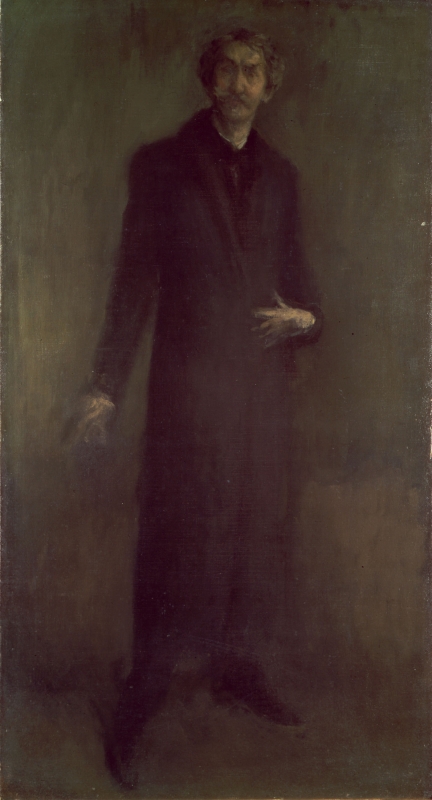
Whistler represented himself in a number of self-portraits, from a young Bohemian in a dashing Courbet-esque hat to an aging star, emerging from the Brown and Gold shadows. Perhaps most tellingly, he developed a monogram, inspired by his enthusiasm for Japanese art, in the shape of a butterfly, to which later he added a stinging tail. Whistler flitted about: he knew everyone and fell out with most; he became ever more restless and unsatisfied.
The Artist in His Studio encapsulates all this. Whistler stands at his easel, with a provocative tilt of his head, channeling Velázquez’s Las Meninas. His studio is full of Japanese objects. The models, one in white, could be there for any number of paintings. A print hangs on the wall. The mirror adds extra ambiguity. Everything is insubstantial: Whistler’s legs dissolve, his hand seems detached from his body, and the furniture shows through the figures. He has created a world, recreated it in paint, and then made us, the viewers, doubt it. The more you look, the more perplexing Whistler’s work becomes. That is what makes him so endlessly interesting.
James McNeill Whistler is on view at Tate Britain until September 27, 2026.