
Between the Body, Nature, and Image: Ana Mendieta at Tate Modern
It is not uncommon for an artist to become known primarily through the circumstances of their life rather than through the complexity of their work.
Ania Kaczynska 6 August 2026
29 January 2026 min Read
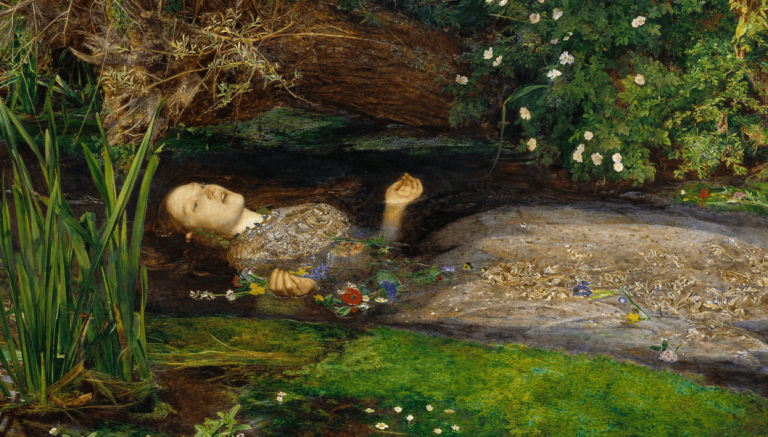
John Everett Millais, Ophelia, 1851-1852, Tate Britain, London, UK.
When did you last read a book that made you angry but still wanted to read on? What is a no-legs woman? Are pockets political? Might tanning be racist? What does it mean to have a bicycle face and is it fine? Do we live in a Matrix? If these questions make you wonder, read Virginia Nicholson’s book, perversely named All the Rage.

Cover of All the Rage by Virginia Nicholson, 2024.
Busy with everyday life, we rarely question the reality we fight through and even rarer its rules. Especially when it comes to such vain things as appearance. We are too focused on keeping up appearances to get a broader look at why we actually do that. This job Nicholson does for us.
Did you know that not that long ago in America there were women publicly beaten up because their swimming suit trouser legs were too short? Women were burned alive not even because someone called them witches but because their crinolines were set on fire by coincidence. Or got pulled by the factory machines and they were drawn in. Women were dying because of complications after injecting paraffin in their noses and because of dieting. Wait, they still are.

Virginia Nicholson. Royal Society of Literature.
Virginia Nicholson, a very skilled non-fiction writer, Fellow of the Royal Society of Literature deals with social history, especially focused on women and does it brilliantly in her book, All the Rage. Stories from the Frontline of Beauty: A History of Pain, Pleasure, and Power 1860–1960. Nicholson is a granddaughter of Vanessa Bell and great-niece of Virginia Woolf. The latter is present in the book among a myriad of fascinating women from our history, some well-known to art enthusiasts, like Jane Morris or Elizabeth Siddal, some dug out for us by the author, forgotten heroines and martyrs brought back to remembrance.

John Everett Millais, The Knight Errant, 1870, Tate Britain, London, UK.
From their stories, Nicholson builds a history of beauty standards and oppression in a very attractive, pictorial way. When you read about the corsets and petticoats you actually feel their hampering burden on your body. Nicholson serves you a well-curated huge chunk of knowledge that is skillfully hidden in a lively, story-like narrative form. Not only easy to digest—it is in fact, a very tasty meal for the mind.
What I cherished especially, is the book’s broad inclusiveness. There are not only white ladies involved, but there are also their servants and milliners, Black women trying to straighten their hair and fight through their way up the society. Nicholson made an effort to find hardly recorded early lesbian and transgender stories. The book is written with compassion and tenderness which works as a soothing balm after all the punches we get from the pages just filled with history (or rather herstory).

John Lavery, A Lady in Black and Green (Mrs. Freda Dudley Ward). Christie’s Images/Bridgeman Images.
Virginia Nicholson reminds the infamous quotation of John Berger, that men just look at women and women watch themselves being looked at, and illustrates this sad truth with many real stories of women who tried too hard. What I found most striking, are the parallels between the Victorian times and today. This is a question that is asked several times in the book, how far did we get? How free are we now? Didn’t we go from no-legs to the legs terror? From corset thinness to (much harder) naked thinness? We bargained a full body cover and discomfort for an (almost) naked body under constant rating—was it a real deal?
And suddenly you see that the history of beauty is not all about frocks, laces, and make-up. It is, in fact, a story about women’s emancipation. Nicholson sets a question if this emancipation was full or enough. About today’s pushed-to-the-limit beauty standards, she says:
It’s a fiction that we can never live up to.
We need to rewrite the story.All the Rage, p. 444.
I am in, read All the Rage and join us.
All the Rage. Stories from the Frontline of Beauty: A History of Pain, Pleasure, and Power 1860–1960 was published in 2024 by Pegasus Books. It is a nicely designed book with many illustrations, a fair bibliography, and a useful index. To get to know more about Virginia Nicholson, visit her website.
DailyArt Magazine needs your support. Every contribution, however big or small, is very valuable for our future. Thanks to it, we will be able to sustain and grow the Magazine. Thank you for your help!

DailyArt Magazine Editor-in-Chief holding a PhD in art history; editor, writer, stylist, and adamant traveler almost constantly on the move.

Antonia Chela is an avid art history fan, always seeking to know more about the wonderful world of art! She is a student of museum studies, and she is interested in learning about all aspects of the art world, current, past and future.
It is not uncommon for an artist to become known primarily through the circumstances of their life rather than through the complexity of their work.
Ania Kaczynska 6 August 2026
Very few artists can claim to be as ubiquitous and iconic as Frida Kahlo. This hotly anticipated exhibition at Tate Modern delves into how and why...
Edoardo Cesarino 6 July 2026
Few museums can trace their origins to an act of collective generosity. Fewer still continue to build their identity around that same principle...
Zuzanna Stańska 17 August 2026
Back in 1998, the Hayward Gallery was the first to host a major exhibition of Anish Kapoor’s work in the UK. Now, in the year of the Southbank...
Edoardo Cesarino 22 June 2026