

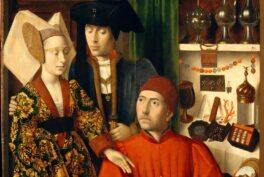
Masterpiece Story: A Goldsmith in His Shop by Petrus Christus
At first glance, A Goldsmith in His Shop (1449) appears to depict an ordinary visit to a jeweller. Yet Petrus Christus transformed an ordinary...
Shivani Gupta 23 August 2026
14 July 2026 min Read
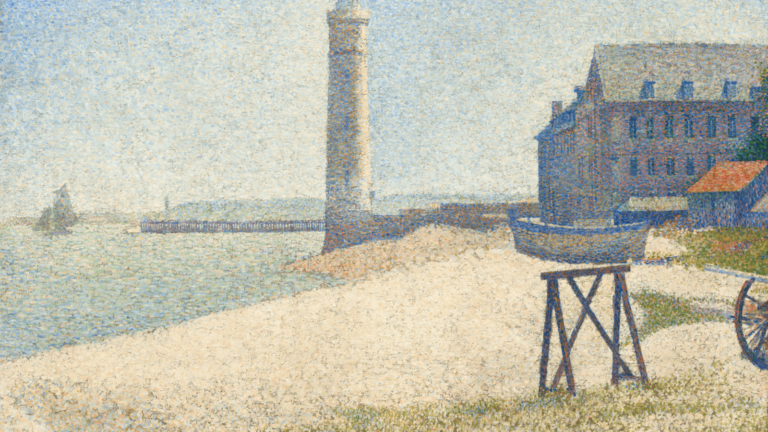
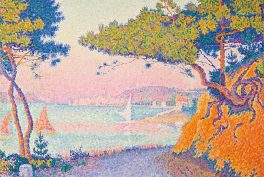
Georges Seurat, The Lighthouse at Honfleur, 1886, National Gallery of Art, Washington, DC, USA. Detail.
The Lighthouse at Honfleur is a Pointilist painting by the French artist Georges Seurat. Let’s learn a little more about what made his paintings, and especially this one, so unique.
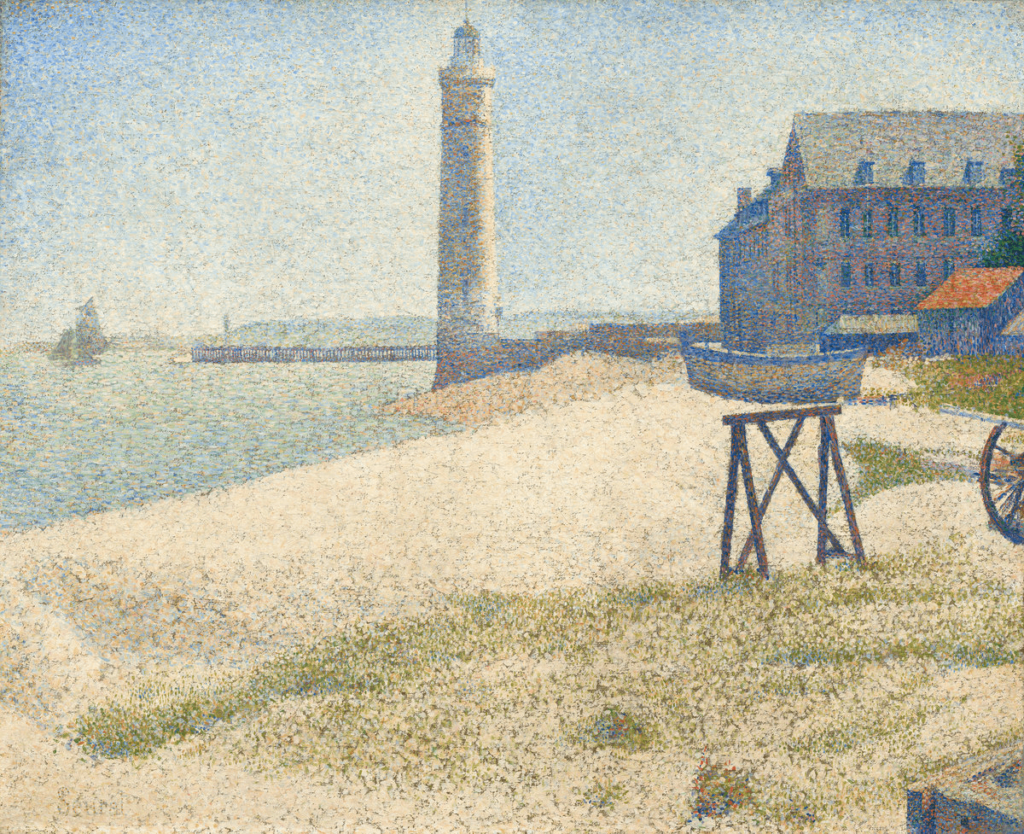
The first thing you’ll probably notice about this painting, as well as Seurat’s famous A Sunday Afternoon on the Island of La Grande Jatte, is that it’s made of tiny little dots. To 21st-century eyes, it might look pixilated. But, of course, pixels didn’t exist in Seurat’s day. So, what’s going on here?
Georges Seurat (1859–1891) developed and practiced a style that came to be known as Neo-Impressionism. Neo-Impressionism was very interested in optics, which is the study of light, particularly as it relates to sight. Seurat and other Neo-Impressionists wanted to use new ideas in optics to make more effective paintings.
The dots that you see in The Lighthouse at Honfleur represent one way in which Seurat attempted to do that. He believed that putting tiny dots of complimentary colors next to each other and letting the viewer’s own eyes mix them would create more effective colors than he could achieve by mixing paint. This practice is also sometimes called Pointillism or Divisionism, depending on whether dots or short lines of color were used.
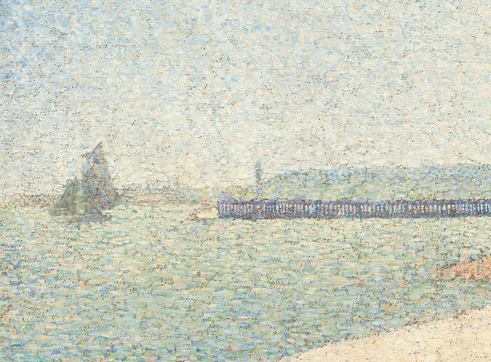
The term Neo-Impressionism suggests that Seurat’s art had something in common with Impressionists, and he did exhibit at the 8th Impressionist exhibition in 1886. He also shared subject matter, including landscapes, bathers, and scenes of modern life, with artists like Claude Monet and Auguste Renoir. The seascape in The Lighthouse at Honfleur could be easily painted by Monet as well. However, Seurat is more correctly considered a Post-Impressionist—someone who started with the Impressionists’ ideas and developments but then took them in his own direction.
Unlike the Impressionists, whose very name came from their emphasis on spontaneity and momentary visual “impressions”, Seurat’s focus was thoughtful and scientific. Besides reading widely on optics, he also made many studies before completing major paintings like La Grand Jatte.
Neo-Impressionism never became a popular style, but it had a big impact on the future of art. Seurat influenced many generations of later modernists, including Vincent van Gogh and the Surrealists.
Dita Amory. “Georges Seurat (1859–1891) and Neo-Impressionism.” In Heilbrunn Timeline of Art History. New York: The Metropolitan Museum of Art, 2000–. (October 2004).
The Art Story Contributors.”Georges Seurat Artist Overview and Analysis, TheArtStory, 2018.
“The Lighthouse at Honfleur“. National Gallery of Art, Washington, DC, USA.
DailyArt Magazine needs your support. Every contribution, however big or small, is very valuable for our future. Thanks to it, we will be able to sustain and grow the Magazine. Thank you for your help!

Alexandra Kiely is an independent art historian based in the greater New York area. Her work focuses on making art, architecture, and art museums understandable to a general audience. She is the author of The Art Museum Insider, a book that guides those without art history training to have more informed and empowered experiences with art. Visit her website, A Scholarly Skater, and follow her on Instagram.

At first glance, A Goldsmith in His Shop (1449) appears to depict an ordinary visit to a jeweller. Yet Petrus Christus transformed an ordinary...
Shivani Gupta 23 August 2026
With Virgin and Child as a cornerstone of her reputation, Elisabetta Sirani should be recognized as an important Italian Baroque artist. Far more...
James W Singer 16 August 2026
Anthony van Dyck was one of the great portraitists of the 17th century. It is largely through his eyes that we now view the doomed reign of Charles I...
Catriona Miller 17 August 2026
Ostracon of a Dancer is one of the boldest and most individualized masterpieces of ancient Egyptian art. Its composition and remarkable sense of...
James W Singer 26 July 2026