



Masterpiece Story: Judith and Holofernes by Caravaggio
Judith and Holofernes is a Caravaggio masterpiece that captures Biblical murder and drama. Rarely has death been captured so intensely and violently...
James W Singer 13 September 2026
4 March 2024 min Read

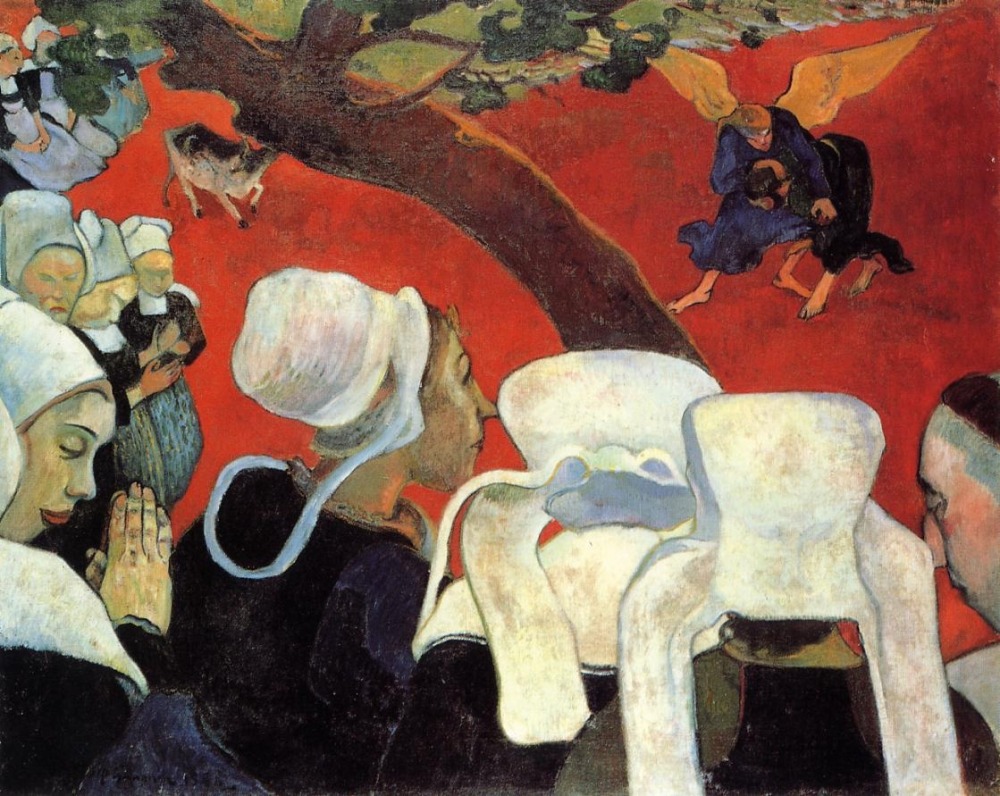
Paul Gauguin, Vision after the Sermon (Jacob Wrestling with the Angel), 1888, Scottish National Gallery, Edinburgh, UK.
Paul Gauguin’s Vision after the Sermon is one of the most important works in the artist’s oeuvre. Painted in Brittany, its rich symbolism and unique aesthetic marked a shift in Gauguin’s art from Impressionism to Synthetism. Let’s delve into it!
The painting is divided into two parts by a large diagonal tree trunk, which reminds us of Japanese woodcuts. The foreground is filled with a group of women dressed in traditional Breton costumes (the caps!), returning from Mass. In the background we see two characters fighting. The ground is red – bloody red. Gauguin viewed Breton peasants as exotic, and here they are depicted as flat silhouettes and painted in bright colors and simplified shapes.
In the Vision, which is also known as Jacob Wrestling with the Angel, Breton women observe an episode described in Genesis 32: 22-31 in which Jacob wrestles with a stranger who turns out to be an angel. Gauguin suggests thereby that the faith of these pious women (and a priest) enabled them to see miraculous events of the past.
The red ground is, in fact, the river Jabbok. In this biblical context, the red field is significant, dividing the lands of struggle and the land of peace. Traditionally, the message of the biblical story shows Jacob struggling with his conscience, and with other men. God, represented by the angel, stands for truth and redemption, sometimes difficult to obtain. After the struggle and the angel’s blessing, Jacob was able to continue his journey, crossing the river into the Promised Land – seen in the distant background of the painting.
The painting is full of symbols. The apple tree (tree of knowledge from Eden?) in the painting symbolizes man’s decision to distinguish between good and evil (remember Adam and Eve?). Its green foliage symbolizes also the promise of man’s redemption and his return to Paradise. 12 Breton women and a priest watch the event – 12 is an important number in itself, representing Jacob’s offspring which founded the 12 tribes of Israel.
The cow we see on the left is the symbol that reveals the means of man’s redemption – only through toil and work one can achieve salvation. In addition, it is also the symbol of four Breton saints venerated as protectors of horned beasts–Saints Cornlèy, Nicodème, Herbot, and Theogonie.
Gauguin wrote about this work in an 1888 letter to Van Gogh (then a friend):
Grouped Breton women, praying, very intense black dress — very luminous yellow white hats. The two hats on the right are like freakish helmets — an apple tree traverses the canvas, dark purple, and the foliage is drawn in masses like emerald green clouds with sunny yellow-green interstices. Ground pure vermilion. At the church it declines and becomes red brown. The angel is dressed in strong ultramarine and Jacob in bottle green. Angel wings pure chrome yellow no. 1 — Angel’s hair chrom no. 2 and feet orange flesh — in the figures I think I’ve attained great simplicity, rustic and superstitious — all very severe — The cow underneath the tree, tiny compared to reality, is bucking — For me, the landscape and wrestling match in this picture exist only in the minds of the people praying after the sermon, that’s why there’s a contrast between the natural people and the wrestling match in a non-natural, disproportionate landscape.
Paul Gauguin
Rodolphe Rapetti, Symbolism, Deke Dusinberre, trans. (Paris: Flammarion, 2006), pp. 108–9.
This painting marked a breakthrough in Paul Gauguin’s career as an artist. He became the leader of the Pont-Aven School which included the painters Paul Sérusier, Émile Bernard, Charles Laval, Louis Anquetin, Armand Séguin, and Jacob Meyer de Haan. The style developed in Pont-Aven by Gauguin and Bernard was known as Synthetism because it synthesized, or combined, images, producing a new result that was quite different from Impressionism. It relied on a number of principles including the abandonment of faithful representation, the creation of a work based on the artist’s memory of the subject and his feelings, the bold application of pure color, and the absence of perspective and shading. Everything mentioned here can be seen in Paul Gauguin’s Vision after the Sermon.
Gauguin tried to present this painting as a gift to two local churches, but it was rejected on the notion that it was not serious or that it would scare the parishioners. Now it belongs to the Scottish National Gallery, Edinburgh. It’s hard to tell if it scares any visitors.
DailyArt Magazine needs your support. Every contribution, however big or small, is very valuable for our future. Thanks to it, we will be able to sustain and grow the Magazine. Thank you for your help!

Art Historian, founder and CEO of DailyArtMagazine.com and DailyArt mobile app. But to be honest, her greatest accomplishment is being the owner of Pimpek the Cat.

Judith and Holofernes is a Caravaggio masterpiece that captures Biblical murder and drama. Rarely has death been captured so intensely and violently...
James W Singer 13 September 2026
Explore an astonishing 1915 nude self portrait by American modernist painter Florine Stettheimer.
Candy Bedworth 21 September 2026
Winslow Homer (1836–1910) was one of the leading American Realist painters. His painting The Veteran in a New Field is a masterpiece of late...
James W Singer 30 August 2026
At first glance, A Goldsmith in His Shop (1449) appears to depict an ordinary visit to a jeweller. Yet Petrus Christus transformed an ordinary...
Shivani Gupta 23 August 2026