
The Eight Moods of Love: Exploring the Aṣṭa-Nāyikā in Pahari Painting
Love, longing, jealousy, anticipation, and devotion are among the most universal human emotions, and few artistic traditions have explored them as...
Shivani Gupta 22 June 2026
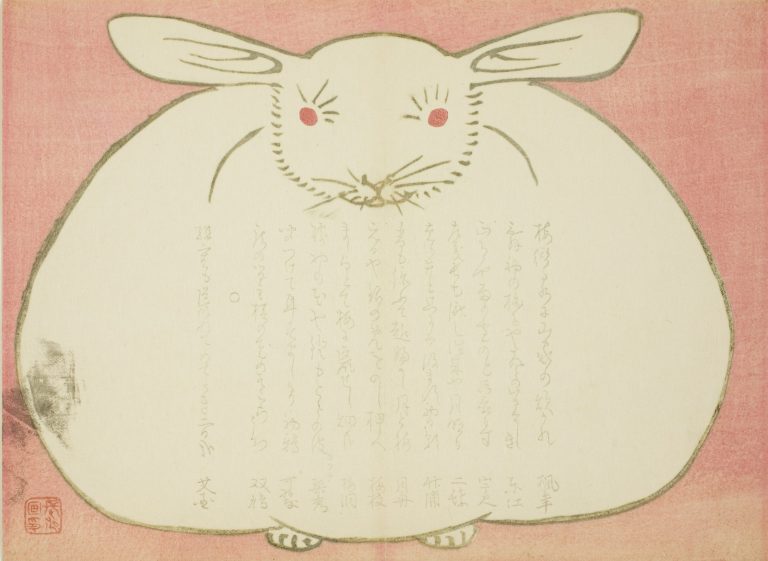
Yabu Chosui, Portrait of a Rabbit, 1867, The Art Institue of Chicago, Chicago, IL, USA.
Rabbits have long held a special place in Asian art. Few animals have inspired as many stories and images as this humble (and cute!) creature. In East Asian cultures, rabbits turn up everywhere, from ancient legends and tales of the Moon to paintings, prints, and other forms of art. They appear frolicking among waves or gazing at the Moon. Let’s take a look!
Let’s start off with a party. The Lunar New Year (or Spring Festival) is the biggest holiday in China. Festivities last for 15 days—each day has a different name and is associated with different festivities. I wonder which one of New Year’s festivities is celebrated in Sparrow and Rabbits Celebrating New Year by Shibata Zeshin… It looks like the sparrow and rabbit depicted in the center of the painting are enjoying dinner while other rabbits are bringing more snacks—probably a feast full of traditional dishes.
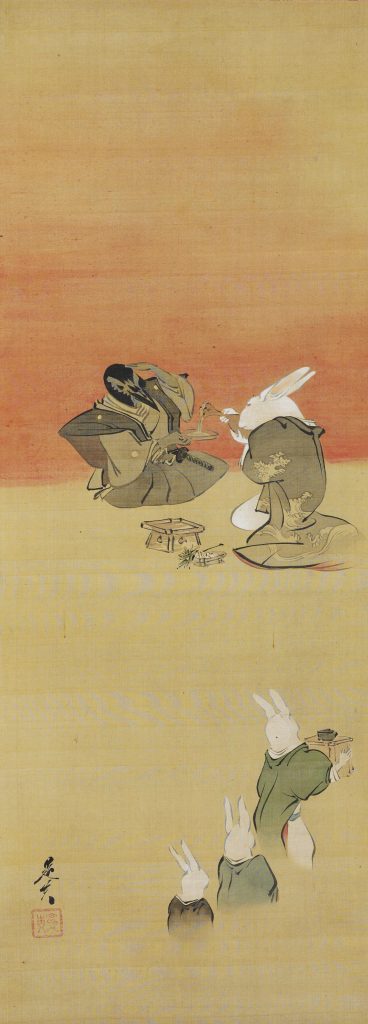
Shibata Zeshin, Sparrow and Rabbits Celebrating New Year, 19th century, private collection. Pinterest.
In the Zodiac cycle, each animal is associated with an element. The most recent Year of the Rabbit—2023, was the Year of Water Rabbit, and this painting depicts rabbits frolicking in the water. According to the Zodiac, Water Rabbit represents gentleness, sophistication, and tenderness. The official painter at Royal Castle at Edo, Kano Osanobu, certainly depicted these two as elegant and sophisticated.
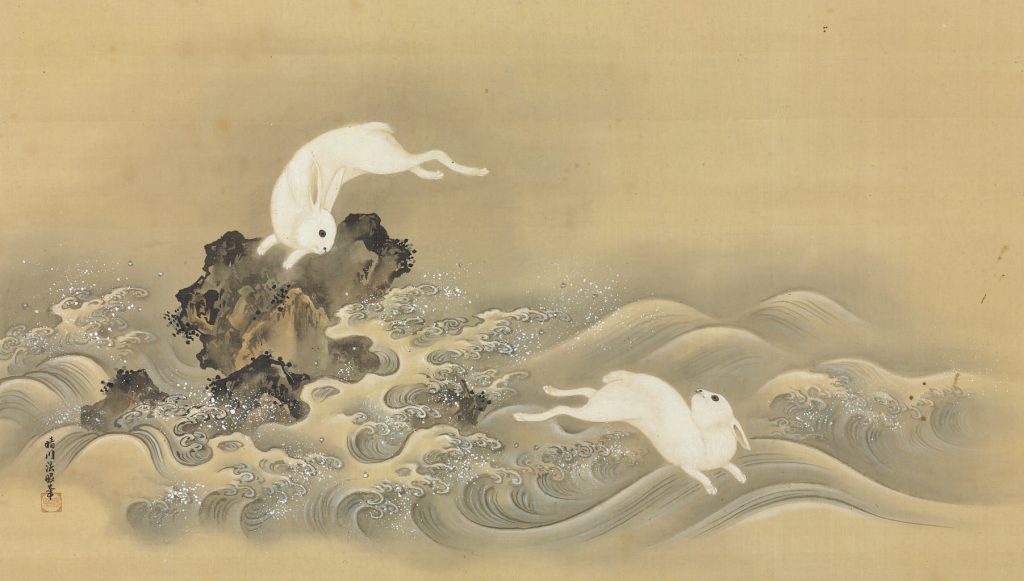
Kano Osanobu, Rabbits Frolicking in the Waves, 1st half of 19th century, private collection. Artnet.
The artist behind these two beautiful rabbits is rather unknown to the wider audience. Nishimura was creating his prints in shin-hanga style – a style inspired by Impressionism. This “new style” of prints was supposed to modernize the old ukiyo-e style in order to please the eye of Western collectors.
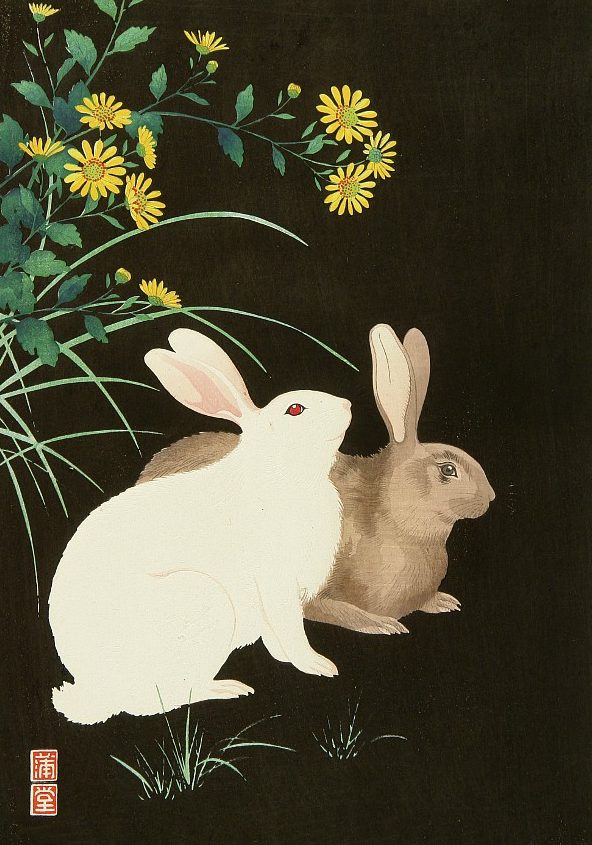
Hodo Nishimura, Rabbits, 1930s, private collection. Artelino.
Grouchy Rabbits is a woodblock print created by Japanese painter and print designer Ohara Koson (also known as Ohara Shōson and Ohara Hōson). He was a master of kachō-e (bird-and-flower) designs. Apart from birds and flowers, he created a lot of artworks depicting animals, such as the Grouchy Rabbits.
In East Asian (as well as indigenous American) folklore, it is believed that the rabbit is a moon animal. It derives from the lunar pareidolia—images seen on the surface of the Moon. Ancient Chinese people believed the Moon goddess Chang’e was accompanied by a rabbit making an elixir of immortality, while the Japanese and Korean believed it to be making rice cakes.
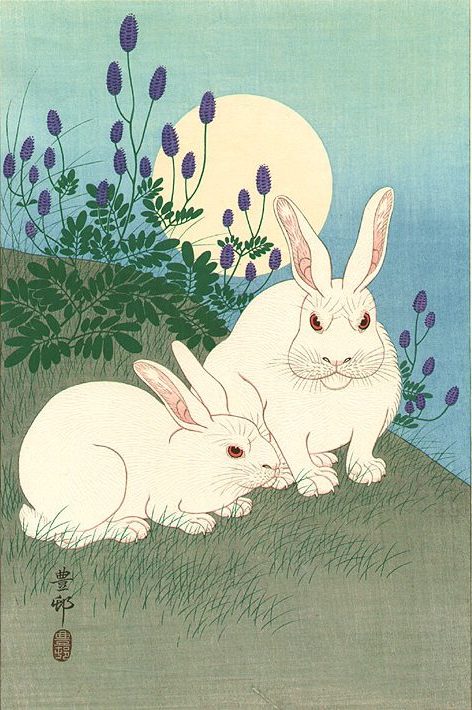
Ohara Koson, Grouchy Rabbits, ca. 1930s, private collection. Pinterest.
This print illustrates another East Asian legend. The story about Sun Wukong (also known as Songoku or Monkey King) and Moon Rabbit was written most likely by Wu Cheng’en in a 16th-century Chinese novel titled Journey to the West.
A Japanese printmaker Tsukioka Yoshitoshi, in one of his earliest print series, depicted the adventures of the mischievous, immortal monkey (Sun Wukong) who was banished from heaven and doomed to live alone forever in the mountain after being imprisoned by Buddha. After 500 years, he was set free to serve monk Tang Sanzang as one of his protectors during Sanzang’s pilgrimage to the West. When they reached India, they met a jade rabbit, who tried to steal the protectors’ unusual abilities, but she failed and returned with goddess Chang’e to the Moon.
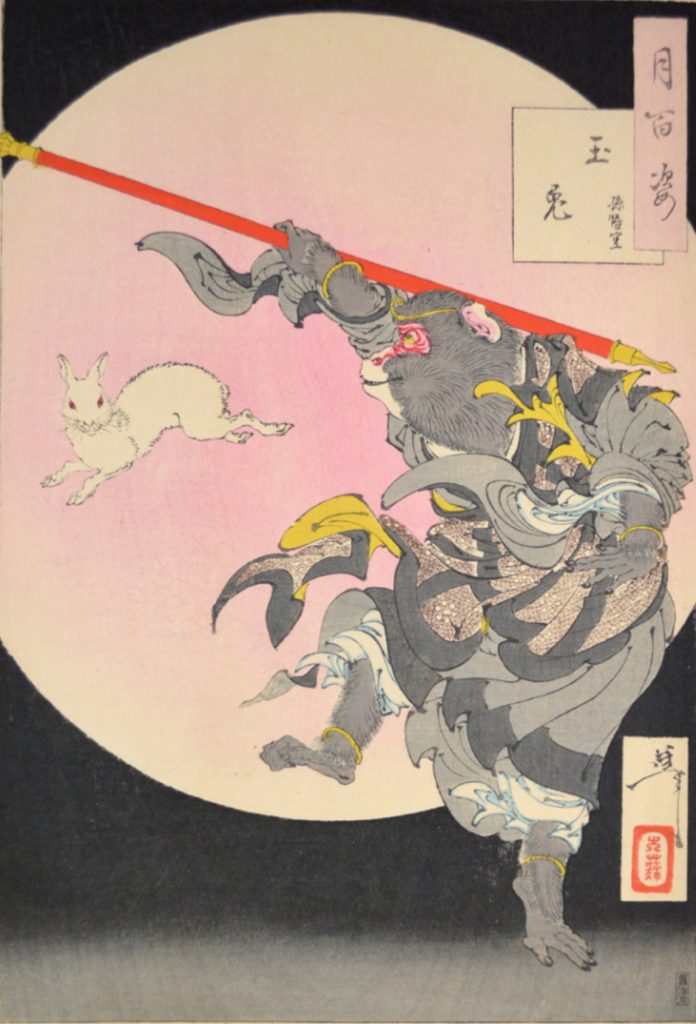
Tsukioka Yoshitoshi, Jade Rabbit: Sun Wukong from the series One Hundred Views of the Moon, 1889, Ronin Gallery, New York, NY, USA.
In this image, the Moon rabbit is offering mochi (rice cakes) to some frogs: mochi are eaten as part of New Year’s traditions. There are some old Chinese myths (older than the one of the immortal rabbit from the Moon) about the goddess Chang’e transforming into a toad. According to those myths, toads in Chinese culture are believed to be moon animals as well. The oldest depictions of moon toads could be traced in art from the Han dynasty (202 BCE–9 CE, 25–220 CE).
It seems that the author of this print was inspired by the stories of both moon animals, but I’m not going to even try to interpret this scene further. I’m in love with the idea of the toad carrying her tiny tadpole in the cloth wrap though!
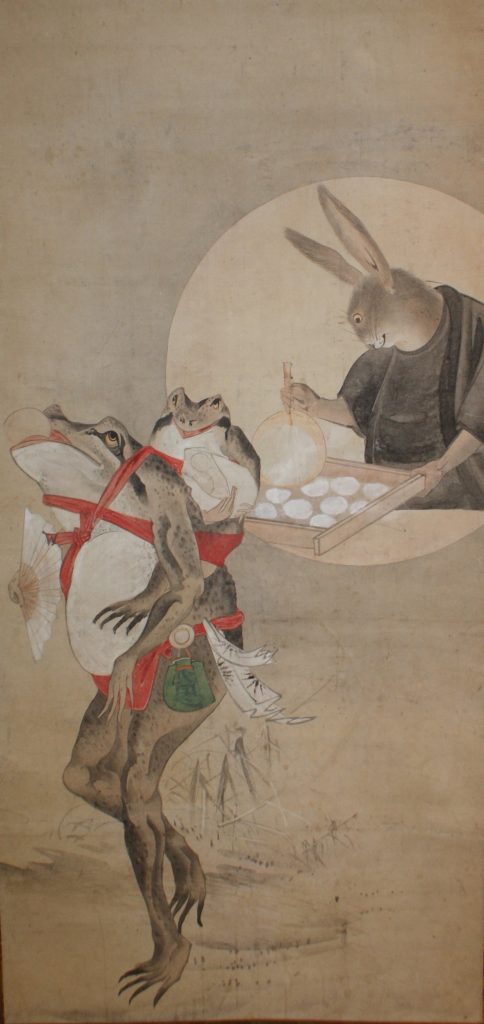
Frogs and Rabbit, mid-19th century, Minneapolis Institute of Art, Minneapolis, MI, USA.
Oh boy, he thicc! But what does his chonkiness mean? First of all, the shape of this rabbit reminds us of the shape of a moon. As we all know by now, the Moon is the home of the jade rabbit. But the large, white body of the rabbit also refers to the white bags of Hotei, a Buddhist god bringing gifts and good fortune for the New Year.
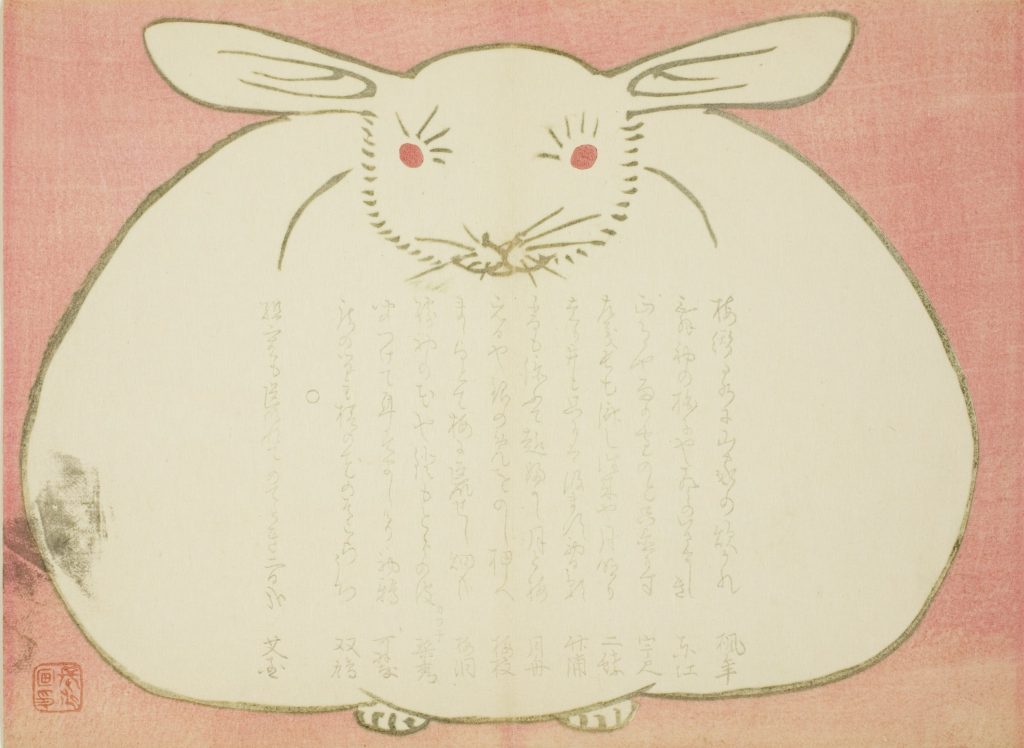
Yabu Chosui, Portrait of a Rabbit, 1867, The Art Institute of Chicago, Chicago, IL, USA.
This print by Utagawa Hiroshige does not show an actual rabbit, but a man in disguise. We all know Hiroshige’s prints depicting The Fifty-three Stations of the Tōkaidō, but who knew that he created illustrations for children too? Those fun charts are called omocha-e (toy pictures). They have written instructions on how to pose or use the hands behind the screen to create a shape of an animal, figure, or object and even make them move.
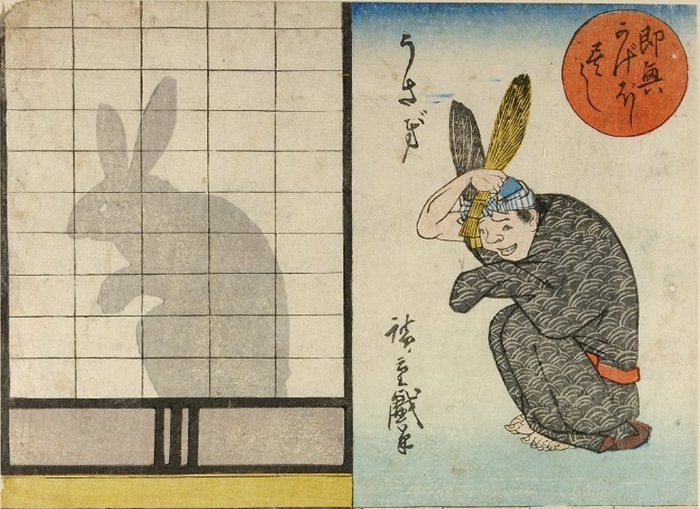
Utagawa Hiroshige, Shadow Figures, ca. 1842. Colossal. Detail.
It’s about time to present something more contemporary. Chinese artist Fang Chuxiong (b. 1950) is a master of traditional Chinese painting, but his paintings are not so traditional in their form and subject. He states that his inspiration is the landscape of Southern China.
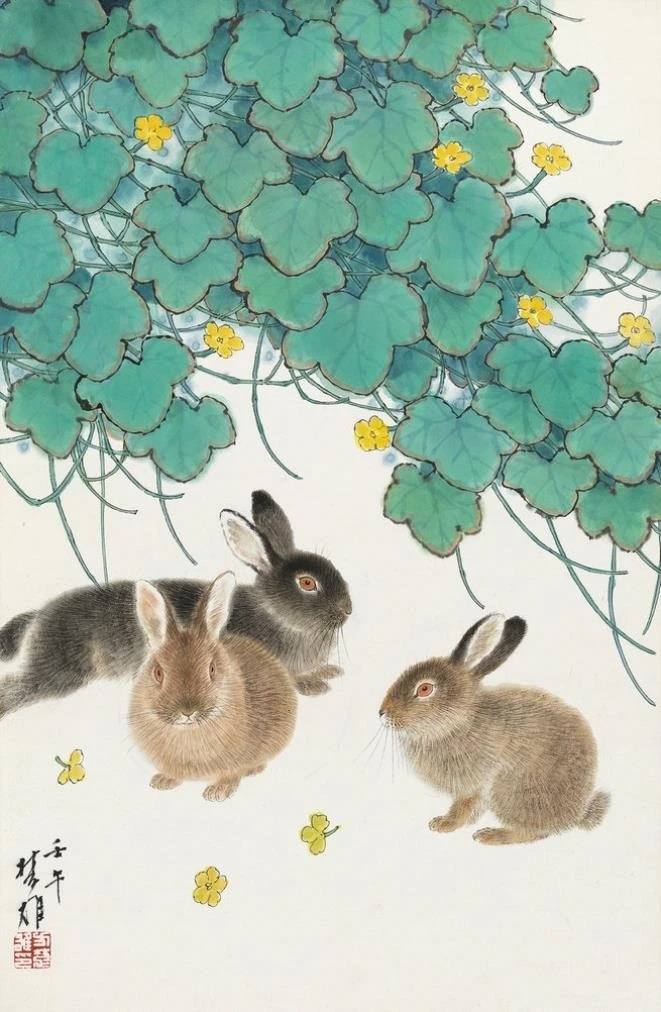
Fang Chuxiong, Three Rabbits, 2002, private collection. Mutual Art.
The centuries-old trees there, together with the streams and unusual plants and animals, all kept me inspired. Not only was I caught by the beauty of the wildlife, but also, I was taken by the rustic atmosphere composed by the houses, domestic animals, and even agricultural tools. Often I couldn’t wait and just painted on-site.
Last but not least, let’s take a look at an old scroll dating back to the Qing dynasty (1636–1912 CE). In traditional Chinese paintings, artists often rejected the use of color and shading, as they considered them distracting to the subject. Instead, they relied on the perfect lines to capture the nature of the objects they were depicting. This changed during the reign of the Qing dynasty: at that time, artists adapted Western illusionistic techniques, such as perspective and chiaroscuro, and combined them with the linear compositions characteristic of Chinese art. Three Rabbits is an example of such a style.
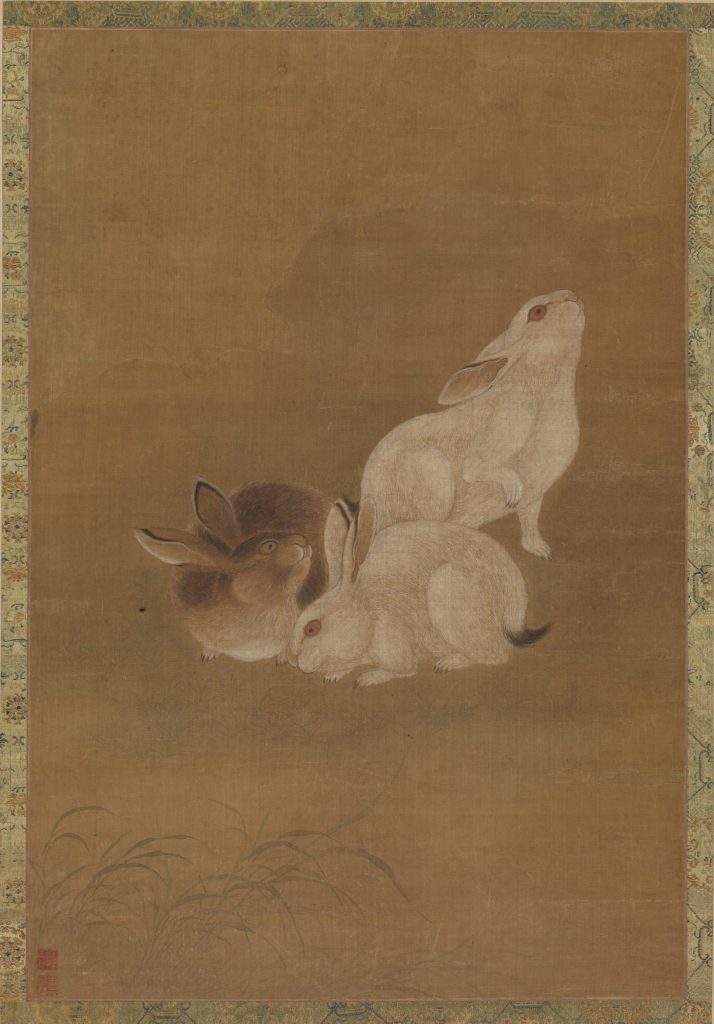
Three Rabbits, ca. 1644–1911, Metropolitan Museum of Art, New York City, NY, USA.
And if you’d like to see more animals in art, don’t forget to check out our Animals postcard set!
DailyArt Magazine needs your support. Every contribution, however big or small, is very valuable for our future. Thanks to it, we will be able to sustain and grow the Magazine. Thank you for your help!

I’m an art historian with a passion for Renaissance art, iconography, and the ways we interpret visual culture today. In my writing, I aim to combine solid historical research with accessible language, making art history engaging for both newcomers and seasoned readers. Whether I’m exploring medieval symbolism, writing about modern reinterpretations of classical themes, or creating interactive quizzes, I enjoy connecting the past with the present through storytelling and curiosity.

Love, longing, jealousy, anticipation, and devotion are among the most universal human emotions, and few artistic traditions have explored them as...
Shivani Gupta 22 June 2026
The Lion and Sun motif is a widely recognizable symbol associated with Iran. While both lion and solar imagery were present in the art and mythology...
Maya M. Tola 6 April 2026
The bronze sculptures of the Chola period are among the most refined and enduring achievements of Indian statuary. Created between the 9th and 13th...
Maya M. Tola 17 September 2026
The Red Fort, or Lal Qila, stands as a commanding symbol of India’s rich cultural and political heritage. Commissioned by Mughal Emperor Shah...
Maya M. Tola 23 June 2025