Painting His World or Painting Men?
The first two museums titled the show Gustave Caillebotte Painting Men; however, the Art Institute decided to rename it as Gustave Caillebotte: Painting His World. Regardless of the title, the exhibition is certainly overpowered with male figures. Thanks to Marie Berthau, the author of the artist’s catalogue raisonné, we can notice that Caillebotte painted 100 works that represent only men, 17 that depict both men and women, and only 32 that include solely female figures. These numbers clearly indicate that the artist was more interested in painting male models. Why is this important for our understanding of his work? The answer to this question is very well answered in the catalog, but unfortunately, it was not evidently explained in the exhibition itself.
Male Gaze on Male Life
Other painters of the time would not necessarily choose male models for their genre scenes. Artists such as Claude Monet, Edgar Degas, or Pierre-August Renoir much preferred depicting women in their works. It was also more agreeable with the art market—people much preferred buying paintings that depicted female figures.
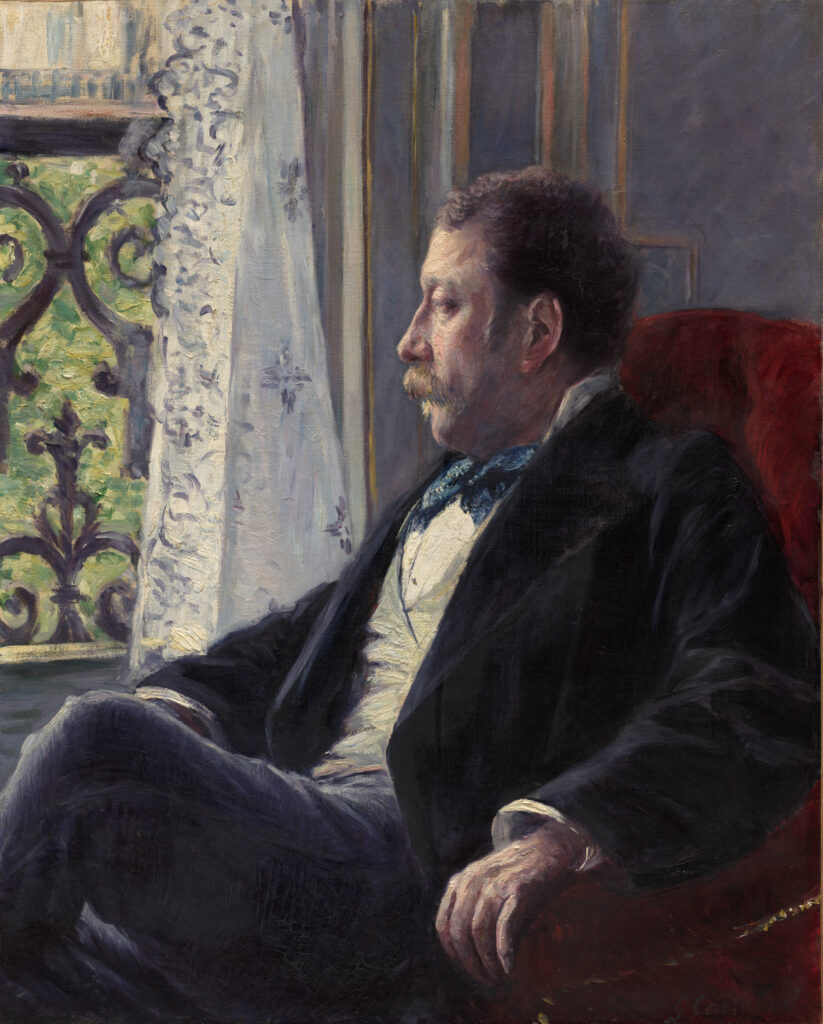
Caillebotte is acting outside of the norm in another manner. Many of his paintings present men in domestic and often intimate interiors. A household was a place associated with women not with men, who could leave whenever they wanted and play an important role in the outside world. This is why Caillebotte’s paintings are one of a kind. He opened the door of a world that we would not have been able to see otherwise: the world of athletic boatmen, recently renovated Parisian neighborhoods, and workers in the city.
The Boatmen, Painters, and Floor Scrapers
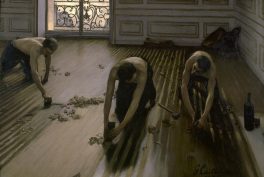
Gustave Caillebotte: Painting His World is organized into fascinating interconnected themes. One of them is the focus on male-only activities, both professional and leisurely, such as rowing or performing physical work (painting houses, floor scraping). Many of the paintings presented in this section have another thing in common—a remarkable perspective.
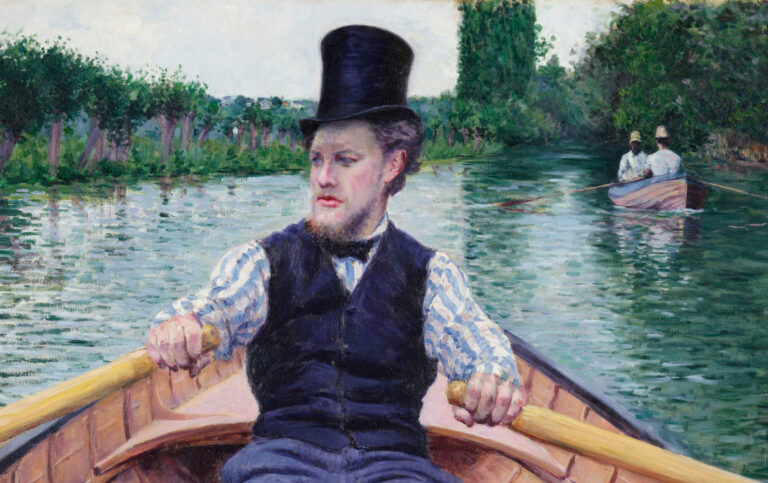
In one of the canvases, Boaters Rowing on the Yerres (1877), we look at two men in a rowboat from above. We cannot see the face of the figure in the front, as it is covered by his hat, and we see only a part of the face of the other rower. The reason behind this is that Caillebotte did not want to portray those specific men, but rather, he wanted to represent their movement. He was interested in how to capture the movement of their bodies in a static painting. As a matter of fact many of his canvases can be compared with modern-day photography.
Paris as a Key Character in Caillebotte’s Work
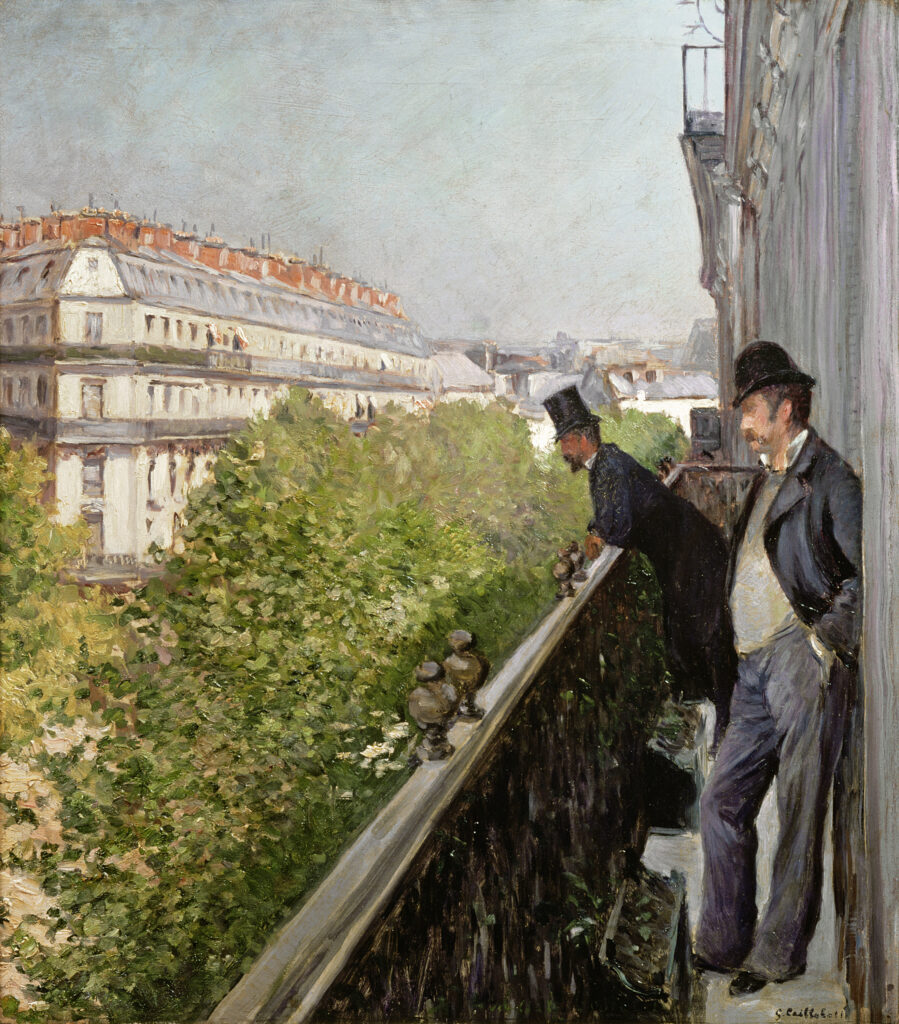
The curators of the exhibition have excellently highlighted how important Paris was in Caillebotte’s work. Thanks to a large map in one of the rooms, we can learn that the majority of the artist’s works are set within a few streets of one another. Understanding the location of the represented places helps us better imagine his everyday life.
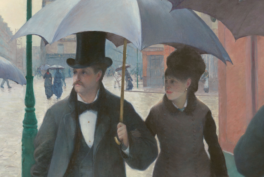
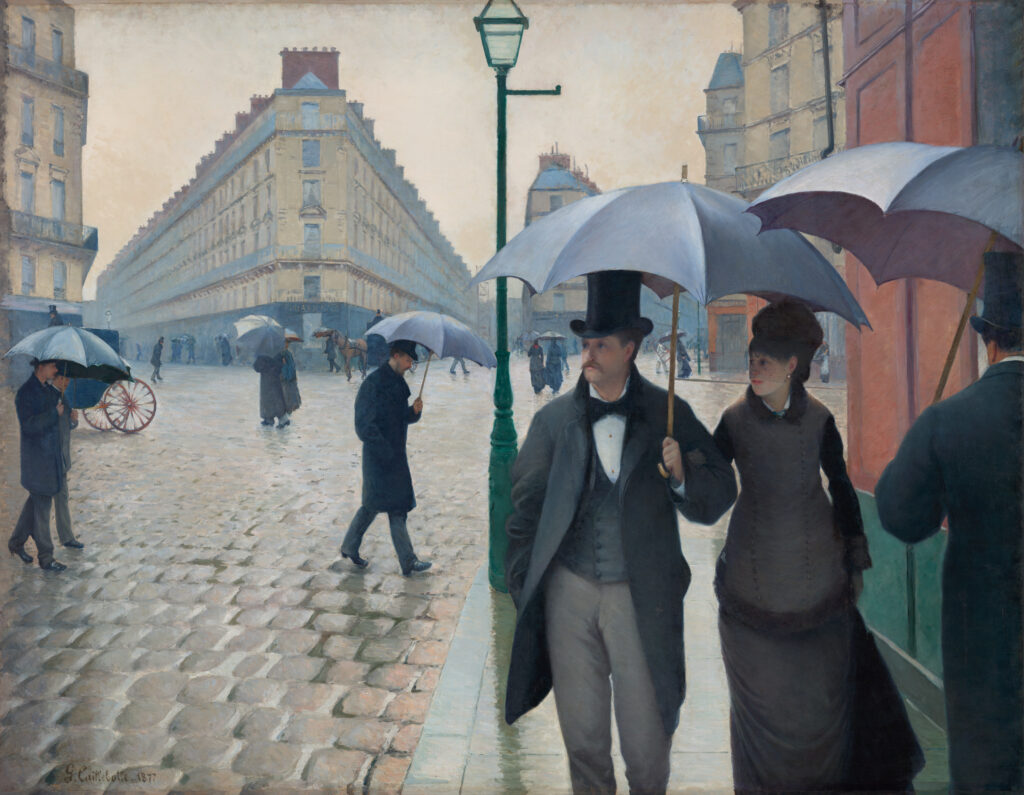
One of the stars of the exhibition is, of course, the Art Institute’s own Paris Street; Rainy Day (1877). This large painting depicts a couple walking on a large boulevard in the city center. They are hiding under a large umbrella, similarly to other pedestrians in sight. Next to the painting, we can see some sketches representing people holding umbrellas, which were an indispensable object in a modern city.
Umbrellas used as protection from the sun were already used in Ancient Egypt. However, it was only in the beginning of the 18th century that a Parisian merchant, Jean Marius, introduced the first lightweight folding umbrella in Europe. By the time Caillebotte painted his canvas, they were a common accessory that was used not only as a protection from the rain but also as a means to remain anonymous in the city.
Gustave Caillebotte: Painting His World is a very engaging exhibition showcasing paintings from several different periods of the artist’s career. The compositions are surprising, the colors are beautiful, and the represented people seem to enjoy their surroundings. If you are a lover of Impressionism, it is certainly a must-visit.
Gustave Caillebotte: Painting His World is on view at the Art Institute of Chicago until October 5, 2025.