What does friendship look like in a museum?
It may sound like a strange question. Yet Łódź, one of Europe’s most important museums of modern and contemporary art, was founded on acts of friendship and generosity-not by wealthy collectors or sponsors, but by the artists themselves. Nearly a century later, those same values have become the subject of one of the institution’s most compelling exhibitions.
Gifts of Friendship presents almost 150 works donated between 2024 and 2026 by around 80 artists from across the world. To understand why this exhibition feels so significant, you must first understand the extraordinary history of the institution itself.
A Museum Unlike Any Other
Museum Sztuki in Łódź occupies a unique place in the history of modern art. In the late 1920s, members of the Polish avant-garde group a.r. (abbreviation for revolutionary artists) launched an ambitious project. Their goal was to create an international collection of other avant-garde artists that would belong to the public.
The initiative was led by painter and theorist Władysław Strzemiński, sculptor Katarzyna Kobro, painter Henryk Stażewski, and poets Julian Przyboś and Jan Brzękowski. Through an impressive network of contacts stretching from Warsaw and Moscow to Paris and Berlin, they reached out to artists across Europe, asking them to donate works to a future collection.
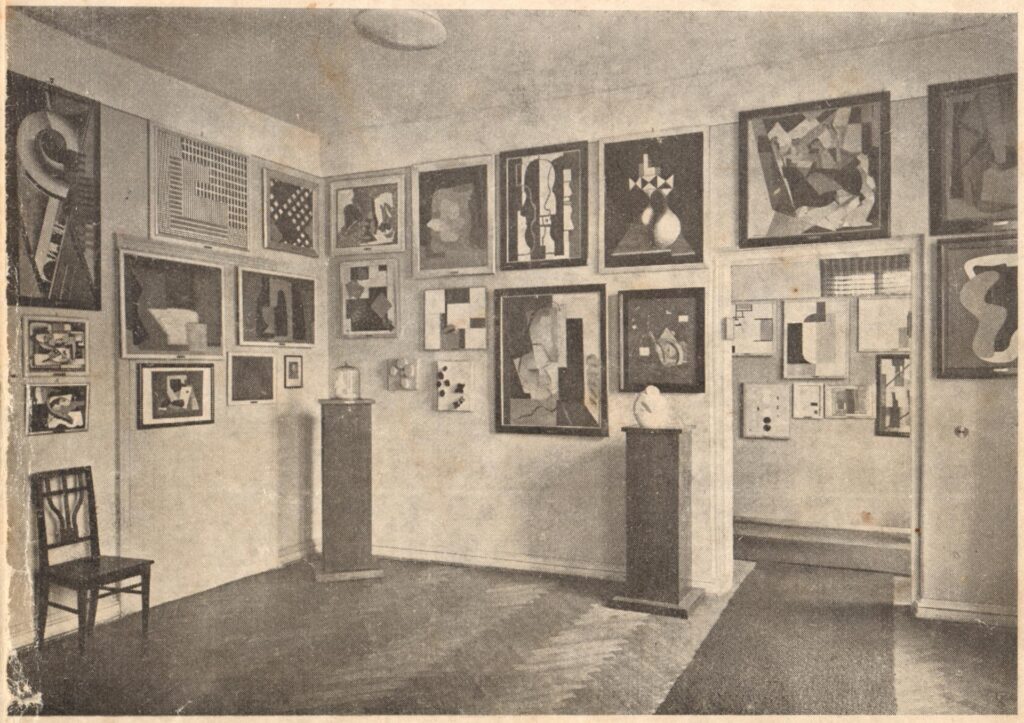
The response was unimaginable. Artists who are now regarded as giants of 20th-century art, including Fernand Léger, Hans Arp, Max Ernst, and Kurt Schwitters, contributed their works. Then known as the International Collection of Modern Art, it was first shown to the public on February 15, 1931. Today it is recognized as one of the earliest public collections of avant-garde art in the world. From this point, the acts of generosity and the idea of interconnectivity became the museum’s founding myth and its institutional DNA.
The process of gifting artworks was continued in later years. In the 1970s, London-based gallerist Mateusz Grabowski donated 239 works by artists associated with the British art scene, including Pauline Boty, Frank Bowling, and Bridget Riley, expanding the collection into new international contexts. In 1981, as part of the Polentransport project, Joseph Beuys donated a portion of his archive to the museum, comprising 787 artworks and documents. In the following decades, the museum’s holdings were further enriched by numerous archives donated by Polish artists and members of the artistic community, helping to establish one of the most significant collections of modern and contemporary art in Central and Eastern Europe.
A Small Gift Keeps a Museum Alive
Now, in 2026, the Gifts of Friendship exhibition is built around the concept of the “gift economy”—a model of exchange based not on transactions and ownership but on relationships. Gifting creates bonds and elevates the museum itself. As the director of the museum, Daniel Muzyczuk, explains, “When we approached artists asking for their support, the museum was emerging from a period of crisis. Our aim was not only to enrich the collection but also to help return the museum to the international stage and rebuild broken relationships.”
The idea of building relationships had an important place within the historical avant-garde. Artists such as Strzemiński and Kobro imagined art not as a luxury commodity but as a social practice capable of shaping new forms of collective life. Donations were ideological gestures, and so they are now. We live in an era of political polarization, military conflicts, environmental crises, and growing distrust of public institutions. Against this backdrop, the simple act of giving appears almost radical. The artists participating in Gifts of Friendship demonstrate that collaboration remains possible across national, linguistic, and political boundaries.
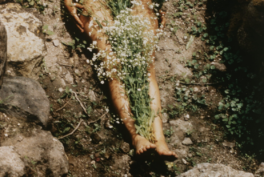
The exhibition therefore asks an important question: what does solidarity look like today? And what’s good, it lets the artworks—and the relationships behind them—speak for themselves. One of the works featured in the exhibition is Gabriele Stötzer’s A Handful of Soil. Created by an artist persecuted by the East German Stasi and imprisoned for her political activities, the photographic tableau changes simple gestures such as holding soil, grain, or another pair of hands into symbols of care and selfless exchange. At a time when even ordinary conversations could be monitored, Stötzer suggests that solidarity can survive without words. It is a good reminder that friendship is sometimes expressed through the smallest acts.
An Exhibition That Trusts Its Audience
The exhibition brings together nearly 150 works by artists representing different generations, nationalities, media, and artistic approaches. The list of participants ranges from long-time collaborators of the museum, including Liam Gillick, R.H. Quaytman, and Karin Schneider, to artists whose work has entered into dialogue with the institution’s recent program, such as Jasmina Cibic, Nikita Kadan, Agnieszka Polska, Mykola Ridnyi, Paulina Ołowska, Julita Wójcik, and Anton Vidokle.
Such diversity could easily become overwhelming. Contemporary art exhibitions often suffer from a familiar problem: they gather together works that are only loosely connected and attempt to unify them through increasingly abstract curatorial narratives. Visitors are left searching for meaning among walls of explanatory text, trying to understand why particular works occupy the same space. The result can feel less like an encounter with art and more like an exercise in decoding institutional language. Sometimes it even feels like a battle.
Gifts of Friendship offers a refreshing alternative. The exhibition does not really possess a single dominant theme. There is no overarching political statement, no central aesthetic movement, no strict chronology, and no obvious narrative structure. Yet it doesn’t feel fragmented. Visitors move through the exhibition without feeling as though they are wandering through an incoherent collection of contemporary art clichés. I would say that the exhibition trusts its audience; it is very liberating.
Across Two Buildings, Three Floors, and Nearly a Century of History
There is no single dominant theme, but there is a dialogue between the museum and the artworks. The exhibition is presented in two branches of the museum. At ms¹, located in the former Poznański Palace, visitors encounter works that engage with questions of collecting, memory, reciprocity, and institutional history. Here, the dialogue with the museum’s past feels especially strong. The legendary Neoplastic Room (in which the exhibition space itself becomes an integral work of art based on Neoplasticist principles), designed by Władysław Strzemiński and “updated” by the donated works, remains a powerful reminder that Muzeum Sztuki was experimental from the very beginning.
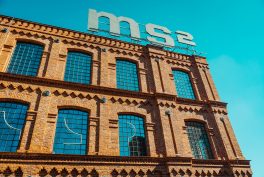
At ms², housed in a converted 19th-century textile factory, the focus shifts toward contemporary artistic practices and future possibilities. The donated works enter into conversation with the museum’s amazing permanent collection (shown in this building is the exhibition Ways of Seeing), creating unexpected connections across time.
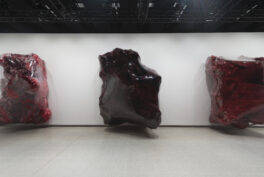
In one of the rooms (seen in the photo above), Jasmina Cibic’s 20th Century (from Afar) examines how exhibition design and systems of display shape collective imagination, while Franz Erhard Walther’s Two Actors, Seven Elements for Hands invites visitors to complete the work through their own participation, dissolving the boundary between artwork and audience. Nearby, Liam Gillick’s Curator B+- turns the figure of the curator into a reflection on the structures through which art is seen and interpreted. Together, these works show how the museum is an active space where artists, institutions, curators, and visitors continually create meaning.
Many museums commemorate their histories through exhibitions that look nostalgically toward the past. Muzeum Sztuki in Łódź takes a different approach. It demonstrates that the ideas on which the institution was founded are alive and continue to shape its present and future.
Frankly, this exhibition is less about the art itself and more about the relations between the artists and the institution and between the museum and its audience. It is about trust, responsibility, and the belief that art matters. This is particularly evident in the work of artists such as Nikita Kadan, whose practice repeatedly asks what role art and cultural institutions can play in times of political violence and historical rupture. Ghislaine Leung’s Parents offers a more intimate counterpart. Built from prefabricated wall panels through which electricity circulates in a closed circuit, her installation turns the invisible flow of energy into a metaphor for care, emotional labor, and the bonds that connect people. Like the exhibition itself, it proposes that relationships are not abstract ideals but structures that have to be continuously sustained.
Gifts of Friendship presents a multidimensional portrait of the museum, as a living network of artistic exchange rather than a neutral repository of objects. It pays tribute to successive generations of artists who have embraced a shared responsibility for art’s public role. It also reminds us of something truly beautiful and often forgotten: the museum’s belief that art is something to be shared, cared for, and passed on together.
If You Go
Gifts of Friendship is on view at the Muzeum Sztuki in Łódź, Poland, across both museum venues.
ms¹
Więckowskiego 36
90-734 Łódź, Poland
ms²
Ogrodowa 19
90-062 Łódź, Poland
The exhibition is best experienced as a single project spread across both locations. Allow at least half a day to visit the two venues. The show runs until February 1, 2027. Information on opening hours, tickets, guided tours, and public programs is available on the Muzeum Sztuki in Łódź’s website.