

Masterpiece Story: Judith and Holofernes by Caravaggio
Judith and Holofernes is a Caravaggio masterpiece that captures Biblical murder and drama. Rarely has death been captured so intensely and violently...
James W Singer 13 September 2026
16 August 2026 min Read
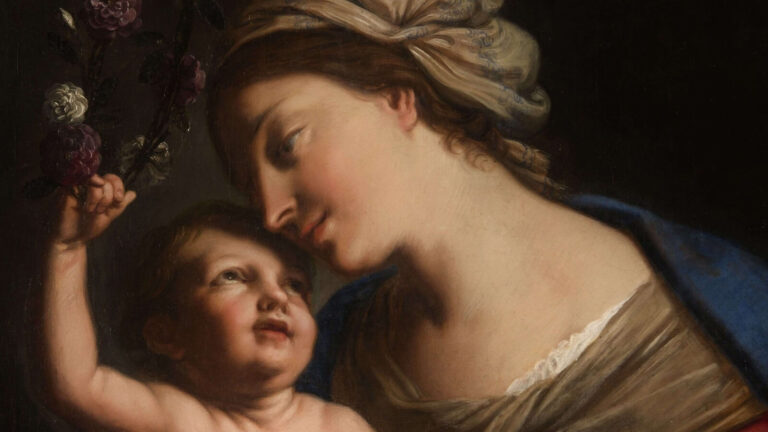
Elisabetta Sirani, Virgin and Child, 1663, National Museum of Women in the Arts, Washington, DC, USA. Detail.
With Virgin and Child as a cornerstone of her reputation, Elisabetta Sirani should be recognized as an important Italian Baroque artist. Far more than a conventional devotional image, the painting demonstrates Sirani’s remarkable ability to combine technical mastery with genuine emotional intimacy.
The Italian Baroque was a major artistic movement that lasted from the late 16th to the early 18th centuries. It was stylistically marked by grandeur, drama, and sensuality to inspire viewers’ emotional reactions. Countless artists lived and worked during this glorious period; therefore, many talented artists have been sadly overshadowed, under-recognized, or forgotten today.
One unfortunate example is Elisabetta Sirani (1638–1665), who lived and worked in Bologna, Italy. She was a brilliant and prolific painter who achieved commercial success and social recognition. However, because she was a female, and after centuries of male-dominated academia, her stellar reputation has fallen into the footnotes of art history. Her masterpiece, Virgin and Child, showcases her gift and justifies a revision of her reputation.
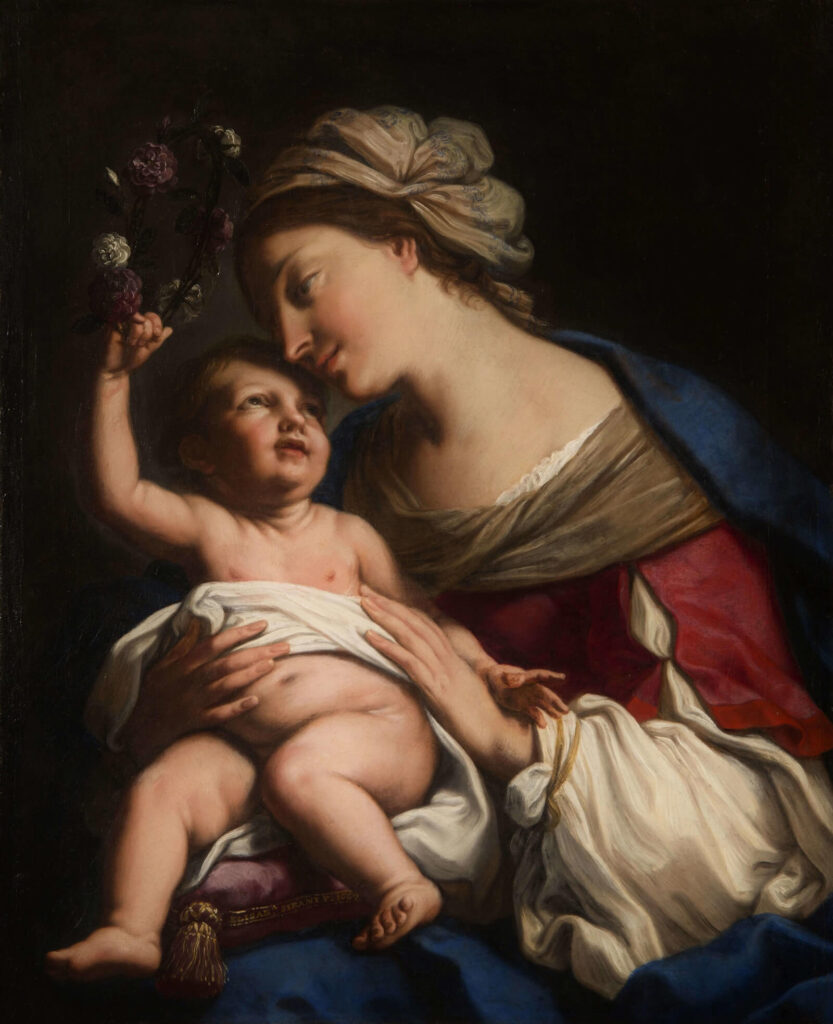
Elisabetta Sirani, Virgin and Child, 1663, National Museum of Women in the Arts, Washington, DC, USA.
Virgin and Child is a relatively small oil on canvas measuring 34 x 27 1/2 in (86.36 x 69.85 cm). It presents the very popular, and ubiquitous, Christian image of the Virgin Mary holding the infant Jesus. This motif was extremely beloved during the Italian Baroque because it was a staunchly Catholic image. Therefore, it was ideal for the artistic policies of the Papacy and the Counter-Reformation.
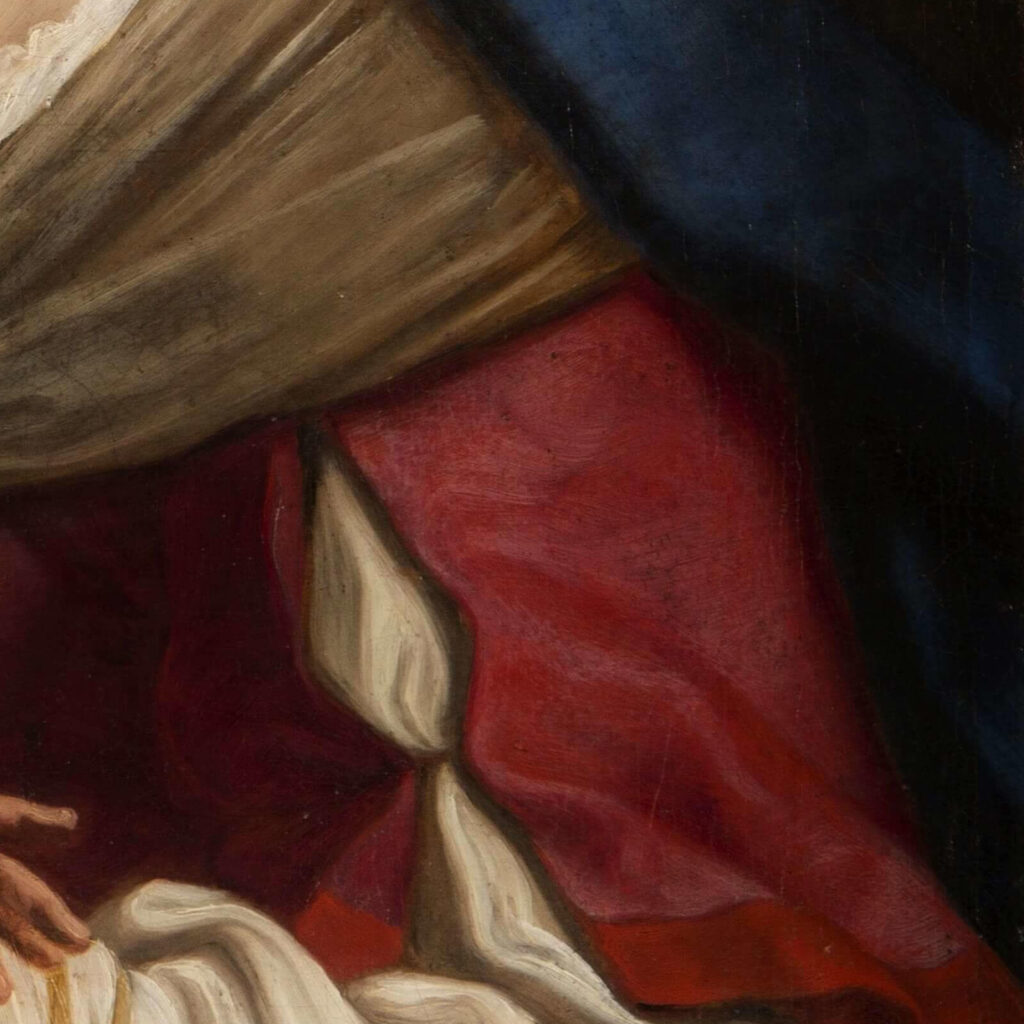
Elisabetta Sirani, Virgin and Child, 1663, National Museum of Women in the Arts, Washington, DC, USA. Detail.
Mary dominates the composition. She wears the traditional red and blue clothing of the Virgin with accents of white. Her deep blue cloak is most likely painted with crushed lapis lazuli, which was an extremely costly material in the 17th century. Hence, it is used sparingly. However, its effervescence adds to the richness of the red tunic, making a palette of jewel-like tones.
The Virgin is sublimely but simply dressed. She wears no jewelry and no fine adornments, but her clothing is exquisite and cut from fine cloth. Sirani uses sweeping brushstrokes to depict the clothing with a virtuosity to equal more famous artists such as Caravaggio and Artemisia Gentileschi. The white sleeve, for example, is almost impasto to reflect its rough homespun texture. It looks very tactile, very touchable, something that the viewer would love to feel and caress like a potential buyer in a fabric store. Additionally, the remarkable texture of the clothing adds a technical and visual contrast to the plain dark background.
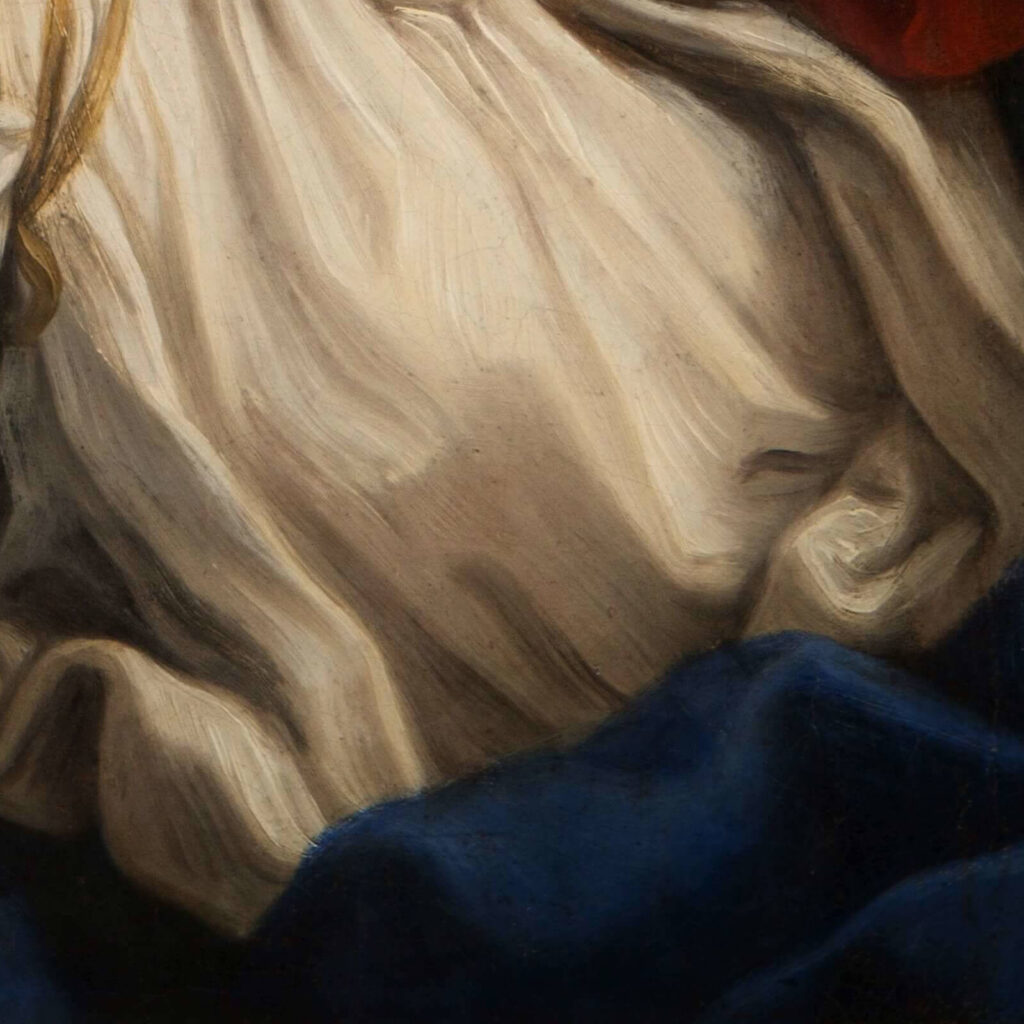
Elisabetta Sirani, Virgin and Child, 1663, National Museum of Women in the Arts, Washington, DC, USA. Detail.
Atop the Virgin’s head is a finely woven piece of fabric shaped in the form of a turban. Traditionally, in most paintings in Western art, the Virgin is depicted with either a blue cloak or veil around her head and shoulders or completely bareheaded. However, a turban is quite unusual for a traditional Virgin and Child image.
Sirani has chosen to use a style of turban widely favoured by peasant women in the Bologna area of her time. Therefore, Sirani adds a regional flair to her Virgin and perhaps makes her more readily relatable to her assumed 17th-century Bolognese viewer. It is a masterstroke of adding a contemporary element to a 1,600-year-old motif.
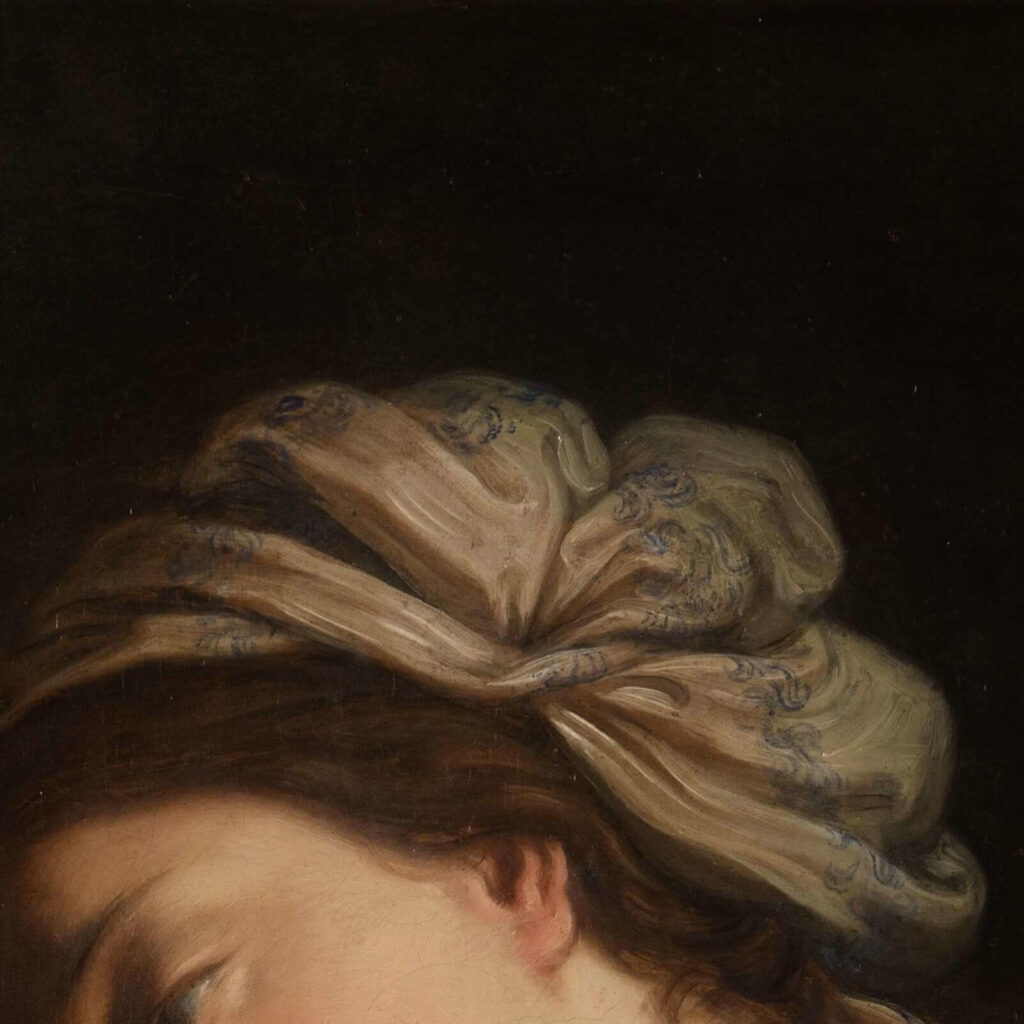
Elisabetta Sirani, Virgin and Child, 1663, National Museum of Women in the Arts, Washington, DC, USA. Detail.
The Virgin’s face is beautifully rendered with smooth Classical features. Unlike the sweeping brush strokes of the clothing, the face has delicate, almost invisible brush strokes to create an unblemished complexion. Mary appears rosy and healthy, the desired image of a young mother happy with her child. Mary lovingly lowers her eyes towards the baby Jesus and slightly bends her head forward to receive the crown of roses being held by her holy child.
The infant Jesus could be a baby model with his happy face and fleshy body. He returns the loving gaze of his mother by lifting his eyes and raising his arms. In his right hand, he holds a crown of roses, which he is about to set upon his mother’s head. A crown of roses in Christian iconography represents the Virgin’s spiritual triumph. It also signifies a spiritual bouquet of prayer (rosary), and additionally, as a symbolic contrast to the crown of thorns that Jesus will later wear during the Passion and his Crucifixion. Jesus’s gift is a loving gesture filled with Christian implications.
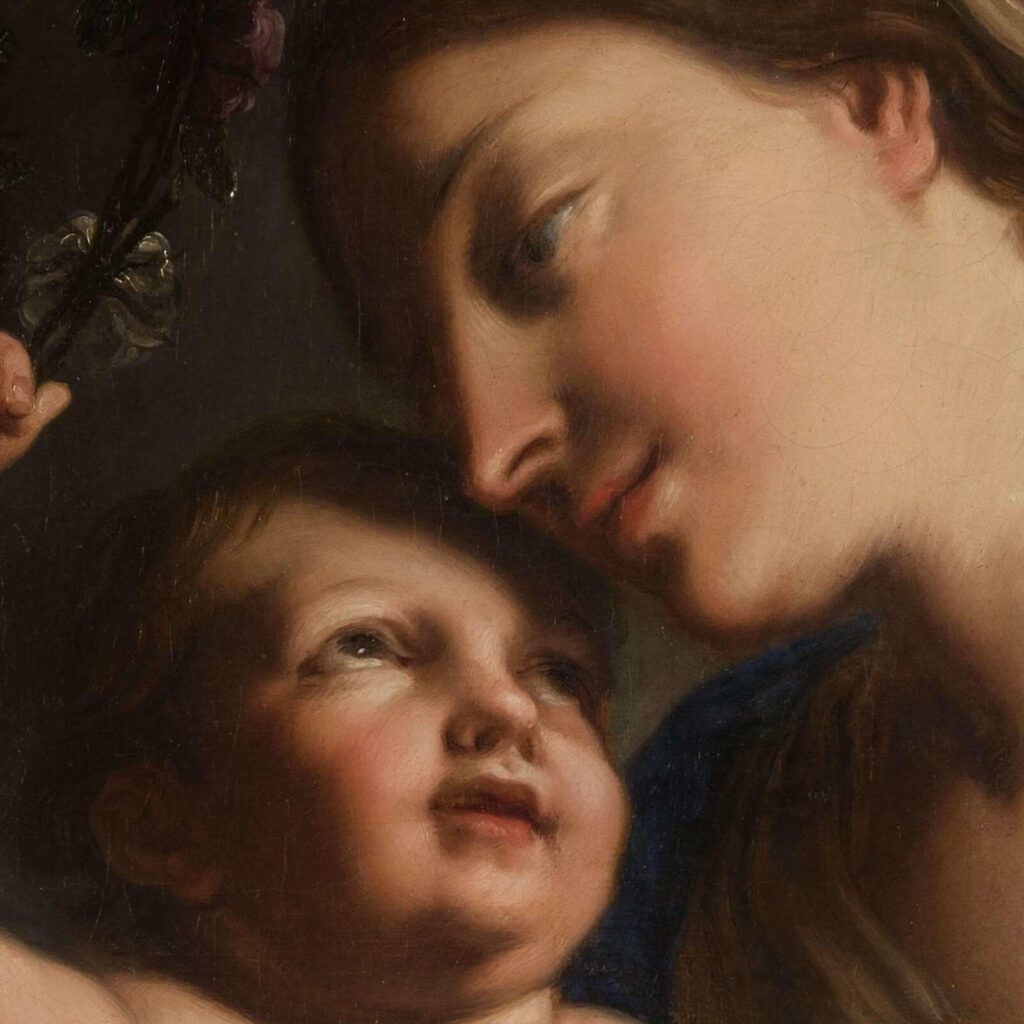
Elisabetta Sirani, Virgin and Child, 1663, National Museum of Women in the Arts, Washington, DC, USA. Detail.
The tenderness and naturalism felt throughout the image express a mature style that Sirani had already and remarkably achieved at the young age of 25 years when the image was commissioned. Paolo Poggi, a member of the powerful Poggi family who commissioned the Virgin and Child, recognized Sirani’s talent alongside other Italian nobles.
Grand Duke Cosimo III de Medici commissioned a Madonna from Sirani, and Prince Leopold of Tuscany commissioned from her an official portrait. Therefore, Sirani was easily the most famous and the highest-paid female artist in Bologna, Italy during her era. She was also a deft businesswoman and operated her own career and studio at the young age of 19 years. However, she only enjoyed commercial success and social recognition for a brief eight years due to her untimely death at 27 years old.
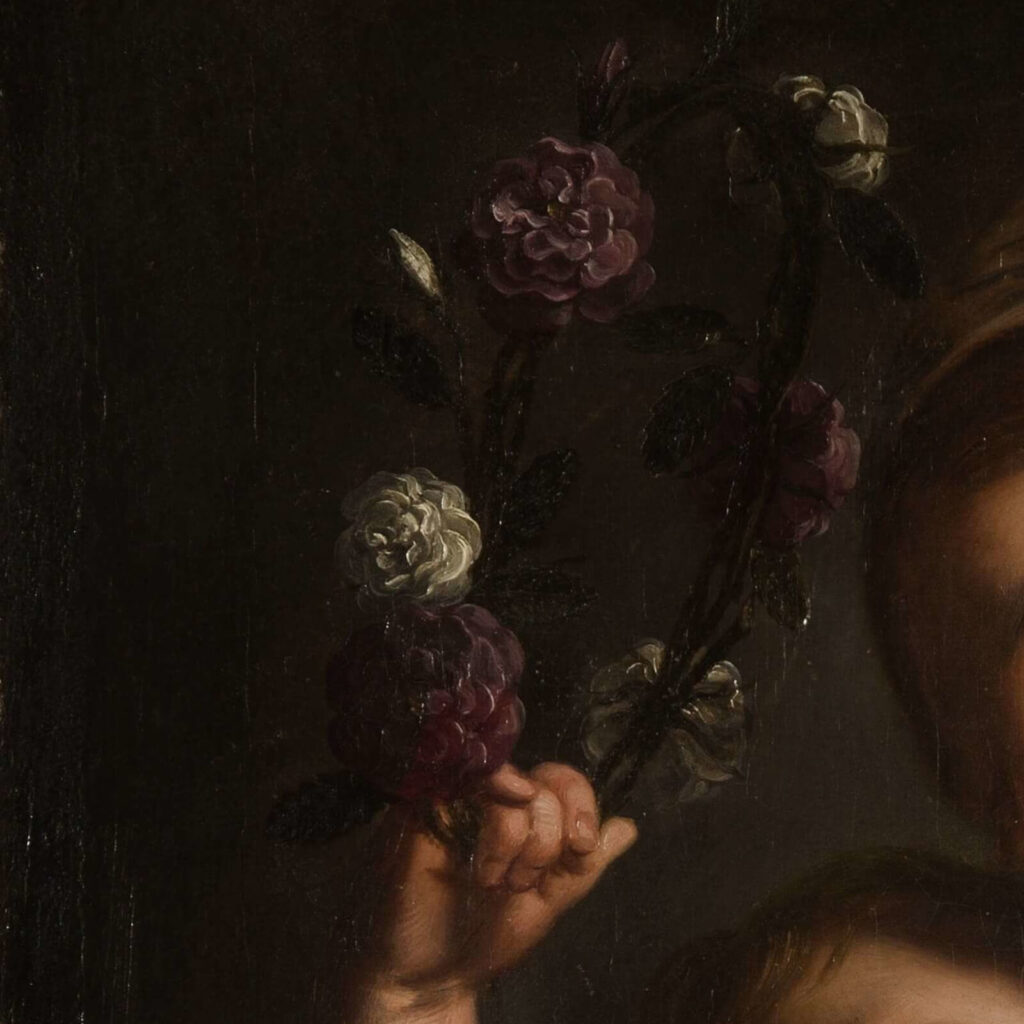
Elisabetta Sirani, Virgin and Child, 1663, National Museum of Women in the Arts, Washington, DC, USA. Detail.
Her sudden death immediately sparked suspicions of murder, particularly with poison, when the young Elisabetta Sirani began complaining of stomach pains just days before her death. A disgruntled maid, Lucia Tolomelli, was suspected and placed on trial. However, the maid was later acquitted, and suspicions of foul play were then dropped after the autopsy of Sirani’s body. Medical evidence revealed that Sirani had painfully died of stomach perforated ulcers, which allowed digestive juices to leak into the abdominal cavity.
This terrible death was likely caused by ongoing overwork and stress prompted by Sirani’s financial burden as sole breadwinner for her family. Unfortunately, her father suffered a debilitating illness, often identified as arthritis, when Sirani was around 17 years old, and Sirani hence assumed the family’s workshop and finances. Financially supporting her father and three sisters, as well as focusing on an intensive artistic career, slowly accumulated stress to unhealthy levels over 10 years.
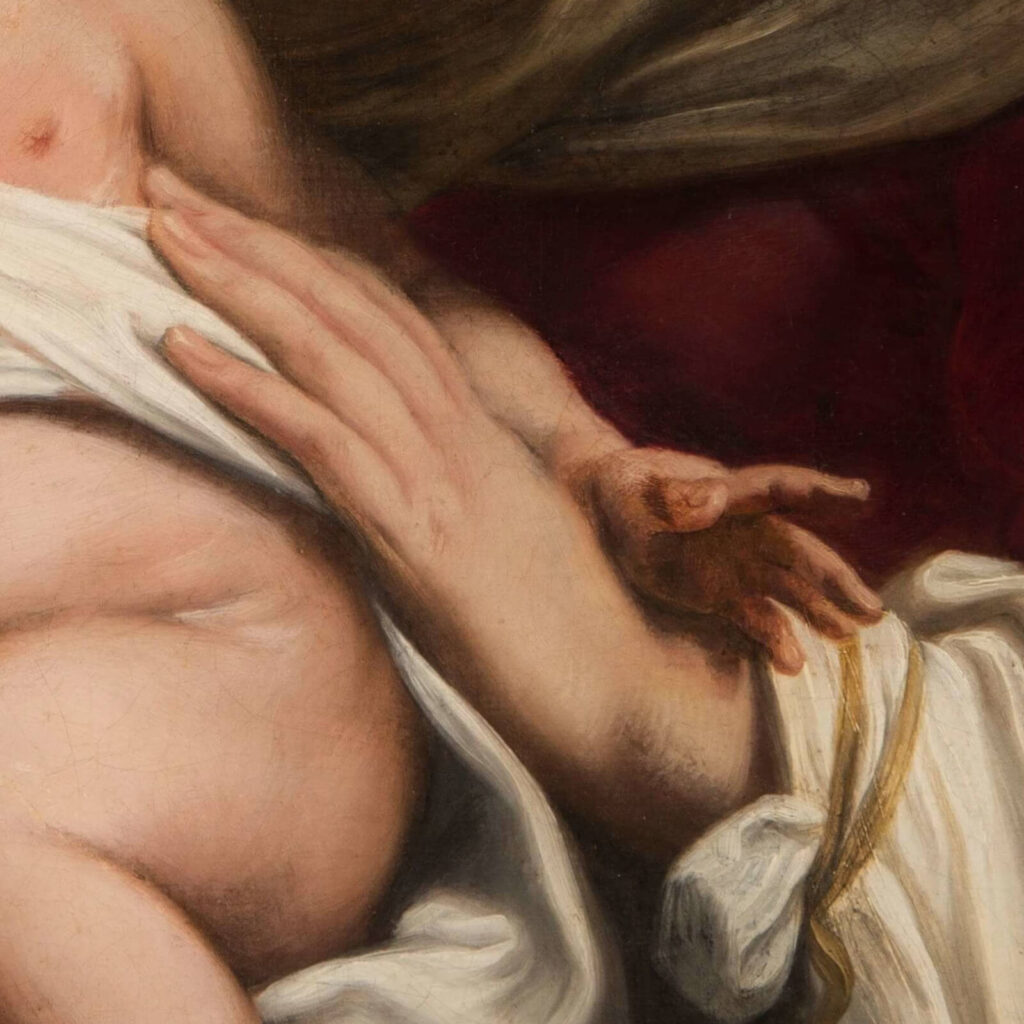
Elisabetta Sirani, Virgin and Child, 1663, National Museum of Women in the Arts, Washington, DC, USA. Detail.
However, Elisabetta Sirani’s dramatic demise should not be the primary reason why she should be remembered. She should be remembered for her social and artistic legacies. She was a paragon of female artistic empowerment that defied traditional social convention. Like a comet, her life was bright but brief. It was an intense illumination that permanently impacted the sky of Bologna.
Thanks to Sirani, Bologna became a very progressive and forward-thinking Italian Baroque city that not only embraced but nurtured its female artists. For example, Sirani is known to have had at least 14 female students in her studio who all later became professional artists. Sirani produced over 150 paintings as well as many drawings and etchings during her brief but brilliant career. With Virgin and Child as a cornerstone of her reputation, Elisabetta Sirani should join Artemisia Gentileschi as a well-known Italian Baroque painter. Art history can always add another shining star to the constellation of recognized artists.
“Elisabetta Sirani”, National Museum of Women in the Arts Online Collection. Retrieved 27 July, 2026.
“Virgin and Child”, National Museum of Women in the Arts Online Collection. Retrieved 27 July, 2026.
Vigué Jordi: Great Women Masters of Art, Watson-Guptill Publications, New York City, NY, USA, 2003.
DailyArt Magazine needs your support. Every contribution, however big or small, is very valuable for our future. Thanks to it, we will be able to sustain and grow the Magazine. Thank you for your help!

James W. Singer is an art historian and fine art photographer. He earned a Bachelor of Arts in Art History from the University of Florida. He later moved to Paris, France. He currently writes “Masterpiece” articles for DailyArt Magazine.

Elizabeth Provost is a visual arts journalist, editor, and scholar of the Italian Renaissance based in New York City and Toronto. She is a PhD student at the Bard Graduate Center. Learn more about her on her website: www.elizabethprovost.com
Judith and Holofernes is a Caravaggio masterpiece that captures Biblical murder and drama. Rarely has death been captured so intensely and violently...
James W Singer 13 September 2026
Explore an astonishing 1915 nude self portrait by American modernist painter Florine Stettheimer.
Candy Bedworth 21 September 2026
Winslow Homer (1836–1910) was one of the leading American Realist painters. His painting The Veteran in a New Field is a masterpiece of late...
James W Singer 30 August 2026
At first glance, A Goldsmith in His Shop (1449) appears to depict an ordinary visit to a jeweller. Yet Petrus Christus transformed an ordinary...
Shivani Gupta 23 August 2026