Fear is the most primeval sensation, a force that links humanity to all other forms of life. It signifies instinct over reason, reaction before consideration. As this response evolves, it provides a mirror for the artists who depict it, revealing shifts in belief and worldview. This duality—between primal reaction and conscious reflection—is powerfully demonstrated by Francisco Goya in two of his stark works: Witches’ Flight and Saturn Devouring His Son.
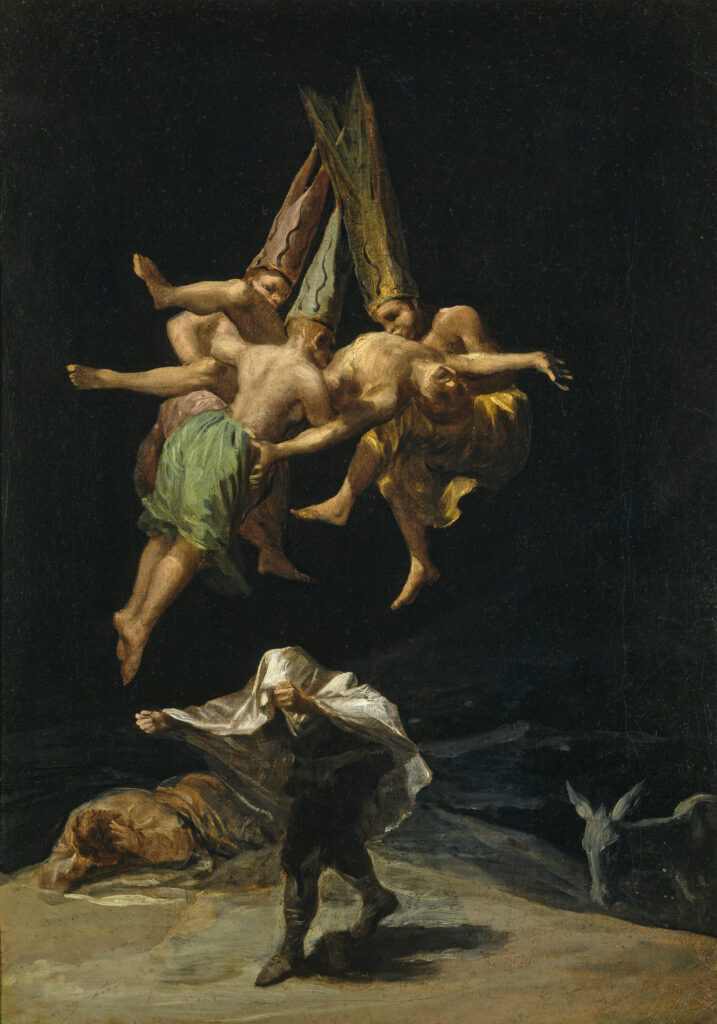
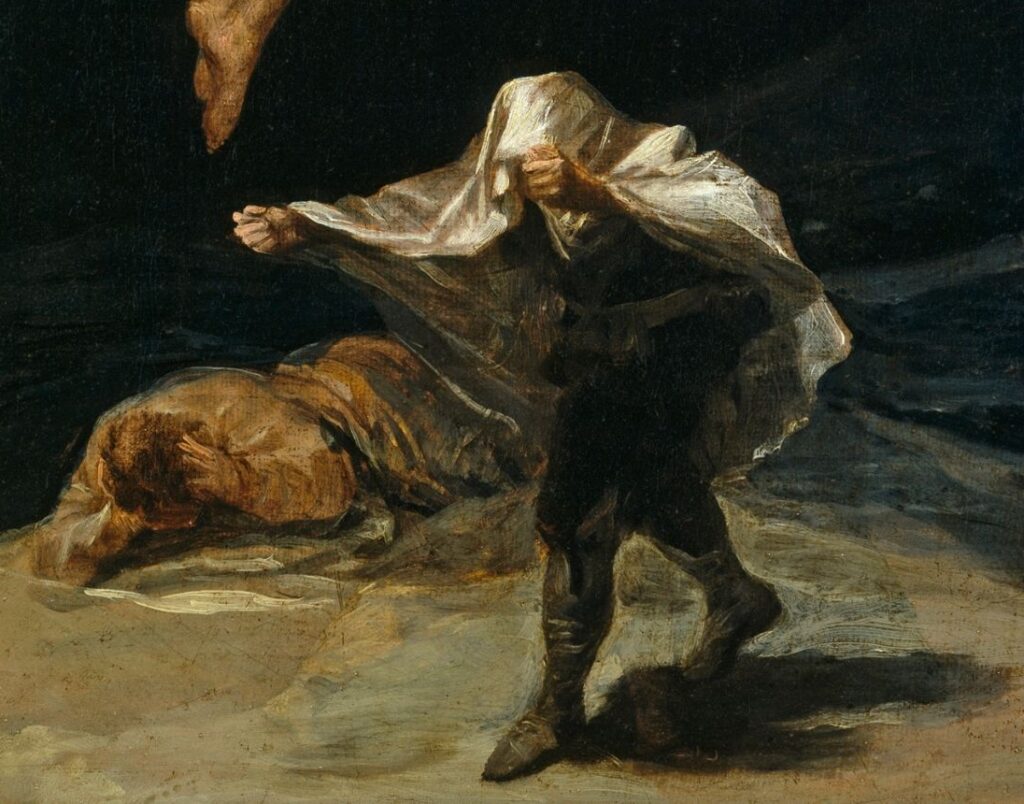
Goya presents a tableau that is immediately arresting and filled with implications. Three semi-naked witches float above the ground, their penitential corozas (a type of traditional, protective raincoat) crossed as they lean over the prostrate body of a limp man. The man’s face is partially obscured in shadows; his arms extend outward in a posture that conveys agony.
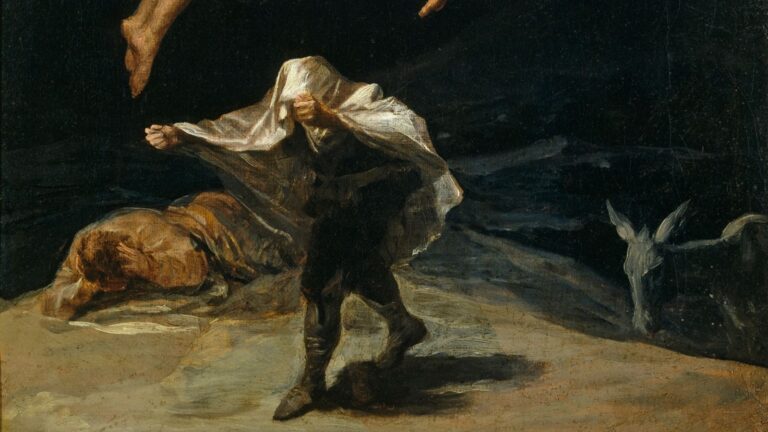
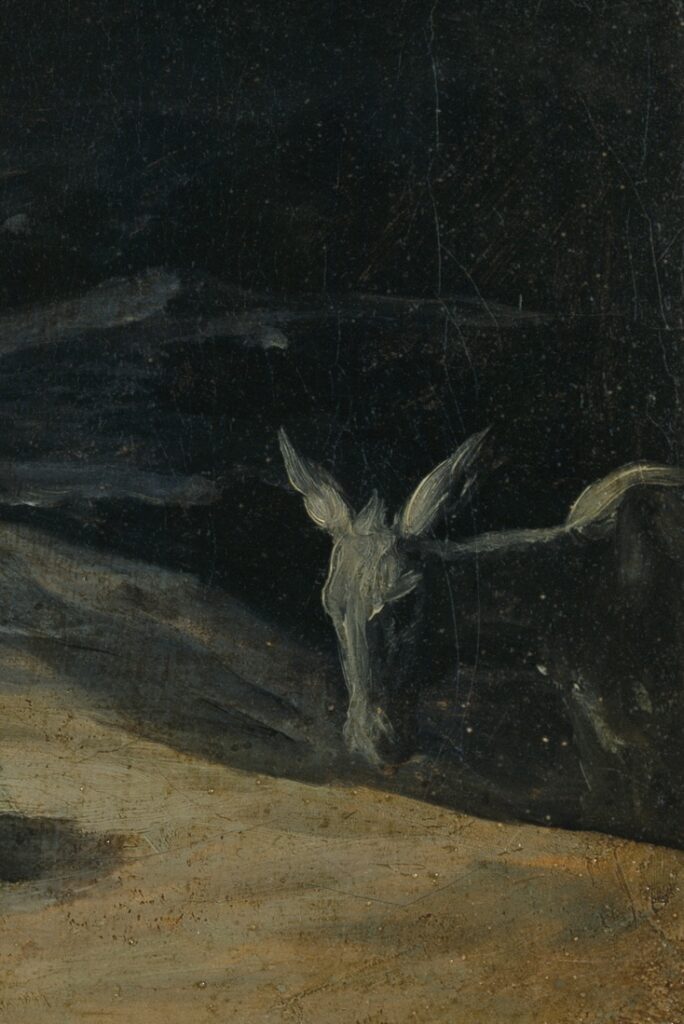
Below the witches, two men in peasant garb recoil in horror from the sight above their heads. One lies prostrate, hands over his ears, hiding like a child beneath his covers. The second stands with a hood over his head, his face twisted with fright, his right hand held in a gesture to ward off the evil eye. To the right of the terrified men stands a donkey. The animal observes the scene with an unsettling composure; its calm presence is sharply at odds with a moment otherwise defined by panic.
The most immediate reading of Witches’ Flight is that Goya presents a scene of supernatural horror: three malevolent figures assault a man as two witnesses recoil in fear. On the surface, this interpretation appears coherent, if slightly simplistic. It begins to falter, however, when we consider the presence of the donkey, which observes this event without visible distress. In the Spanish visual tradition, the donkey often signifies ignorance or brutishness. Within this composition, the animal’s calm calls this assumption into question.
The donkey neither recoils nor averts its gaze from the tableau. It stands with a placidity that quietly calls into question the spectacle’s reality in a scene otherwise charged with terror. Such composure suggests that the supernatural assault above the terrified men originates not from objective fact but from their own imaginations.
In his later years, Goya created the paintings now known as the Black Paintings, 14 haunting images marked by intensity and darkness. While theatrical fear is evident in Witches’ Flight, the Black Paintings—such as Saturn Devouring His Son—transform fear into a visceral display of viciousness and bloodshed that feels more bestial than divine.
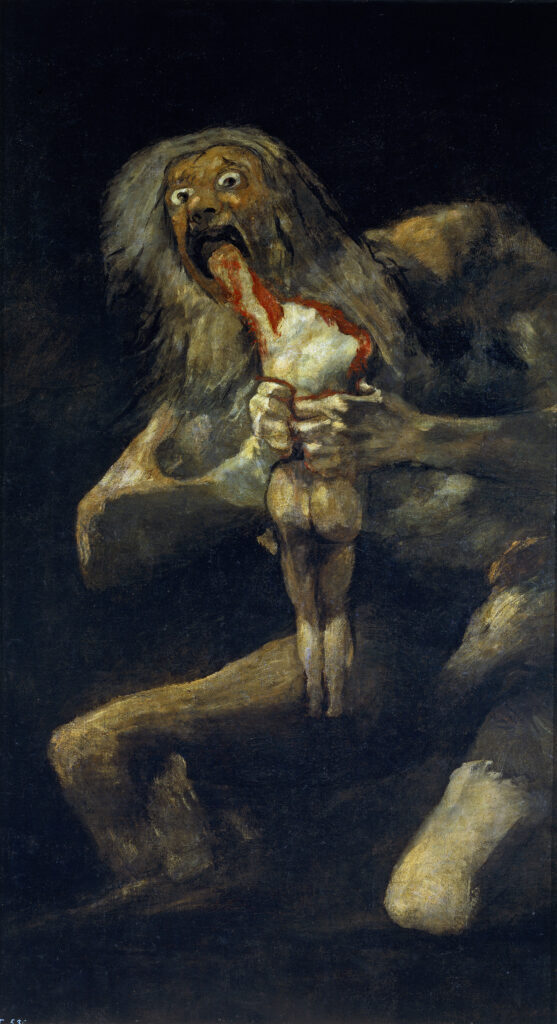
According to Greco-Roman mythology, Saturn receives a prophecy that one of his children will overthrow him as King of the Gods. Fearing this fate, he swallows each child at birth, only to be later forced to disgorge them alive by the son he seeks to destroy.
In Saturn Devouring His Son, Goya depicts a deity whose terror has reduced him to something feral. Saturn crouches in darkness, wild-eyed and mad. He clutches the body of a mutilated child, its head and right arm already torn away. Blood stains his mouth as he bites the remaining arm. His eyes do not convey intelligence, but the uncontrolled terror of a hunted animal.
Fear is a primal force that manifests in different forms. In Witches’ Flight, it appears in the terror of the two men at the sight of a supernatural assault; yet the placidity of the donkey suggests that their horror arises from superstition and imagination. In contrast, the fear in Saturn Devouring His Son is no longer projected outward but embodied, reducing a divine being to a feral beast. These contrasting visions reveal the evolving depth of fear as seen through Goya’s eyes.
In Witches’ Flight, fear is projected outward, shaped by belief and imagination, yet quietly undermined by the stillness of the observing animal. In Saturn Devouring His Son, there is no distance left. Fear is no longer something seen or interpreted. It is an act that the viewer feels and experiences. The divine figure, once part of a myth meant to explain the world, has become something savage, immediate, and consumed by the very terror it seeks to escape. Goya leaves no explanation in its place; only the frantic act remains.