



Halloween Monsters: What Our Fears Reveal About Society
Halloween monsters have long served as mirrors of human fear and imagination. From vampires and witches to zombies and digital phantoms, they reveal...
Errika Gerakiti 30 October 2025
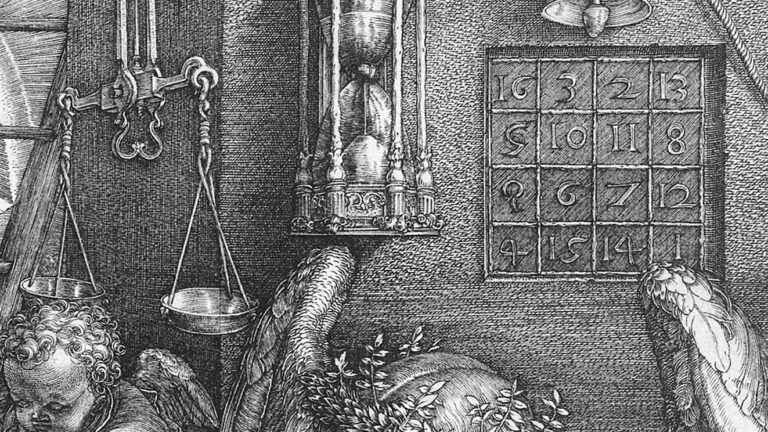
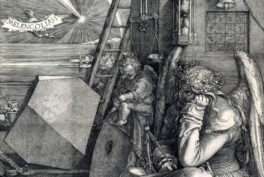
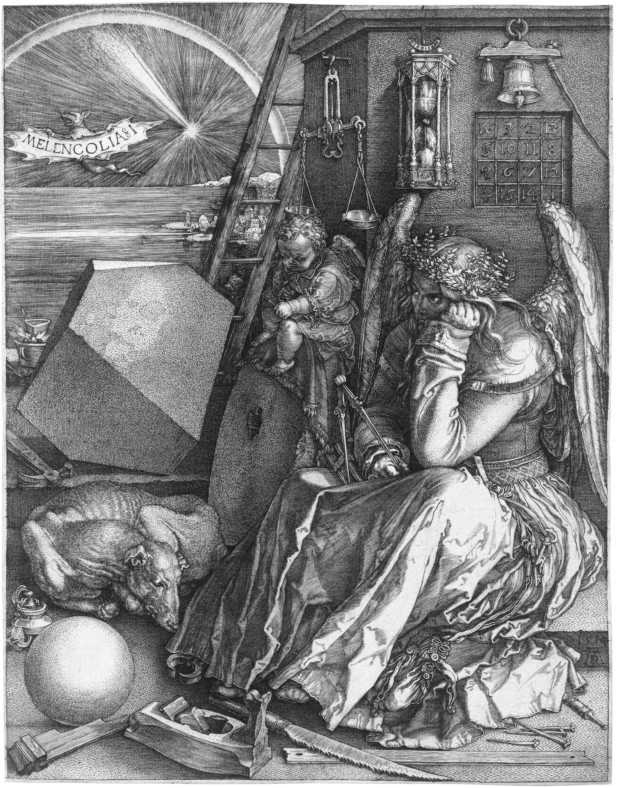
Albrecht Dürer, Melencolia I, 1514, National Gallery of Art, Washington, DC, USA. Detail.
Many very strange symbols appear in Albrecht Dürer’s famous engraving Melencolia I. Among them is a magic constant 34, a well-known and enigmatic example. The engraving shows a disorganized clutter of scientific equipment lying around while a scientist sits absorbed in thoughts. The magic square is located in the upper right-hand corner of the engraving. The numbers 15 and 14 appear in the middle of the bottom row, indicating the date of the engraving, 1514.
The sum 34 can be found in the rows, columns, diagonals, each of the quadrants, the center four squares, the corner squares, the four outer numbers clockwise from the corners (3+8+14+9), and likewise, the four counter-clockwise, the two sets of four symmetrical numbers (2+8+9+15 and 3+5+12+14), the sum of the middle two entries of the two outer columns and rows (e.g. 5+9+8+12), as well as several kite-shaped quartets, e.g. 3+5+11+15. Actually, there are 86 different combinations of four numbers from Dürer’s square that add up to the sum of the magic number, 34!

Each row, each column, and each diagonal adds up to 34; these are the traditional magic properties. But there is more magic to be found here. There are actually 13 different ways of dividing this square into four groups of four cells, with each group of four cells adding to 34. The menu in the applet can be used to select among these. The positions in the square can be seen as a finite vector space in which each set of four groups of four cells is a set of parallel affine planes.
The magic square has additional properties: the sum in any of the four quadrants, as well as the sum of the middle four numbers, are all 34. Because of that, it is called a gnomon magic square: a 4×4 magic square in which the elements in each 2×2 corner have the same sum. In addition, any pair of numbers symmetrically placed about the center of the square sum to 17.
Probably this magic square represents a jovial exercise, where jovial means happiness or cheerfulness – the opposite of the gloomy and sad mood associated with Melencolia I. Up to this day, this contrast of virtue and fortune enchants viewers who are willing to solve Dürer’s riddle hidden in this masterpiece.
Weisstein, Eric W. “Dürer’s Magic Square.” MathWorld–A Wolfram Web Resource. Accessed Jan 31, 2022.
DailyArt Magazine needs your support. Every contribution, however big or small, is very valuable for our future. Thanks to it, we will be able to sustain and grow the Magazine. Thank you for your help!

Art Historian, founder and CEO of DailyArtMagazine.com and DailyArt mobile app. But to be honest, her greatest accomplishment is being the owner of Pimpek the Cat.
Halloween monsters have long served as mirrors of human fear and imagination. From vampires and witches to zombies and digital phantoms, they reveal...
Errika Gerakiti 30 October 2025
When you picture Halloween, a flood of familiar images rushes in: glowing jack-o’-lanterns, fluttering bats, skeletons, and black cats. But the...
Errika Gerakiti 31 October 2025
Marian Henel’s tapestries are huge. The largest one measures over 6 m in length and 3 m in width (19 ft. 8 in. by 9 ft. 10 in.). Created in the...
Zuzanna Stańska 22 May 2026
Los Caprichos are some of the most disturbing of Francisco Goya’s works. A sharp critique of society and its values, there are plenty of monsters...
Edoardo Cesarino 31 October 2024