


Halloween Monsters: What Our Fears Reveal About Society
Halloween monsters have long served as mirrors of human fear and imagination. From vampires and witches to zombies and digital phantoms, they reveal...
Errika Gerakiti 30 October 2025
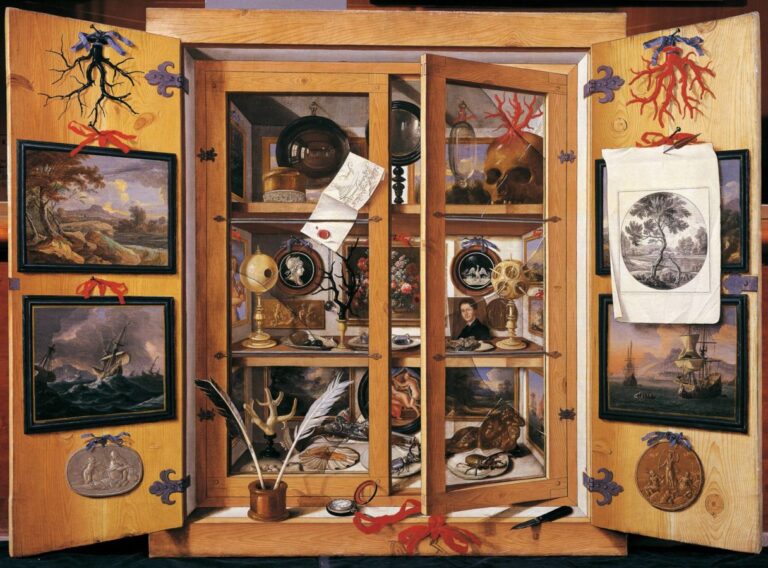
Domenico Remps, Cabinet of Curiosities, 1690s, Museo dell’Opificio delle Pietre Dure, Florence, Italy.
How would you feel if you found a mummified crocodile in your best friend’s room? Well, pretty awkward I guess, although I imagine that you’ve seen worse if you’ve ever lived in a boarding school or college accommodation… The collections of curiosities, or Wunderkammers, that now are kept under the beds or at the bottoms of closets, in the Renaissance were really fashionable. People had whole rooms, cabinets, in which to keep their favorite objects together, and special pieces of furniture which hosted the most precious pieces. Are you ready to have a little peek into some of the most bizarre collections?
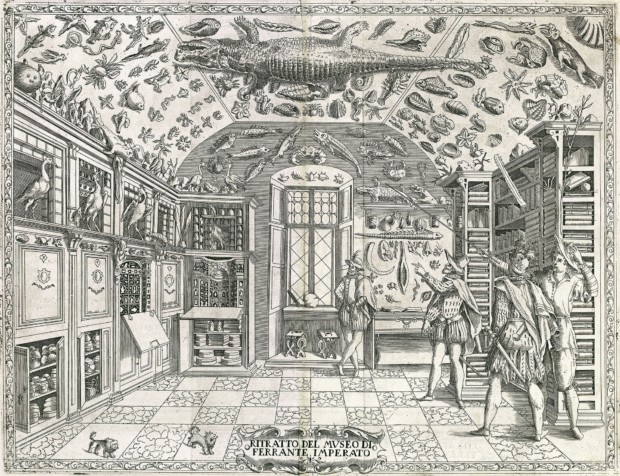
Crocodiles were considered quite an oddity back then! For the people of the 15th and 16th centuries, they were intriguing creatures that looked a little bit like monsters. Collections like this one, which hosted all kinds of animal species, stones, or shells, primarily served the nobles and rich merchants as status symbols and to make others admire them. Who else could have shown off with a real crocodile?
This engraving shows the collection of Italian Ferrante Imperato. However, most of the Wunderkammers were to be found in central and northern Europe.
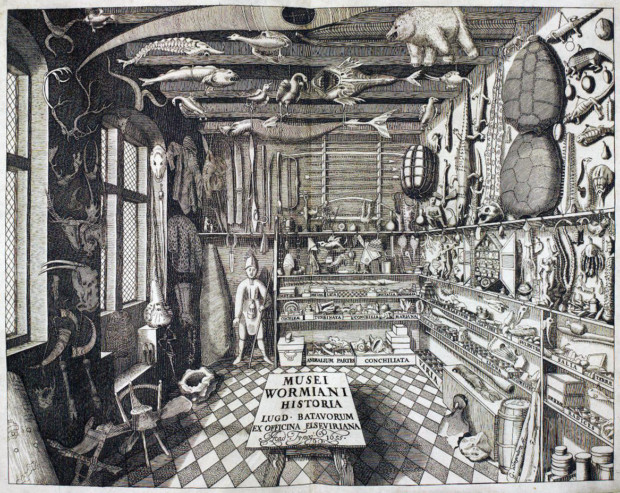
The Wunderkammer, that is the wonder rooms, were meant to showcase the universe within them, symbolically and literally. For this reason, the collectors amassed all types of objects of different dimensions and provenance. Their collections grew and grew, and with time the disorganized rooms began to be systematized as you can see here. Ole Worm divided his collection into sections, a shelf per each. Moreover, the shelves were labeled and the objects were described in Worm’s notes. Ladies and gentlemen, you’re looking at the predecessor of a modern natural history museum!
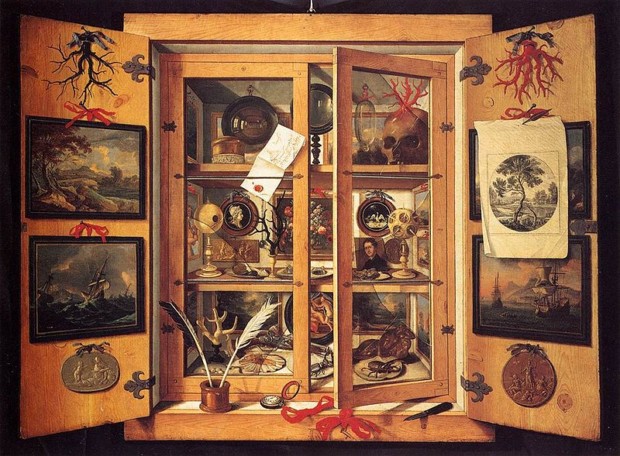
Look at the amazingly broad range of objects kept in this cabinet. From drawings to medallions to precious stones… One could have found virtually anything in these closets. This is why the collectors began to share their wonderful collections with others. Not only did they show their wealth, but they also facilitated people’s studies and the advancement of science.
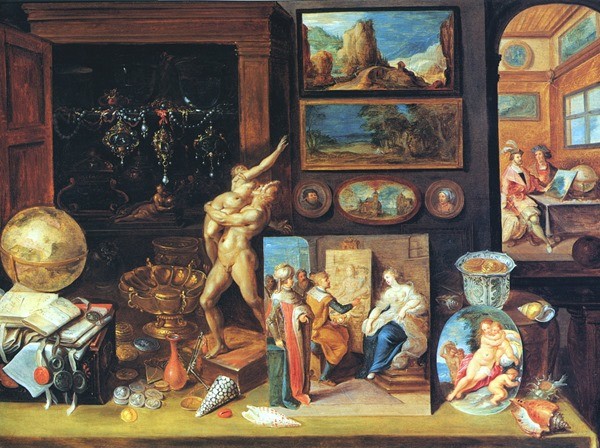
If you wonder why on earth I’m writing about collections of bizarre objects in DailyArt Magazine: the Wunderkammers often hosted many works of art, too. The greatest collectors, like the emperor Rudolph II, were also great art sponsors. And after all, the history of art is linked to the histories of collecting and of museums, isn’t it?
DailyArt Magazine needs your support. Every contribution, however big or small, is very valuable for our future. Thanks to it, we will be able to sustain and grow the Magazine. Thank you for your help!

Magda, art historian and Italianist, she writes about art because she cannot make it herself. She loves committed and political artists like Ai Weiwei or the Futurists; like Joseph Beuys she believes that art can change us and we can change the world.

Halloween monsters have long served as mirrors of human fear and imagination. From vampires and witches to zombies and digital phantoms, they reveal...
Errika Gerakiti 30 October 2025
When you picture Halloween, a flood of familiar images rushes in: glowing jack-o’-lanterns, fluttering bats, skeletons, and black cats. But the...
Errika Gerakiti 31 October 2025
Marian Henel’s tapestries are huge. The largest one measures over 6 m in length and 3 m in width (19 ft. 8 in. by 9 ft. 10 in.). Created in the...
Zuzanna Stańska 22 May 2026
Los Caprichos are some of the most disturbing of Francisco Goya’s works. A sharp critique of society and its values, there are plenty of monsters...
Edoardo Cesarino 31 October 2024