
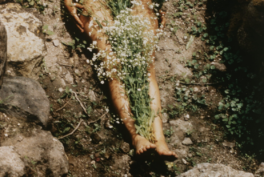
Between the Body, Nature, and Image: Ana Mendieta at Tate Modern
It is not uncommon for an artist to become known primarily through the circumstances of their life rather than through the complexity of their work.
Ania Kaczynska 6 August 2026

Peter Fraser, Untitled, from Arnolfini Series, 1984 © Peter Fraser. All Rights Reserved, DACS Artimage 2024.
The 80s: Photographing Britain at Tate Britain in London was a kaleidoscopic chronicle of more or less a decade, where photography witnessed and participated in a profound upheaval. With nearly 350 images and archival materials, this vast exhibition painted a fragmented but resonant portrait of Britain. It was an ode to the power of the camera as a tool for storytelling, social critique, and cultural reclamation in a nation viewed through its many lenses.
The decade unfurled in thematic displays of fragments belonging to a larger mosaic. Despite its shifting nature, the political backbone of the exhibition was immediate and potent. Photographs of miners’ strikes, Greenham Common protests, and anti-racism demonstrations grounded the viewer in the turbulence of Thatcher’s Britain.

Anna Fox, Friendly Fire, target (Margaret Thatcher), 1989 © Anna Fox.
John Harris and Brenda Prince’s images of defiance were charged with dignified anger, while Syd Shelton and Paul Trevor framed the collective power of protest. On the other hand, we had regional disparities as a particularly effective focal point: Chris Killip’s portraits of “sea-coalers” in Northumberland and Tish Murtha’s documentation of youth unemployment in Newcastle capture lives shaped and scarred by economic decline. These works held an unflinching mirror to a nation unraveling under the weight of industrial decay and political transformation.

Paul Trevor, Outside police station, Bethnal Green Road, London E2, 17 July 1978. Sit down protest against police racism, 1978 © Paul Trevor.

Syd Shelton, Darcus Howe addressing the anti-racist demonstrators, Lewisham, 13 August 1977. Dated 1977, printed 2020. Tate: Presented by the artist 2021 © Syd Shelton.


Paul Trevor is known for images of British inner-city neighborhoods.
Syd Shelton extensively documented the Rock Against Racism movement.

Roy Mehta, from the series Revival, London, 1989–1993. Roy Mehta, Courtesy of the artist and L A Noble Gallery.
But not everything told a story of rupture. Many of the exhibition’s strongest moments celebrated community and resilience. Vanley Burke’s portraits of multicultural Birmingham were vibrant with pride and intimacy, and Roy Mehta’s work explored the complexities of identity within these communities.

Joy Gregory, Magenta Dress with Pink Tulips, 1984. Courtesy of the Artist. © Joy Gregory. All rights reserved, DACS.
The show deftly interweaved the personal and political. Sutapa Biswas and Roshini Kempadoo employed portraiture to confront and reframe diasporic identities, their works layered with poetic defiance. Meanwhile, Joy Gregory and Maxine Walker created self-portraits to celebrate Black femininity. These demurely radical images communicated a defiance that refuses to be diminished.
The exhibition’s handling of queer representation was equally poignant, especially when viewed against the backdrop of the AIDS crisis and Section 28. Sunil Gupta’s ‘Pretended’ Family Relationships juxtaposed intimate portraits with oppressive legislative text, creating a deeply moving tension between presence and erasure. Ajamu X and Rotimi Fani-Kayode reclaimed the eroticized Black male body with fierce tenderness, their images vibrating with desire and defiance.

Ajamu X, Body Builder in Bra, 1990. Tate: Presented by Tate Members 2020 © Ajamu X.
As the exhibition wound toward its conclusion, it embraced the cultural vitality of countercultural movements. Ingrid Pollard and Franklyn Rodgers brought the riotous energy of underground performances and club culture to life. The exuberant creativity in these images felt like an act of resistance—a refusal to be silenced, even as the country struggles under the weight of conservative policies. This crescendo of energy led seamlessly into the fashion photography of Wolfgang Tillmans and Jason Evans, whose bold, youthful aesthetic signals the dawn of a new cultural era.

The 80s: Photographing Britain installation view at Tate Britain 2024. Photo © Tate (Jai Monaghan).
What emerged is not a neat narrative but a fractured, multifaceted picture of Britain—a nation in flux. This was the exhibition’s great triumph. It did not attempt to simplify the complexities of the 1980s but instead embraced them, presenting a decade as a series of shifting perspectives. Each photograph held a fragment of a larger truth, and together, they created a portrait of a country caught between despair and renewal. At Tate Britain, the lenses did not merely document; they transformed, reminding us that every image is an act of witness and a gesture of imagination.
DailyArt Magazine needs your support. Every contribution, however big or small, is very valuable for our future. Thanks to it, we will be able to sustain and grow the Magazine. Thank you for your help!

Art historian and aspiring writer. Interested in contemporary art from Eastern Europe, Latin America and East Asia, transnational networks of artistic collaboration and exchange, and modernist architecture and design.

It is not uncommon for an artist to become known primarily through the circumstances of their life rather than through the complexity of their work.
Ania Kaczynska 6 August 2026
Very few artists can claim to be as ubiquitous and iconic as Frida Kahlo. This hotly anticipated exhibition at Tate Modern delves into how and why...
Edoardo Cesarino 6 July 2026
Few museums can trace their origins to an act of collective generosity. Fewer still continue to build their identity around that same principle...
Zuzanna Stańska 17 August 2026
Back in 1998, the Hayward Gallery was the first to host a major exhibition of Anish Kapoor’s work in the UK. Now, in the year of the Southbank...
Edoardo Cesarino 22 June 2026