




Masterpiece Story: The Setting of the Sun by François Boucher
With sweet putti, handsome gods, beautiful nymphs, vibrant colors, and elaborate compositions, The Setting of the Sun is a testimony to François...
James W Singer 8 February 2026
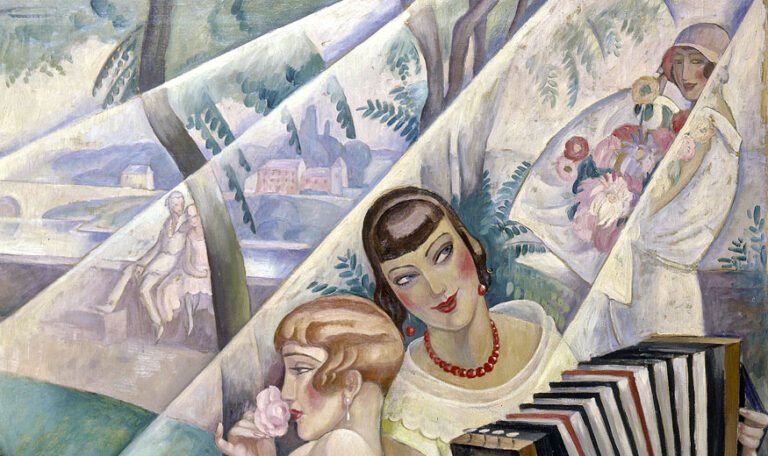
Gerda Wegener, A Summer Day, 1927. Wikimedia Commons (public domain). Detail.
This Pride Month, we invite you to explore a compelling work by Gerda Wegener, an artist whose dazzling contributions to the early 20th-century art scenes of Copenhagen and Paris were later unjustly veiled by decades of obscurity. It was only in recent years that the world truly re-encountered Wegener: not solely as a painter of exceptional skill, but as a formidable female artist whose life and work heralded new freedoms for women’s expression, women’s rights, and the LGBTQ+ community. Let us now illuminate one such masterpiece and the remarkable woman behind it.
Despite her standing as one of the most influential painters in the Danish and Parisian Art Deco movements, Gerda Wegener remained relatively obscure for many years. However, her significant contributions to the art world were rightfully brought back into the spotlight in 2015 when the Arken Museum of Modern Art near Copenhagen, Denmark, dedicated a major retrospective to her, showcasing a substantial collection of her works.
As we celebrate Pride Month, it feels particularly fitting to highlight one of her many remarkable pieces, especially considering her marriage to Lili Elbe, who is widely recognized as one of the first individuals to undergo gender-affirming surgery and a true pioneer in transgender history.

Exhibition view of Gerda Wegener, 2015, Arken Museum of Modern Art, Ishøj, Denmark. Copenhagen Film Fund.
Born Gerda Gottlieb in Denmark in 1886, she grew up in a small rural town in a relatively conservative family, as her father was a vicar. Despite the traditional upbringing, the young Gerda possessed a persuasive spirit, convincing her parents to allow her to enroll at the Royal Danish Academy of Fine Arts in Copenhagen as a teenager. It was here that she met fellow painter Einar Wegener, whom she married at the age of 19.
This period also marked the beginning of Gerda’s artistic career. In 1904, she exhibited some of her works at the Kunsthal Charlottenborg, the official gallery of the Academy, though this initial showing didn’t bring significant recognition. However, a turning point came in 1907 when she won a drawing contest for the Danish newspaper Politiken. This success brought her work into the public eye, and she began to build a career illustrating fashion magazines for women. Her pieces are distinguished by a prominent Art Deco sensibility.

Gerda Wegener in 1904. Photograph by C. L. Wilhelm Kihlstrøm. Wikimedia Commons (public domain).
Gerda Wegener’s artworks predominantly feature captivating depictions of stylish women, often characterized by chic short bob hairstyles, full lips, and striking almond-shaped eyes. Among her models, one held particular prominence: Lili Elbe. Elbe was, in fact, Einar Wegener, Gerda’s husband. When an actress who was meant to sit for Gerda failed to appear, Einar stepped in to model for his wife. During the process, Einar began to discover and embrace his female identity, eventually becoming Lili Elbe, one of the first individuals to undergo gender-affirming surgery. Many will undoubtedly be familiar with the acclaimed film The Danish Girl, which tells the story of their relationship, starring the outstanding Alicia Vikander as Wegener and Eddie Redmayne in the role of Elbe.

Gerda Wegener, Two Cocottes with Hats, c. 1925. Wikimedia Commons (public domain).

Gerda Wegener, At The Mirror, 1931–1936. Wikimedia Commons (public domain).

Gerda Wegener, Carnival, Lily, 1928, Paris. Wikimedia Commons (public domain).


Lili Elbe, in her blonde wig, holds a rose symbolizing femininity, her sensual gaze meeting the viewer’s.
Her sensual gaze fixed on her own reflection, a woman is mirrored alongside a man intently watching her. She doesn’t look his way, yet she’s clearly conscious of his scrutiny.
A beautiful woman with full red lips is looking to the side with a sensual gaze, holding a mask in her hands.
Following Lili’s transition, Gerda and Lili continued their lives together. This profound personal evolution also found expression in Gerda Wegener’s art. Facing the conservative climate in Copenhagen at the time, the couple chose to relocate to Paris, where they could live with considerably more freedom. While Wegener also created a notable series of lesbian erotic paintings, for this occasion, let’s focus on a specific piece titled A Summer Day.

Gerda Wegener, A Summer Day, 1927. Wikimedia Commons (public domain).
Consistent with many of Gerda Wegener’s works, A Summer Day portrays a group of beautiful women engaged in various leisurely activities. The scene unfolds outdoors, with the women arranged in diverse poses. They are all occupied with different pastimes.

Gerda Wegener, A Summer Day, 1927. Wikimedia Commons (public domain). Detail.
In the foreground, a nude woman is depicted semi-reclining, gently smelling a rose. She leans against another woman with dark hair, who is playing an accordion. To the left, another woman holds an open book, though her gaze is directed towards the right side of the painting, mirroring the attention of the accordion player.
In the background, a figure in a hat, holding a large palette, is captured in the act of painting. To the right, a woman who seems to be passing by, carrying a large bouquet, turns to observe the central group.

Gerda Wegener, A Summer Day, 1927. Wikimedia Commons (public domain). Detail.
The painting exemplifies Wegener’s signature style, embodying the characteristics of the Art Deco movement. This is evident in the use of soft pastel colors and smooth, flowing lines, all contributing to a harmonious composition. Wegener skillfully depicts rays of warm sunlight illuminating the central figures, and the light glinting off the rings worn by two of the women.

Gerda Wegener, A Summer Day, 1927. Wikimedia Commons (public domain). Detail.
The women in Wegener’s painting are portrayed through a distinctly female gaze, as opposed to the traditional depictions of (often nude) women by male artists. Wegener captures their beauty without resorting to objectification or the prevalent male perspective of her time. She portrays these strong, beautiful women with admiration. She presents them not as mere objects, but as subjects endowed with their own agency and will.
Wegener liked to challenge conventional gender norms in her artworks, often featuring androgynous figures (drawing inspiration from Lili Elbe). In A Summer Day, we can see an androgynous painter in the background, capturing the entire scene.

Lili Elbe, 1926. Wikimedia Commons (CC BY 4.0).
Gerda Wegener played an important role in revolutionizing the portrayal of women in art. Beyond her artistic contributions, she demonstrated profound personal courage. She defied the pervasive prejudices and conservative societal norms of her time to live life authentically and on her own terms. This was powerfully evident in her modern and liberated portrayals of women, such as A Summer Day, as well as her unwavering love and support for her partner, Lili Elbe, especially after Lili embarked on her journey of gender affirmation to live fully as a woman. Wegener’s steadfast commitment endured despite the immense personal cost, including the annulment of their marriage by the King of Denmark, a testament to her remarkable character and conviction.
Gerda Wegener, Ed. Christian Gether, Stine Høholt, Andrea Rygg Karberg, Amalie Grubb Martinussen, Arken Museum of Contemporary Art 2015.
Get your daily dose of art
Click and follow us on Google News to stay updated all the time

DailyArt Magazine needs your support. Every contribution, however big or small, is very valuable for our future. Thanks to it, we will be able to sustain and grow the Magazine. Thank you for your help!

Univ. of New Orleans, Fine Arts and History; Fine Artist, Professional Graphic Designer, Art Historian, Historian, Musician, worked at the New Orleans Museum of Art and MS Museum of Art; learning enthusiast!
With sweet putti, handsome gods, beautiful nymphs, vibrant colors, and elaborate compositions, The Setting of the Sun is a testimony to François...
James W Singer 8 February 2026
Among the Sierra Nevada, California, by Albert Bierstadt, is a majestic mountainous landscape filled with wild beauty and blissful idealism. Its...
James W Singer 25 January 2026
The Cardsharps is an early masterpiece of Baroque art by Caravaggio that explores the revolutionary theme of crooked card playing. Let’s delve...
James W Singer 11 January 2026
As Europe burned during WWII, Wassily Kandinsky, who had fled Nazi Germany in 1933, lived as a recluse in his Neuilly-sur-Seine apartment. In that...
Javier Abel Miguel 8 January 2026





.jpg)
