
Simeon Solomon: Painting Queerness and Judaism in Victorian England
Despite being a Jew in a city still grappling with religious freedoms, Simeon Solomon rose to become one of London’s notable painters only to come...
Theodore Carter 28 August 2026
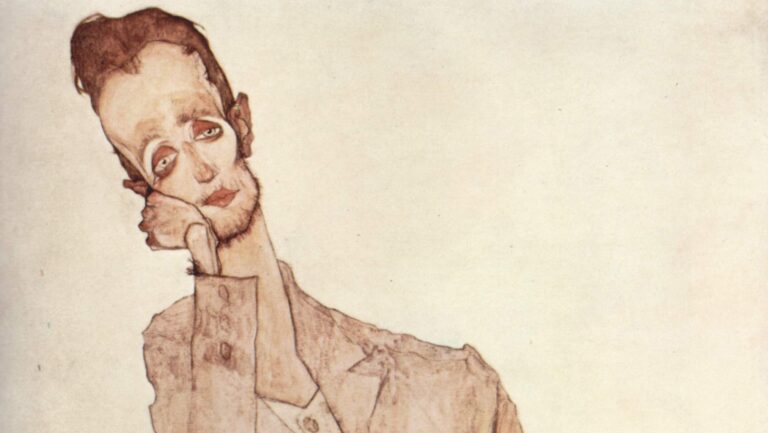
Egon Schiele, Portrait of Karl Zakovsek, 1910, oil on canvas, private collection. Wikimedia Commons (public domain). Detail.
For most art lovers and historians, Karl Zakovsek is merely a name on a museum label—the introspective figure captured in Egon Schiele’s (1890–1918) iconic 1910 portrait. While the subsequent provenance of the physical painting is documented, including its sale to the Viennese collector Carl Reininghaus in 1912, Zakovsek’s personal trail within the public art scene stops abruptly after 1910, leaving a decades-long gap in his biography.
Before his disappearance from public records, Karl Zakovsek’s creative connection to Egon Schiele was well-established. American art dealer Jane Kallir’s catalogue raisonné records four preparatory drawings leading up to the final 1910 oil painting. Zakovsek was a contemporary who shared a studio and a classroom with Schiele, Anton Peschka, and several other classmates at the Academy of Fine Arts Vienna starting in 1906. When institutional constraints became too oppressive, Zakovsek stood side-by-side with Schiele, cosigning the historic 1909 founding manifesto of the Neukunstgruppe (New Art Group) and exhibiting at their debut at the Salon Pisko. Yet, after 1910, his name faded entirely from the avant-garde gallery scene.
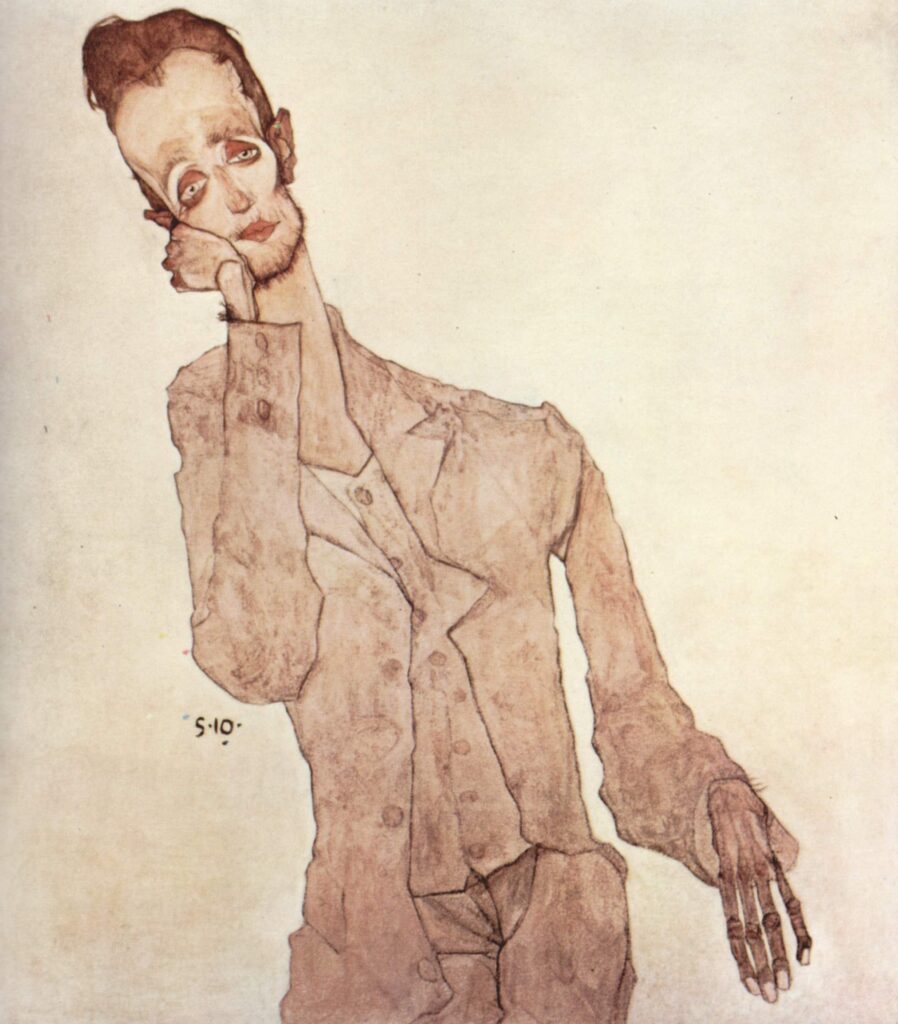
Egon Schiele, Portrait of Karl Zakovsek, 1910, oil on canvas, private collection. Wikimedia Commons (public domain).
It was long assumed that Karl Zakovsek had stopped working as an artist, with some speculating that he had perished during World War I. Recent contact with the artist’s grandson, who manages his private archive, proves otherwise. Karl Zakovsek (1888–1965) simply chose a quieter environment. Seeking financial stability, he qualified as a permanent state drawing professor in 1912, moving away from the commercial art market.
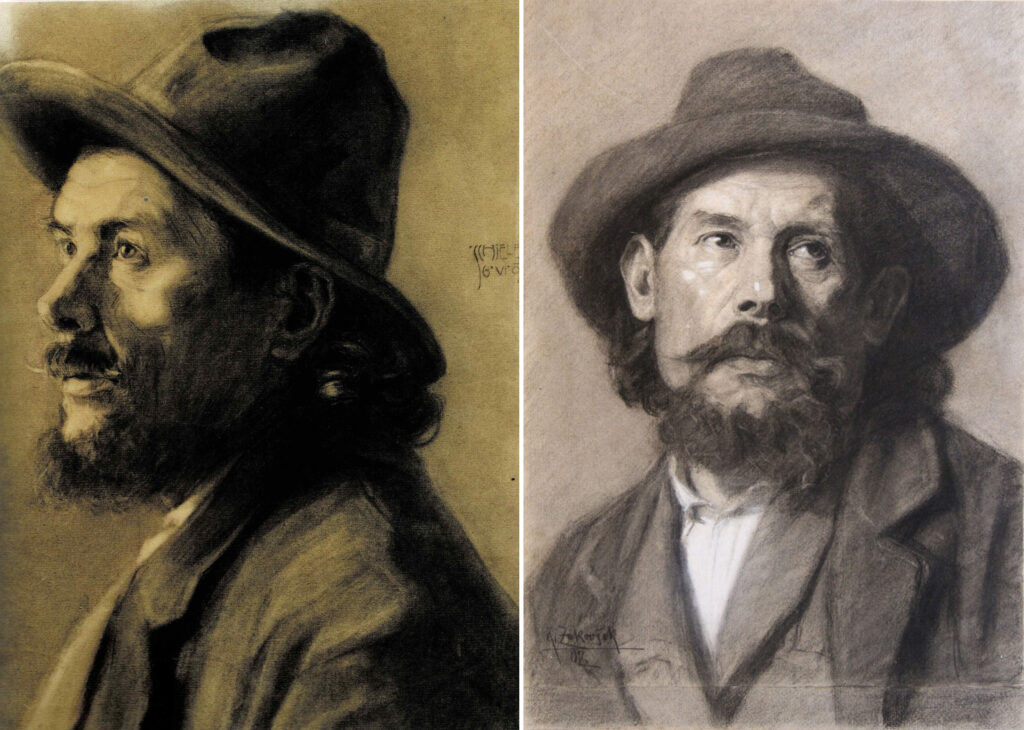
Left: Egon Schiele, Head of a Bearded Man with a Hat, 1907, charcoal on paper, private collection; Right: Karl Zakovsek, Academic Study of a Man with a Hat, 1907, charcoal on paper, private collection, Zakovsek family archive, Vienna, Austria. Courtesy of the Zakovsek family.
Newly discovered studio drawings from the family archive offer rare visual evidence of his early talent, showing how Zakovsek and Schiele sketched identical poses of the same models from their respective angles in the classroom. Zakovsek excelled within the traditional structure, winning the Academy’s prestigious Perspective Prize in 1907. Their close creative and personal dialogue during this era is further highlighted by surviving artifacts, including a personal invitation postcard Schiele sent to Zakovsek on September 12, 1910, inviting him to his studio.
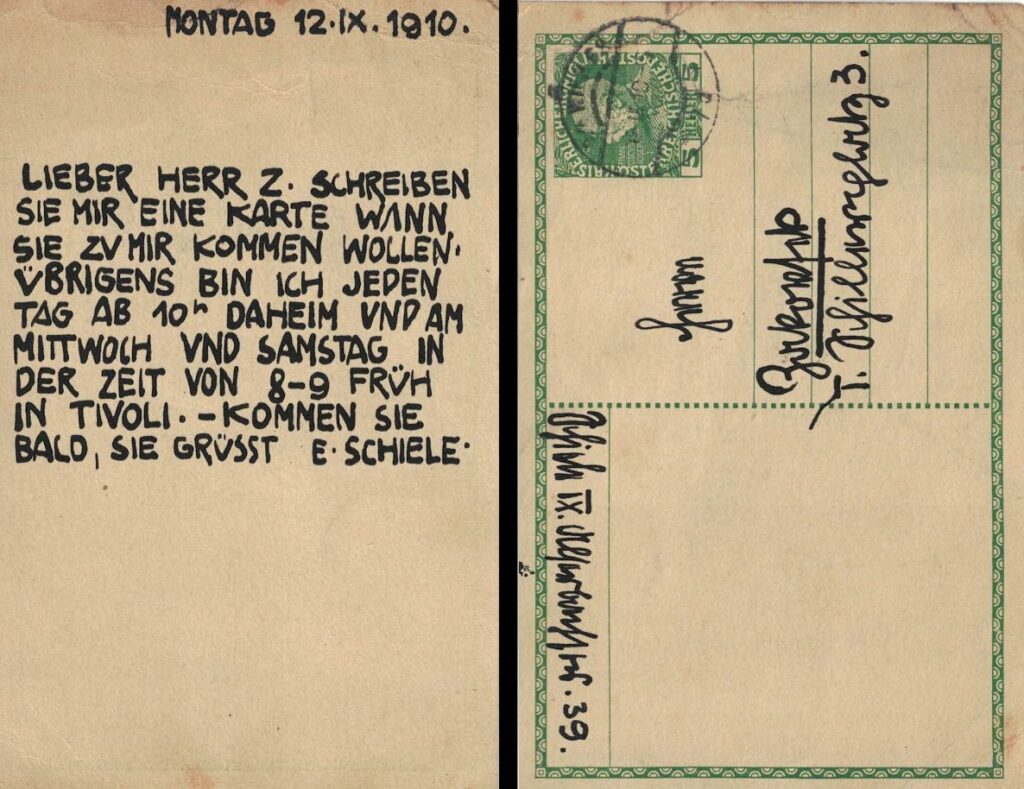
Egon Schiele, Autograph invitation postcard to Karl Zakovsek, September 12, 1910, ink on paper, private collection, Zakovsek family archive, Vienna, Austria. Courtesy of the Zakovsek family.
During World War I, Zakovsek served with the Red Cross on the Italian front. Archival documents shared by his grandson show a remarkable parallel between the two artists in the autumn of 1918. While retreating on a military march near Lavis in South Tyrol, Zakovsek contracted the Spanish flu. In a tragic historical coincidence, Zakovsek finally recovered in South Tyrol on October 31, 1918—the exact day his former classmate Egon Schiele succumbed to the very same pandemic in Vienna.
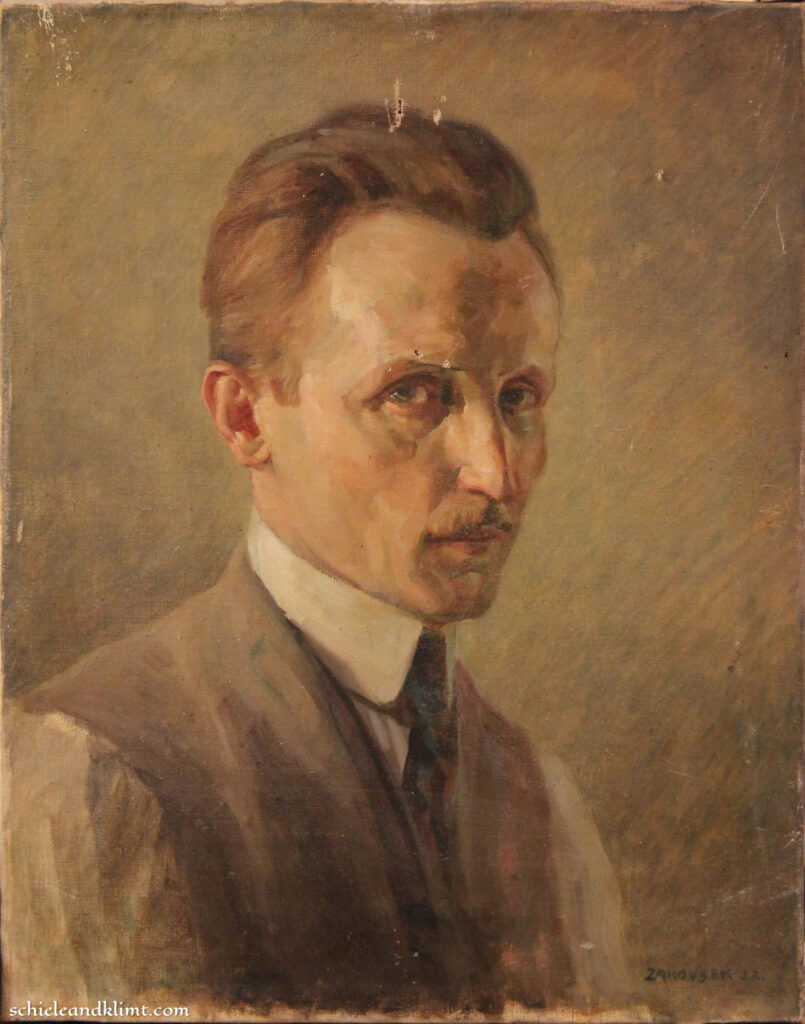
Karl Zakovsek, Self-Portrait, 1922, oil on canvas, private collection, Zakovsek family archive, Vienna, Austria. Courtesy of the Zakovsek family.
Karl Zakovsek survived the fractured post-war era and balanced his career as an educator in Vienna with a continuous, private passion for creating art. While removed from the commercial gallery system, he remained locally active, cofounding the Künstlergruppe Rosenhügel in 1927 and exhibiting work in a 1928 show alongside prominent Expressionists, including Ernst Ludwig Kirchner.
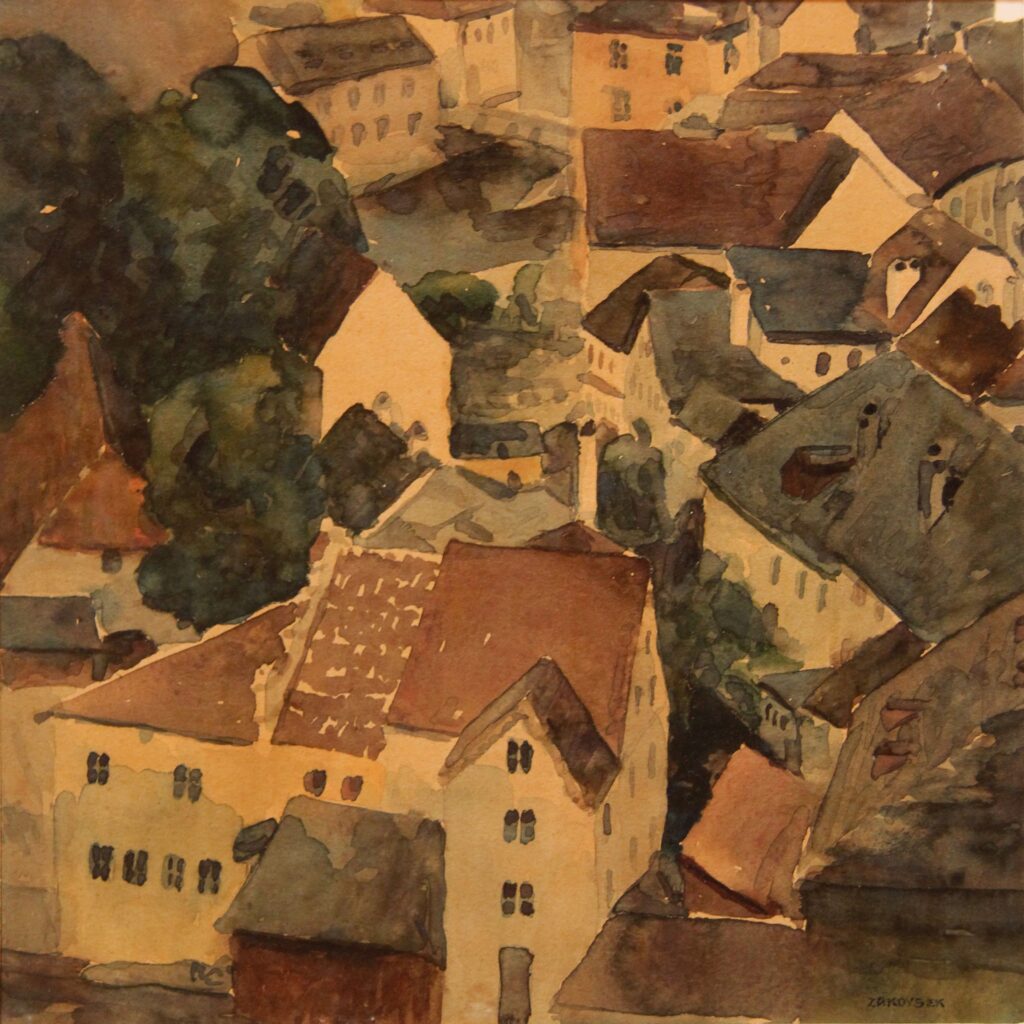
Karl Zakovsek, View of Krumau (Český Krumlov), c. 1912, oil on canvas, private collection, Zakovsek family archive, Vienna, Austria. Courtesy of the Zakovsek family.
Zakovsek’s commitment to his work extended far beyond exhibitions. An avid mountaineer, he routinely carried watercolor supplies on alpine treks and even contributed 3,000 hours of physical labor to cast the bricks for his own home and studio. His transition away from the avant-garde is captured in early works like View of Krumau (Český Krumlov) from around 1912, which led into his later oeuvre of post-impressionistic landscapes and detailed botanical studies. Zakovsek spent his retirement traveling through Italy and painting Mediterranean coastal landscapes. He passed away following a heart attack in November 1965 at the age of 77.
This research restores the career of an artist once known only through a single portrait, opening new perspectives on the interconnected lives of the Viennese avant-garde.
Author’s bio:
Harold van de Laar is an independent researcher and the founder of schieleandklimt.com, a website about Klimt, Schiele, and the Vienna Secession. He tracks down lost artwork, letters, and forgotten life stories. His current work focuses on bringing lesser-known artists from this Viennese era back into the spotlight.
DailyArt Magazine needs your support. Every contribution, however big or small, is very valuable for our future. Thanks to it, we will be able to sustain and grow the Magazine. Thank you for your help!

This is our guest profile for occasional authors. If you have an interesting story about art to tell, send it to our Editor-in-chief Kate at [email protected]. You might be the next here!

Univ. of New Orleans, Fine Arts and History; Fine Artist, Professional Graphic Designer, Art Historian, Historian, Musician, worked at the New Orleans Museum of Art and MS Museum of Art; learning enthusiast!
Despite being a Jew in a city still grappling with religious freedoms, Simeon Solomon rose to become one of London’s notable painters only to come...
Theodore Carter 28 August 2026
In Rembrandt’s prints, you can see the whole of life passing you by, from the cradle to the grave. Every stage of life held something...
Guest Author 12 June 2026
There is a dead man on the table. His skullcap has been removed, and someone loosens the meninges with a lancet. Not an easy sight, yet fascinating:...
Guest Author 14 May 2026
Gerhard Richter is a widely-known and revered German artist, as well as one of the world’s most expensive living artists. Several of his works...
Nikolina Konjevod 4 May 2026