

Simeon Solomon: Painting Queerness and Judaism in Victorian England
Despite being a Jew in a city still grappling with religious freedoms, Simeon Solomon rose to become one of London’s notable painters only to come...
Theodore Carter 28 August 2026
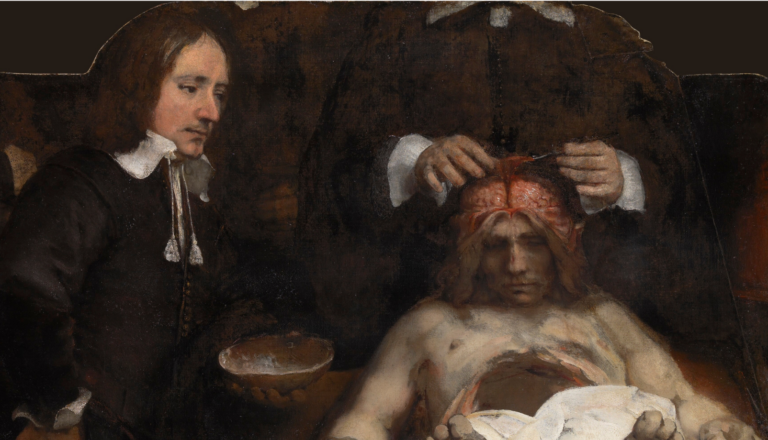
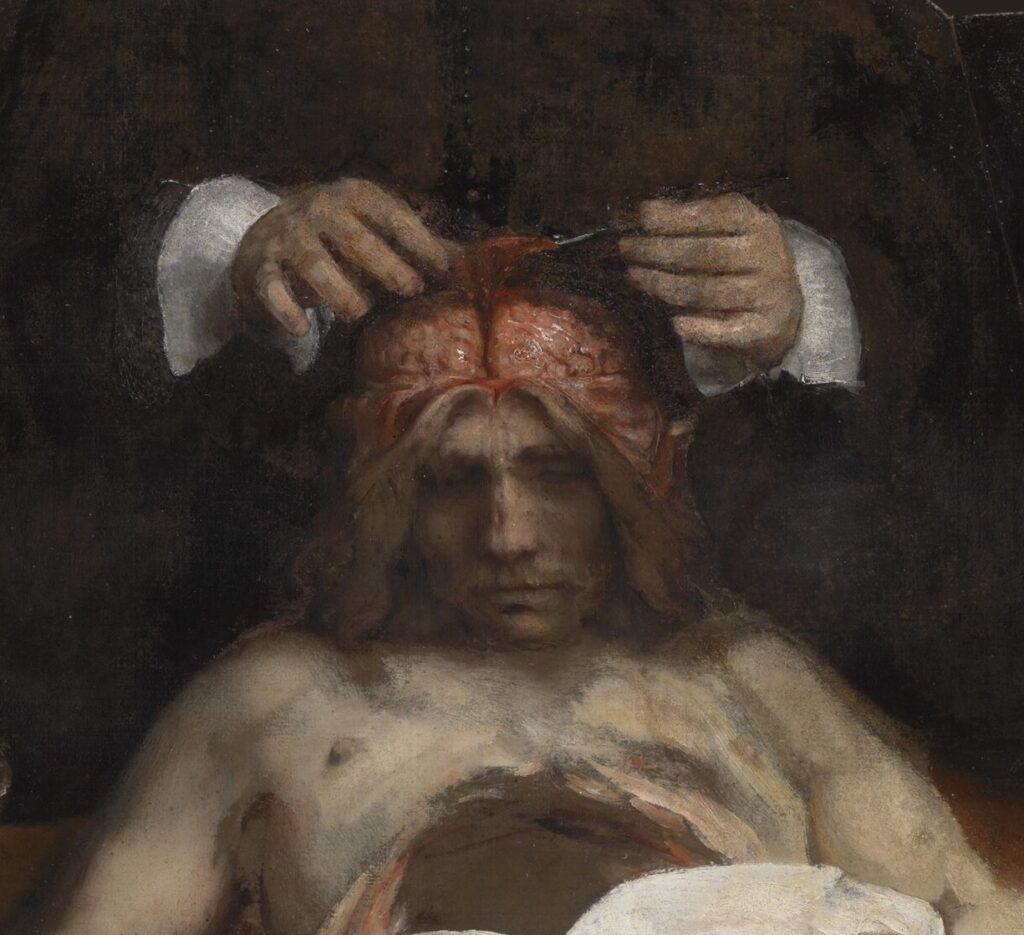
Rembrandt, The Anatomy Lesson of Dr. Deijman, 1656, Rembrandt House Museum, Amsterdam, Netherlands, on loan from the Amsterdam Museum until August 30, 2026. Detail.
There is a dead man on the table. His skullcap has been removed, and someone loosens the meninges with a lancet. Not an easy sight, yet fascinating: a scientist opens the body to study its inner workings. This lesson took place in Amsterdam 370 years ago, drawing surgeons, scholars, the curious, and Rembrandt. Inspired, he later painted The Anatomy Lesson of Dr. Deijman in his studio. The work is now on view at the Rembrandt House Museum, where it was created, until the end of August 2026.
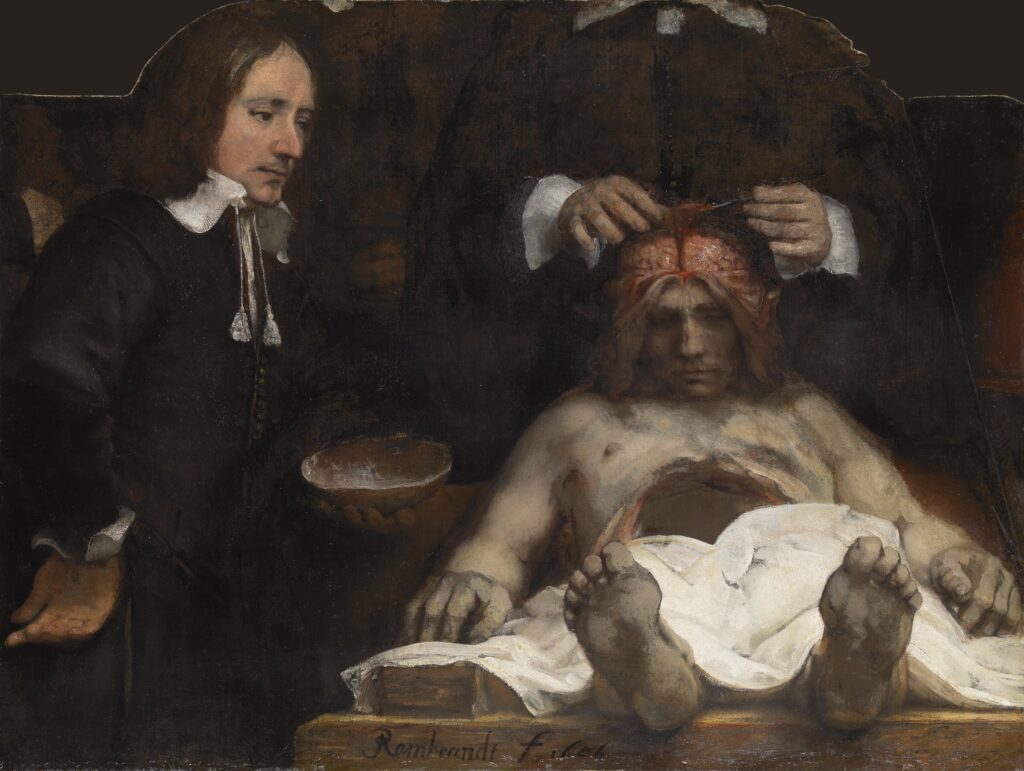
Rembrandt, The Anatomy Lesson of Dr. Deijman, 1656, Rembrandt House Museum, Amsterdam, Netherlands, on loan from the Amsterdam Museum until August 30, 2026.
Rembrandt’s striking painting was once much larger: about two and a half meters high and three meters wide (approximately 8.2 by 9.8 feet). More than half of it was destroyed in a fire in 1723; now, only the middle part remains. We can still see the hands of the doctor who is giving the anatomy lesson: Jan Deijman. The man on the left is his assistant, Gijsbert Calkoen. He is holding the skullcap. And, of course, there is the body. That is the body of Joris Fonteijn, a criminal who had received a death sentence. Doctor Deijman was allowed to use his body for his anatomy lesson.
In the fire, the doctor’s head went up in flames, just like most of the people around him. Besides Deijman and his assistant, seven more men—the surgeons—were watching on the right and left. These are doctors who perform simple medical procedures, such as pulling molars and splinting broken arms. They ordered and paid for this painting by Rembrandt to hang it in the building of their guild: De Waag on the Nieuwmarkt. It is an impressive painting, even now that only a fragment of it survives. But how did Rembrandt achieve that? Let’s find out by looking at a few details.
Rembrandt, The Anatomy Lesson of Dr. Deijman, 1656, Rembrandt House Museum, Amsterdam, Netherlands, on loan from the Amsterdam Museum until August 30, 2026. Detail.
The way the scalp is opened, its colors and texture—you can’t make that up. You must have studied that with your own eyes. Rembrandt must have paid close attention during the anatomy lesson. And that is what those lessons are ultimately about: careful observation as a form of research. Deijman did that as a doctor, but Rembrandt did it just as much as an artist.
Rembrandt, The Anatomy Lesson of Dr. Deijman, 1656, Rembrandt House Museum, Amsterdam, Netherlands, on loan from the Amsterdam Museum until August 30, 2026. Detail.
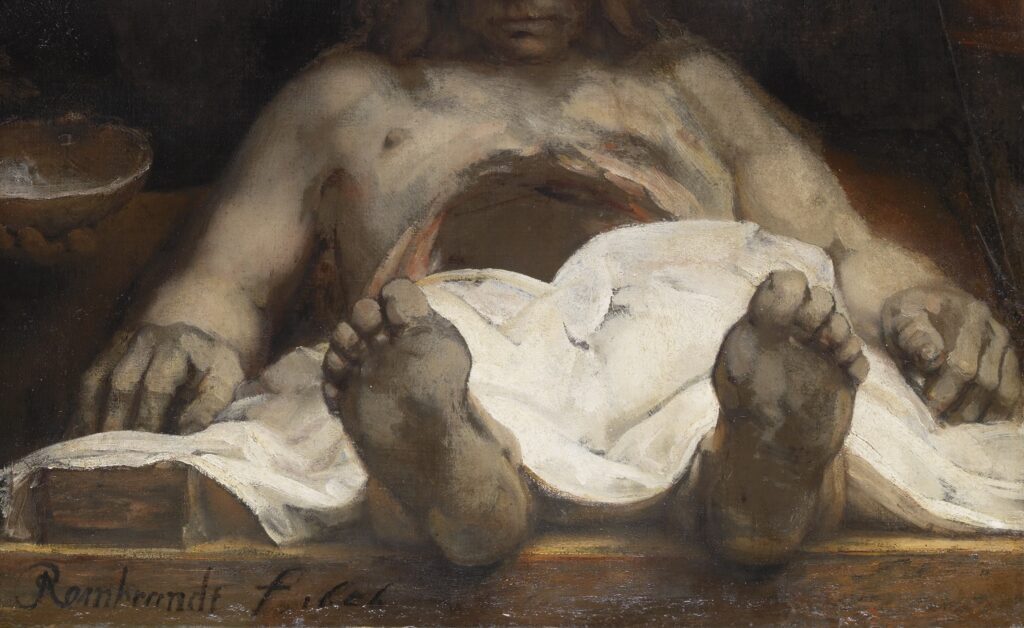
How exactly did Rembrandt depict the corpse’s feet? The dark gray layer is the underpainting Rembrandt first applied across the entire surface. He then began working on it. He outlined the feet with touches of black paint. But the most important thing is the light gray paint. With this, he shaped the feet. But it doesn’t completely cover the dark gray underlayer.
That color helps with shaping the feet. In the end, Rembrandt used little paint and still managed to make a pair of feet appear. It even looks like they’re sticking out of the painting. This is typical of Rembrandt: he conjures an entire world onto the canvas, but he also always shows how he did it: material and technique remain visible. Up close, it is paint; from a distance, it looks like feet.

Andrea Mantegna, Lamentation of Christ, c. 1480, Pinacoteca di Brera, Milan, Italy.
Rembrandt was a master in evoking emotions. He made the dead body feel both real and relatable. To understand how he did this here, it is useful to know that Rembrandt copied the position of the corpse from older paintings of the dead Christ. The Italian Andrea Mantegna, who lived almost two centuries before Rembrandt, was the first to depict Christ in this way.
This painting was supposed to bring up feelings of compassion. This is not only because of the sadness of the women on the left, but also because of the way Christ is painted. His body is not godly, but very human. Gray and sunken. And we are right on top of it. The death of Christ suddenly comes very close. The same happens with the corpse in Rembrandt’s painting. It looks so completely lost. Not nicely laid out, but gray and damaged. You would almost feel sorry for the dead Joris Fonteijn.
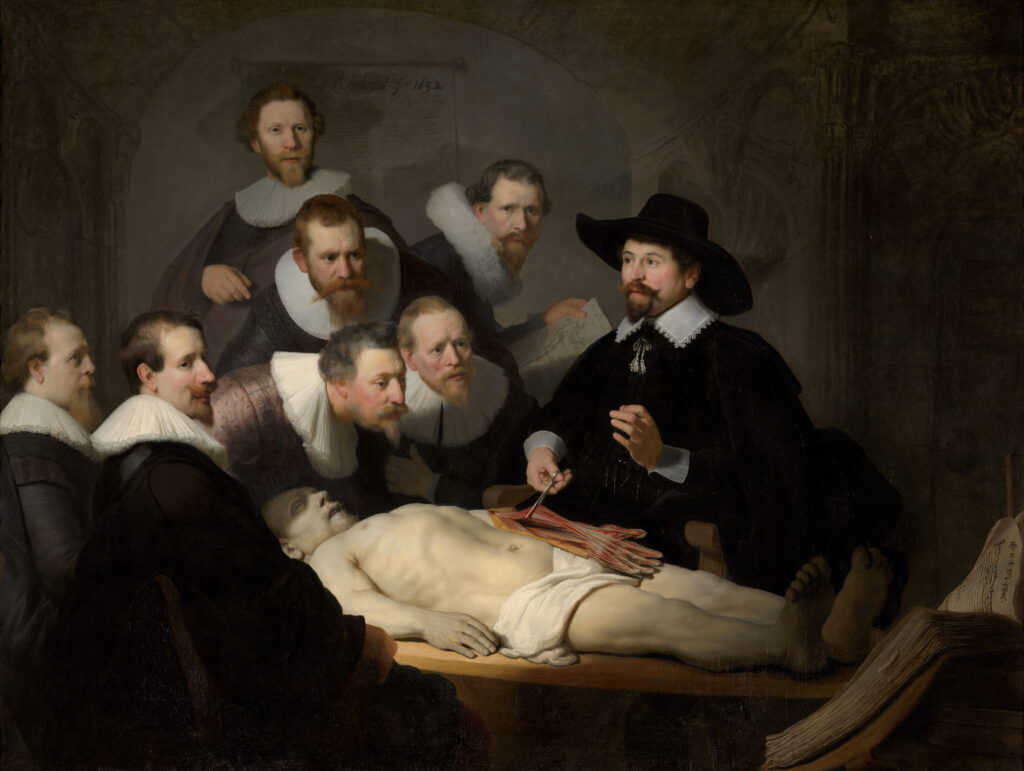
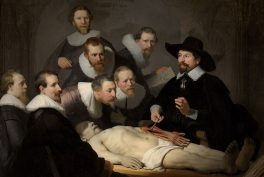
Rembrandt van Rijn, The Anatomy Lesson of Dr. Nicolaes Tulp, 1632, Mauritshuis, The Hague, Netherlands.
Rembrandt had already painted an anatomy lesson once. Almost 25 years earlier, he created The Anatomy Lesson of Dr. Nicolaes Tulp (now in the Mauritshuis collection). The two paintings are somewhat similar. Both show a group of men surrounding a corpse. But one thing is really different. In the painting of Doctor Deijman, Rembrandt placed the corpse not at an angle, but exactly in the middle. In line with your gaze. Because of that, you only see the feet and the upper body. The legs disappear completely. And you look straight into the stomach, where the intestines have been removed.
That is where anatomy lessons always began, because the intestines spoil the quickest. Yet during the first anatomy lesson, the one by Dr. Tulp in 1632, the stomach is still intact. Apparently, Rembrandt did not want to make it too gruesome. But after 25 years, he didn’t care anymore. He even emphasized the empty abdominal cavity. The viewer looks directly into it. This level of realism is strikingly bold.
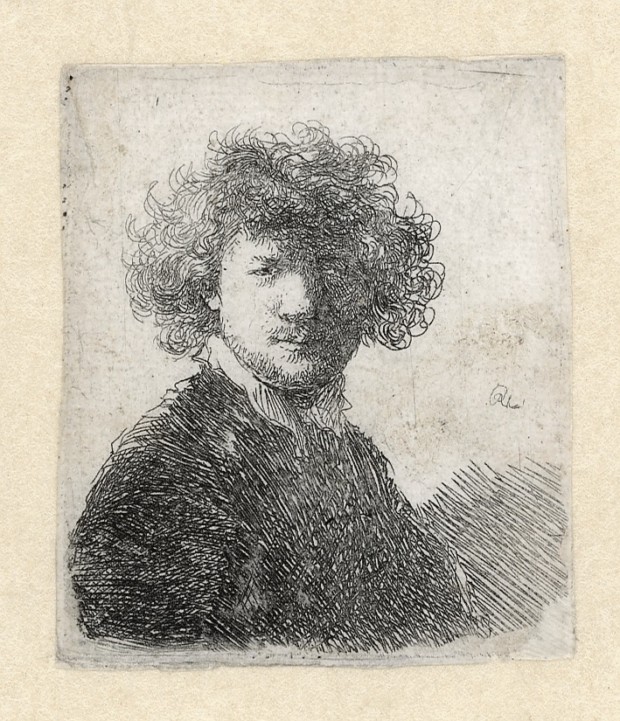
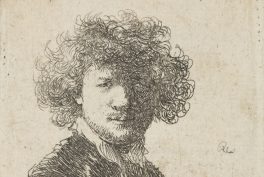
Rembrandt, Self-Portrait with Curly Hair, c. 1629, Rembrandt House Museum, Amsterdam, Netherlands.
Rembrandt painted Jan Deijman’s anatomy lesson in 1656. That year is inscribed on the painting, below the foot. It was an important year in Rembrandt’s life. He has not had any major assignments for almost 15 years and was heavily in debt. He was even in danger of going bankrupt. So the commission for this painting came at just the right time. Not only because of the income, but also because it would hang in the barber surgeons’ association building, a prominent place where possible future clients would see it.
So, Rembrandt needed to show what he was capable of. He used everything he was good at: careful looking, experimental technique, bold realism, and a subtle sense of humanity. And it worked. Unfortunately, we only have a fragment left, but even so, it is clear: with this painting, Rembrandt proved that he was still among the greatest.
Author’s bio:
Epco Runia is Head of Collections and Research of the Rembrandt House Museum in Amsterdam, Netherlands.
DailyArt Magazine needs your support. Every contribution, however big or small, is very valuable for our future. Thanks to it, we will be able to sustain and grow the Magazine. Thank you for your help!

This is our guest profile for occasional authors. If you have an interesting story about art to tell, send it to our Editor-in-chief Kate at [email protected]. You might be the next here!

An admirer of antiquity, art, and architecture. An avid reader and amateur photographer. Always curious, always on an adventure.
Despite being a Jew in a city still grappling with religious freedoms, Simeon Solomon rose to become one of London’s notable painters only to come...
Theodore Carter 28 August 2026
In Rembrandt’s prints, you can see the whole of life passing you by, from the cradle to the grave. Every stage of life held something...
Guest Author 12 June 2026
Gerhard Richter is a widely-known and revered German artist, as well as one of the world’s most expensive living artists. Several of his works...
Nikolina Konjevod 4 May 2026
Akseli Gallen‑Kallela (1865–1931), one of Finland’s most famous painters, holds a distinctive place in European art at the turn of the 20th...
Catherine Razafindralambo 19 February 2026