

Masterpiece Story: The Setting of the Sun by François Boucher
With sweet putti, handsome gods, beautiful nymphs, vibrant colors, and elaborate compositions, The Setting of the Sun is a testimony to François...
James W Singer 8 February 2026

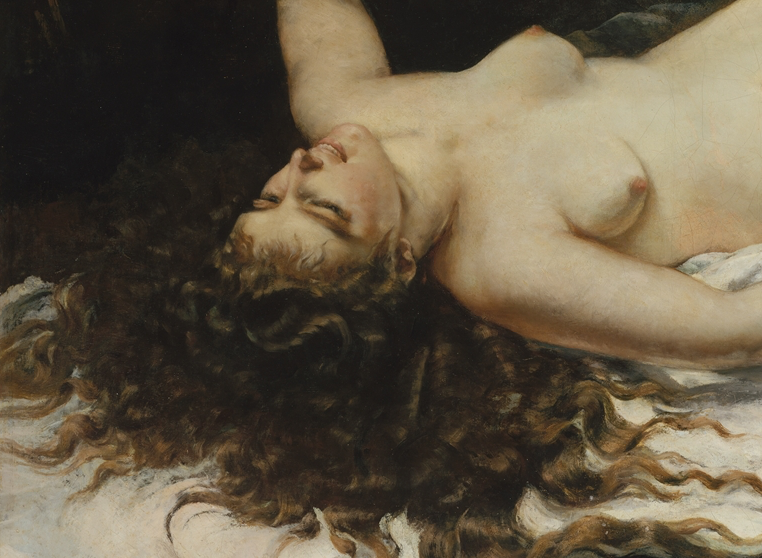
Gustave Courbet, Woman with a Parrot, 1866, Metropolitan Museum of Art, New York, NY, USA. Detail.
Gustave Courbet, the enfant terrible of French 19th-century art, did everything he could to save himself in the memory of the contemporary art critics. After the success of Cabanel’s Birth of Venus at the Salon of 1863, Courbet wanted to challenge the French Academy and painted two masterpieces. His first attempt in 1864 was rejected on the grounds of indecency; however, two years later, his Woman with a Parrot was accepted to be exhibited in the Salon of 1866.

The viewers were shocked by the presence of the model’s discarded clothing and disheveled hair. Although it triggered shocking reactions in many of its viewers, the provocative picture found favor with a younger generation of artists who shared Courbet’s disregard for academic standards. The same year, Édouard Manet began his version of the subject, while Paul Cézanne was said to carry a photograph of Courbet’s work in his wallet.
Interestingly, Jules-Antoine Castagnary, Courbet’s great defender, praised the artist for representing a “woman of our time.” Likely, the woman on the painting is Joanna Hiffernan, Courbet’s (and Whistler’s) muse, and lover. Compared to the idealized Cabanel’s Venus, she was a normal woman. The parrot, identified as a blue-fronted Amazon parrot, doesn’t help matters either as it “[embodies] both the exotic and the erotic.”
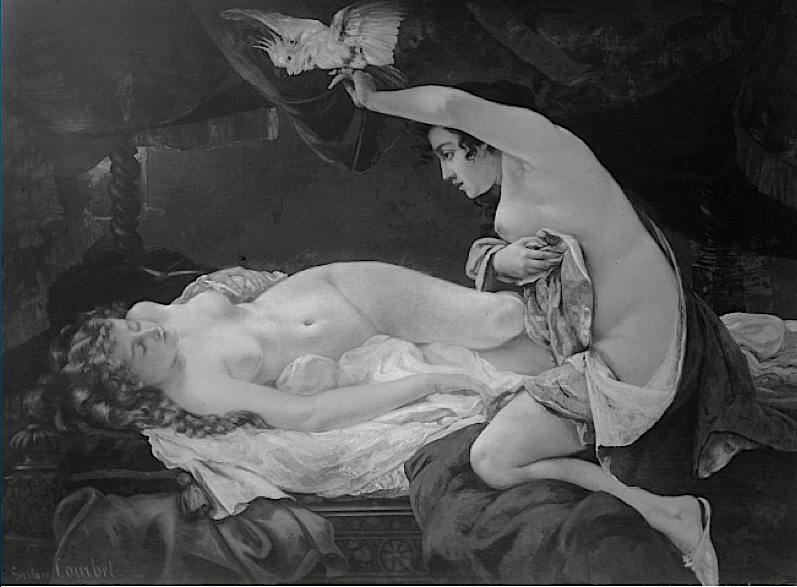
In 1864, before Woman with a Parrot, Courbet painted Venus and Psyche. It depicted “a masculine-looking brunette [leaning] with an equivocal expression (hatred? lust?) over a sumptuous, sleeping blonde.” The sleeping girl, Psyche, is in a position almost identical to that of the woman in Woman with Parrot. Unfortunately, the painting was destroyed in an air raid in Berlin in 1945. By then, it had already done its job of making Woman with Parrot appear relatively modest compared to Courbet’s other compositions. Two nudes were too much for the contemporary critique. One was enough.
Louisine Havemeyer, a famous US art collector, feminist, and philanthropist who initially bought the work, had a sense of what it would become. She recalled,
I begged Mr. Havemeyer to buy the picture. Not to hang it in our gallery lest the anti-nudists should declare a revolution and revise our constitution, but just to keep it in America, just that such a work should not be lost to the future generations.
Louisine Havemeyer
Alice Cooney Frelinghuysen, Splendid Legacy: the Havemeyer Collection. New York: Metropolitan Museum of Art, 1993.
And luckily it wasn’t.
Get your daily dose of art
Click and follow us on Google News to stay updated all the time

DailyArt Magazine needs your support. Every contribution, however big or small, is very valuable for our future. Thanks to it, we will be able to sustain and grow the Magazine. Thank you for your help!

Art Historian, founder and CEO of DailyArtMagazine.com and DailyArt mobile app. But to be honest, her greatest accomplishment is being the owner of Pimpek the Cat.
With sweet putti, handsome gods, beautiful nymphs, vibrant colors, and elaborate compositions, The Setting of the Sun is a testimony to François...
James W Singer 8 February 2026
Among the Sierra Nevada, California, by Albert Bierstadt, is a majestic mountainous landscape filled with wild beauty and blissful idealism. Its...
James W Singer 25 January 2026
The Cardsharps is an early masterpiece of Baroque art by Caravaggio that explores the revolutionary theme of crooked card playing. Let’s delve...
James W Singer 11 January 2026
As Europe burned during WWII, Wassily Kandinsky, who had fled Nazi Germany in 1933, lived as a recluse in his Neuilly-sur-Seine apartment. In that...
Javier Abel Miguel 8 January 2026