




The Empire’s Visual Language: A History of Star Wars Propaganda Art
Few franchises have looked history this directly in the face. George Lucas did not invent the Galactic Empire’s visual identity from scratch.
Errika Gerakiti 4 May 2026
25 June 2026 min Read
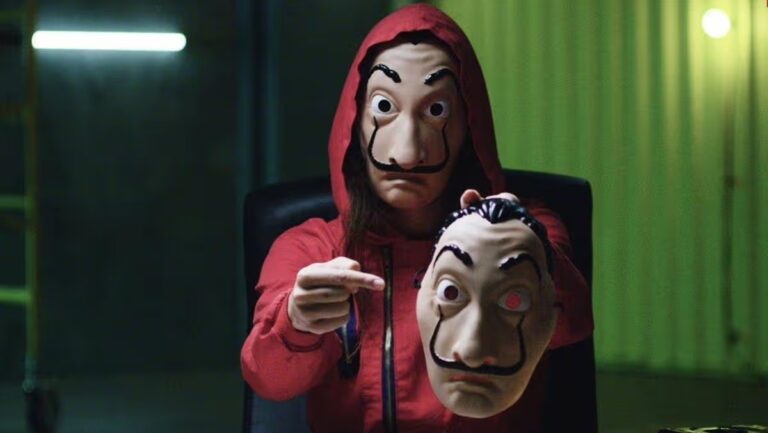
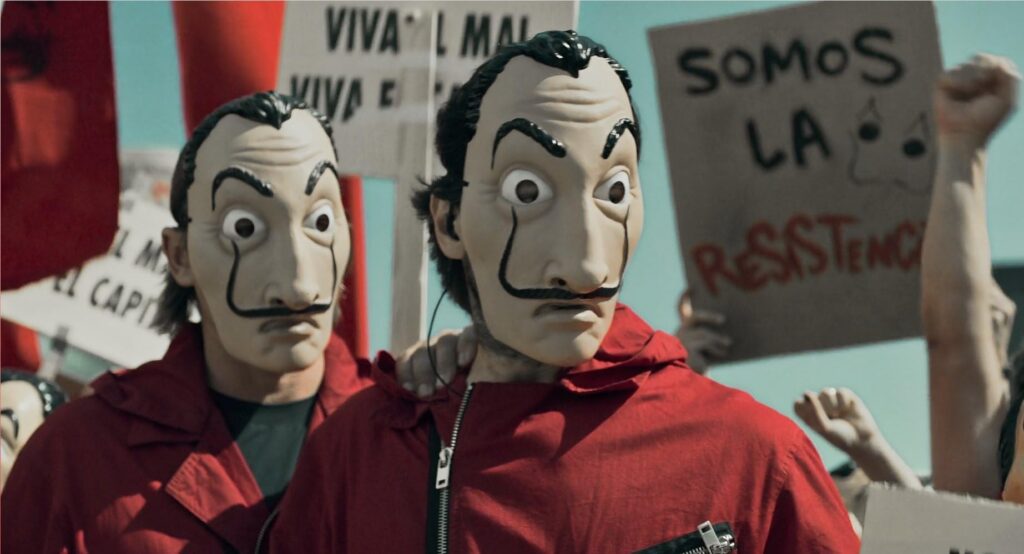
Still from Money Heist, Netflix. Irish Mirror. Detail.
Millions of viewers around the world recognize the red jumpsuits and masks of the famous Netflix series Money Heist (La Casa de Papel). The image has become a global symbol of rebellion. But did you know that this iconic look was inspired by Salvador Dalí? What makes it even more intriguing is the irony hidden beneath the mustache—Dalí himself was never truly a revolutionary.
Before that face became a mask, it was already a performance. Salvador Dalí spent his life turning himself into an image: the upturned, needle-sharp moustache borrowed from the 17th-century painter Diego Velázquez, the wide hypnotic stare, the cape and cane, and the deliberately outrageous public statements. He understood, decades before the age of screens, that an artist could become a brand and that a face could circulate further than any single canvas.
This theatricality was not separate from his art; it was an extension of it. Surrealism prized the dreamlike, the irrational, and the shocking, and Dalí performed those qualities with his own body as much as on canvas. He courted photographers and film cameras, collaborated with Walt Disney and Alfred Hitchcock, and posed for Philippe Halsman in images as carefully staged as any painting. The persona was a Surrealist artwork in its own right, and it was built to be reproduced.
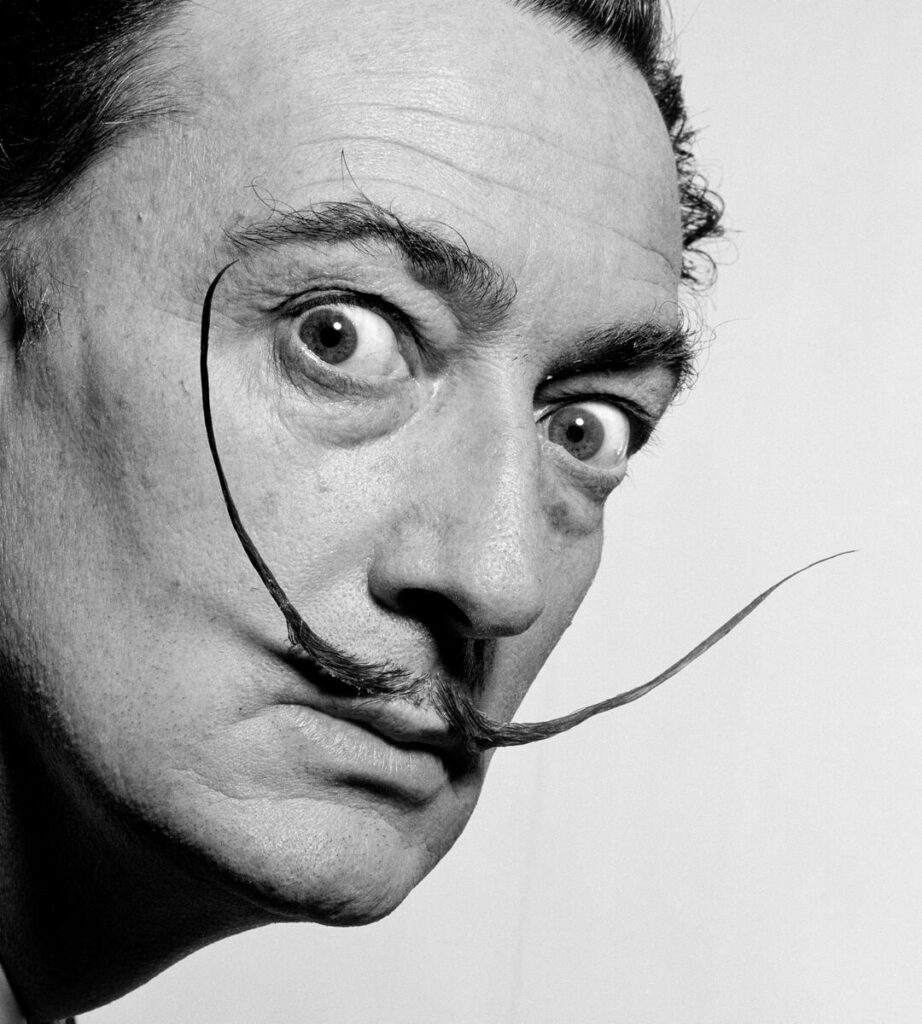
Philippe Halsman, Spanish Painter Salvador Dalí, 1954. © Philippe Halsman/Magnum Photos. Magnum Photos.
And yet the politics behind that flamboyant surface were strikingly conservative. Salvador Dalí never positioned himself as a revolutionary in the political sense. Unlike Pablo Picasso, who openly opposed Francisco Franco’s regime, Dalí avoided direct criticism of authoritarian power and at times spoke of Franco in approving terms. He identified with monarchist ideas and remained close to structures of order and authority rather than rebellion.
This ambiguity disturbed many of the intellectuals and artists around him. The Surrealists, who saw their movement as bound up with radical politics, eventually expelled him. André Breton famously rearranged the letters of his name into the mocking anagram “Avida Dollars,” a jab at the artist’s open hunger for money and fame.
Yet the most fascinating irony surrounding Dalí may not lie in his paintings at all. It lies in what happened to his face after his death.
Today, Dalí’s image circulates around the globe through the masks worn in the television series La Casa de Papel, known to many viewers as Money Heist. Inside the story, the mask becomes a symbol of rebellious identity—resistance against financial power, authority, and social frustration.
The irony is hard to ignore. A face linked to a man who often stood close to authority is now worn by fictional revolutionaries who confront the system itself. The robbers print their own money, occupy the Royal Mint of Spain, and turn Dalí’s features into a uniform of defiance. This reversal reveals something profound about modern popular culture. In the contemporary world, ideas rarely survive in their original philosophical or political form. Instead, images detach themselves from their creators and begin to live independent symbolic lives.
Still from Money Heist, S1E02, Netflix. IMDb.
The Money Heist mask functions less as a portrait of Salvador Dalí’s actual beliefs and more as a visual shorthand for rebellion itself: the exaggerated mustache, the intense stare, and the theatrical expression. The image becomes stronger than the biography behind it.
A similar transformation happened to Guy Fawkes. Historically, Fawkes took part in the failed Gunpowder Plot of 1605, an attempted act of political violence against the English Parliament. Centuries later, the stylized Guy Fawkes mask designed for V for Vendetta became a global emblem of protest movements, internet activism, and anti-establishment resistance.
Popular culture did not preserve the historical figure faithfully. It preserved the emotional effect of the image. The same mechanism now operates through Dalí. What circulates in the streets, on posters, and across digital culture is not really Dalí’s politics, but the emotional atmosphere generated by his face.
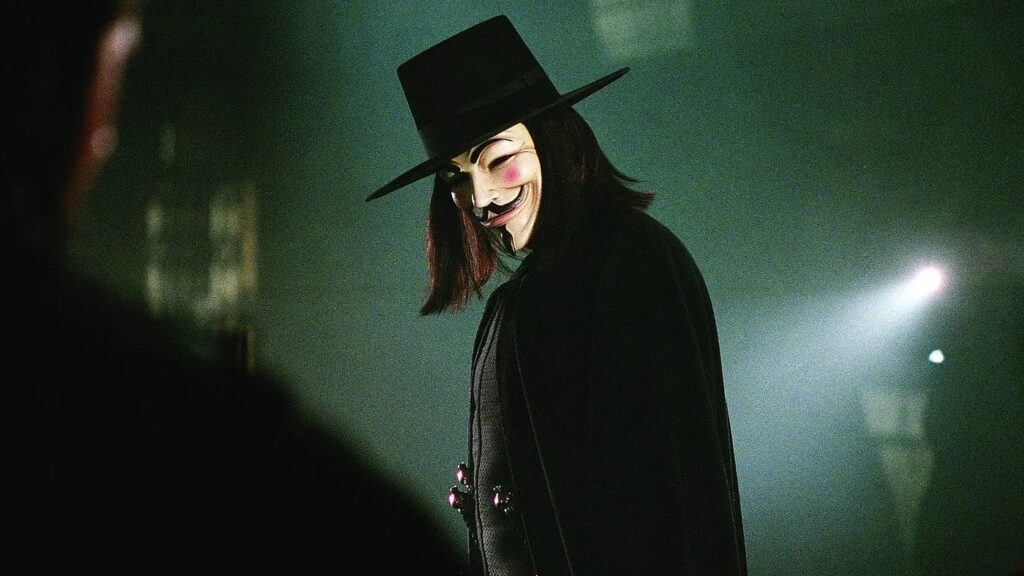
Movie still from V for Vendetta, directed by James McTeigue, 2005. Medium.
Modern culture increasingly turns thinkers, artists, and historical figures into symbols that can be endlessly reused regardless of their original context. Images travel faster than ideas. Symbols survive more easily than philosophies. This may explain why contemporary societies no longer simply consume products. They consume identities, moods, gestures, and symbols. The revolutionary feeling produced by a mask often matters more than the historical beliefs of the person printed on it.
Seen this way, Dalí’s transformation into an anti-system icon tells us less about Dalí himself and more about the strange logic of contemporary image culture. Popular culture has the power to detach symbols from history, empty them of contradiction, and refill them with entirely new meanings.
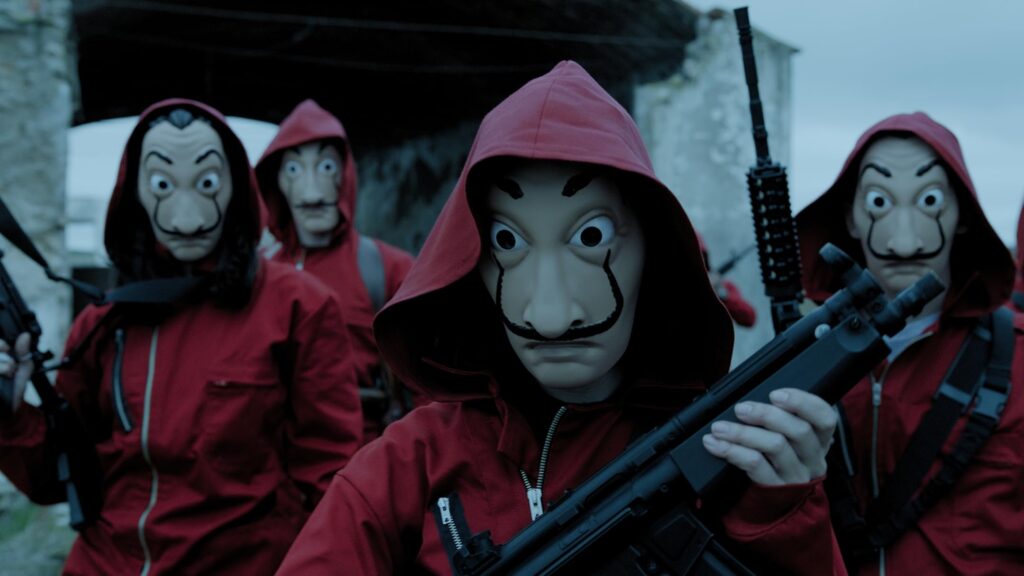
Still from Money Heist, Netflix. IMDb.
Perhaps this is one of the defining features of modernity: not the destruction of ideas, but their conversion into endlessly recyclable images. A face that once belonged to a man fascinated by monarchy and money now belongs to anyone who wants to feel, for a moment, like a rebel.
And maybe that is the final irony Dalí himself would have enjoyed. He spent his life turning his own image into a spectacle, courting cameras and controversy with equal delight. In death, the spectacle escaped him completely. The mask kept performing long after the man stopped, and it no longer needs his permission, or his beliefs, to mean whatever the moment requires.
Money Heist: The Phenomenon, directed by Luis Alfaro, Netflix, 2020.
Salvador Dalí, The Secret Life of Salvador Dalí, translated by Haakon Chevalier, New York: Dial Press, 1942.
André Breton, Manifestoes of Surrealism, translated by Richard Seaver and Helen R. Lane, Ann Arbor: University of Michigan Press, 1969.
Ian Gibson, The Shameful Life of Salvador Dalí, London: Faber & Faber, 1997.
Elliott H. King, “Introduction, Special Issue on Salvador Dalí” in Journal of Surrealism and the Americas, Vol. 13, no. 1, 2022.
Sarah Bea Milner, “Money Heist: Why They Really Wear Salvador Dalí Masks & Red Jumpsuits” in Screen Rant, April 2020.
DailyArt Magazine needs your support. Every contribution, however big or small, is very valuable for our future. Thanks to it, we will be able to sustain and grow the Magazine. Thank you for your help!

Tunacan Tuna is a culture writer and journalist exploring art history, museums, cultural heritage, cultural memory, and the ways people connect with places, objects, and stories.

Leigh is a writer, reader, art lover, radio nerd and herbalist based in Nashville, TN.
Few franchises have looked history this directly in the face. George Lucas did not invent the Galactic Empire’s visual identity from scratch.
Errika Gerakiti 4 May 2026
Most people recognize the look of Star Wars instantly. Few, however, know the name of the artist who built it. Ralph McQuarrie’s concept art...
Errika Gerakiti 4 August 2026
May the 4th be with you! Let’s celebrate Star Wars Day with some art! Famous paintings, like Girl with the Pearl Earring and The Wanderer, are just...
Szymon Jocek 4 May 2026
Whether troubled or exciting, extraordinary or perfectly average, the lives of artists are an endless source of inspiration for cinematographers.
Edoardo Cesarino 18 September 2025