

François Boucher in 10 Paintings
François Boucher (1703–1770) was one of the major exponents of the Rococo style in the 18th century. His paintings showed the ostentation and...
Jimena Escoto 10 April 2025
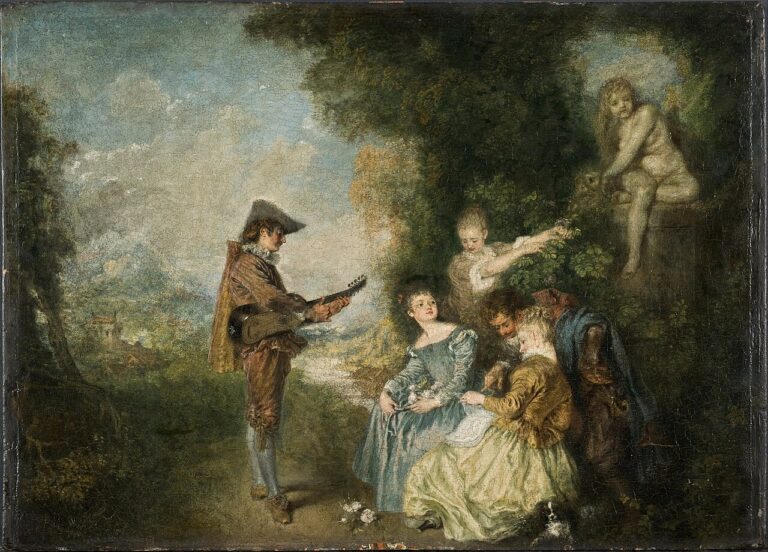
Jean-Antoine Watteau, The Love Lesson, 1716–1717, Nationalmuseum, Stockholm, Sweden.
Jean-Antoine Watteau is best known for his elegant scenes of love, music, theater, and aristocrats at leisure. His paintings are often very layered, appearing light and carefree at first, but revealing more complex inner worlds of the people he portrays. Through 10 paintings, we can discover the different sides of Watteau and the world he lived in.
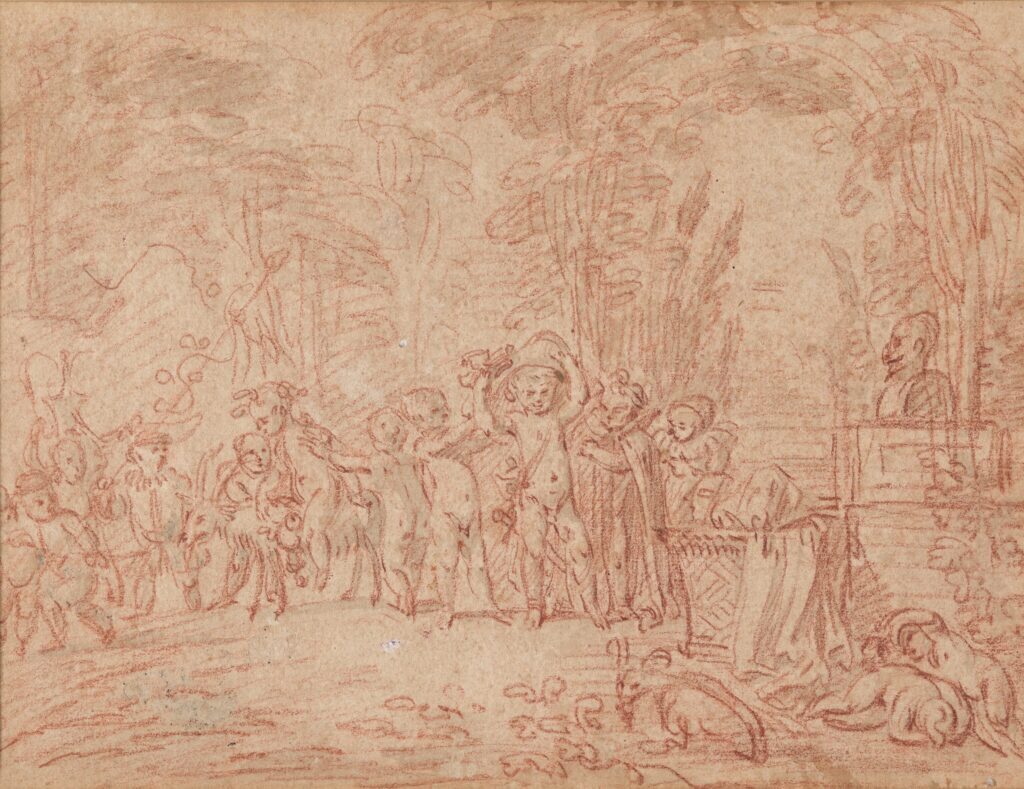
Jean-Antoine Watteau, Children Parodying a Triumph of Bacchus, 1708–1709, National Gallery of Art, Washington, DC, USA.
Like many young artists, Watteau began his career by studying the work of other painters. He copied paintings by famous Flemish and Venetian artists such as Rubens, Van Dyck, Titian, and Veronese. However, everything changed when Watteau met Claude Gillot, a painter and engraver who became his new master and introduced him to the rich world of commedia dell’arte, which would remain an important part of his artistic expression. Watteau later continued developing his skills while working with the French painter and ornamental designer Claude Audran III.
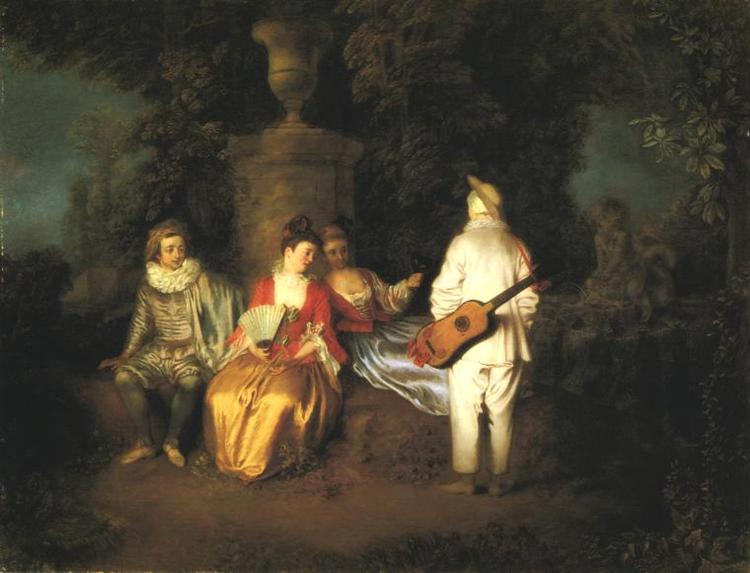
Jean-Antoine Watteau, The Foursome, 1713, Fine Arts Museums of San Francisco, San Francisco, CA, USA.
After the strict reign of Louis XIV came to an end, the cultural life of the French elite began to move away from the grand royal palace of Versailles and into the more private homes of Paris. The mood became more intimate, relaxed, and playful. Art changed with it. Rococo moved away from the monumental seriousness of Baroque art and embraced lighter subjects, delicate colors, romance, and pleasure. Watteau became one of its key figures. This new atmosphere was perfectly captured by his fête galante paintings, showing elegant people in beautiful landscapes, enjoying music, conversation, romance, and each other’s company.
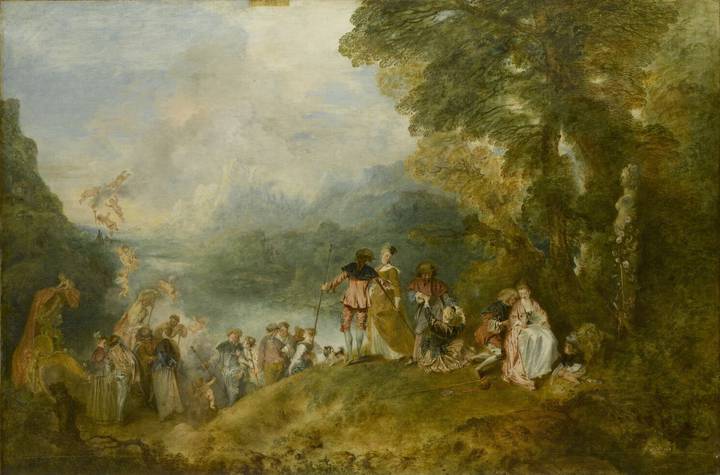
Jean-Antoine Watteau, Pilgrimage to the Isle of Cythera, 1717, Louvre, Paris, France.
This painting is often considered the first of Watteau’s fête galante paintings. This new genre showed elegant gatherings of aristocrats in idealized landscapes. One such place was the Greek island of Cythera. The whole scene is immersed in a cheerful and romantic atmosphere, with cupids flying around and the statue of Venus on the right side, seemingly observing the scene from a hidden spot. The couples are enjoying themselves in a light and erotic gathering.
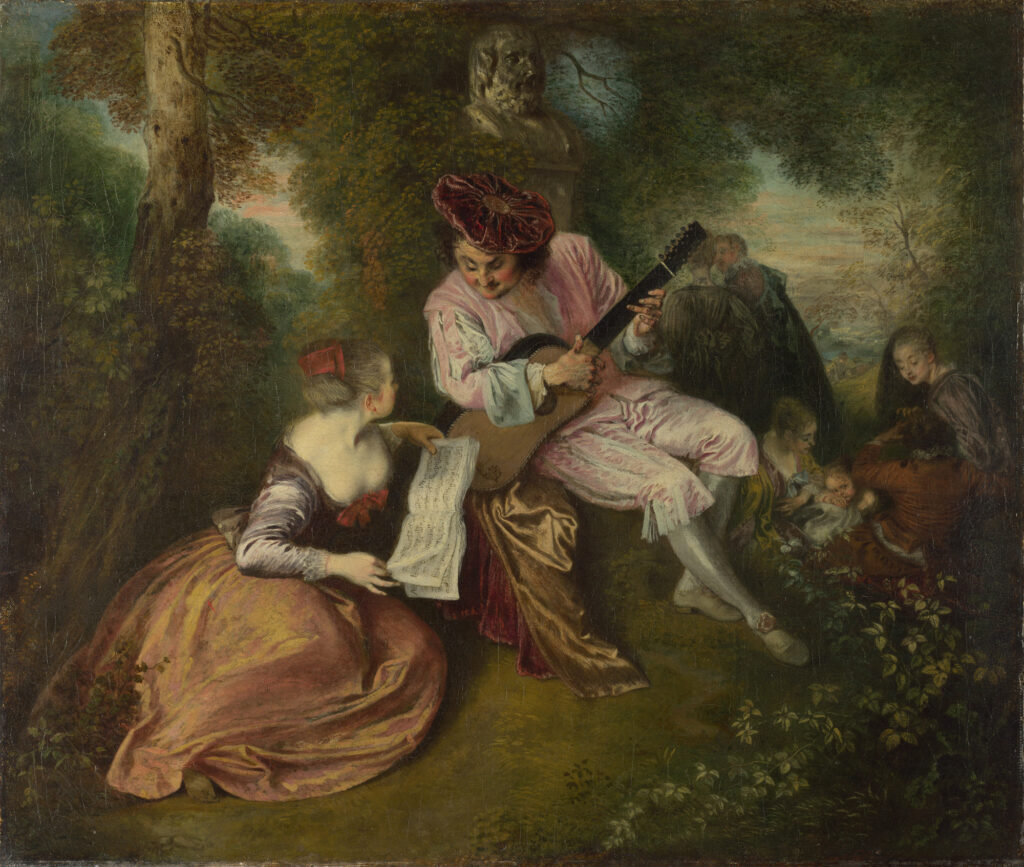
Jean-Antoine Watteau, La Gamme d’Amour (The Love Duet), 1717, National Gallery, London, UK.
The fête galante is sometimes connected to another genre known as the fête champêtre. These paintings also show the elites gathering outdoors, often in elegant gardens like those at Versailles. At the heart of many fête galante paintings are young aristocrats flirting, courting, and falling in love. Watteau was interested in the different stages of romance, from the excitement of a new attraction to passion and, eventually, separation. These gatherings offered a space for them to meet, talk, flirt, and, of course, quietly judge each other’s outfits.
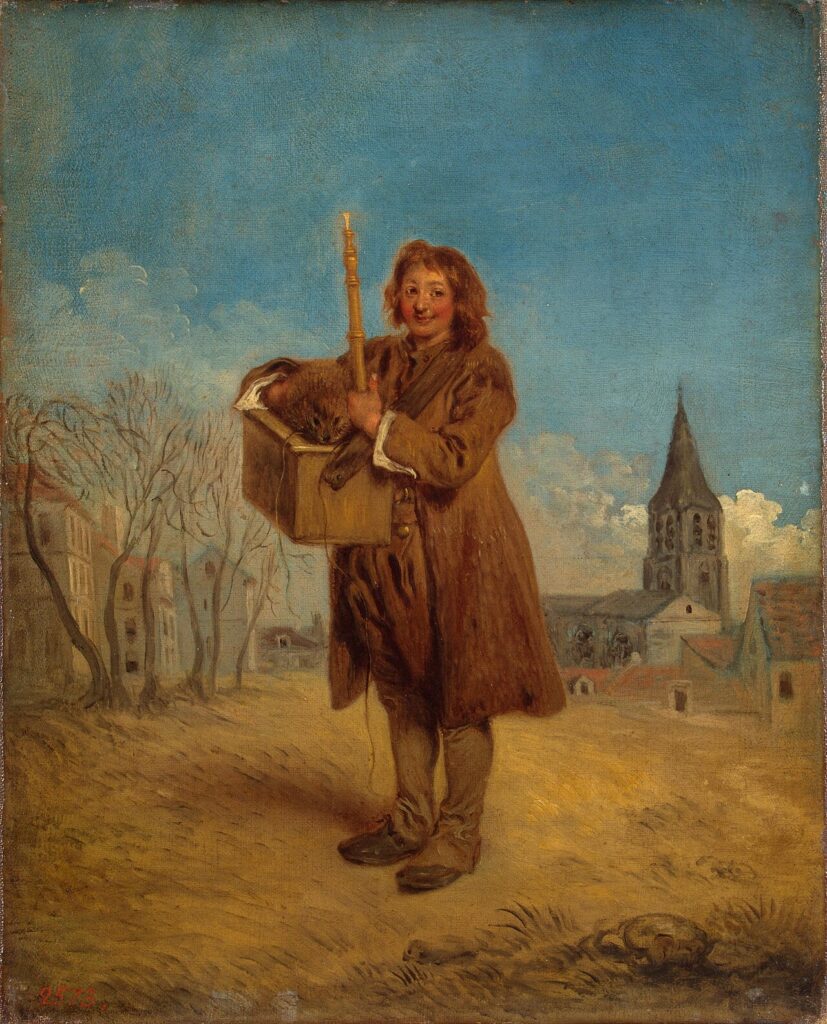
Jean-Antoine Watteau, Savoyard with a Marmot, 1716, Hermitage Museum, St. Petersburg, Russia.
Watteau’s paintings often have somewhat ambiguous meanings. For example, this painting depicts a musician from Savoy with his oboe and a marmot. Savoyards were known for their traveling shows at local fairs, where they often performed with animals. Some believe that the image of a man holding his oboe upright and making a marmot dance was also a sexual metaphor that would have been understood at the time. The Hermitage Museum offers another interpretation from a socio-historical perspective. Savoy was a poor region, and Savoyard emigrants were often treated as outsiders where they moved. The painting could therefore highlight the alienation of the Savoyard. What looks like a simple and amusing scene can have a much more complicated meaning in Watteau’s paintings.
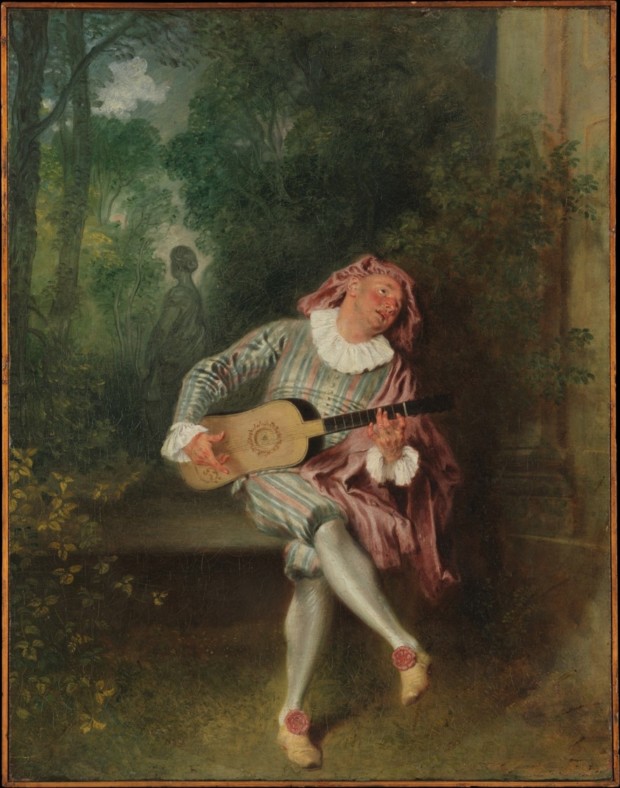
Jean-Antoine Watteau, Mezzetin, 1718–1720, Metropolitan Museum of Art, New York City, NY, USA.
Watteau painted more than elegant aristocrats. He was also fascinated by the theater. Between 1705 and 1708, he worked with Claude Gillot, who introduced him to commedia dell’arte. From the 16th to the 18th century, this type of theater was very popular for its cheerful stories, vibrant costumes, and familiar characters. These included the witty Harlequin in his famous checkered costume, the naïve and melancholic Pierrot, and Mezzetin, often shown playing the guitar for a lady. The characters of commedia dell’arte gave him another way to explore different personalities and emotions, which became an important part of his work.
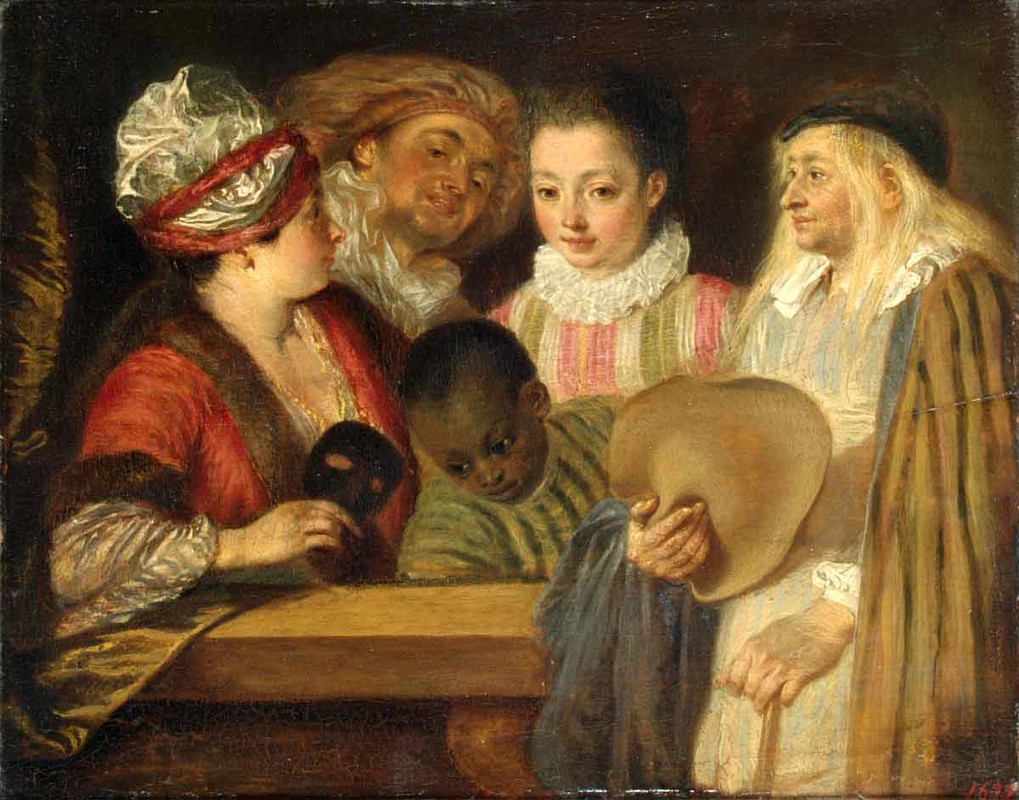
Jean-Antoine Watteau, Actors of the Comédie-Française (Coquettes qui pour voir), 1711–1712, Hermitage Museum, St. Petersburg, Russia.
Watteau was undoubtedly interested in scenes from the theater and the actors who portrayed these different characters. In this painting, he takes a completely different approach from the majority of his work. Actors of the Comédie-Française presents a half-length composition featuring five figures: two women, two men, and a boy. Unlike the open landscapes that often appear in his fêtes galantes, the figures here are set against a dark, almost empty background. This makes the group itself the main focus of the painting.
For centuries, however, the identity of these figures and the subject of the work remained uncertain. Since the late 20th century, the most accepted interpretation has been that he portrayed actors from the Comédie-Française who performed in Florent Carton Dancourt’s play The Three Cousins. However, the uncertainty surrounding the subject has also resulted in the painting being known by several different titles.
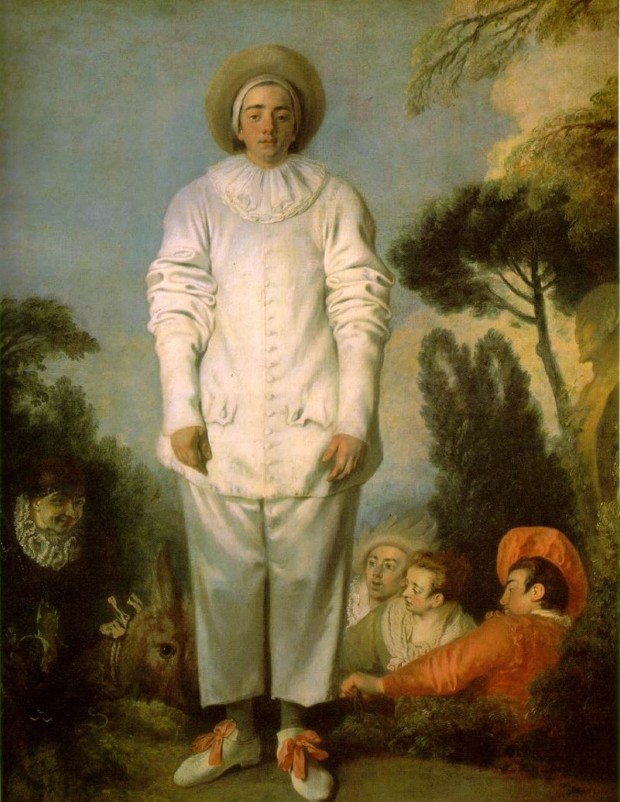
Jean-Antoine Watteau, Pierrot (formerly known as Gilles), ca. 1718–1719, Louvre, Paris, France.
Hidden behind the light-hearted themes and funny roles of the commedia dell’arte lies a more serious side of Watteau’s work. Pierrot is one of these ambiguous characters, recognizable by his white costume and powdered face. However, Pierrot also carried Watteau’s own concerns about the solitude and uncertainty brought by wartime changes. Behind the familiar theatrical character, we can therefore see a more personal side of the artist. This darker theme becomes even more apparent in Watteau’s paintings of military subjects.
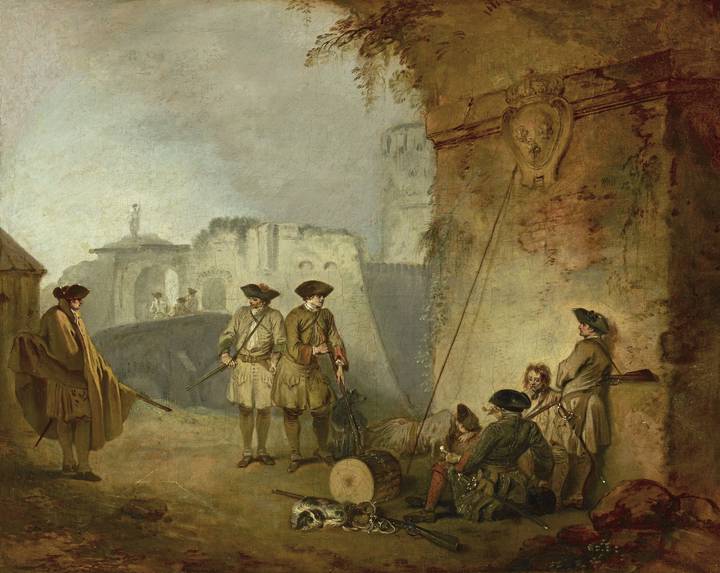
Jean-Antoine Watteau, The Portal of Valenciennes, 1710–1711, Frick Collection, New York City, NY, USA.
In The Portal of Valenciennes, he portrayed soldiers during the War of the Spanish Succession. But he did not focus on dramatic battles, heroic generals, or victorious kings. Instead, he showed the ordinary side of being a soldier: marching, stopping, and setting up camp. This approach was influenced by earlier Dutch and Flemish artists, but Watteau gave these scenes a particularly intimate and human quality. Rather than treating soldiers as part of a huge military machine, he presented them as individuals with their own inner lives. It is a very different side of the artist from the one we see in his romantic fêtes galantes. And it shows just how much more there was to Watteau than elegant parties and playful theater scenes.
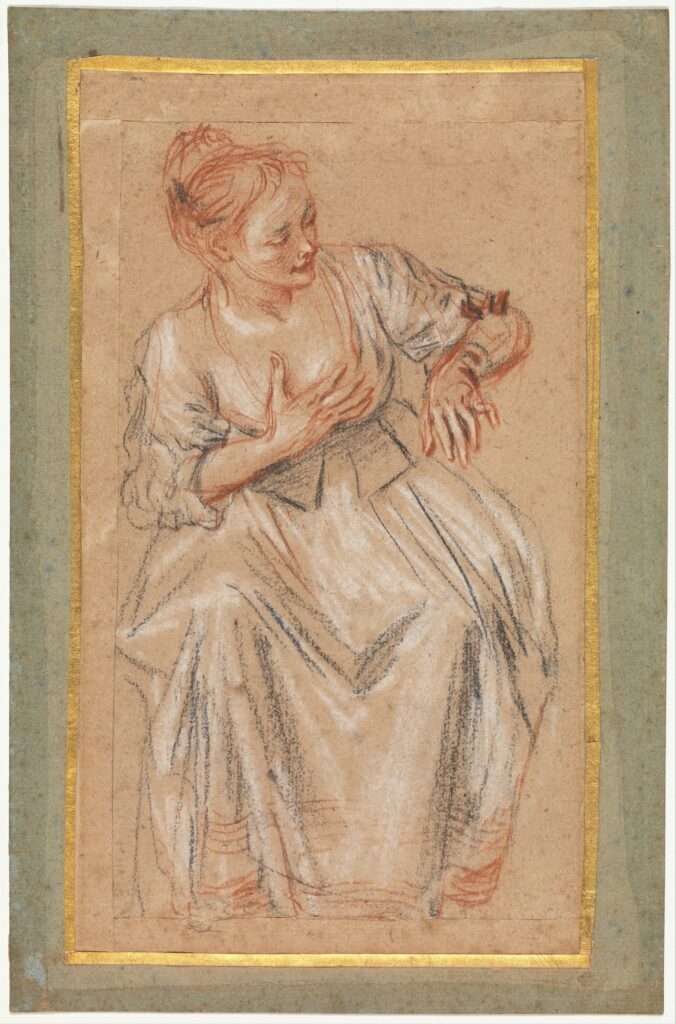
Jean-Antoine Watteau, Seated Woman, 1716–1717, Metropolitan Museum of Art, New York City, NY, USA.
Watteau is often considered one of the best draftsmen of the 18th century. His use of the trois crayons, or “three chalk,” technique later helped him develop paintings with a variety of rich and nuanced colors. In this study of a seated woman, we can see how he mixed red, black, and white chalk to capture the position of her body and the way her dress falls. Watteau’s influence, particularly his studies of rural female figures, is also visible in the work of François Boucher, whose training included making etchings after Watteau’s drawings. Boucher’s pupil, Jean-Honoré Fragonard, later carried on the themes of the fête galante. You probably know his famous painting The Swing, where Watteau’s influence is clearly showing.
Watteau is often remembered for his elegant couples, beautiful landscapes, and playful theater scenes. But his paintings tell more complicated stories, too. They touch on love, loneliness, migration, and war, often without giving us a clear answer about what they mean. Perhaps that is what makes his paintings so enjoyable to look at. The longer you spend with them, the more you start to notice.
DailyArt Magazine needs your support. Every contribution, however big or small, is very valuable for our future. Thanks to it, we will be able to sustain and grow the Magazine. Thank you for your help!

History of art graduate and enthusiastic appreciator of anything art and culture-related. Currently very interested in Catalan Modernism and Postmodernism, Surrealist artist-designer Elsa Schiaparelli, and 15th-century Florentine art.

Coffee-fueled writer, artist, and daydreamer.
François Boucher (1703–1770) was one of the major exponents of the Rococo style in the 18th century. His paintings showed the ostentation and...
Jimena Escoto 10 April 2025
The 18th-century painter, miniaturist, and pastelist Jean-Étienne Liotard is perhaps one of the most eccentric artists of his time. Known for his...
Anna Ingram 17 April 2026
Rococo was the major art movement of the 18th century. Its main characteristics are lightness, decorativeness, and subjects from everyday life of the...
Anastasia Manioudaki 6 July 2026
Do you know the great Rococo portraitist Rosalba Carriera? She was one of the most famous painters of the early 18th century. Carriera became known...
Maia Heguiaphal 17 April 2026