The Seams of Royalty: Justine Picardie’s Fashioning the Crown
Fashioning the Crown: A Story of Power, Conflict, and Couture is Justine Picardie’s latest book. She explores all the ways haute couture and...
Errika Gerakiti 23 February 2026
15 September 2025 min Read
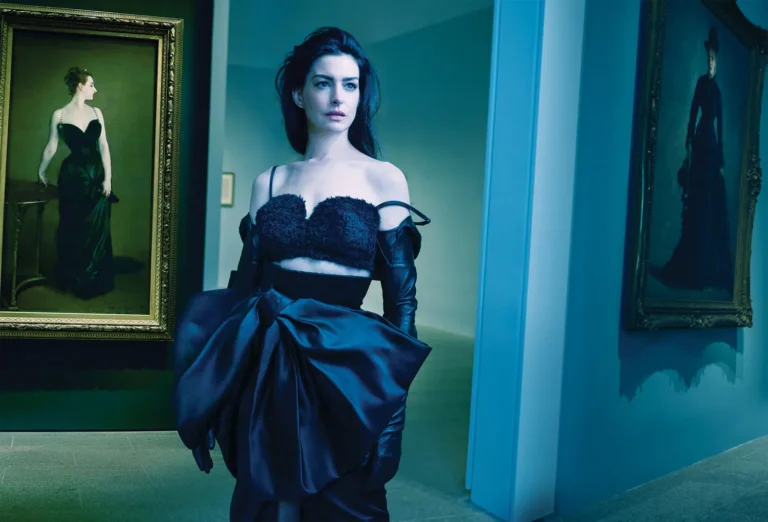
Anne Hathaway in Givenchy for Vogue’s 2025 August cover story. Photograph by Annie Leibovitz. Vogue.
Renowned photographer Annie Leibovitz once again proves to us that when art and fashion meet, the result is always striking. Together, they can create a powerful duo, even a new kind of modern masterpiece. Just as we have already seen in the DailyArt Magazine articles on Elsa Schiaparelli and Takashi Murakami, the merging of art and fashion leads to interesting and unexpected creations. See how Leibovitz captures this artistic interplay with an art-inspired Vogue photoshoot featuring Anne Hathaway.
Let’s start with the probably most seen photograph from this shoot—Hathaway as a Madame X from the famous painting by John Singer Sargent. From our perspective today, Sargent’s painting appears very elegant. It shows a graceful woman with smooth, pale skin and refined features, dressed in a carefully made black gown with gold straps. Her hair is styled in an updo and she stands before a soft brown background. One hand holds a fan while the other rests lightly on a round table. Her face is turned in profile, her long nose guiding the viewer’s gaze beyond the frame.
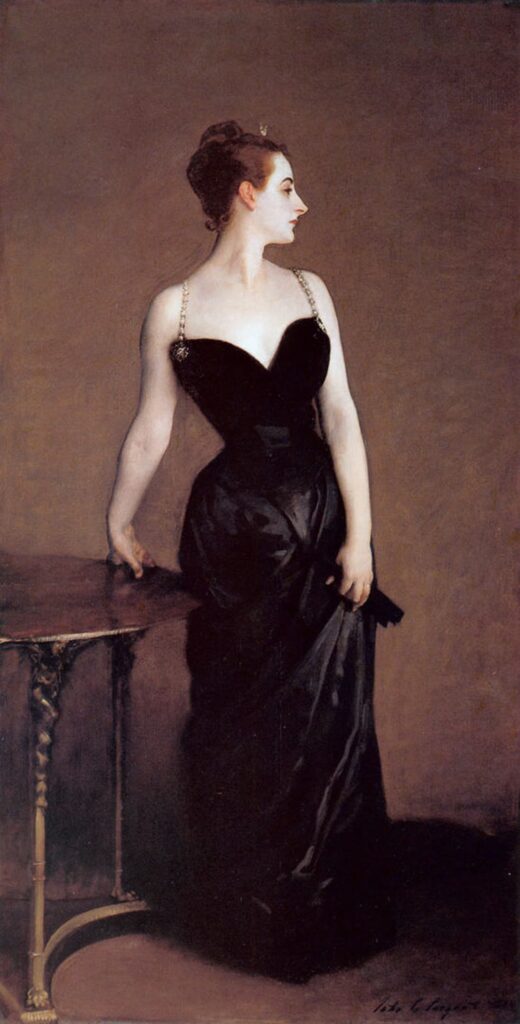
John Singer Sargent, Madame X (Virginie Amélie Avegno Gautreau), 1883–1884, Metropolitan Museum of Art, New York City, NY, USA.
However, when it was first exhibited, the painting received a very different public reaction. The main reason was a small detail that now seems harmless: Sargent had painted one strap of the dress slipping off the woman’s shoulder. Critics attacked the work so harshly that he later repainted the strap in its proper place. He also tried to reduce attention on Gautreau herself. When he donated the painting to the Metropolitan Museum of Art in 1916, he asked that her name be hidden. This is why the work is still known as Madame X.
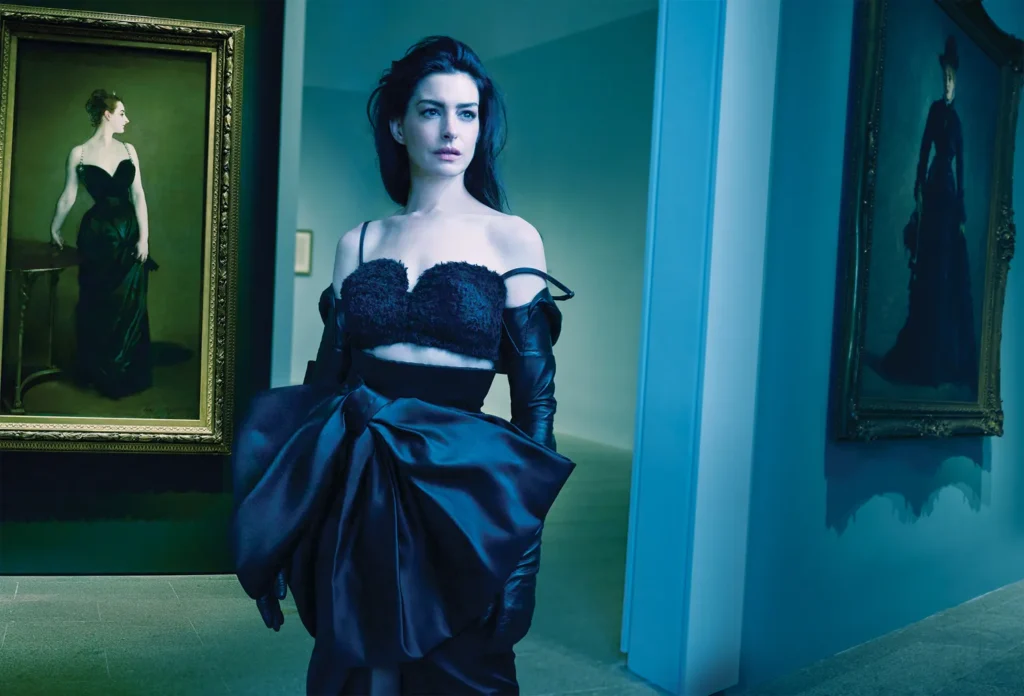
Anne Hathaway in Givenchy for Vogue’s 2025 August cover story. Photograph by Annie Leibovitz. Vogue.
The Vogue photoshoot shows Anne Hathaway in Givenchy, styled as a reimagining of Sargent’s Madame X, which appears in the background. The reference is clear, and Hathaway’s confident pose mirrors the atmosphere of the original subject. With the dress strap lowered, Vogue recalls the painting’s history while presenting Hathaway as bold and provocative.
The same photograph of Hathaway as Madame X also includes another artwork in the background, this one by the famous painter Édouard Manet. As its title suggests, the painting depicts a modern Parisian woman, standing confidently in a black dress with a hat and gloves. The plain background keeps the focus on her figure, while the soft brushwork, typical of Impressionism, blends the colors and captures the shine of the fabric, showing both her elegance and the style of the time.
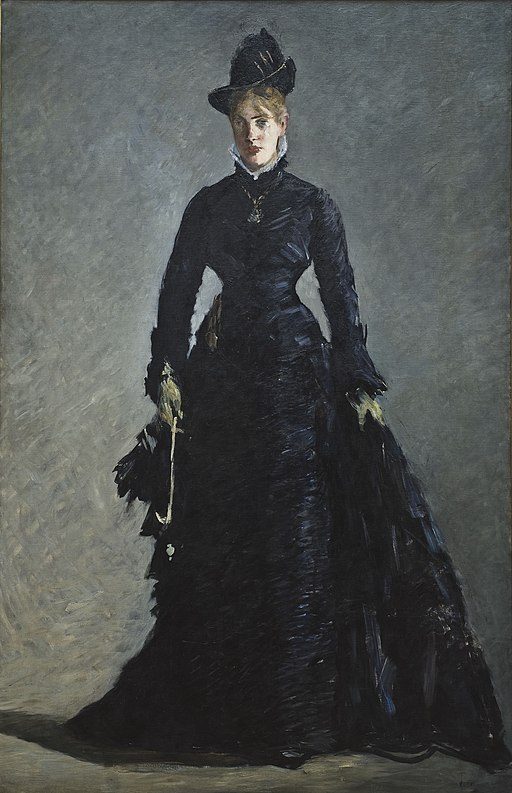
Édouard Manet, La Parisienne, 1876, Nationalmuseum, Stockholm, Sweden.
Similar to Sargent’s piece, the female figure in Manet’s painting represents an attractive modern woman who confidently claims her space in modern society. The selection of these two paintings, to be seen alongside Anne Hathaway seems very effective in echoing the desired message of the photoshoot.
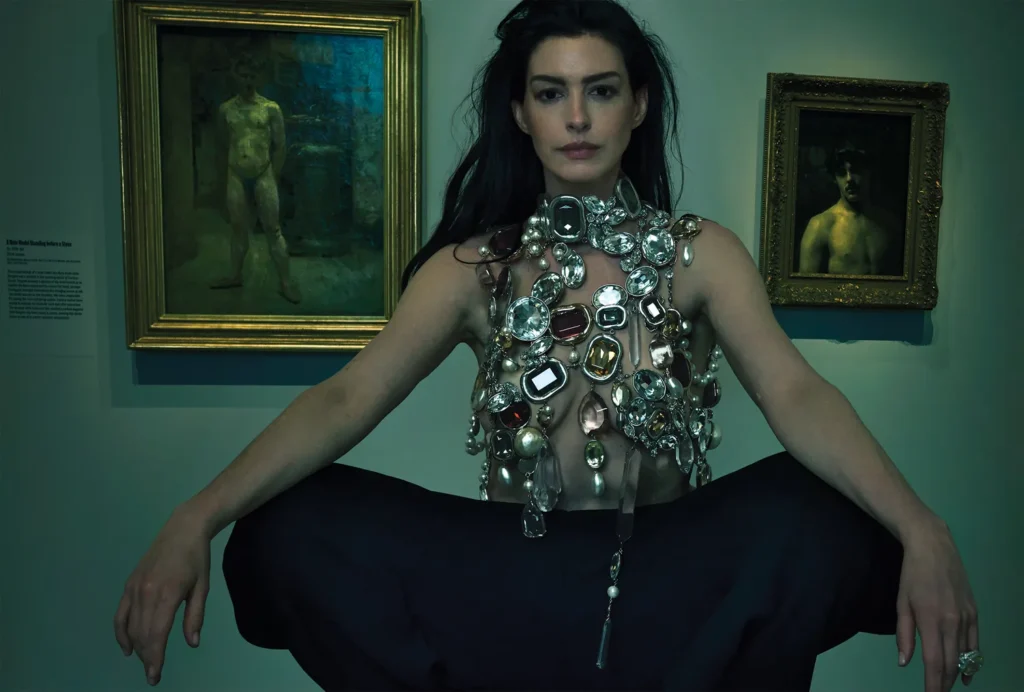
Anne Hathaway in Givenchy by Sarah Burton and a Bvlgari High Jewelry ring at the Metropolitan Museum of Art. Photograph by Annie Leibovitz. Vogue.
In this scene, Hathaway is flanked by two more Sargent masterpieces at The Met. She is dressed in an elaborate jeweled garment that turns her into a living counterpart to the male nudes behind her. A subtle tension emerges between their nakedness and Hathaway’s own presentation. She is not nude, but the jeweled top suggests a state of undress, since it is clear she wears nothing beneath the cascade of gems.
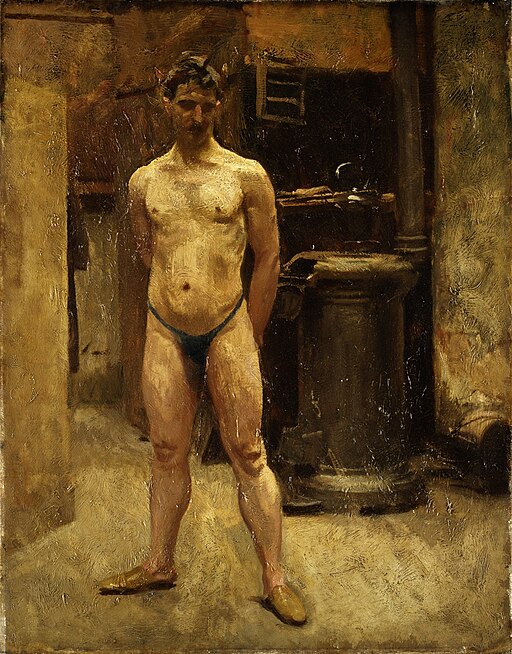
John Singer Sargent, A Male Model Standing Before a Stove, 1875-1880, Metropolitan Museum of Art, New York City, NY, USA.
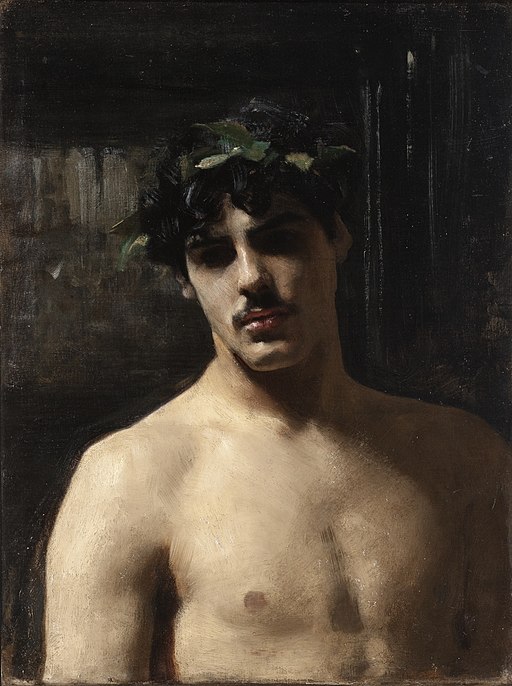
John Singer Sargent, Man Wearing Laurels, 1874–1880, Los Angeles County Museum of Art, Los Angeles, CA, USA.


This quick sketch of a male model was probably done while Sargent was still a student. The model is posing next to the stove for warmth showing us a part of the studio around him.
Sargent made several studies of male nudes, most likely during or just after his student years. This one shows only the head and upper body. He shaped the model’s face with strong lights and darks to give it depth, saving the brightest tones for the nose and chin. His brushstrokes are quick and confident, without much focus on fine details or polish. The dim light creates a sharp contrast on the chest and face while also giving the figure a softer look.
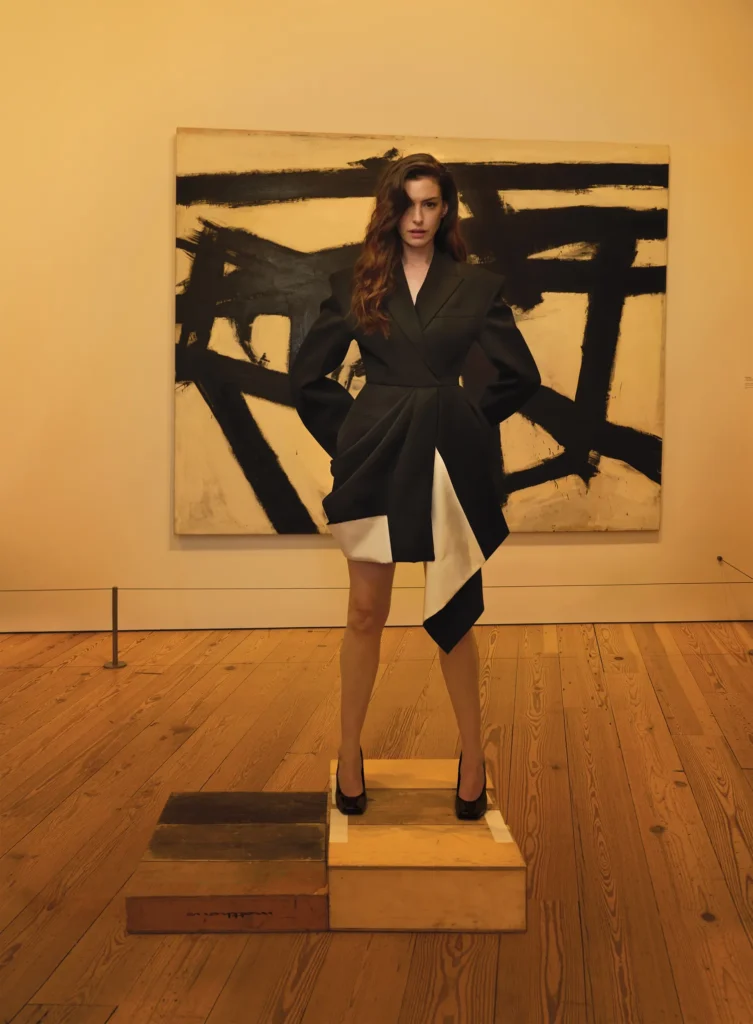
Anne Hathaway in Givenchy by Sarah Burton at the Whitney Museum of American Art. Photograph by Annie Leibovitz. Vogue.
The art and fashion pairings continue, this time with Hathaway standing in front of Franz Kline’s Mahoning at the Whitney Museum in New York, wearing a look from Sarah Burton’s March 2025 debut collection for Givenchy. The setup is very captivating through Hathaway’s strong and confident pose that makes her stand out from the painting behind her, while at the same time becoming a part of it.
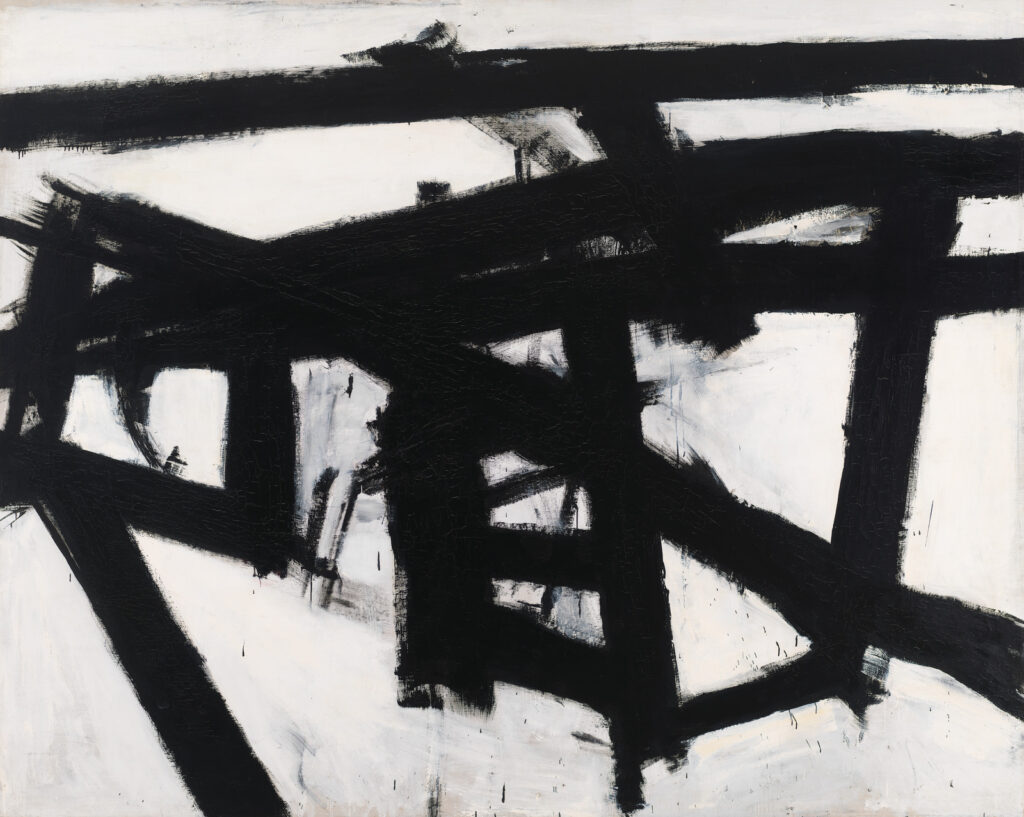
Franz Kline, Mahoning, 1956, Whitney Museum of American Art, New York City, NY, USA.
Franz Kline is famous for his abstract works that often look spontaneous but were actually very carefully planned. This is true for Mahoning, which shows bold black strokes set against a white background. Starting with a small sketch in a telephone book, Kline projected strong lines onto the canvas that seem to extend beyond its edges. He added more complexity by including collage elements, attaching pieces of paper beneath the layers of black paint. The name of the painting might make us wonder if it represents a place, but it is worth noting that Kline often titled his abstract works after towns near Wilkes-Barre, Pennsylvania, where he grew up—including this one.
Similar to the photos we saw previously, where Hathaway is positioned next to other strong female figures from Sargent’s paintings, here again we observe her in relation to the former First Lady. Her stance is steady and self-assured, her gaze directed toward the portrait in front of her. Hathaway becomes part of the composition—her posture, clothing, and expression linking her to the same visual language as the painting she is looking at. The photograph highlights the encounter of these two women and a sense of continuity between navigating visibility, power, and elegance.
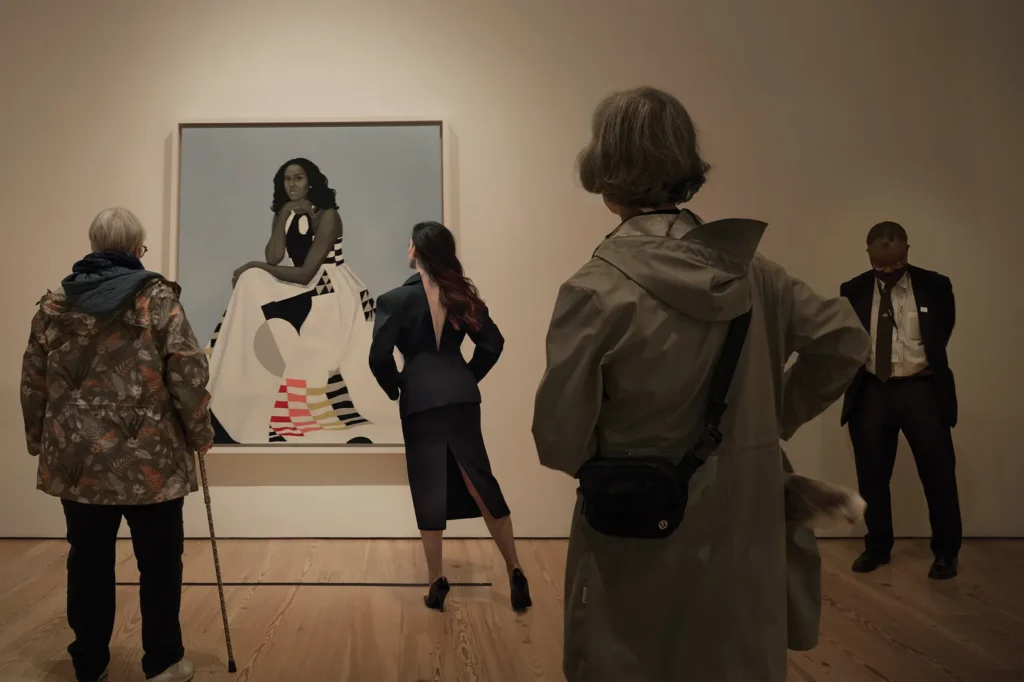
Anne Hathaway looking at the Amy Sherald’s Michelle LaVaughn Robinson Obama at the Whitney Museum of American Art. Photograph by Annie Leibovitz. Vogue.
Amy Sherald and Kehinde Wiley, who made a portrait of former president Barack Obama, were the first African American artists to receive commissions for National Portrait Gallery presidential portraits. Sherald depicts her subjects in the technique called grisaille which can be seen in this work, with Michelle Obama’s face, arms, and hands painted in shades of gray. Interestingly, this is not just an artistic preference. Sherald explains that choosing grayscale instead of natural skin tones is her way of resisting narrow ideas about race that confine how people see the sitter.
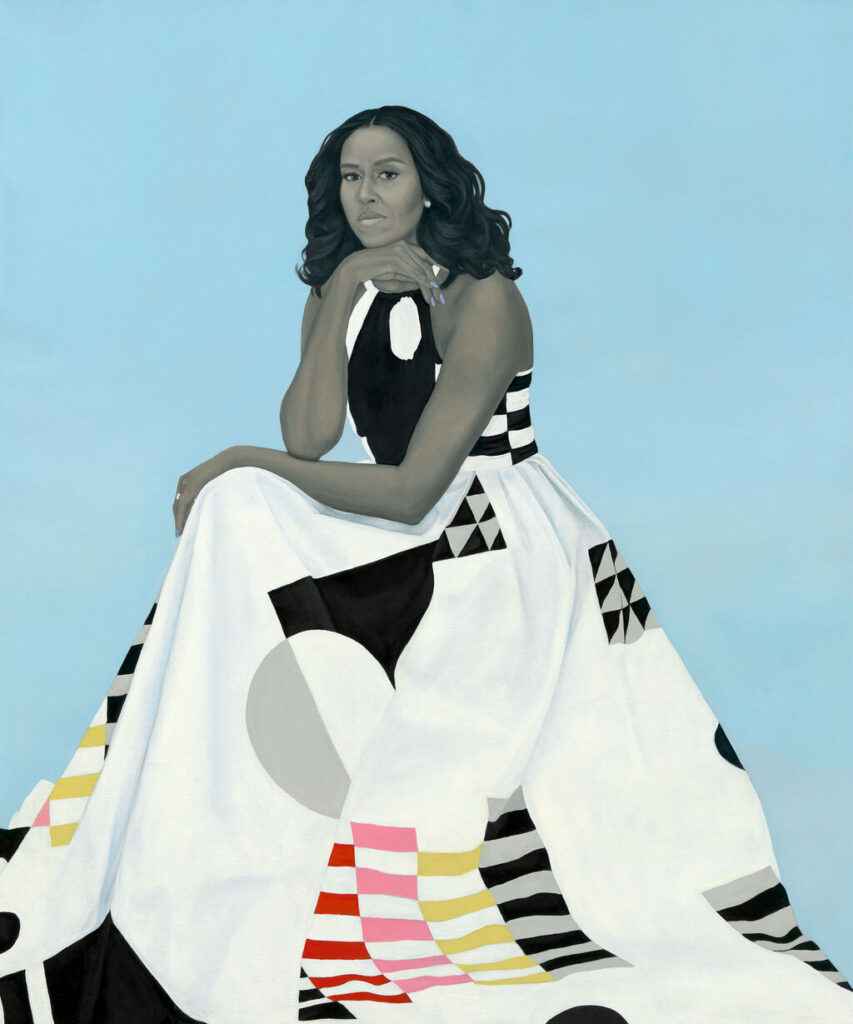
Amy Sherald, Michelle LaVaughn Robinson Obama, 2018, Whitney Museum of American Art, New York City, NY, USA.
This art-inspired Anne Hathaway photoshoot does an amazing job of echoing the subjects of the paintings, as well as their atmosphere and message. However, it also received some negative comments about the lighting and color balance, which led some to question the work of photographer Annie Leibovitz. Still, what stands out most is the way art, fashion, and photography come together to create bold and original photographs.
Get your daily dose of art
Click and follow us on Google News to stay updated all the time

DailyArt Magazine needs your support. Every contribution, however big or small, is very valuable for our future. Thanks to it, we will be able to sustain and grow the Magazine. Thank you for your help!

History of art graduate and enthusiastic appreciator of anything art and culture-related. Currently very interested in Catalan Modernism and Postmodernism, Surrealist artist-designer Elsa Schiaparelli, and 15th-century Florentine art.
Fashioning the Crown: A Story of Power, Conflict, and Couture is Justine Picardie’s latest book. She explores all the ways haute couture and...
Errika Gerakiti 23 February 2026
Turbans are one of the most enduring forms of headwear in human history. Though associated today with Sikh and Muslim communities, turban and...
Maya M. Tola 3 July 2025
Thierry Mugler’s art redefined the boundaries of fashion, blending creativity, drama, and innovation. His bold silhouettes and futuristic...
Errika Gerakiti 30 December 2024
An Italian artist-designer at the turn of the 20th century, Rosa Genoni is described as a founder of Italian fashion, a dressmaker, a teacher, a...
Nikolina Konjevod 17 November 2025