

The Artist Behind Egon Schiele’s Famous Portrait
For most art lovers and historians, Karl Zakovsek is merely a name on a museum label—the introspective figure captured in Egon Schiele’s...
Guest Author 5 October 2026
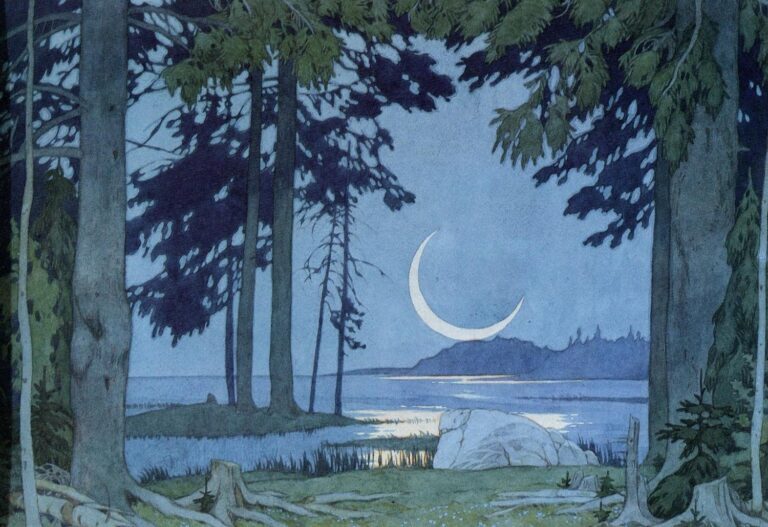
Ivan Bilibin, Sketches of scenery for Sadko by Nikolai Rimsky-Korsakov, 1914. Visual Melt.
Welcome to the dark world of Slavic folklore! You’re probably familiar with it—the popularity of the game The Witcher, based on Polish legends, leaves little doubt about that. Slavic folklore is diverse: it stretches from the Baltic Sea to the Black Sea, from the Elbe to the Volga. Let’s explore it.
Before the advent of writing, people all over the world passed on knowledge through folklore: stories, fairy tales, proverbs, and catchphrases. Folklore had several functions. First, it served to consolidate and explain rituals. Peasants closely monitored natural cycles and tied the start and end of fieldwork to holidays. They believed that observing rituals on certain days helped to ensure a good harvest.
Commemorations of ancestors also played an important role. It was believed that the spirits of deceased relatives could influence the fertility of the land. On certain days, peasants visited cemeteries, bringing treats to secure the support of the departed. For peasants, the harvest was an important matter—their life literally depended on it. Unpredictable weather—droughts, hailstorms, and prolonged rains—forced people to look for causes and ways to influence the situation. Myths and rituals gave the illusion of control: if you followed the ritual, you could “negotiate” with the forces of nature and get a bountiful harvest.
Another important element of Slavic folklore was the personification of dangerous things: the fire in the stove that, when out of control, could cause harm or burn down the house; the scorching sun that could cause fainting and hallucinations; or the bitter cold in winter that could kill. An example of this is Ded Moroz (literal meaning “Frost Grandfather”), who appears as Treskun (onomatopoeia for crackling) or Karachun. He is an evil spirit that shortens life and embodies death, the lord of cold and darkness. He’s nothing like the friendly Santa you’d want to leave milk and cookies for (which, by the way, is also a ritual act and a kind of offering!).
Another quite pragmatic and necessary task was to warn children about the dangers that await them outside the home—in the forest, in the field, in the water—and to teach them to respect nature.
Unfortunately, much of the original Slavic mythology was not preserved, having been reworked and reinterpreted through Christian traditions. Some surviving sources contain fragments from the higher mythology of the ancient Slavs, and researchers have used these fragments to construct a hierarchy of deities. However, much more information has been preserved about lower mythology—demonology, the study of spirits that inhabit the world around us and influence a person’s life depending on their mood.
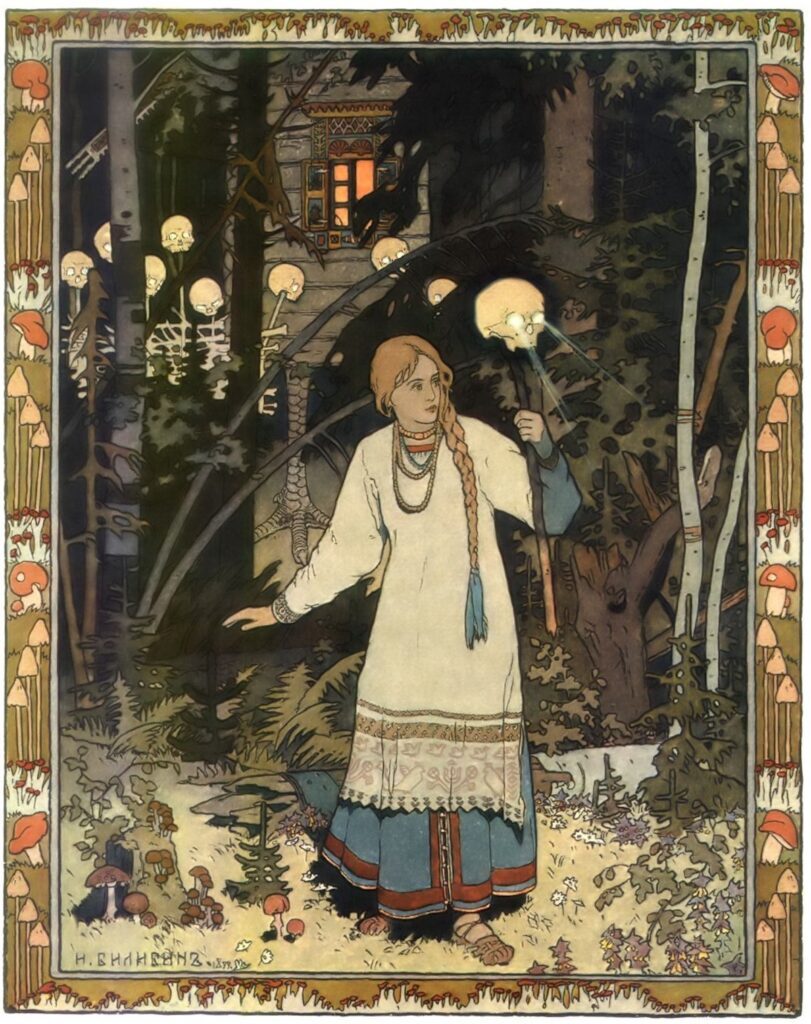
Spirits in Slavic folklore: Ivan Bilibin, Vasilisa at the Hut of Baba Yaga, illustration for Vasilisa the Beautiful, 1899. Visual Melt.
Of course, all these characters found their reflection in decorative and fine arts. They were carved from wood, embroidered on fabrics, and modeled from clay. In the early 20th century, professional artists became interested in traditional art, and we invite you to explore the illustrations by Ivan Bilibin (1876–1942).
Bilibin was born in 1876 near Sestroretsk. This wooded area unites Karelian, Swedish, and Russian folklore. After studying easel painting in St. Petersburg, Bilibin engaged in teaching, book illustration, theatrical set design, and costume design. After the Russian Revolution, he emigrated, settled in Cairo, traveled with his family around the Middle East, and later moved to Paris. He continued to work on themes of folklore—he created illustrations for Russian fairy tales, as well as for the tales of the Brothers Grimm and the tales of One Thousand and One Nights.
The Bilibin style is characterized by graphic precision. Black ornamental lines create volume and perspective on the flat surface of the paper, separating the colors as in a stained‑glass window. He fills the black‑and‑white graphic drawing with watercolor paints, emphasizing the outlines. Bilibin also makes generous use of ornamentation to frame his illustrations.
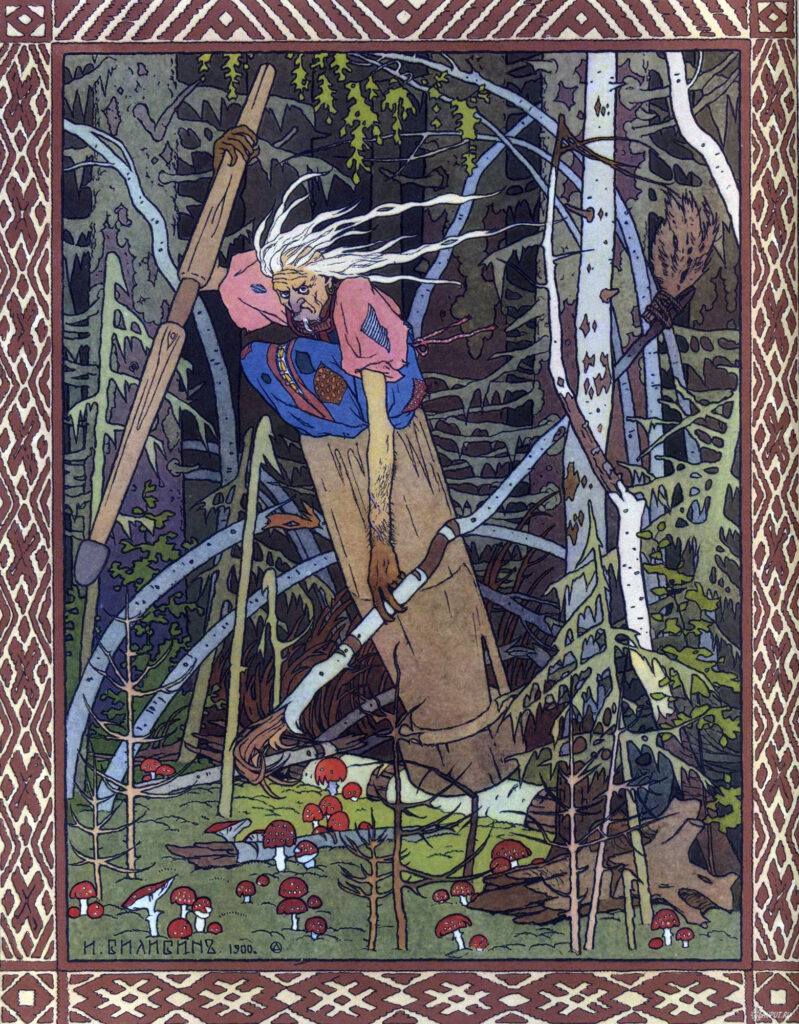
Spirits in Slavic folklore: Ivan Bilibin, Baba Yaga, illustration for Vasilisa the Beautiful, c. 1900. Wikimedia Commons (public domain).
A special place in Slavic folklore is occupied both by people who have a connection with supernatural forces—blacksmiths, millers, beekeepers—and those who made pacts with such forces—warlocks and witches. For example, Baba Yaga is an ugly old woman who possesses magical objects (a broom and a mortar) and is endowed with magical power. In some fairy tales, she is likened to a witch or sorceress. Most often, she is a negative character, but sometimes she acts as an assistant to the hero.
Take a look at this work. We see a silver‑haired witch rushing through the thicket of the forest in her mortar and looking at us malevolently. Her appearance is unsettling: look how her bony arm is covered in hair and changes color as if her hand is turning into a piece of driftwood. A decorative pattern of poisonous mushrooms—fly agarics—spreads across the ground. In the background, there’s an impenetrable thicket. The painting exudes danger and threat.
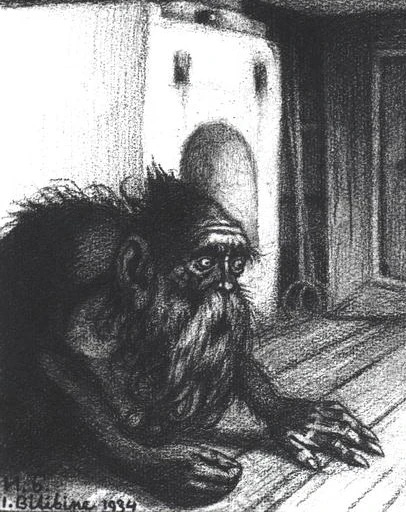
Spirits in Slavic folklore: Ivan Bilibin, Domovoy, 1934. Wikimedia Commons (public domain).
The main spirit of the dwelling among many Slavic peoples is the Domovoy—the first ancestor who found rest in that house. He ensures the well-being of the family, protects it from hardships, punishes for sloppiness and disorder, and maintains order in the house. Among the Western Slavs, the household spirit is most often represented as a snake or eel. Among the Southern Slavs, it is more human‑like, a little devil living behind the stove with disheveled hair and a dirty face. To appease the house spirit, treats such as milk or porridge should be left for him.
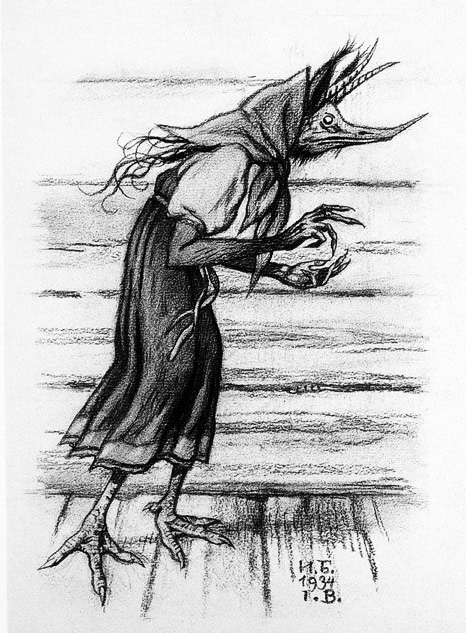
Spirits in Slavic folklore: Ivan Bilibin, Kikimora, 1934. Wikimedia Commons (public domain).
Kikimora is a female character who lives in a house and in other buildings on a farm. She disturbs sleep, frightens people with various sounds, annoys small children, drops and breaks things, tears and tangles yarn, and plays with cats at night (yes, that’s exactly why they run and jump while you’re trying to sleep). The appearance of a kikimora was considered a sign that something was wrong in the house. It could be sent into the house by disgruntled builders, neighbors, or sorcerers, who would leave behind a magical object—usually a doll—that would then come to life. To rid the house of a kikimora, herbs it dislikes, such as juniper and fern, should be brought inside, and the doll should be found and thrown into the fire.
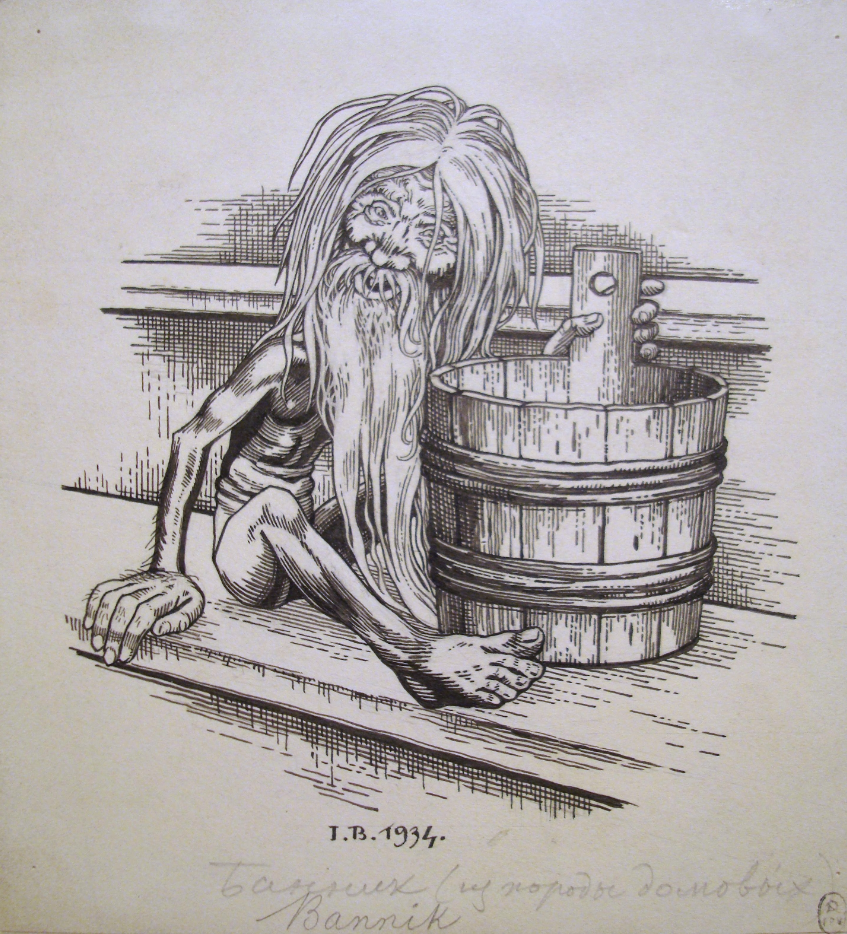
Spirits in Slavic folklore: Ivan Bilibin, Bannik, illustration for Mythology of the Slavs, 1934.
The Bannik is known mostly in cold regions. It is a mischievous, dangerous, evil spirit that lives in a banya (bathhouse)—a detached house where people would wash, give birth, and receive medical treatment. It can throw hot stones, splash boiling water, and steam people to death. To avoid angering or frightening the bannik, one should behave quietly and respectfully, as if visiting someone else’s home. Knocking and speaking loudly are forbidden, and one should not stay in the bathhouse for too long (which is indeed harmful to your health).
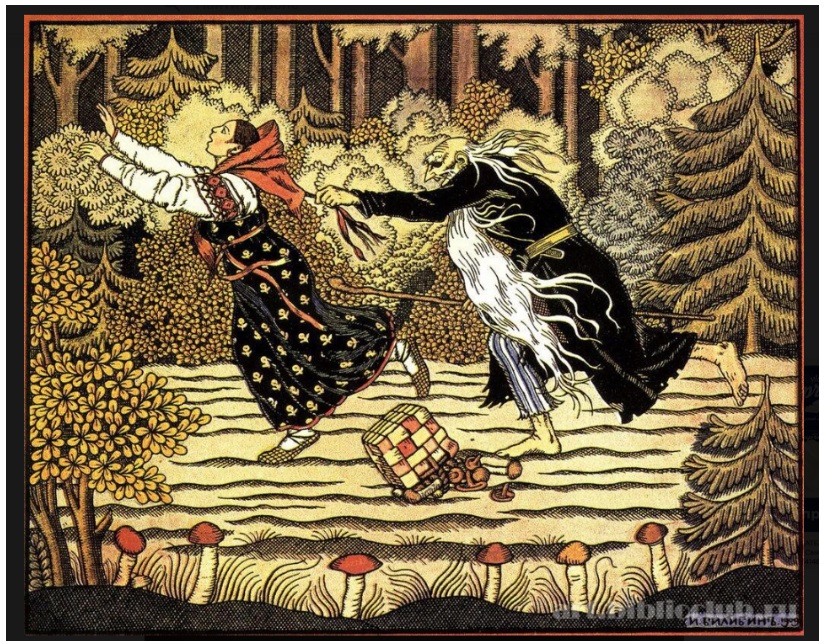
Spirits in Slavic folklore: Ivan Bilibin, Lesovik, illustration for The Tale of the Wooden Prince, 1911.
Spirits also dwell outside the house. The master of the forest is Leshy. He can take the form of an animal, a bear or a wolf, or turn into a tree, a bush, or become human-like. He can kidnap a girl gathering mushrooms or picking berries so that he can make her his bride. A typical trick Leshy plays in fairy tales is to throw objects into trees or confuse paths, causing travelers to lose their way. To avoid falling victim to Leshy’s tricks, one should know how to outwit him—for example, by putting on clothes inside out, walking backwards, or cursing loudly and expressively. Such actions may not only help drive Leshy away but also help travelers relax, have a good laugh, and find their way.
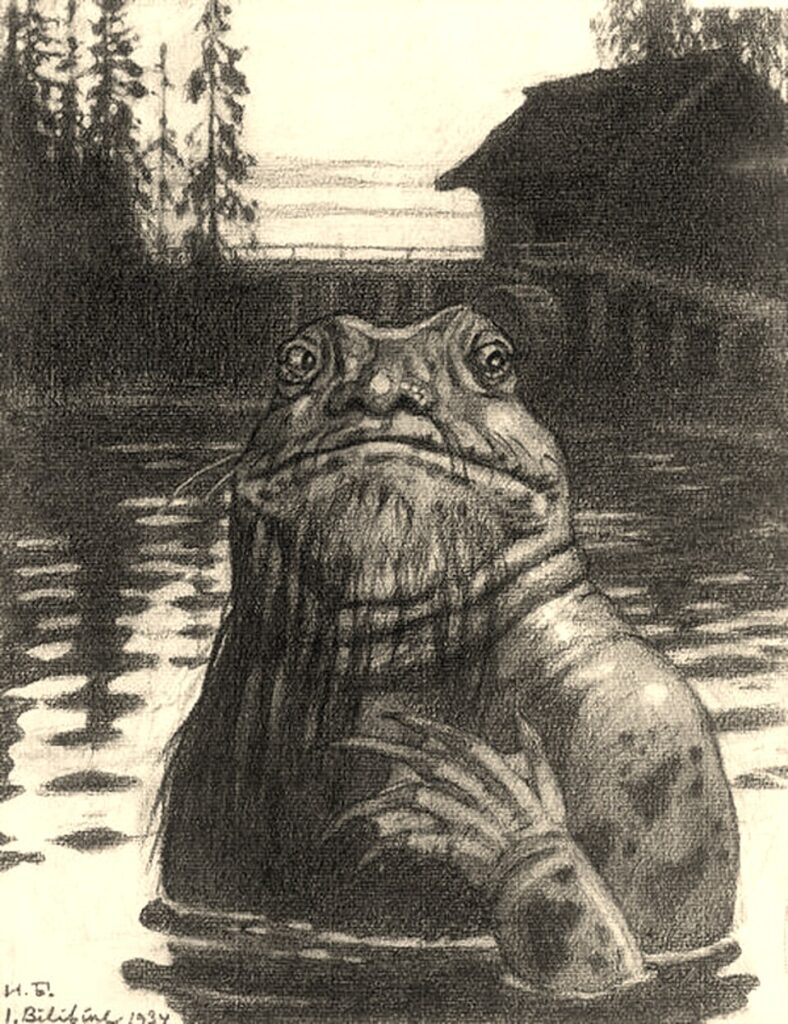
Spirits in Slavic folklore: Ivan Bilibin, Vodyanoy, illustration for Mythology of the Slavs, 1934. Wikimedia Commons (public domain).
In swamps, lakes, and rivers, you can encounter the water spirit, Vodyanoy. He is usually depicted as a naked, bloated old man with bulging eyes and a fish‑like tail or with very long legs. Vodyanoy is believed to inhabit deep waters—river pools, whirlpools, and stretches of water that remain unfrozen throughout the winter. He is also said to dwell in abandoned watermills, especially near the mill wheels and beneath the mills or sluice gates. According to folklore, his palace lies deep beneath the river’s surface. While waiting for a nearby victim, he may clap his hands loudly. Millers preferred to be on good terms with Vodyanoy; otherwise, he might break the mill wheels or damage the dam. To prevent him from causing mischief, a sacrifice was offered to him once a year, and on holidays, vodka was poured into the water.
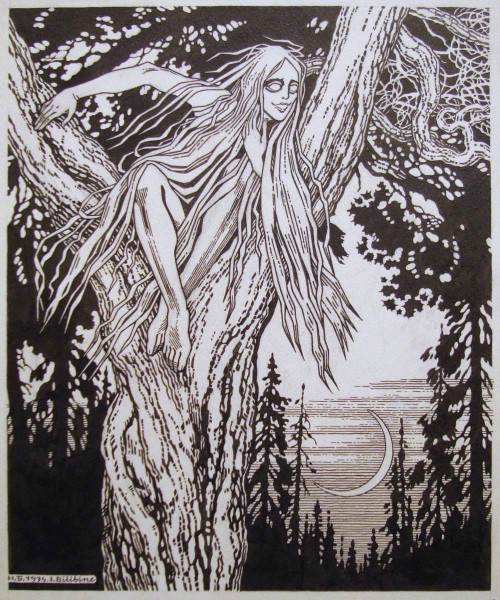
Spirits in Slavic folklore: Ivan Bilibin, Rusalka, illustration for Mythology of the Slavs, 1934.
Rusalka, also known as Mavka, is a spirit from East Slavic mythology, typically depicted as a young woman with long, loose, light-colored hair, dressed in white. She is believed to be the spirit of a woman who died an unnatural or premature death, such as by suicide, or who died before marriage. According to popular belief, Rusalka lives in forests, in the branches of tall trees. In pine forests, trees can often be found surrounded by bare patches of ground where no grass grows. According to popular legend, rusalki dance around these trees, trampling the ground beneath their feet. Rusalka is described as a mischievous and dangerous creature, often hostile toward people of all ages. In some beliefs, she can throw stones, catch someone, tickle them to death, or drown them. However, she can also help a child who has gotten lost in the forest.
Author’s bio:
Svetlana Prokopenko has been translating text for the DailyArt since 2021. She lives in Russia and works for a travel company. She love Pilates, reading, drawing, and studying art.
DailyArt Magazine needs your support. Every contribution, however big or small, is very valuable for our future. Thanks to it, we will be able to sustain and grow the Magazine. Thank you for your help!

This is our guest profile for occasional authors. If you have an interesting story about art to tell, send it to our Editor-in-chief Kate at [email protected]. You might be the next here!

Coffee-fueled writer, artist, and daydreamer.
For most art lovers and historians, Karl Zakovsek is merely a name on a museum label—the introspective figure captured in Egon Schiele’s...
Guest Author 5 October 2026
Despite being a Jew in a city still grappling with religious freedoms, Simeon Solomon rose to become one of London’s notable painters only to come...
Theodore Carter 28 August 2026
In Rembrandt’s prints, you can see the whole of life passing you by, from the cradle to the grave. Every stage of life held something...
Guest Author 12 June 2026
There is a dead man on the table. His skullcap has been removed, and someone loosens the meninges with a lancet. Not an easy sight, yet fascinating:...
Guest Author 14 May 2026