Whistler and the Dutch Old Masters
James Abbott McNeill Whistler (1834-1903) discovered the artists of 17th-century Holland early, while visiting the Hermitage in St. Petersburg. The family lived in Russia for six years, from 1843 until Whistler’s father, who was employed as an engineer on the Russian state railway, died. It was at the Imperial Academy of Fine Arts there that Whistler began his formal training as a painter.
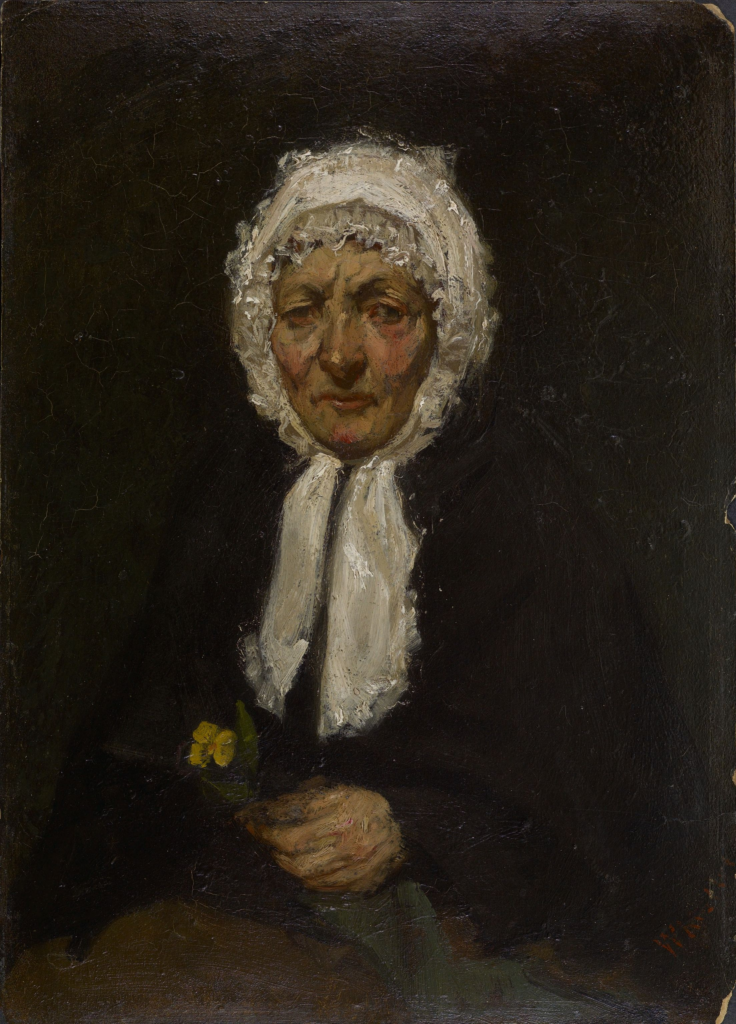
While living in Paris from 1855, Whistler’s first paintings were heavily influenced by the dark, earthy coloration of Rembrandt. The elderly woman who sat for La Mère Gérard was a street-seller who also features in his etchings. The focus on her aged face–illuminated by the white bonnet against a dark background and the visible brushstrokes, heavily impastoed (textured) in some areas–recalls Rembrandt’s work, including Portrait of an Old Woman in the Hermitage.
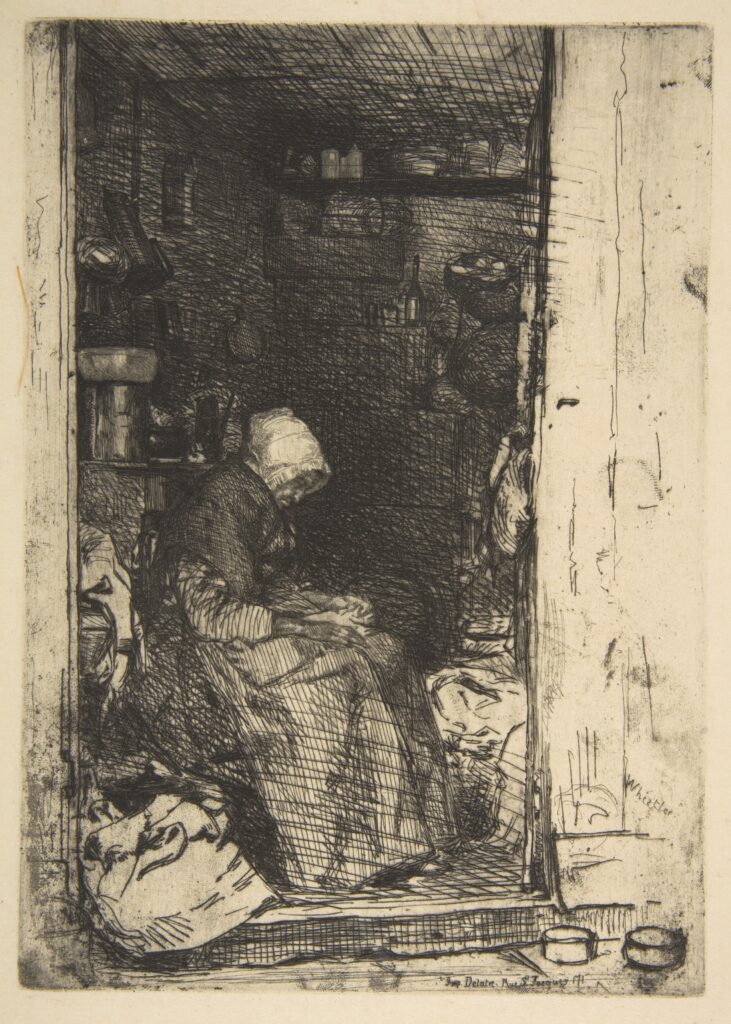
In Paris and on trips around France, Whistler produced his first etchings, which collectively became known as the French Set. The detailed depictions of street scenes and houses in poor neighborhoods, and of the people he encountered there, exploited the compositions of Dutch artists like Pieter de Hooch and Johannes Vermeer in their use of narrow doorways, briefly glimpsed interiors and working figures.
The heavily worked plate and strong tonal contrasts of La Vieille aux Loques help to generate a sense of gritty realism in the very mundane scene of a woman going about her daily tasks in her tiny home. Rembrandt’s etchings were another inspiration. The Dutch artist used the same visible cross-hatching and chiaroscuro (light and shade contrast) in works like Woman at a Door Hatch.
1863
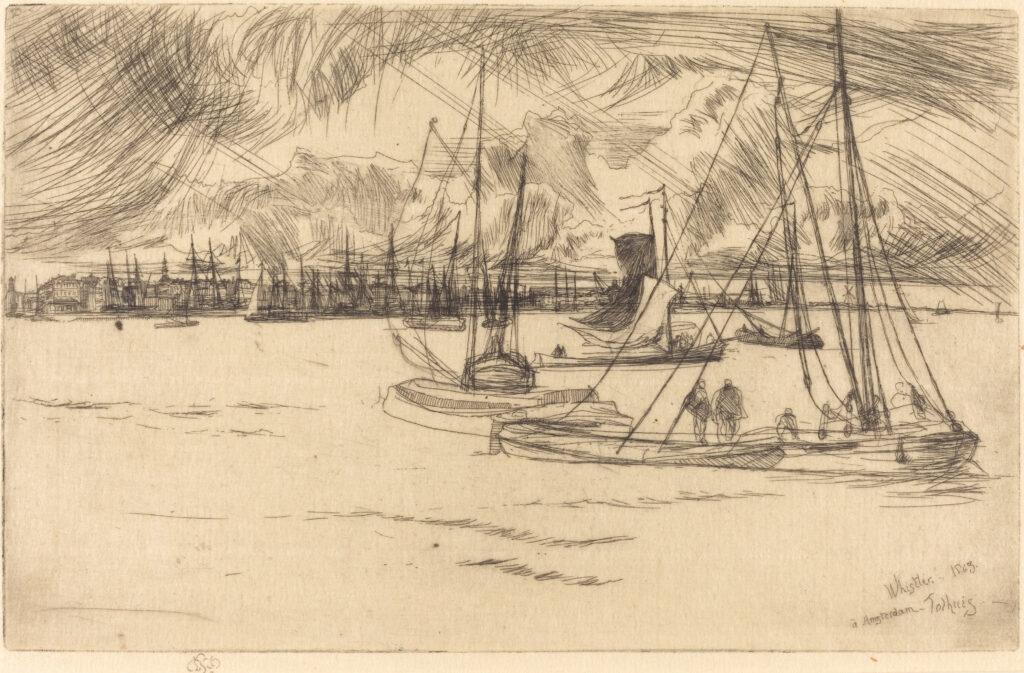
Whistler’s first two visits to the Netherlands, both made in 1863, coincided with his first gold medal at an exhibition in The Hague, a rare success at a time when his work was being rejected elsewhere. Travelling with his brother-in-law, amateur print enthusiast Francis Seymour Haden, the two men viewed Old Master paintings and made etchings in Amsterdam.
There was already a marked shift in style. Whistler was now working outdoors and effectively sketching directly onto the copper etching plate. The mark-making was more minimal, suggestive and fluid. He was content to leave large areas, especially the water, almost unworked, with just the occasional suggestion of rippled movement. Whistler had also started to use drypoint as well as conventional etching: by scratching directly into the plate, he produced softer, slightly fuzzy lines.
A Watery Landscape
Whistler was a painter of water, and the Netherlands is a country of canals and watercourses, so the attraction was obvious. From that very first etching of Amsterdam’s busy waterfront, Whistler produced very few works in the country which did not feature water to some extent. Using the reflections generated in canals and rivers, Whistler added to the ambiguity of his compositions, where hard objects become fluid, and reality seemed insubstantial.
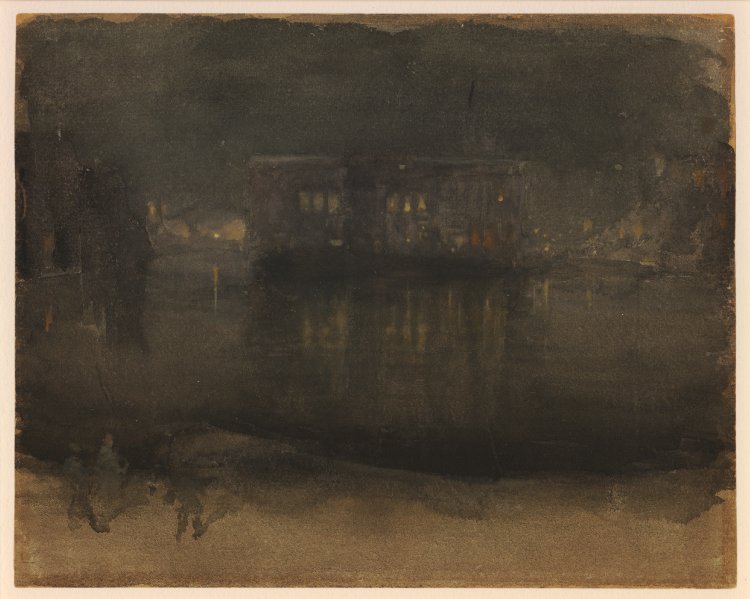
Amsterdam Nocturne is a more extreme examples of this style. Buildings on the far side of the canal are barely defined beyond their half-illuminated windows, which in turn are elongated reflections in the canal in the middle-ground. The light-toned band in the foreground further disputes the sense of space, making the viewer’s eye aware of the flatness of the picture surface. Brown paper and a near-monochrome palette exaggerate the gloom.
Watercolors
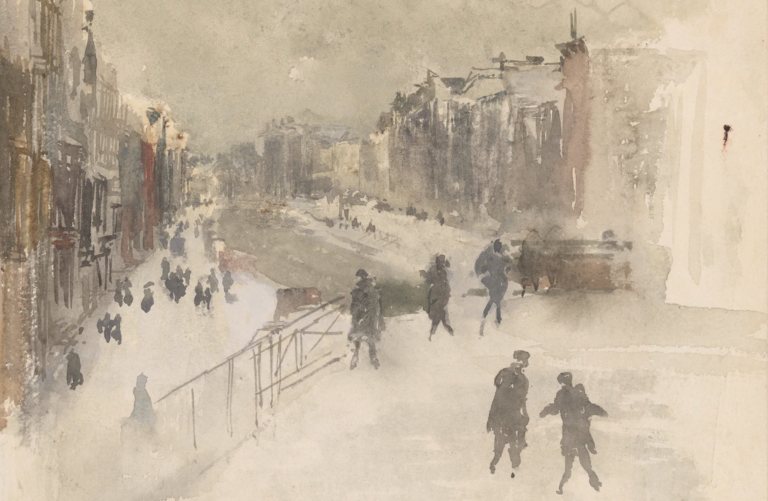
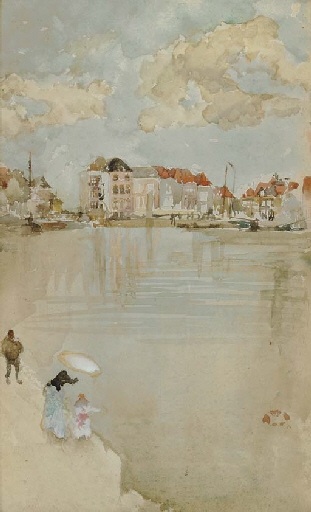
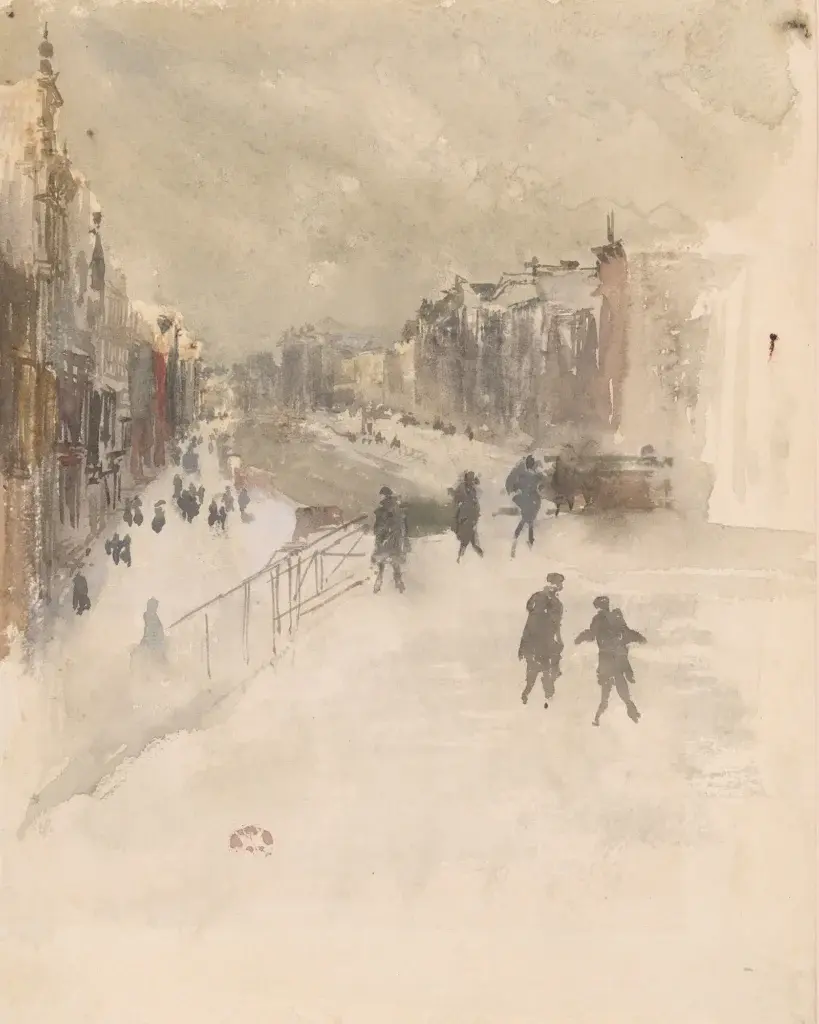
From the 1880s, Whistler increasingly experimented with watercolor, which allowed him to work quickly, outside, with easily portable materials. For an artist who had been systematically thinning his oil paints for years, and favored tonal washes, the medium held an obvious attraction. By working on wet paper with overlaid, translucent washes, Whistler further developed the indistinct semi-abstraction of his London Nocturnes.
As with his London paintings, Whistler frequently treated these as emotional and aesthetic images rather than representations of a particular place. Using titles like Note in Rose and Silver, he evoked the idea that these are color sketches rather than landscapes. Paradoxically, however, these watercolors were often more detailed in their inclusion of architecture and figures than many of the larger, earlier oil paintings.
The Beauty of Old Buildings
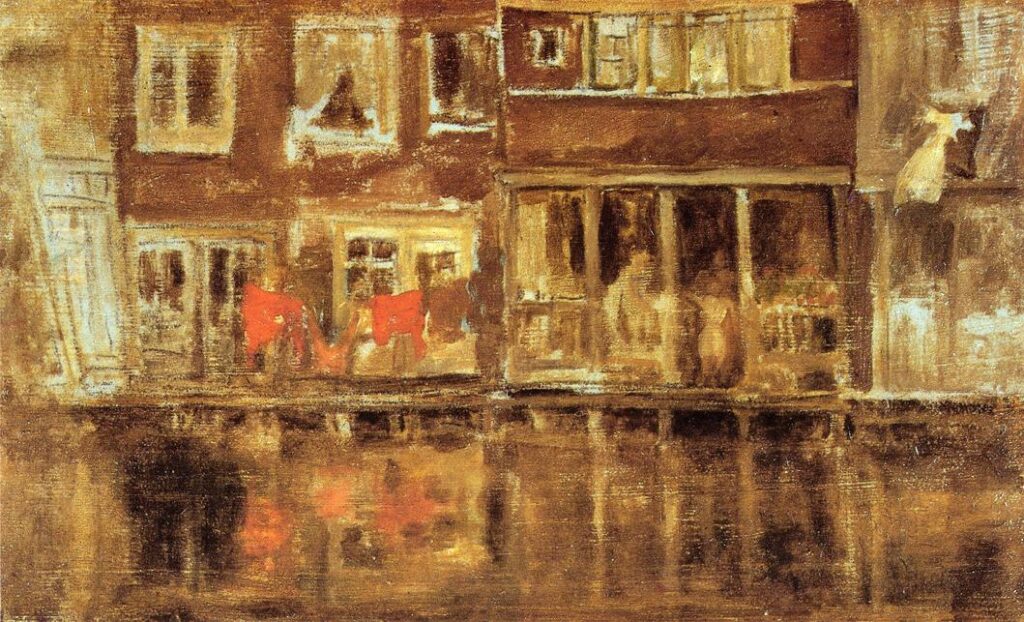
After Whistler went to Venice in 1879, following his declaration of bankruptcy after the Ruskin libel trial, he turned increasingly to the small-scale urban scene, often painted outside, which focused on the architecture of the city. His visits to the Netherlands cemented this approach, which also saw him visit places like Dieppe in Northern France. Some of these were watercolors; some were small-scale oils painted on board.
In paintings like Canal Amsterdam, Whistler presents a wall of buildings with little or no context—no sky, often no foreground. The architecture itself is ramshackle, often unremarkable, rather like a throwback to his early etchings of France. Often, details like washing lines or ragged curtains suggest the impoverished lives of those who live there. However, Whistler was more interested in the formal qualities of the buildings: the shapes, textures and tonal distinctions.
The Amsterdam Set
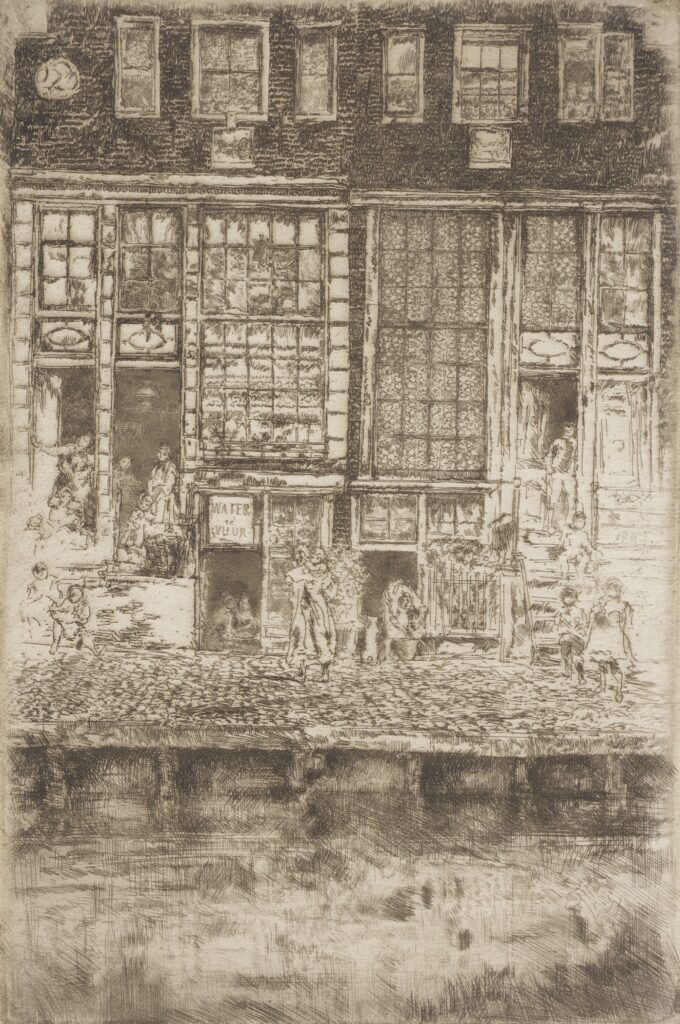
The Netherlands was also the site of Whistler’s late, great group of drypoint etchings known as the Amsterdam Set, produced over a two-month stay in Holland in 1889. These were some of the most complex and densely worked plates of Whistler’s entire career and the prints he was most proud of. He made 14 etchings in total, although they were never published as a set, and at least two showed scenes outside Amsterdam. Most, like the Embroidered Curtain, showed cropped buildings in a vertical format.
Compared with the sketchy minimalism of the Tolhuis, these are claustrophobic and airless, with an intensely patterned surface. There is much greater detail than in paintings like Canal—you can see lettering, broken windows, figures going about their lives, and even a sense of recession in the angled cobbles on the road. In parts, it almost resembles an old photograph fading out towards the edges. However, the effect remains abstracted and strangely unreal. It never feels like a street scene so much as a carefully manipulated and virtuosic piece of design.
Whistler’s Influence
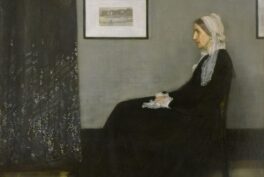
Whistler’s work was shown regularly in the Netherlands. Arrangement in Grey and Black No. 1 (Portrait of the Artist’s Mother), for instance, was exhibited at the 1889 Exhibition of Living Masters in Amsterdam. Although the artist’s work remained controversial, there was, by the end of his career, an enthusiastic group of younger followers, in Holland as elsewhere. Ironically, the Dutch artist perhaps most heavily inspired by Whistler, actually travelled to London to see his work.
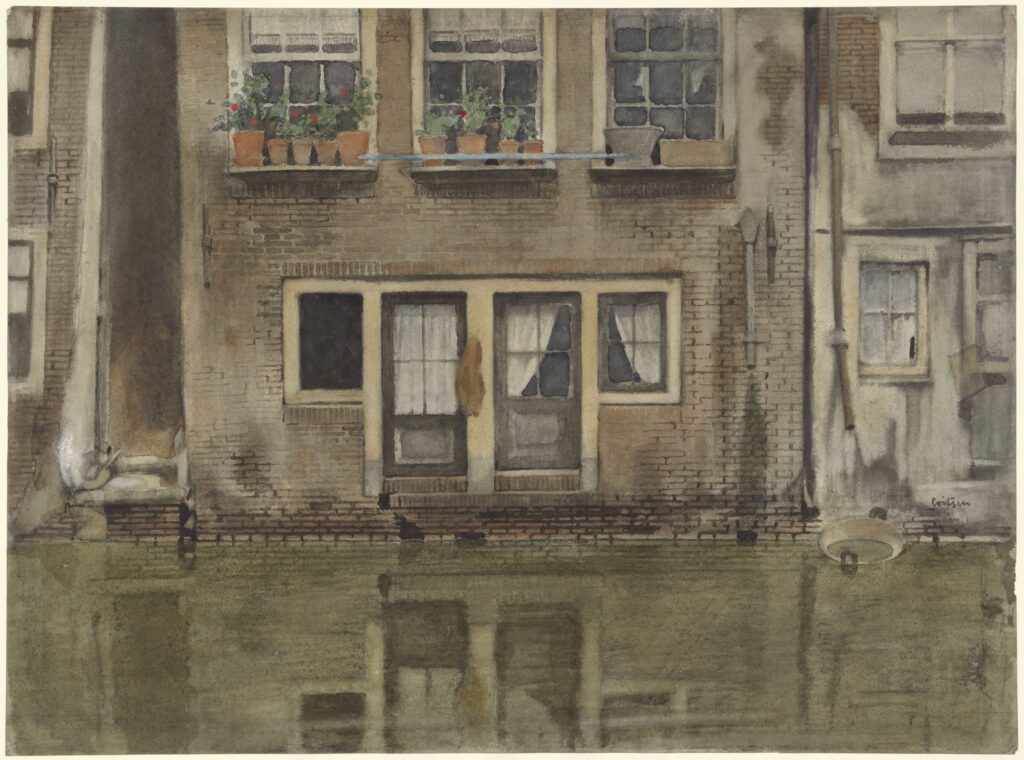
Like Whistler, Willem Witsen (1860–1923) was a printmaker as well as painter. As Whistler had done for his Amsterdam Set, Witsen worked from a canal barge, allowing him to achieve a low viewpoint and parallel composition. Houses on an Amsterdam Canal has a much more conventionally finished style than Whistler ever employed, but the tonal uniformity, lack of sky, and cropped street are all obviously indebted to him.
Whistler and Van Gogh
There were fewer stylistic similarities between Whistler and Vincent van Gogh (1853-90), but the Dutchman was enthusiastic about the older artist’s work. Van Gogh frequently mentioned Whistler’s etchings in his letters to his brother and particularly empathized with Portrait of the Artist’s Mother, which reminded him of his own mother. Both artists were, of course, interested in the compositional potential of Japanese prints.
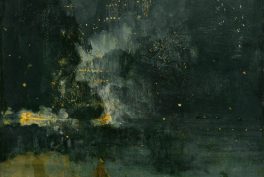
The Nocturnes, with their poetic reinterpretation of urban night scenes, may well have been an inspiration for paintings like Van Gogh’s Starry Night Over the Rhone. The two artists’ application of paint could not be more different, but compositionally, Van Gogh used the same flattened horizontality. Equally, he exploits the potential of reflected lights on water and uses a uniform blue tonality, albeit in this case juxtaposed with the yellow highlights.
Whistler clearly loved the Netherlands and produced some of his most experimental work while visiting there. The fame of his Nocturnes, and of works like The Artist’s Mother, can often obscure the range of Whistler’s work, in terms of media and of style. A focus on his Dutch production addresses that imbalance and highlights prints, watercolors, and the small-scale urban scenes which dominated the later part of his career.
Whistler, Loving the Netherlands is on at the Mesdag Collection in The Hague from October 16, 2026, until January 10, 2027.






,_1641,_NGA_9979.jpg)