
Masterpiece Story: Judith and Holofernes by Caravaggio
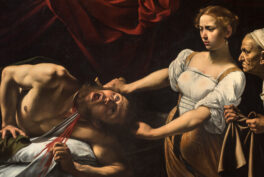
Judith and Holofernes is a Caravaggio masterpiece that captures Biblical murder and drama. Rarely has death been captured so intensely and violently...
James W Singer 13 September 2026
30 August 2026 min Read
Winslow Homer, The Veteran in a New Field, 1865, Metropolitan Museum of Art, New York City, NY, USA. Detail.
Winslow Homer (1836–1910) was one of the leading American Realist painters. His painting The Veteran in a New Field is a masterpiece of late summer art while commenting on American society healing after the Civil War.
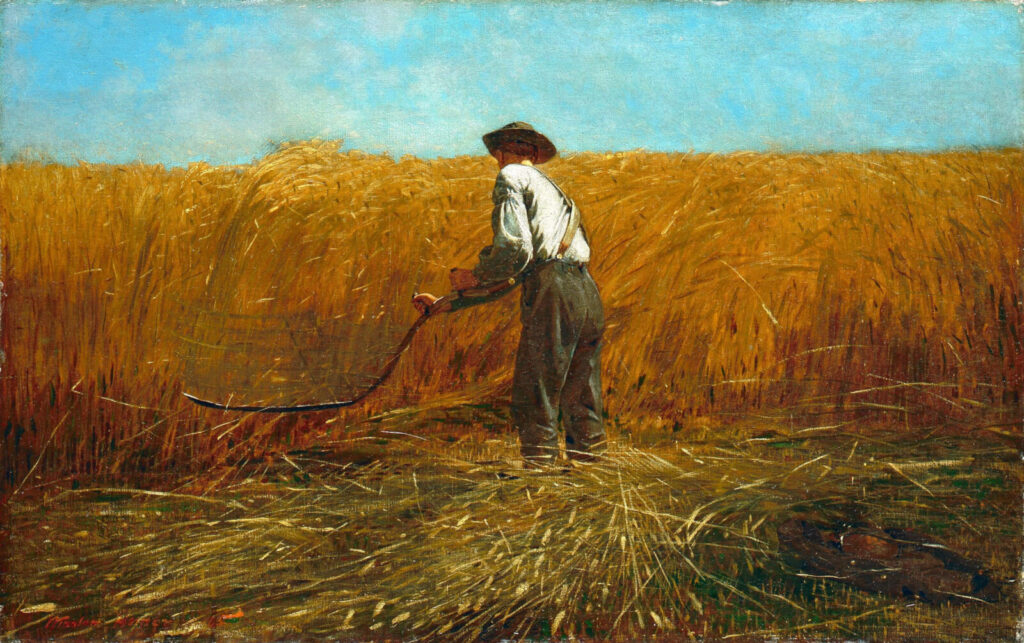
Winslow Homer, The Veteran in a New Field, 1865, Metropolitan Museum of Art, New York City, NY, USA.
Realism was a 19th-century Western artistic movement focusing on recording human activities and experiences through careful, almost scientific observation. Its influence and evolution were primarily felt in the artistic spheres of France, the United Kingdom, and the United States. Winslow Homer, as an American, viewed his ever-changing American society through an internal perspective and typically aimed for a grassroots interpretation.
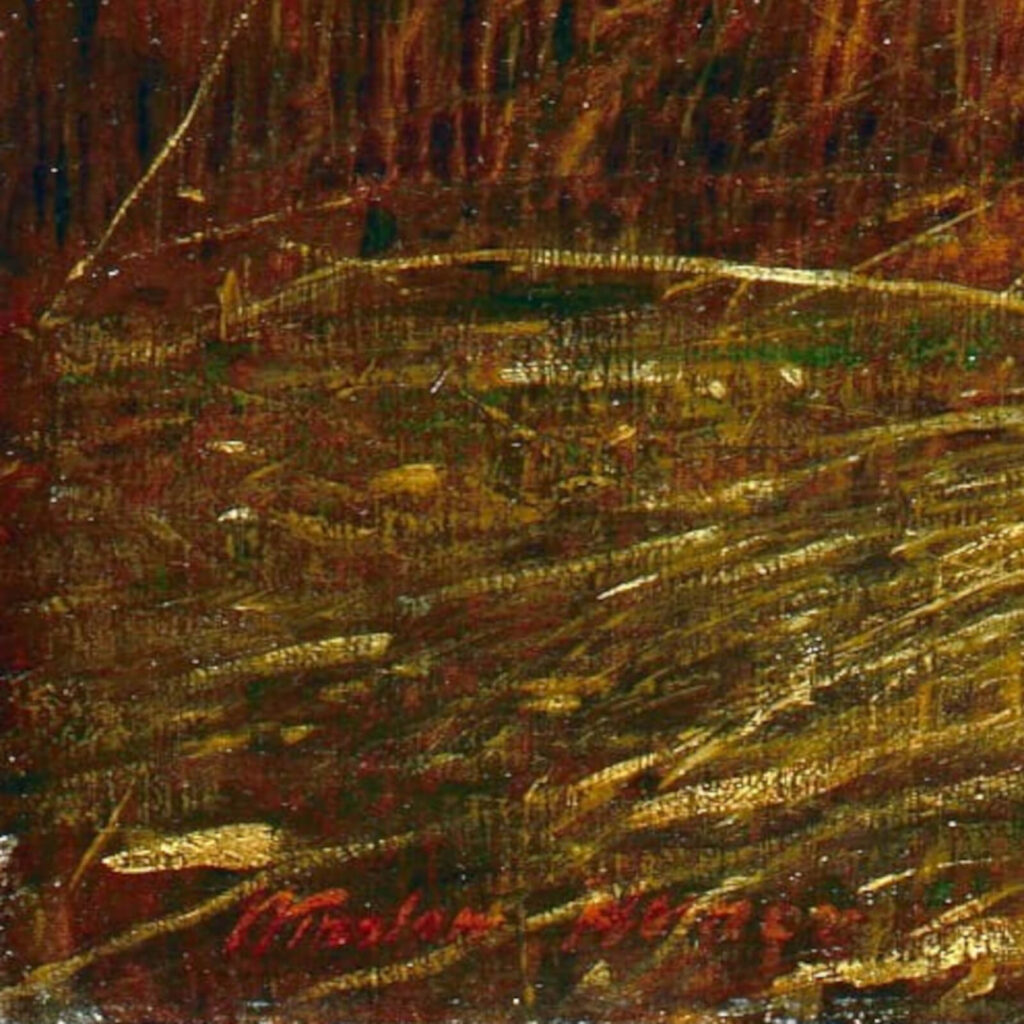
Winslow Homer, The Veteran in a New Field, 1865, Metropolitan Museum of Art, New York City, NY, USA. Detail.
He, like most Americans, was affected by the American Civil War (1861–1865) and questioned how the fractured country would heal and recover. The summer of 1865 was a time of transition when the majority of former soldiers returned home and tried to regain a civilian life. Winslow Homer’s The Veteran in a New Field explores this late summer event and captures its human condition.
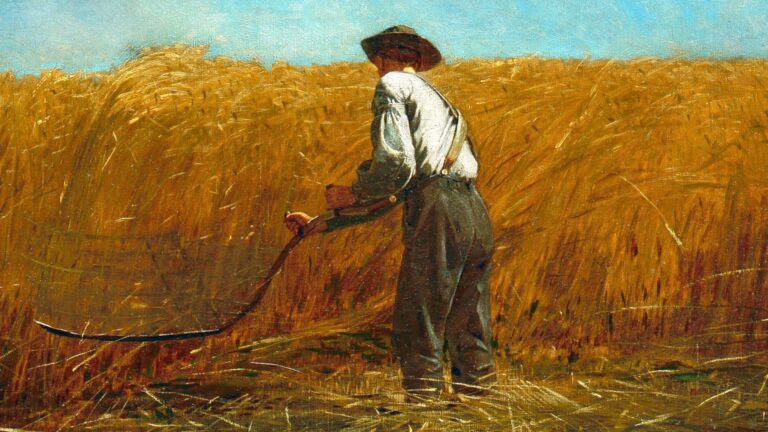
Winslow Homer painted The Veteran in a New Field in the late summer of 1865. It is an oil on canvas measuring 24 1/8 x 38 1/8 in. (61.3 x 96.8 cm). It presents a landscape scene of a singular farmer in the middle of a large wheatfield. The farmer’s back faces the viewer as he makes a three-quarter turn to the left while holding a single-blade scythe. It is a visually simple composition but ingrained with complex ideas and allusions.
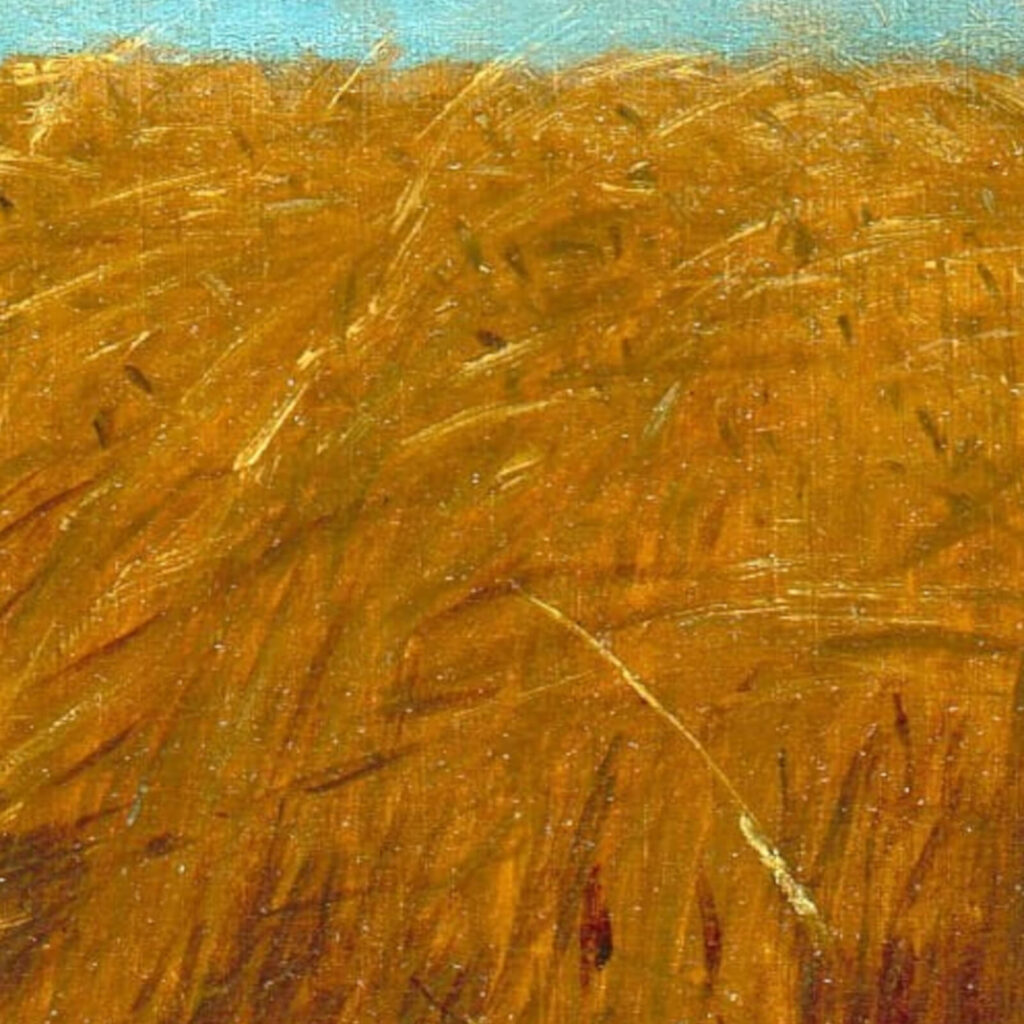
Winslow Homer, The Veteran in a New Field, 1865, Metropolitan Museum of Art, New York City, NY, USA. Detail.
The image is distinctly divided into three picture planes. The foreground is filled by the stubble field and only punctuated by the lower right detail of a discarded jacket and canteen. The midground is dominated by the high wheat shafts of the wheatfield and divided by the centrally placed farmer reaping the stalks. The background is a carpet of blue sky mottled by feathery white clouds just perched above the wheat heads of grain. Linear perspective is abandoned for a tight composition of horizontal bands. It creates a rhythmic pattern and a sense of atmospheric enclosure. The viewer feels to be inside the depth of the wheatfield alongside the veteran–farmer.
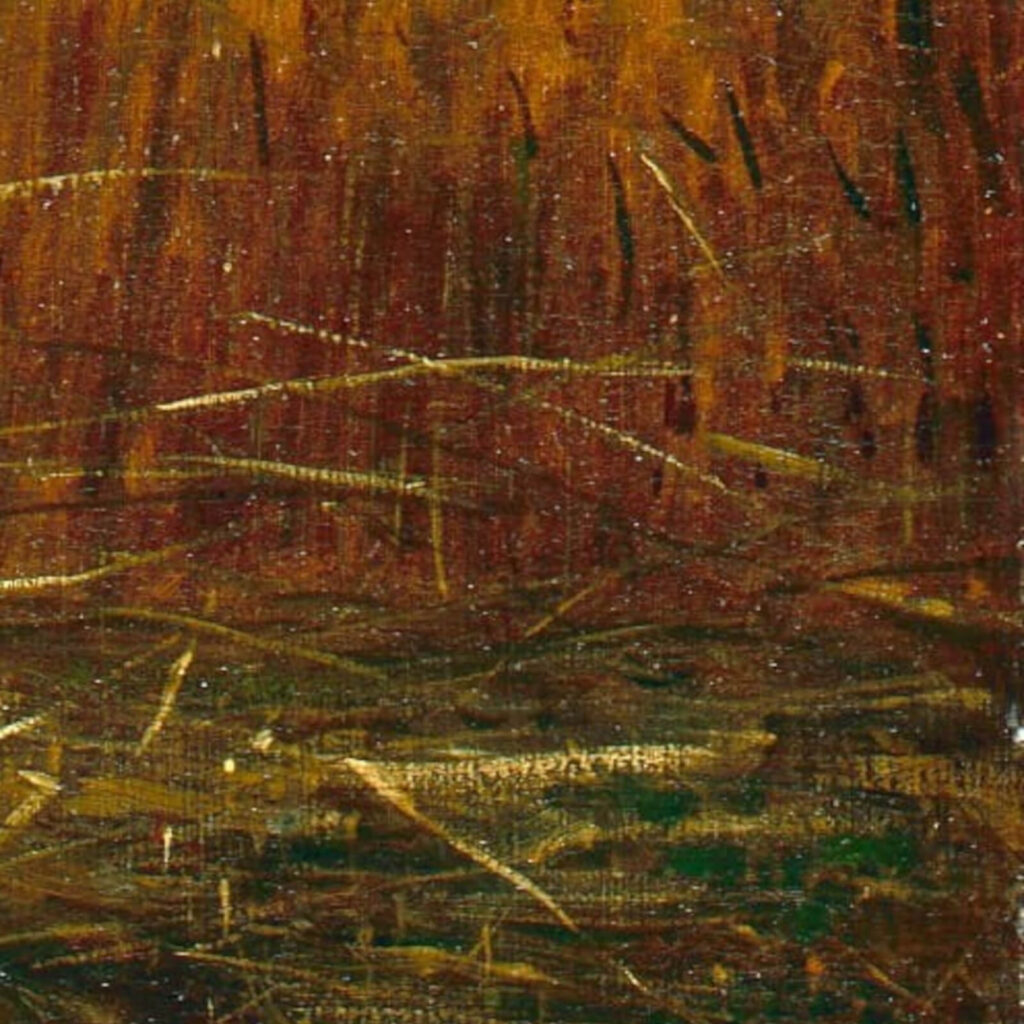
Winslow Homer, The Veteran in a New Field, 1865, Metropolitan Museum of Art, New York City, NY, USA. Detail.
The stubble field dominates the foreground. Flattened and trodden wheat stocks carpet the ground. They scatter and radiate around the feet of the farmer like a circular fountain spray gushing into a basin. The sunlight glistens off the stalks’ smooth surfaces as Homer depicts them in highlights of bright yellow against the dark amber ground. The shafts blend together and form a patterned ground and a contrast to the discarded items in the bottom right corner.
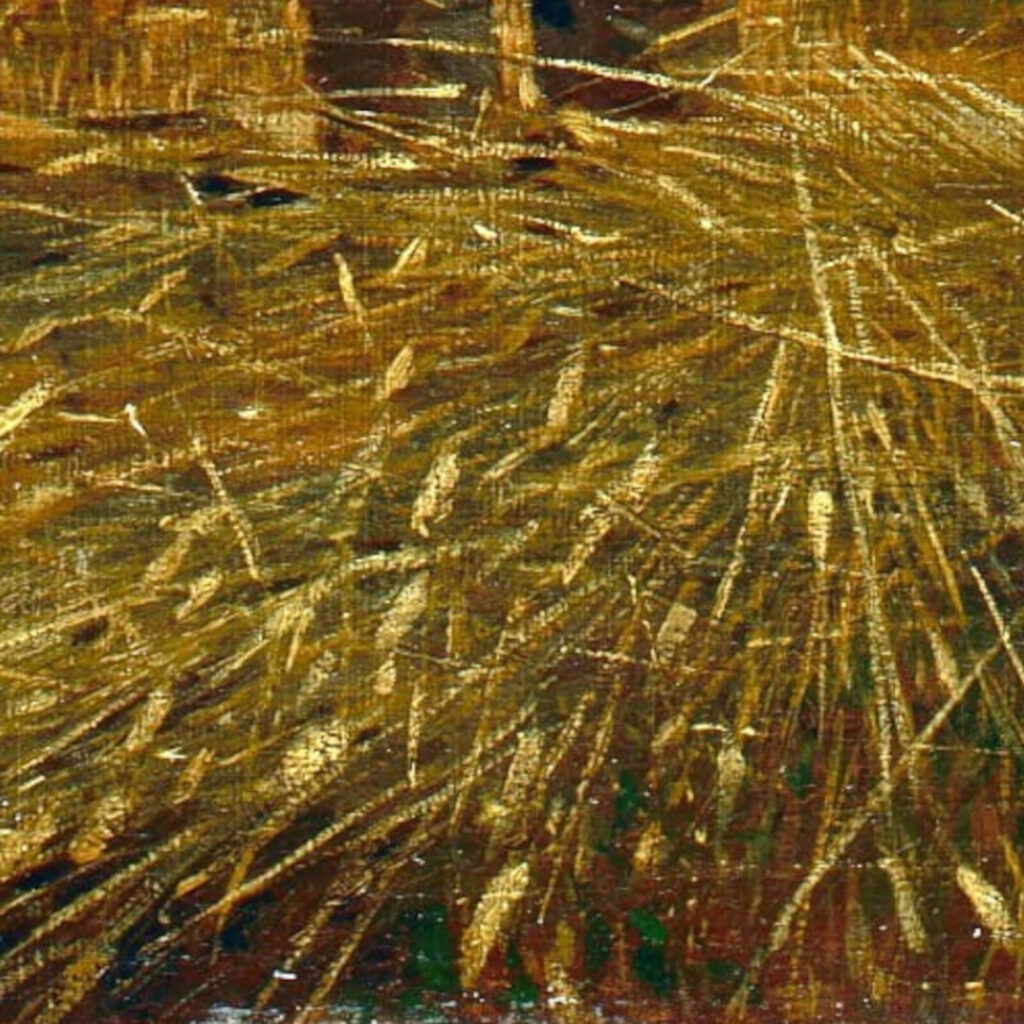
Winslow Homer, The Veteran in a New Field, 1865, Metropolitan Museum of Art, New York City, NY, USA. Detail.
A discarded jacket and canteen are found in the bottom right corner of the foreground stubble field. The items are from the uniform of a Union Army soldier. They are presumably the belongings of the farmer and mark him as a veteran of the American Civil War. Homer’s inclusion of these objects in the composition denotes the farmer has shed his former military life for the currently new (or perhaps regained) civilian agricultural life. It was a very common experience in 1861, with the outbreak of the American Civil War, for farmers to volunteer or to be drafted into both the Union Army and Confederate Army as soldiers and camp-aides. Therefore, in 1865, with the closure of the war, it was very common for these same soldiers to then return home and try to resume their previous agricultural lifestyle.
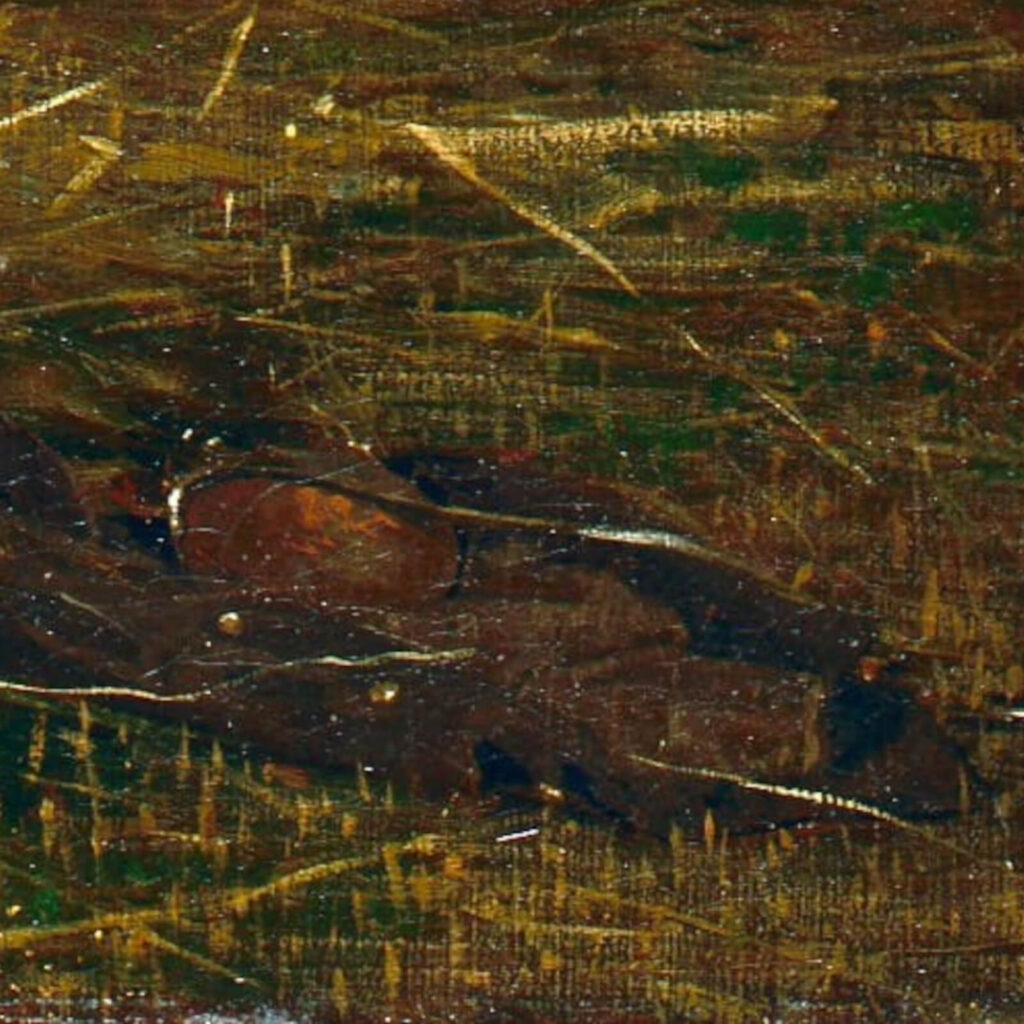
Winslow Homer, The Veteran in a New Field, 1865, Metropolitan Museum of Art, New York City, NY, USA. Detail.
Many former soldiers successfully completed the transition, and by 1865, contemporaries considered it a reflection of America’s greatness, with the peaceful renewal of antebellum civilian life. Unlike other countries that retain a large standing army after a great war, America returned to a more pacific and largely agricultural society. The smooth transition was considered a great national American strength. It was a source of 19th-century pride, and all hinted by Homer’s inclusion of the jacket-and-canteen detail.
The veteran–farmer dominates the central midground. He faces the field as he holds a single-blade scythe and cuts at the wheatfield. Winslow Homer’s choice of a single-blade scythe is intentional and incredibly symbolic. A typical 19th-century American farmer would not have used a single-blade scythe but a cradled scythe that has a wooden or iron finger-like frame (cradle) attached to the scythe. The cradle catches and collects the cut stalks so that the farmer can then easily bundle the stalks into a wheat sheaf. Why did Homer choose to depict a single and not a cradled scythe?
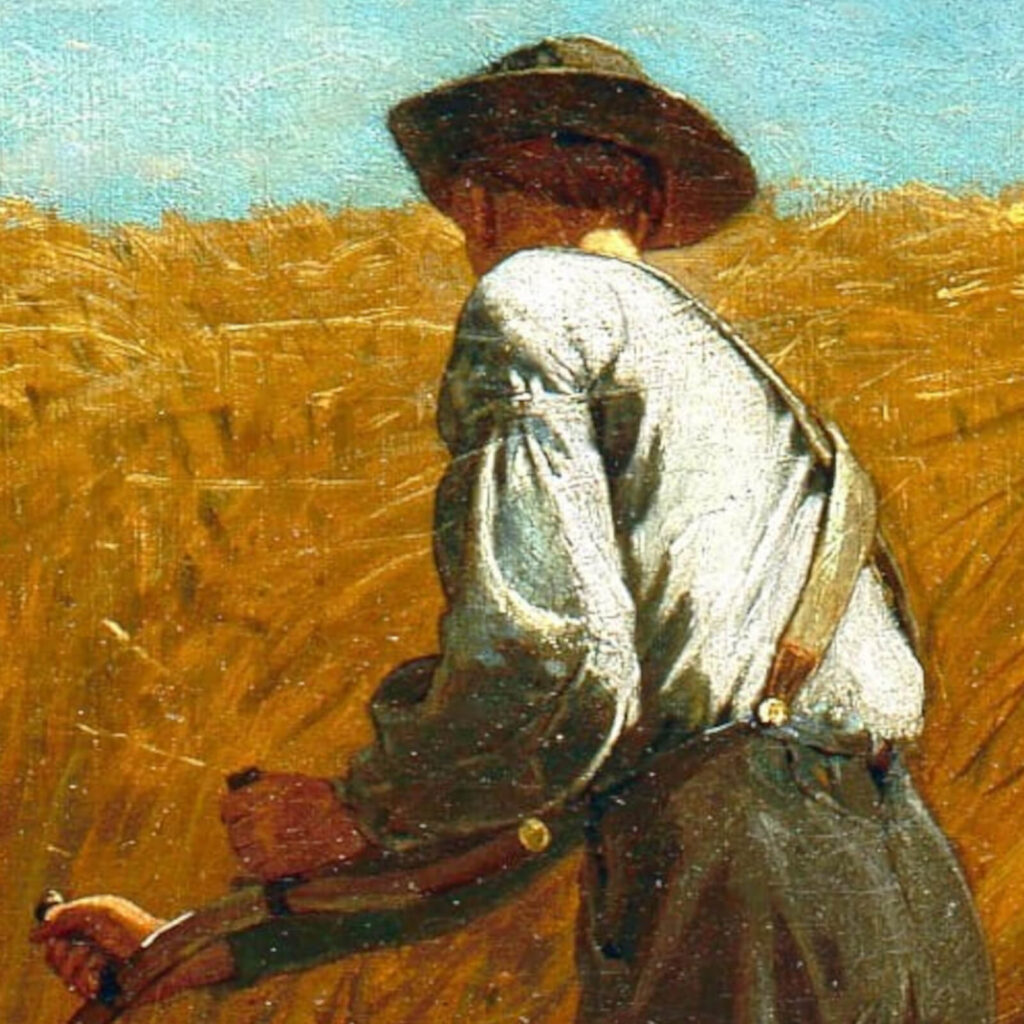
Winslow Homer, The Veteran in a New Field, 1865, Metropolitan Museum of Art, New York City, NY, USA. Detail.
The single scythe visually alludes to the Grim Reaper, a Western personification of death. The Grim Reaper is typically represented in a hooded black shroud with a large single scythe that he uses to cut a life short like a farmer cuts a wheat shaft. Hence, Homer is referencing death through the farmer’s tool. The farmer was once a soldier, a bringer of death. The same hands that now reap wheat once reaped death upon the enemy soldiers of the Confederate Army. His hands once brought death to the battlefield, but now they bring nourishment from the wheatfield. Same hands, same person, but different employment.
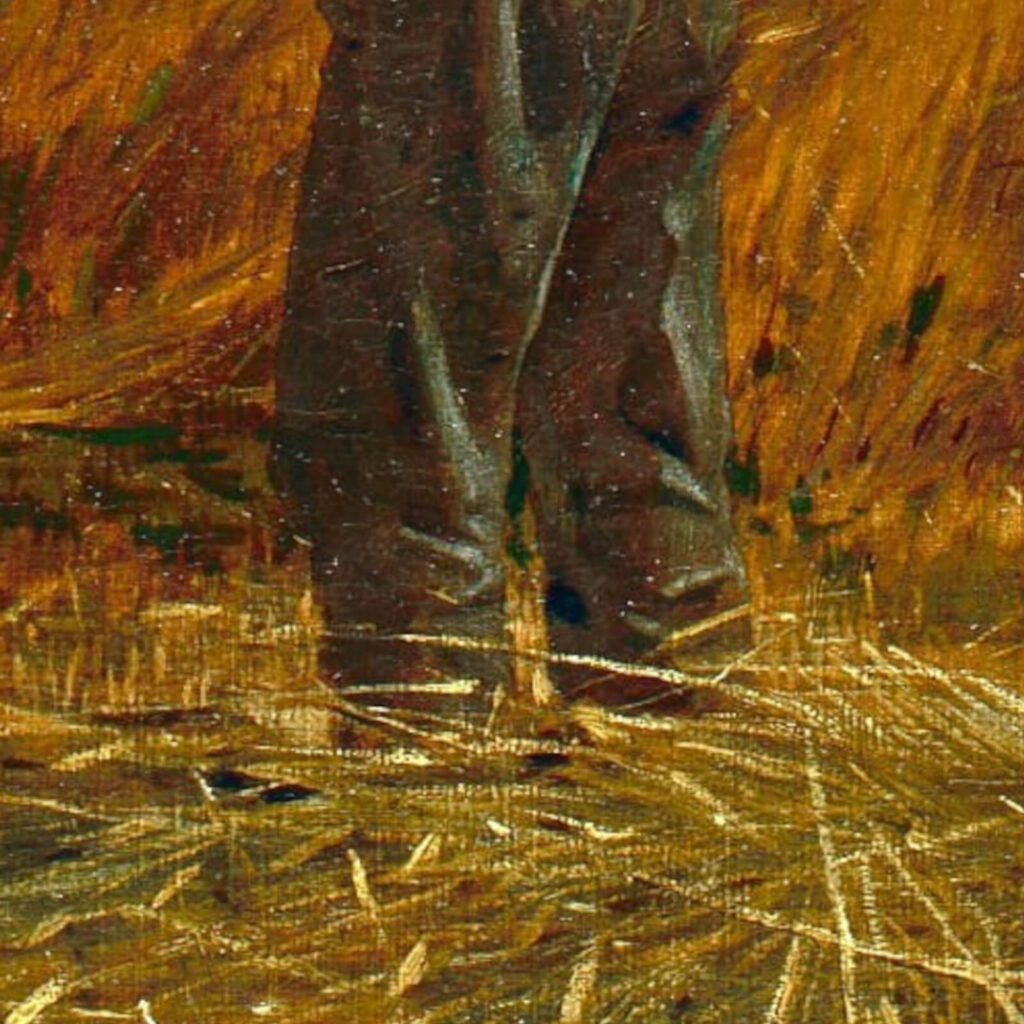
Winslow Homer, The Veteran in a New Field, 1865, Metropolitan Museum of Art, New York City, NY, USA. Detail.
The cutting action of the scythe against the wheatfield is implied by the multiple horizontal gray lines above the scythe. This small detail is not within the traditional scope of Realism and somewhat foreshadows the repetitive and echoing style of Futurism in early 20th-century Italy. The scythe’s movement is implied to be in multiple places simultaneously within the canvas.
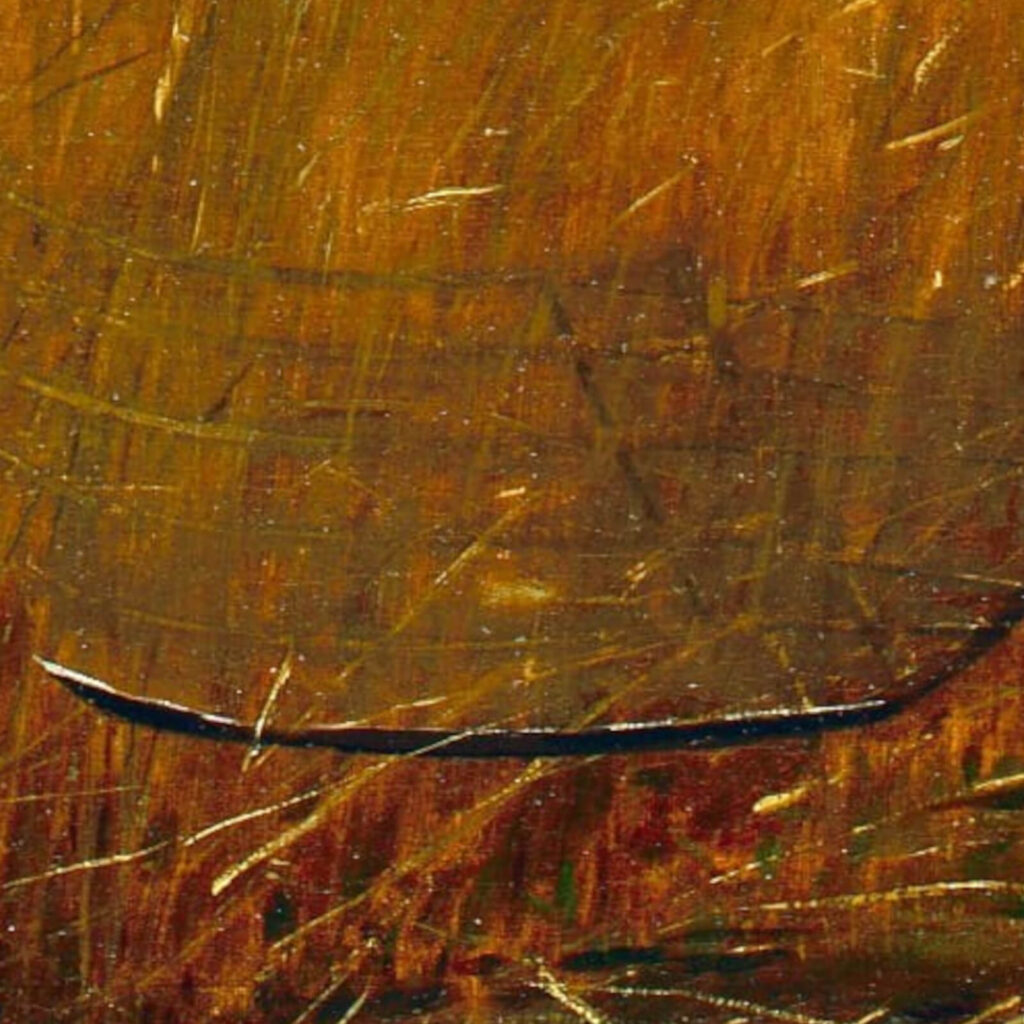
Winslow Homer, The Veteran in a New Field, 1865, Metropolitan Museum of Art, New York City, NY, USA. Detail.
The same recurrent positioning is felt and more boldly expressed in Giacomo Balla’s Dynamism of a Dog on a Leash, where the dog’s leash bounces and sways through its multiple representations. For a 21st-century viewer, it is easy to make visual connections between disparate artistic movements such as 19th-century American Realism and 20th-century Italian Futurism. The connection is probably a false association, and the visual similarity is probably coincidental, but the visual similarity expresses Homer’s creativity. He was not a blind follower of established methods, restricting himself to rigid visual traditions. He was willing to experiment and try a novel detail within a more traditional composition.
Winslow Homer’s The Veteran in a New Field possesses a visually elegant simplicity with deeper philosophical undertones. At first glance, a casual viewer would say it’s just a man in a field. Perhaps a more philosophical viewer would reflect upon its quietness and tranquility. However, the most informed viewer would understand the farmer’s previous life, the context of a healing postbellum America, and the return to predictability, productivity, and peace. Homer allows a wide range of viewers to appreciate his image. Like swimmers at a beach, some viewers will enjoy the surface waves, some will dive into the cooler depths, and others will find hidden treasure in the seabed.
The Veteran in a New Field, Metropolitan Museum of Art online collection. Retrieved 14 August, 2026.
Gardner, Helen, Fred S. Kleiner, and Christin J. Mamiya: Gardner’s Art Through the Ages. 12th ed., Thomson Wadsworth, Belmont, CA, USA, 2005.
Herdrich, Stephanie L: Art for Solace: Winslow Homer’s the Veteran in a New Field and More, The Digital Editors. Perspectives, Metropolitan Museum of Art, New York City, NY, USA, April 17, 2020.
DailyArt Magazine needs your support. Every contribution, however big or small, is very valuable for our future. Thanks to it, we will be able to sustain and grow the Magazine. Thank you for your help!

James W. Singer is an art historian and fine art photographer. He earned a Bachelor of Arts in Art History from the University of Florida. He later moved to Paris, France. He currently writes “Masterpiece” articles for DailyArt Magazine.

Judith and Holofernes is a Caravaggio masterpiece that captures Biblical murder and drama. Rarely has death been captured so intensely and violently...
James W Singer 13 September 2026
Explore an astonishing 1915 nude self portrait by American modernist painter Florine Stettheimer.
Candy Bedworth 21 September 2026
At first glance, A Goldsmith in His Shop (1449) appears to depict an ordinary visit to a jeweller. Yet Petrus Christus transformed an ordinary...
Shivani Gupta 23 August 2026
With Virgin and Child as a cornerstone of her reputation, Elisabetta Sirani should be recognized as an important Italian Baroque artist. Far more...
James W Singer 16 August 2026