


Stonehenge: Incredible Facts and Fascinating Theories
Stonehenge is one of the most famous archeological sites in the world, located in the county of Wiltshire, UK. Nowadays we do know some things about...
Camilla de Laurentis 9 October 2025
13 August 2026 min Read
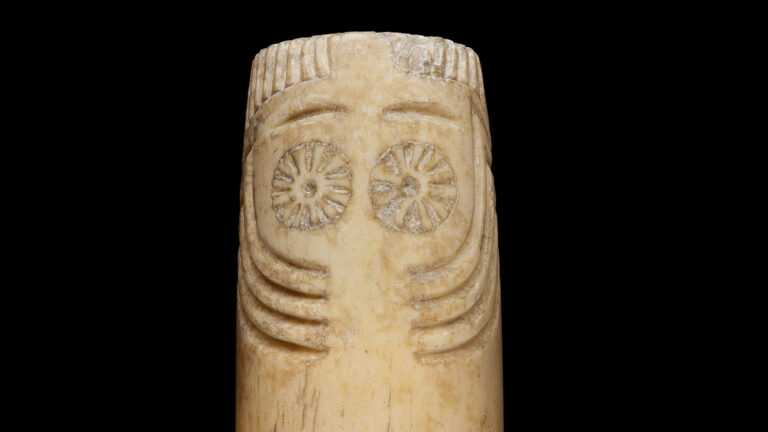
Idol of Extremadura, ca. 2500 BCE, National Museum of Archaeology, Madrid, Spain. Photo by Verónica Schulmeister Guillén. Museum’s website. Detail.
The Idol of Extremadura is one of the most outstanding examples of Iberian Chalcolithic art due to its distinctive appearance and the prominent representation of the eyes, a feature that gave name to this group of artifacts—“eye idols.” This idol is exceptional from both an artistic and historical point of view, as it provides valuable information about the art, settlements, social practices, and spirituality of prehistory.
Before discussing this particular piece, it is necessary to talk about the phenomenon of “eye idols.” The study of these figures takes us back to the Neolithic period, when this type of representation became especially significant in the Iberian Peninsula, particularly during the Neolithic and the Chalcolithic. Although this phenomenon was not exclusive to that region, it reached a remarkable level of development there, becoming one of the most characteristic manifestations of the symbolic repertoire of Iberian prehistory.
Classifying eye idols is far from straightforward as research has revealed a wide range of formal variations that make it difficult to establish a single division. Nevertheless, scholars have identified five main typologies.
The first consists of simple pieces in which only the eyes and facial tattoos are represented. The second, known as the “Moncarapacho type,” is distinguished by the presence of radial lines surrounding the ocular circles, accompanied by parallel lines that complete the curved eyebrow incisions. The third variant incorporates a slight widening in the central part of the piece, where the eyes, eyebrows, and facial tattoos are depicted. In the fourth type, which the Idol of Extremadura represents, the cylindrical shape becomes broader, and the representation of hair is added through zigzag lines at the top. Finally, the fifth variant is characterized by a more defined formal appearance, abandoning the cylindrical section in favor of a flat, rectangular profile, and standing out primarily for its wider eyebrows filled with incised lines.
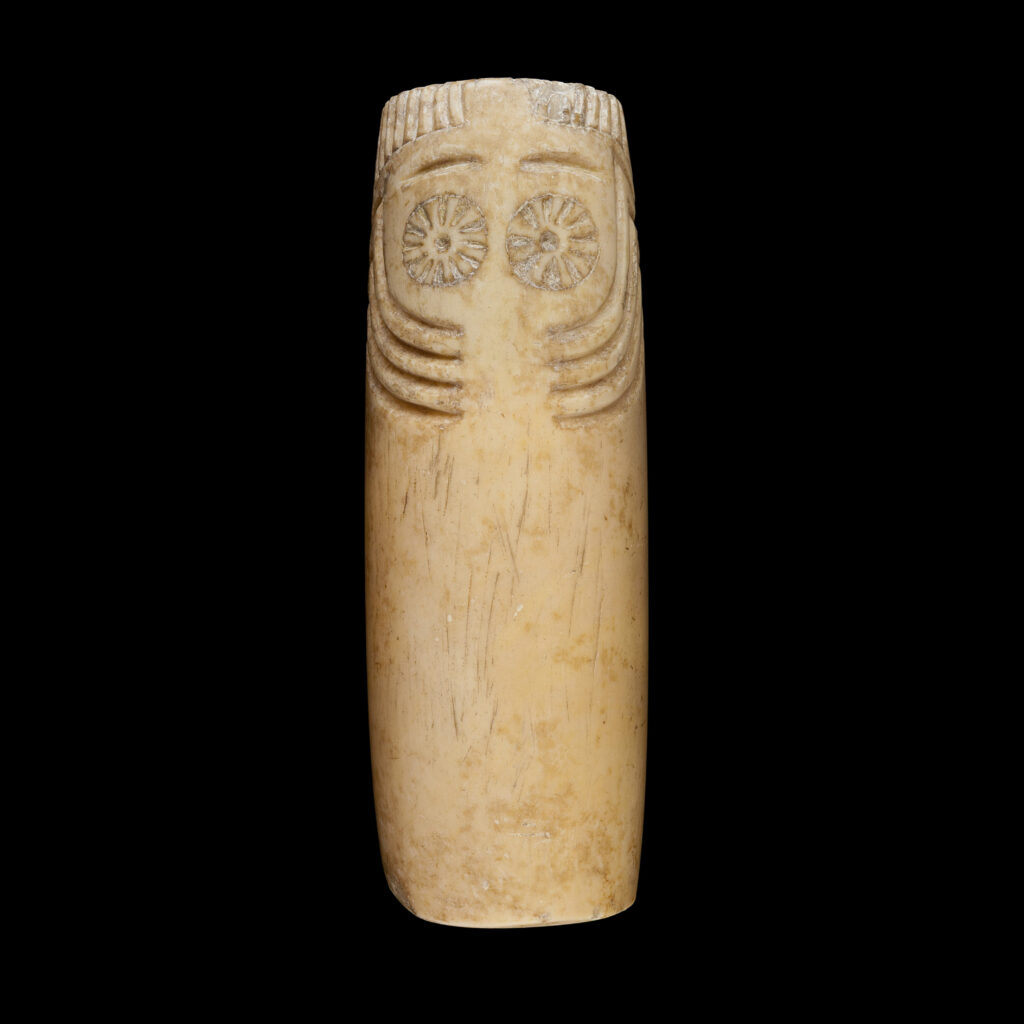
Idol of Extremadura, ca. 2500 BCE, National Museum of Archaeology, Madrid, Spain. Photo by Verónica Schulmeister Guillén. Museum’s website.
The Idol of Extremadura is a cylindrical alabaster sculpture measuring 19 cm (7 1/2 in.) in height. It dates to the Chalcolithic period, approximately 2500 BCE. According to various sources, it was discovered south of the Guadalquivir Valley. Its state of preservation is remarkably good, showing no significant fractures or damage, which is particularly striking given its antiquity.
The figurine features several interesting elements. In the upper section, on both the back and the top, the zigzag lines represent the hair. They cover almost half of the surface. Below are the eyebrows and the eyes, which are the most striking element of the artifact. They are accompanied by a series of lines or incisions that may represent some form of facial tattooing or body paint.
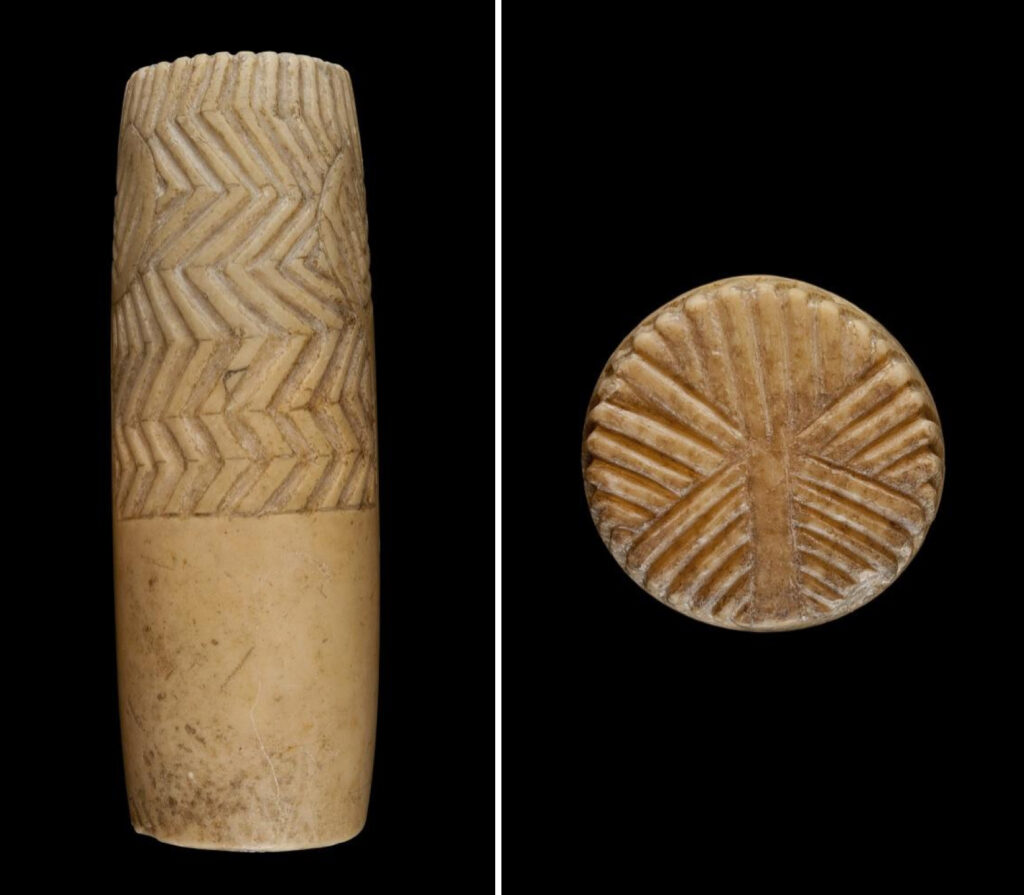
Idol of Extremadura (view from the back and from the top), ca. 2500 BCE, National Museum of Archaeology, Madrid, Spain. Photo by Verónica Schulmeister Guillén. Museum’s website.
The symbolic interpretations of what this idol represents have varied over time, and no single theory has been universally accepted by scholars. In general, it has been associated with female deities linked to fertility and the protection of the dead—an interpretation also proposed for other prehistoric figures, such as Cycladic figurines.
Other studies place the idol within the context of death, suggesting that it may have served as the personification of the deceased or as a vessel for the spirit of the dead, and would therefore not have been associated with any deity. More recent research has proposed that the idol may represent a community leader, a priest, or a chief, as Chalcolithic societies are thought to have already exhibited forms of social hierarchy and leadership.
Another element that has given rise to a great deal of debate is the facial markings present on the figure. The most widely accepted theory, proposed by Joseph Déchelette, holds that these are facial tattoos. However, other scholars, such as Luis Siret, have suggested that they could be a stylized representation of an octopus and its arms, similar to that found in Minoan and Mycenaean iconography. Siret, along with other authors such as Martín Almagro-Gorbea, suggested that they might be related to the power of water and that, in connection with the zigzag pattern of the hair—an established symbol of water in Egyptian art—they could personify the ocean.
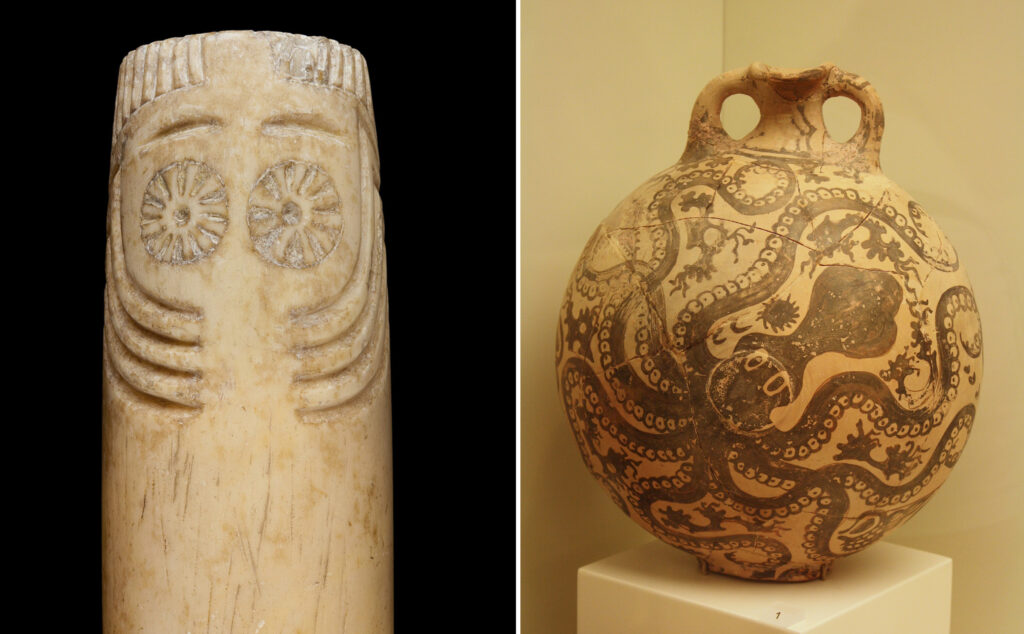
Left: Idol of Extremadura, ca. 2500 BCE, National Museum of Archaeology, Madrid, Spain. Photo by Verónica Schulmeister Guillén. Detail.; Right: Minoan amphora with a typical octopus motif, ca. 1500 BCE, Heraklion Archaeological Museum, Heraklion, Greece. Photo: Mark Cartwright (CC BY-NC-SA) via World History Encyclopedia.
More recent theories propose that the markings could represent wounds of mourning. They would be inflicted by relatives and close associates who scratched their faces as an expression of grief—a hypothesis that has also been proposed for Cycladic figures with similar markings. This adds yet another theory, as it would imply that the figure represents a relative or loved one of the deceased who displays their grief in front of them and offers these pieces as an offering.
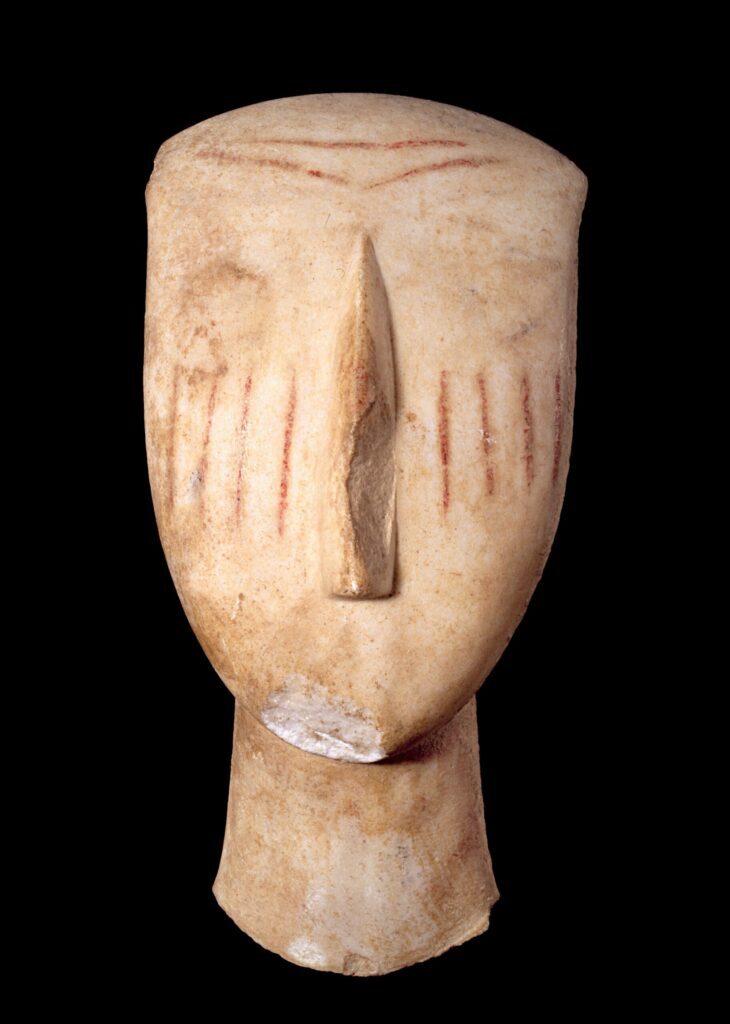
Head of a Cycladic figurine, ca. 2700–2300 BCE, National Museum of Denmark, Copenhagen, Denmark. Khan Academy.
Contemporary studies, such as those carried out by Alfredo Mederos and Javier Jiménez, argue that, due to the depth of the markings, it is unlikely that they represent paint or facial tattoos and instead suggest that they may be scarifications. They compare this phenomenon with the facial scarifications of the Gobir, Yoruba, or Igbo peoples of Nigeria, used to identify a person’s ethnic group and clan of origin—a practice that is currently prohibited.
However, both authors acknowledge that they are aware these contemporary cultural manifestations are temporally distant from the context of the Idol of Extremadura, and they recommend that this analogy be considered with caution and prudence.

Facial scarifications in Nigeria, image from Alfredo Mederos Martín, Javier Jiménez Ávila, “Al servicio de la divinidad…”
More than 4,500 years after it was carved, the Idol of Extremadura still invites questions rather than answers. Whether it represented a deity, a community leader, or the dead, its mysterious gaze continues to fascinate us, reminding us that prehistoric art was not merely decorative but deeply connected to belief, identity, and the human search for meaning.
Author’s bio:
Lara Martínez Ródenas recently graduated with a bachelor’s degree in Art History from the Complutense University of Madrid. She is seeking opportunities to further develop her knowledge and experience in art history and cultural management while contributing to projects that promote cultural engagement.
Ojos que nunca se cierran: Ídolos en las primeras sociedades campesinas, Ed. by Carmen Cacho, Ruth Maicas, Eduardo Galán, and Juan Antonio Martos, Madrid: Ministerio de Cultura, 2010.
Esther Corredera, Consuelo Gutiérrez. “Ídolos oculados en la Península Ibérica”, Archivos de la Sociedad Española de Oftalmología 96, no. 7 (2020): 1–3.
Juan Javier Enríquez, “Nuevos ídolos antropomorfos calcolíticos de la cuenca media del Guadiana,” Spal, no. 9 (2000): 351–368.
Víctorv Hurtado, Ídolos, estilos y territorios de los primeros campesinos en el sur peninsular. Manuscrito inédito, Departamento de Prehistoria y Arqueología, University of Sevilla, 2008.
Javier Jiménez, Alfredo Maderos, “Al servicio de la divinidad. Figuras antropomorfas oculadas calcolíticas del sur de la Península Ibérica en piedra, marfil y hueso”, Cuadernos de Prehistoria y Arqueología de la Universidad Autónoma de Madrid 49, no. 2 (2023): 51–96.
DailyArt Magazine needs your support. Every contribution, however big or small, is very valuable for our future. Thanks to it, we will be able to sustain and grow the Magazine. Thank you for your help!

This is our guest profile for occasional authors. If you have an interesting story about art to tell, send it to our Editor-in-chief Kate at [email protected]. You might be the next here!

Stonehenge is one of the most famous archeological sites in the world, located in the county of Wiltshire, UK. Nowadays we do know some things about...
Camilla de Laurentis 9 October 2025
Located in southern France, the Lascaux Cave houses some of the most famous prehistoric cave paintings, dating to approximately 15,000 BCE. The cave...
Vithória Konzen Dill 16 July 2026
On the Texas-Mexico border, there are treasures of prehistoric art: hundreds of painted caves and rock shelters dating as early as 2000 BCE. Filled...
Alexandra Kiely 12 September 2024
Our prehistoric ancestors moved around a lot. It was a short and brutal life back then – you needed the protection and guidance of your gods and...
Candy Bedworth 12 September 2024