Summary
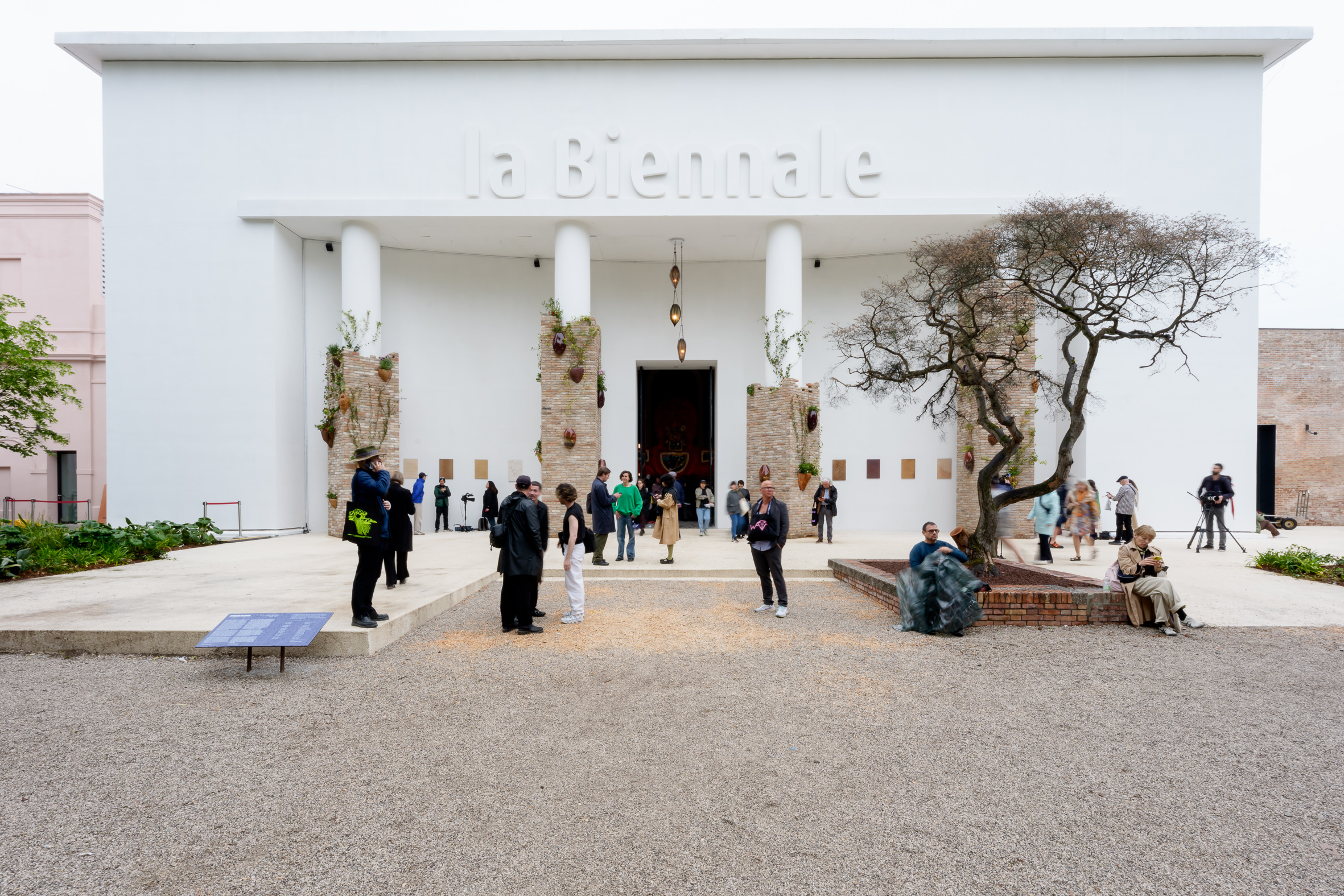
The 2026 Venice Biennale is an emotionally charged one. Curated posthumously by Koyo Kouoh, it combines a healing vision of contemporary art with unprecedented controversy marked by protests, a resigned jury, artist withdrawals, and strikes that have pushed this edition to the center of global debate.
- Argentina’s pavilion presents Matías Duville’s Monitor Yin Yang, a large-scale salt-and-charcoal installation exploring time, nature, and cycles of ruin and renewal.
- The Bahamas pavilion features works by John Beadle and Lavar Munroe that reinterpreted Junkanoo traditions into reflections on memory and what is left unseen or discarded.
- The Democratic Republic of Congo pavilion brings together nine artists exploring unity and transformation through the metaphor of fire.
- The Finnish pavilion Aeolian Suite by Jenna Sutela is an immersive soundscape of wind-inspired sculptures and recordings.
- The Holy See pavilion is a sound-based project inspired by Hildegard of Bingen that uses environmental recordings.
- The Iceland pavilion Pocket Universe by Ásta Fanney Sigurðardóttir is an immersive installation that combines playful surreal elements.
- The Japan pavilion Grass Babies, Moon Babies by Ei Arakawa-Nash uses 200 baby dolls to explore participatory rituals and the process of parenthood.
- The Latvia pavilion revisits 1990s experimental fashion to inquire how collective desires are shaped during moments of political and economic transition.
- The Nordic Countries pavilion transforms the space into a mythic, unstable environment with works inspired by folklore and myth.
- Taiwan’s collateral project Screen Melancholy is an immersive installation that explores anxiety and alienation with screen culture and artificial intelligence.
- South Africa’s Gabrielle Goliath presents Elegy, a video installation that turns mourning into a ritual of remembrance.
A Landmark and Controversial Venice Biennale
The Venice Biennale is by far the most prestigious art event globally, and every other year it brings to Venice hundreds of thousands of visitors, art lovers, and professionals. But some editions are more memorable than others. The 61st Venice Biennale that just opened on May 9, 2026, has proved to be one of those.
Curated by the late Koyo Kouoh (December 24, 1967 – May 10, 2025), this edition of the Venice Biennale is the first to be led by an African woman curator and realized after her death. The title, In Minor Keys, beautifully mirrors Kouoh’s curatorial practice, and the Biennale itself—carried out by her team following the project she had already designed for this edition—is the perfect testament to her commitment to art.
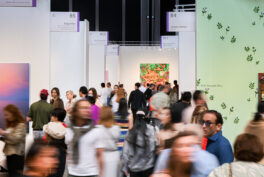
With 111 participating artists, 99 national pavilions, and 31 collateral events, In Minor Keys is a comprehensive exploration. Monumental installations are presented alongside smaller and intimate works, creating a touching symphony where artists come together to explore what it means to make art today. The exhibition unfolds as a healing experience, suggesting a form of collective redemption.
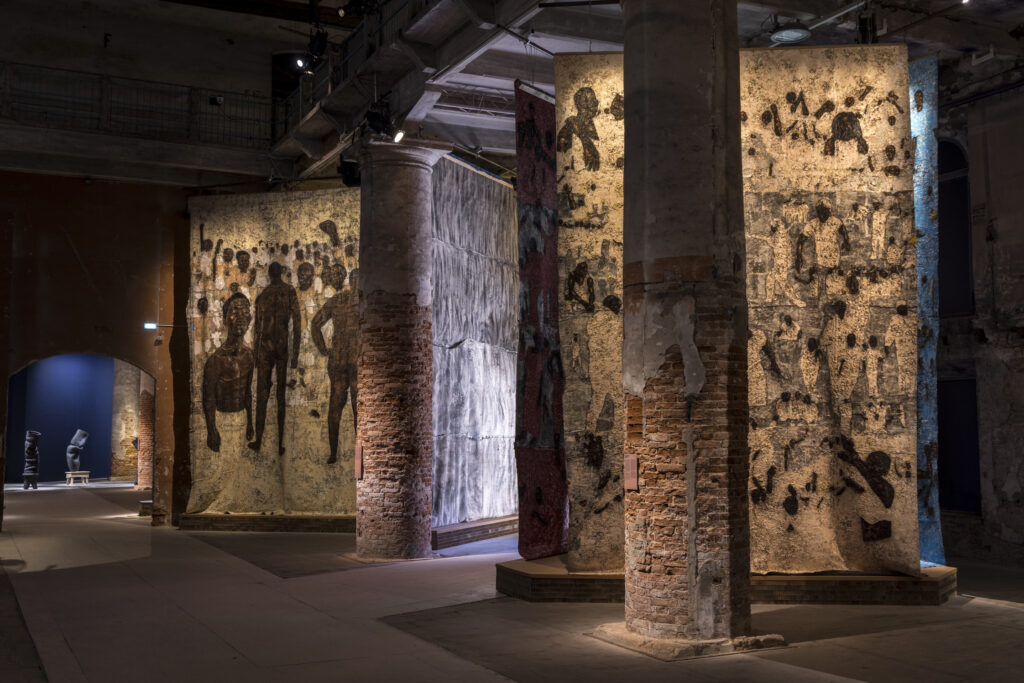
Installation view of work by Kaloki Nyamai, part of In Minor Keys, 2026, Venice Biennale, Venice, Italy. Photo by Marco Zorzanello. Press materials.
But with great achievements come great controversy. The Biennale has always been at the center of the international discourse, as well as a perfect stage for protests and activism. As a matter of fact, something different was in the air this year. The joyous, festive climate that usually permeates Venice for every Biennale’s pre-opening week was swept over by a number of protests against the participation of Russia and Israel. The jury resigned at the end of April, just days before the official opening, eventually leaving the Biennale without a jury to assign the prestigious Golden Lion. The Biennale, then, decided to have visitors vote for their favorite artist, but several artists and national pavilions withdrew from the competition. And on May 8, a historic strike broke out as a protest against the war in Gaza, as well as against the precarious working conditions of cultural workers, leading to the closure of several national pavilions.
Just a few days after its official opening, the Biennale has already gathered massive attention worldwide. Unlike previous editions, In Minor Keys has brought art and the institution of the Biennale at the forefront of the international discourse, not just for art, but for the values and ideas brought forward by its participants.
In this political climate, though, the beauty and significance of Kouoh’s work and her team remain untouched. In Minor Keys is one of the most touching biennales in the past decade, and these 10 pavilions are some of the most compelling to visit.
1. Argentina

Matías Duville, Monitor Yin Yang, 2026, Venice Biennale, Venice, Italy. Photo Giacomo Bianco. Press materials.
For the 61st Venice Biennale, Argentina presents a multimedia installation Monitor Yin Yang by Matías Duville. Hosted inside the Arsenale, the work is a monumental-scale installation made of salt and charcoal, that incorporates video, sound, and drawing. It explores our relationship with beauty and time and themes of future and tragedy.
Drawing on the concept of yin and yang, Duville created an immersive installation visitors can roam through almost like a ritualistic dance. Among dunes of white salt and black charcoal, visitors immerse in sound while they become part of a large-scale drawing. Salt and charcoal act as residues of seas and forests, a metaphor of geological and human times. In doing so, Monitor Yin Yang establishes an intimate yet collective experience that oscillates between ruin and potential, energy and debris, highlighting the crucial role of ecosystems in human survival.
2. The Bahamas
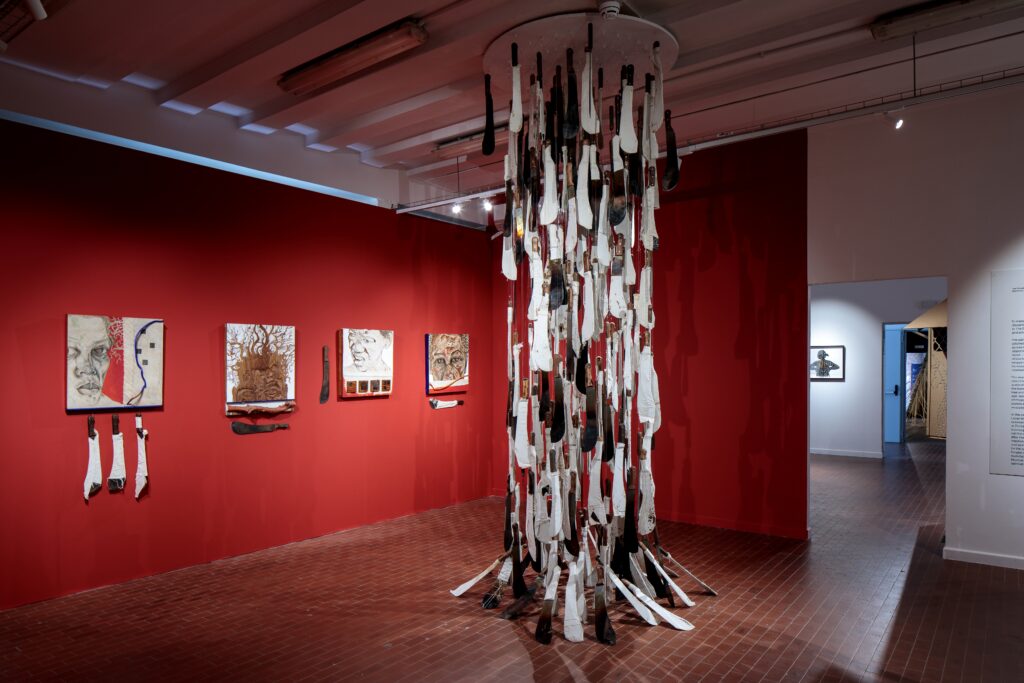
John Beadle, Lavar Munroe, and the Spirit of (Posthumous) Collaboration, In Another Man’s Yard, 2026, Venice Biennale, Venice, Italy. Photo Francesco Allegretto. Press materials.
Located at the San Trovaso Art Space in Dorsoduro, the Bahamas pavilion presents works by John Beadle and Lavar Munroe deeply embedded in Bahamian social practices and the broader African diaspora. The pavilion highlights themes of border-crossing, commemoration, and collaboration. All those compose a meaning-making journey, where bold colors and discarded objects tell a cultural history.
John Beadle, who died in 2024, worked with recycled materials and contributed costume designs for the biennial Junkanoo masquerade, a centuries-old tradition of the islands celebrating emancipation. Lavar Munroe is also member of a Junkanoo group. His sculptures are made out of strips of Junkanoo costumes he collected after the parades.
Both artists work around the themes of the hidden, the discarded, the thrown away, and the underrepresented.
3. Democratic Republic of Congo
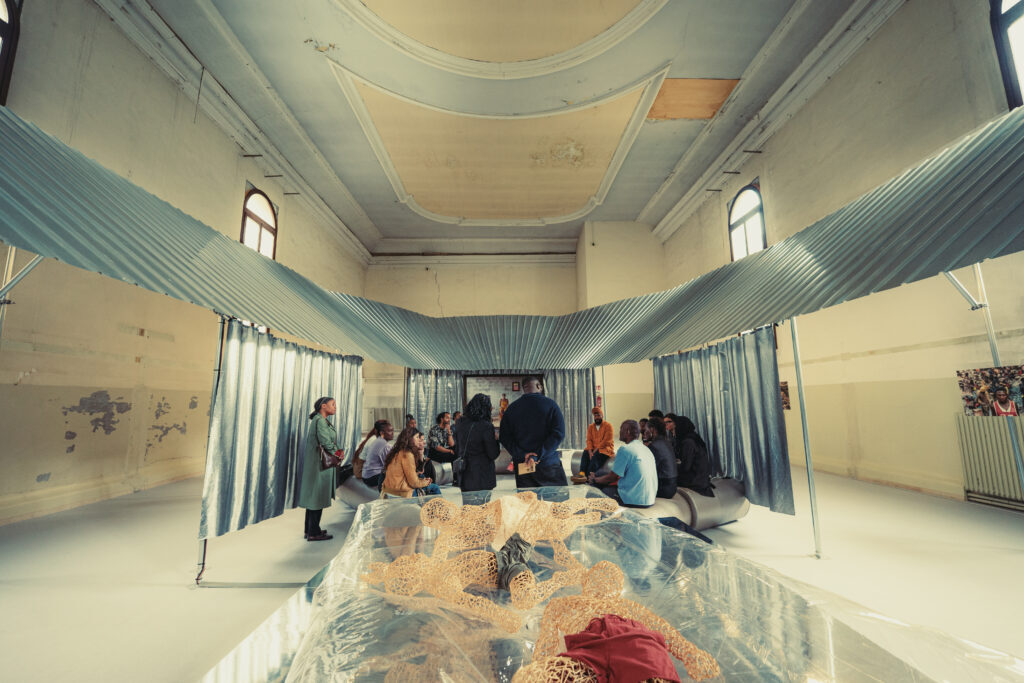
Simba Moto! Seize the Fire! Saisis le feu!, 2026, Venice Biennale, Venice, Italy. Institute for Ideas and Imagination. Press materials.
The scenographic pavilion of the Democratic Republic of Congo catches the visitors’ attention from the moment you step inside. Its futuristic setting clashes with the historic venue of the Antico Refettorio at the Scuola Grande di San Marco. But what is really fascinating about Simba Moto! Seize the Fire! Saisis le feu! are the artists in it. Curated by Nadia Yala Kisukidi, the pavilion brings together nine artists from the Democratic Republic of the Congo and its diaspora. Presented across a variety of media, including painting, sculpture, photography, film, and tapestry, the works embody ideas of unity, transformation, and transcendence, moving from past turbulence and pain towards the creation of futures, life, and hope.
The central theme is that fire can burn and destroy, but, if tamed, it can also transform, shape, and create. In doing so, the pavilion is shaped like a forge, where each artist realize their own story surrounding the central theme. In this collective chant, the pavilion embraces subtlety, improvisation, and shared imagination, calling for new narratives beyond discourses of paucity, pain, and death.
4. Finland
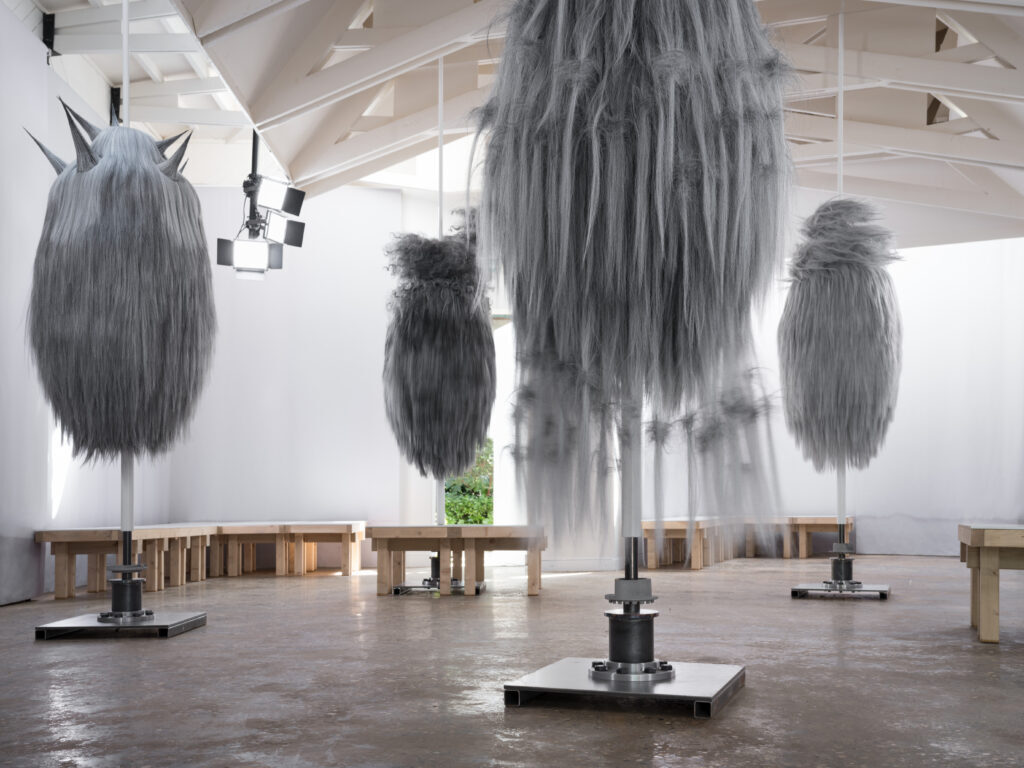
Jenna Sutela, Aeolian Suite, installation view, 2026, Venice Biennale, Venice, Italy. Photo Ugo Carmeni. Press materials.
One of the most recognizable pavilions of Giardini, the Finnish pavilion features Aeolian Suite by artist Jenna Sutela. Curated by Stefanie Hessler, Aeolian Suite marks the 70th anniversary of the Pavilion of Finland and transforms the Aalto pavilion into an immersive soundscape.
The exhibition features five sonic-kinetic sculptures installed in a circle, like a medieval wind rose diagram, impersonating the five Venetian winds: Tramontana, Scirocco, Garbin, and two different Boras. The sculptures are covered in soft, fuzzy wigs that reference the wind muffs used on microphones. Here, instead of blocking out wind sounds, they become vessels for it, channeling the whispers and songs of wind while inviting us to reflect on what we consider noise and how we relate to our natural and cultural environment, addressing pressing environmental questions.
Blowing through the pavilion, the winds become the protagonists of an elemental drama unfolding on a stage, each with its own energetic, tempestuous personality. The newly composed musical score, running about 16 minutes, brings together sounds from wind machines, alto, basset, and contrabass recorders, and a children’s woodwind orchestra. It also features recordings of wind moving through a bridge, sailboat masts, poplar trees, and clotheslines in Venice and Helsinki, and follows weather data collected for one year at the Acqua Alta Oceanographic Tower (AAOT), a permanent research platform in the Gulf of Venice.
5. Holy See
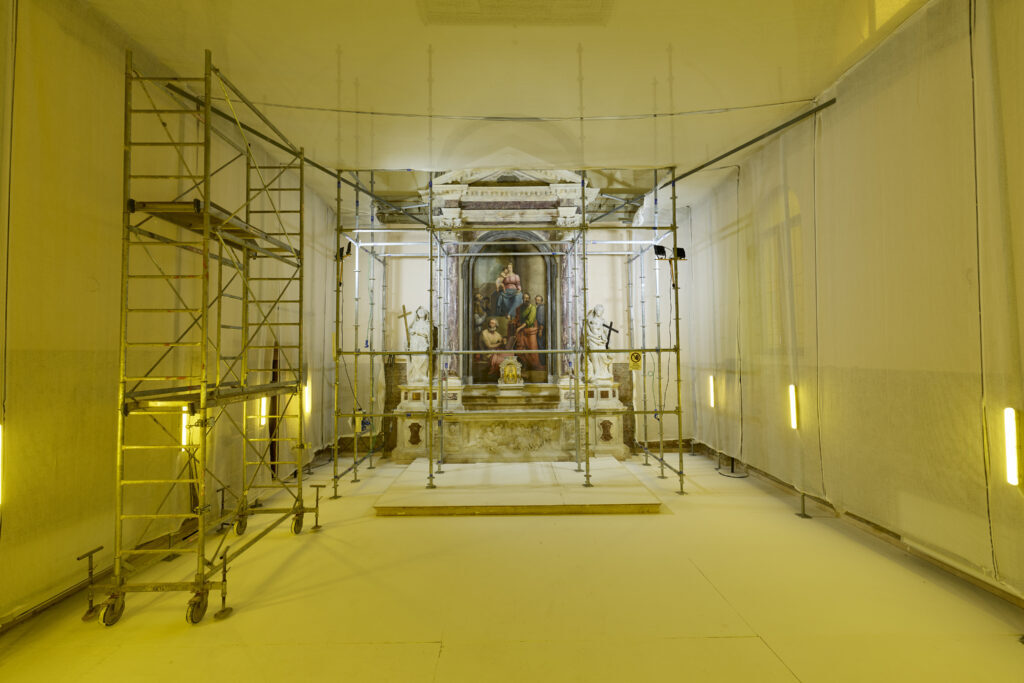
The Ear is the Eye of the Soul, installation view of the Santa Maria Ausiliatrice complex, 2026, Venice Biennale, Venice, Italy. Photo David Levene. Press materials.
The Holy See has done it again. In 2024, they presented one of the most talked-about pavilions, and this year’s pavilion is no less of a sensation. Spread across two locations, The Ear is the Eye of the Soul is an ensemble of new commissions by 24 artists. Inspired by the life and legacy of Saint Hildegard of Bingen (1098–1179), medieval abbess, poet, healer, and composer, the exhibition takes the form of a sonic prayer, a call to the contemplative act of listening.
In the ancient Giardino Mistico (Mystic Garden), the Pavilion features new sound installations by 20 contemporary composers, musicians, and poets, responding to Hildegard’s chants, writings, and visionary images through voice, instrumentation, and at times, silence. Moreover, Soundwalk Collective created a bespoke sonic instrument that listens to the garden in real time, translating subtle natural rhythms, including bioelectrical activity in plants and the micro-acoustics of wind, water, wood, insects, and soil, into an evolving composition.
Across the city, in Castello, the Pavilion’s second venue is the complex of Santa Maria Ausiliatrice. It functions as a contemporary scriptorium and hosts a living archive of Hildegardian texts, Alexander Kluge’s final work, and the ‘twinned sonic liturgy’ from the nuns of Eibingen Abbey.
6. Iceland

Ásta Fanney Sigurdardottir, Pocket Universe, 2026, Venice Biennale, Venice, Italy. Photo by Andrea Ferro Photography. Press materials.
Blue envelopes visitors as they enter the Iceland pavilion, Pocket Universe. Conceived as an immersive experience, the pavilion presents a new multidisciplinary exhibition by artist, poet, composer, and filmmaker Ásta Fanney Sigurðardóttir. The exhibition weighs in on hope, imagination, and belief, proposing that even in times of instability, a shift in mindset can open up new possibilities.
Presented at the Icelandic Pavilion’s new location at Docks Cantieri Cucchini, a former shipyard between the Giardini and the Arsenale, Pocket Universe unfolds across interconnected indoor and outdoor spaces. Moving between the cosmic and the everyday, the exhibition combines playful, surreal elements with moments of contemplation, encouraging visitors to wander, linger, and follow their own path.
Across the exhibition, Ásta Fanney Sigurðardóttir reflects on how we trick ourselves into new ways of thinking. Themes of luck, chance, and opportunity run throughout Pocket Universe, emerging through playful structures that resemble games, where returns to square one remain possible. Orbs, charms, and talismans appear as small, charged objects, brought to life by the artist. Familiar rules are suggested, but outcomes remain unknown, allowing space for transformation through risk, play, and the navigation of uncertainty.
7. Japan
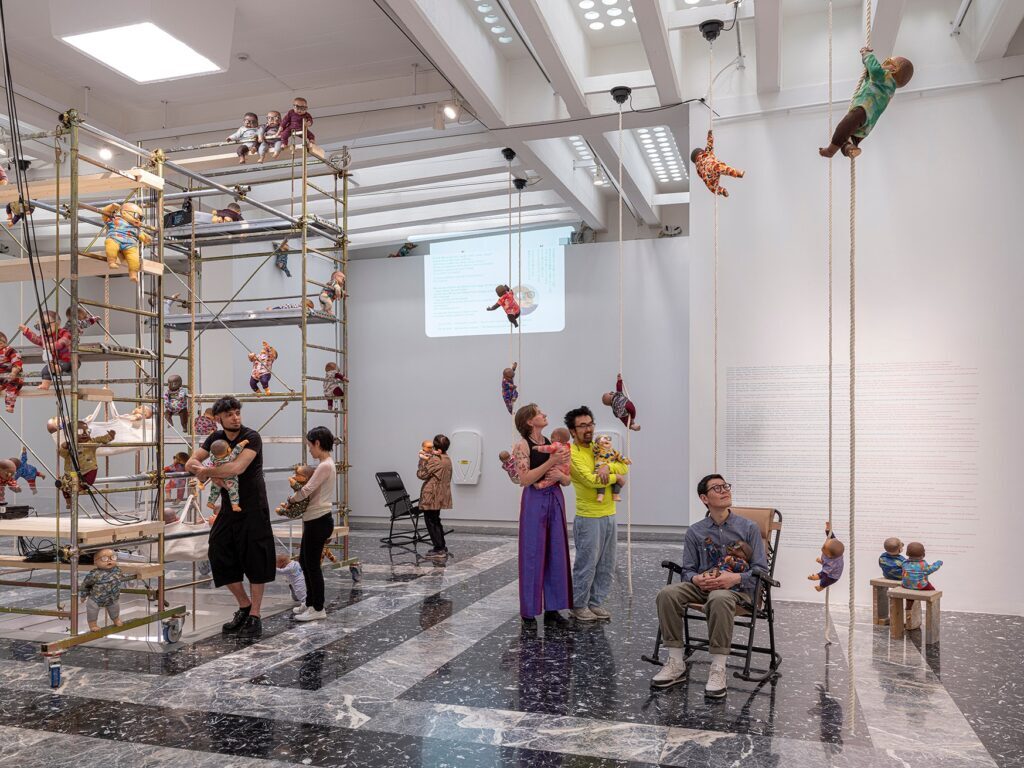
Ei Arakawa-Nash, Grass Babies, Moon Babies, 2026, Venice Biennale, Venice, Italy. Photo by Uli Holz. Courtesy of the Japan Foundation. Press materials.
Surreal, uncanny, and slightly disturbing, the Japan pavilion at the 2026 Venice Biennale was a hit from the very first day of the pre-opening. Presenting the work of Ei Arakawa-Nash, the pavilion features 200 baby dolls to reflect on the decline in global birth rates. Grass Babies, Moon Babies emerges from Ei Arakawa-Nash’s experience of becoming a queer artist and parent—the process, in which artmaking and parenting become part of each other, transforms the artist’s personal experience into a collective engagement with care and nurturing.
As visitors move through the Japan Pavilion, they are invited to hold one of the baby dolls as they wander through the surrounding gardens and into the building’s interior, where a sound piece composed from the voices of Arakawa-Nash’s own twin babies resonates throughout the space. Carrying the weight of these “babies” in their arms, visitors encounter works by other artists that destabilize perceptions of national identity through their diasporic presence. Visitors are also encouraged to perform the ultimate act of caring by changing the dolls’ diapers, engaging in a QR-code ritual through which a poem, uniquely tailored to each baby’s birthday, is gifted to them. These birthdays are drawn from historical dates, mostly from 20th-century Japan.
Behind the playful appearance, though, this pavilion proposes a deep reflection on childcare, engaging with themes of migration, race, and queer communities.
8. Latvia
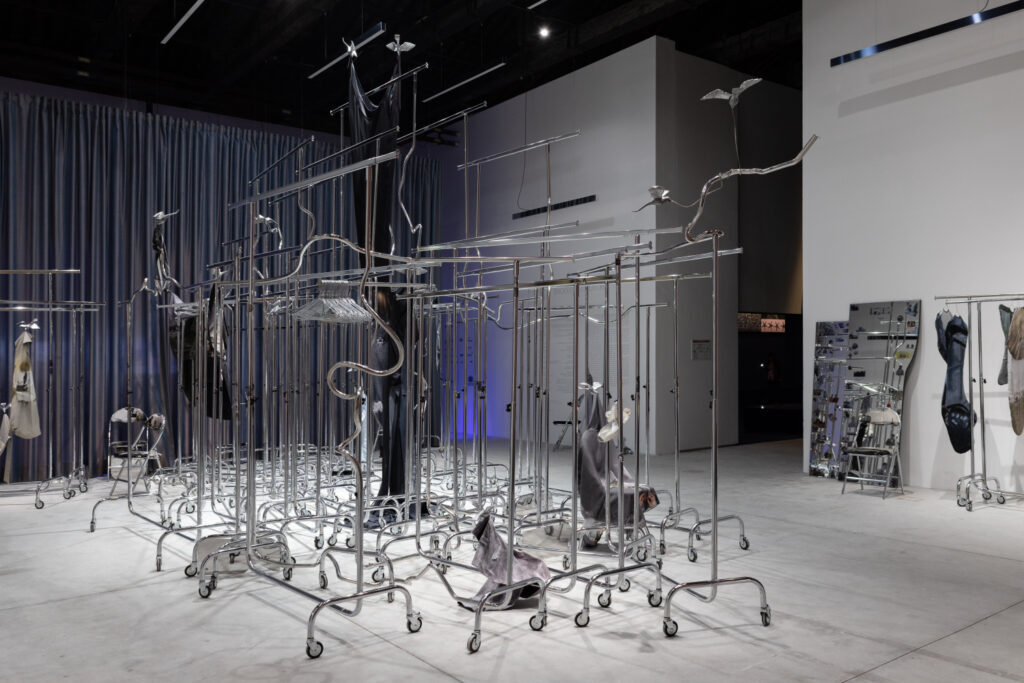
MAREUNROL’S and Bruno Birmanis, Untamed Assembly—Backstage of Utopia, 2026, Venice Biennale, Venice, Italy. Photo by Kristine Madjare. Press materials.
Titled Untamed Assembly: Backstage of Utopia, the Latvia Pavilion presents a new work by MAREUNROL’S—an interdisciplinary art studio run by Rolands Pēterkops and Mārīte Mastiņa-Pēterkopa. It was created in dialogue with alternative fashion designer Bruno Birmanis and the archives of the Untamed Fashion Assemblies (UFA), a series of experimental fashion, art, and performing art events that took place in Riga between 1990 and 1999.
Curated by Inga Lāce and Adomas Narkevičius, the exhibition links past and present, highlighting utopian thinking at moments of transition. It asks how collective imagination, desire, and visibility are produced as political and economic systems shift, and how futures and new forms of togetherness are rehearsed behind the scenes rather than on the main stage. The installation by MAREUNROL’S rethinks the legacy of UFA and is conceived as a fashion show backstage.
Taking place during a decade of profound political transformation, UFA expanded fashion across visual art, music, and club culture, offering an alternative to the commercialized fashion markets in the West. Improvised and collaborative, the Assemblies brought students and international stars onto the same stage. The pavilion questions what can be gathered today from the utopian visions of these festivals.
9. Nordic Countries
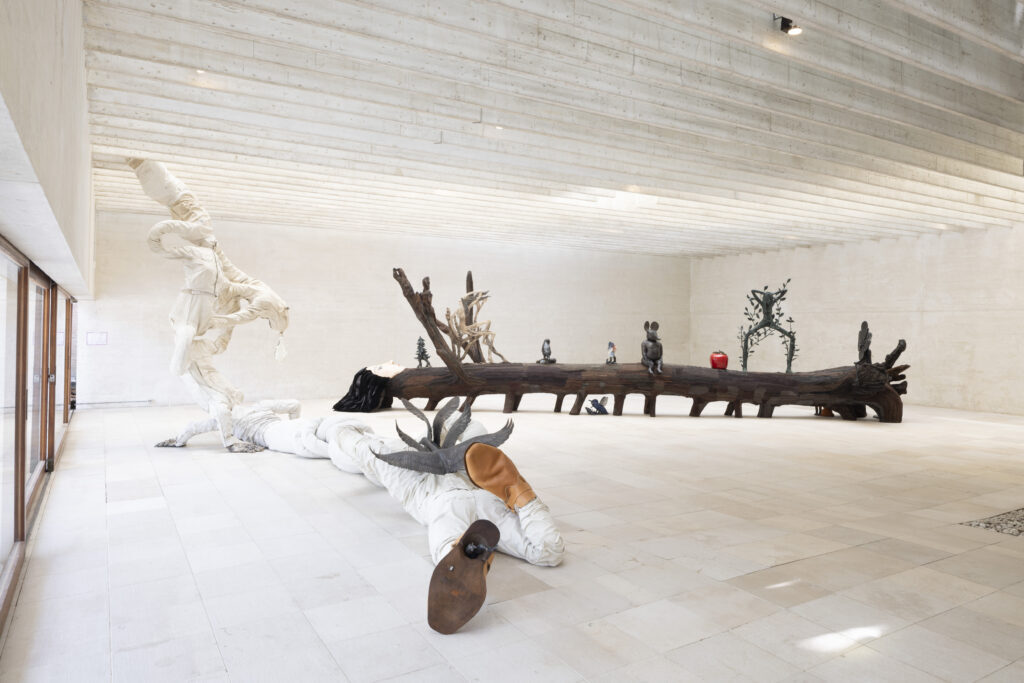
Tori Wrånes, Human Lace (front) and Klara Kristalova, Lust for Life (back), 2026, Venice Biennale, Venice, Italy. Photo: Kansallisgalleria | Finnish National Gallery / Pirje Mykkänen. Financial Times.
In the Nordic Countries Pavilion, nature and art intertwine. How Many Angels Can Dance on the Head of a Pin? features a collaborative exhibition that brings together works by Klara Kristalova, Benjamin Orlow, and Tori Wrånes. Curated by Anna Mustonen, the show transforms the pavilion into a sculptural, mythical environment where bodies, materials, and architecture interact in shifting and unstable ways.
The exhibition’s title draws on a medieval philosophical question concerning how multiple entities may occupy the same space. Here, it opens onto broader reflections on coexistence, between bodies, systems, and perspectives, at a time marked by increasing social, environmental, and geopolitical division. Visitors are invited to consider their relationship to one another, to the natural world, and to the passage of time. Drawing from myth, folklore, and fairytale traditions, the three artists respond to contemporary conditions of disconnection.
Kristalova, Orlow, and Wrånes transform the Nordic Countries Pavilion into a living environment, populated by uncanny and folklore figures. The exhibition proposes a space of coexistence shaped by continual change, asking how we might inhabit systems that are inherently unstable, and how transformation can become a shared condition rather than a point of rupture.
10. Spain
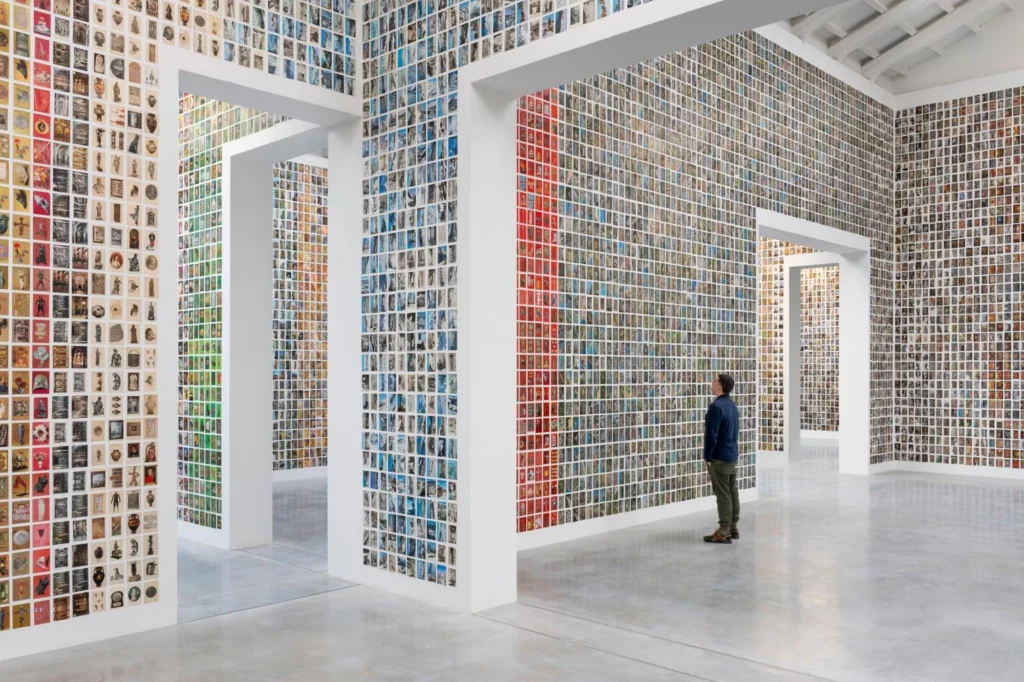
Oriol Vilanova, Los restos, 2026, Venice Biennale, Venice, Italy. © Roberto Ruiz. AC/E.
Minimal yet enchanting, the Spanish Pavilion, titled Los restos (The Remains), presents a project by artist Oriol Vilanova curated by Carles Guerra. Drawing on the theme of the archive, it proposes a large-scale intervention that transforms the interior of the pavilion into a pseudo-museum based on accumulation and memory. It is built around the systematic practice that Vilanova has developed for over two decades of collecting postcards salvaged from flea markets and second-hand shops. These fragments, vestiges of the era of global tourism, are displayed in a mural composition without hierarchies or linear narrative.
Grouped by theme and locations, the installation shuns monumentality to focus on the obsessive gesture of gathering and preserving, inviting reflection on the fragility of materials and the shifts in communication regimes. Carefully aligned on the walls, spanning the entire space without any pause, the postcards tell silent stories. Visitors walk around an empty space that feels strangely filled with ghosts and joy. Each postcard is fixed on the wall and cannot be read, marking the remains of stories we can no longer tell.
Bonus:
Taiwan: Screen Melancholy by Li Yi-Fan
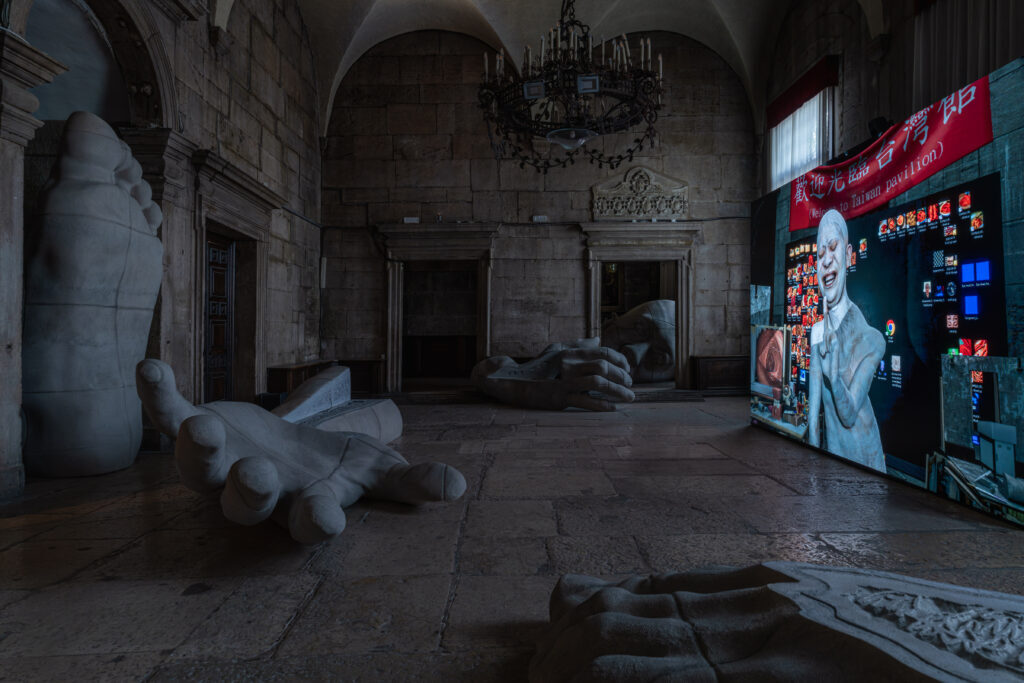
Li Yi-Fan, Screen Melancholy, 2026, Palazzo delle Prigioni, Venice. © Li Yi-Fan. Courtesy of the artist and TFAM of Taiwan Collateral Event 2026. Press materials.
As a collateral event of the 2026 Venice Biennale, Taiwan presents Screen Melancholy, a new immersive installation by Li Yi-Fan curated by Raphael Fonseca. Hosted inside Palazzo delle Prigioni and infused with dark humor and absurdity, the project explores the anxiety, alienation, and emotional flattening brought about by prolonged screen use and the rapid development of artificial intelligence.
At the center of the exhibition is a 60-minute video following the surreal journey of an eyeball returning home, accompanied by large-scale 3D-printed body fragments that blur the boundaries between digital and physical space. Engaging directly with the former prison’s architecture, Screen Melancholy transforms the Palazzo delle Prigioni into a haunting stage where viewers become both spectators and participants, confronting the increasingly complex relationship between technology, images, and human perception.
Elegy by Gabrielle Goliath
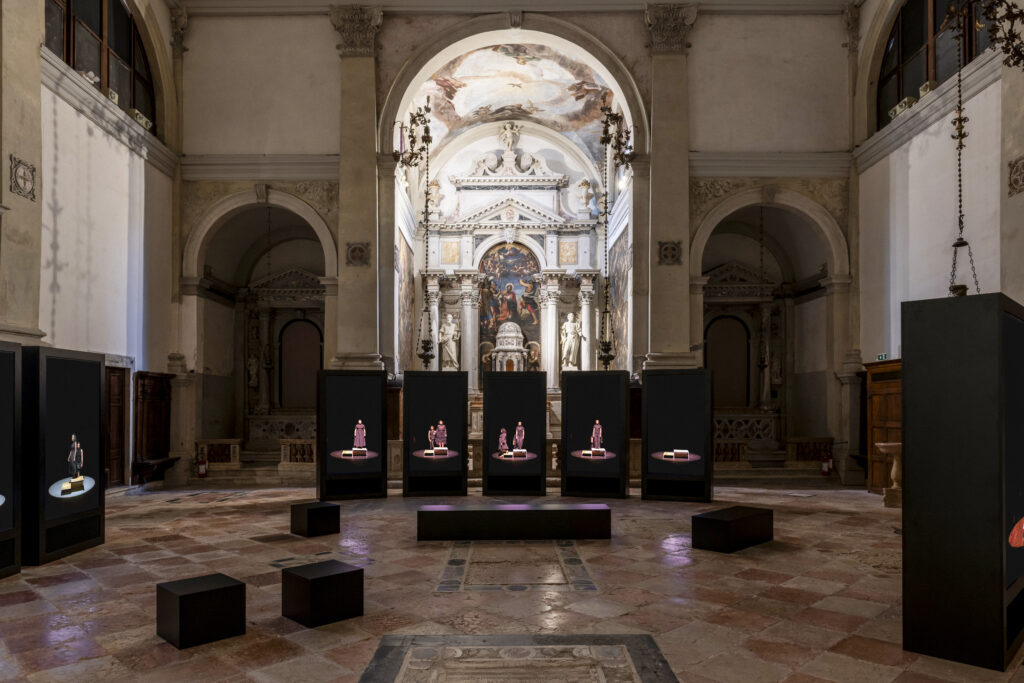
Gabrielle Goliath, Elegy, 2026, Chiesa di Sant’Antonin, Venice, Italy. Courtesy of the artist. Photo Luca Meneghel. Press materials.
Following the cancellation of the South African Pavilion, Gabrielle Goliath presents an independent exhibition of her acclaimed long-term performance project Elegy at the Chiesa di Sant’Antonin. Developed over more than a decade, Elegy is a ritual lament of shared breath and song that addresses intertwined histories of colonial, patriarchal, and racial violence.
Installed across eight monumental video monoliths, the work brings together three new performances commemorating South African student Ipeleng Christine Moholane, two murdered Nama women ancestors, and Palestinian poet Heba Abunada. It transforms mourning into a collective and political act, inviting visitors to reflect on grief, solidarity, and the possibility of imagining a more equitable world.