
Masterpiece Story: Judith and Holofernes by Caravaggio
Judith and Holofernes is a Caravaggio masterpiece that captures Biblical murder and drama. Rarely has death been captured so intensely and violently...
James W Singer 13 September 2026

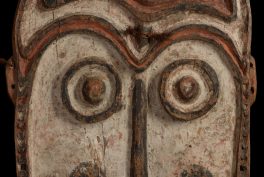
Asmat people, Bisj Pole, late 20th century, mangrove wood, plant fibers, and pigments, Jow Village, Indonesia, Musée du Quai Branly—Jacques Chirac, Paris, France. Detail.
Bisj Pole is a masterpiece of indigenous art from the Asmat people of Western New Guinea, Indonesia. The work is housed at the Musée du Quai Branly—Jacques Chirac in Paris.
The Asmat people are located in Western New Guinea, one of the largest island-regions of Indonesia. They are one of the few communities in the contemporary world that hold strongly onto their preindustrial way of life. Their communities do not have electricity, automobiles, computers, and most of the modern conveniences of our digital age. They live firmly within their ancestral heritage and traditional beliefs. Their artwork reflects their “unplugged” and “off-the-grid” lifestyle that modern anthropologists and art historians could call native or indigenous. The artwork of the Asmat people has been collected and valued by connoisseurs of indigenous art for more than 70 years. One such masterpiece is Bisj Pole at the Musée du Quai Branly—Jacques Chirac in Paris, France.

Asmat people, Bisj Pole, late 20th century, mangrove wood, plant fibers, and pigments, Jow Village, Indonesia, Musée du Quai Branly—Jacques Chirac, Paris, France.
Bisj Pole is a sculptural work of art measuring 4.57 m (14 ft. 11 29/32 in.) tall, 1.05 m (41 5/16 in.) long, and 35 cm (13 3/4 in.) thick, and it weighs 90 kg (198 lbs). It is expertly carved from a solid piece of mangrove wood and then meticulously painted with natural red and white pigments. Plant fibres adorn the piece as braided jewelry encircling the necks, waists, wrists, and ankles of the seven figures.

Asmat people, Bisj Pole, late 20th century, mangrove wood, plant fibers, and pigments, Jow Village, Indonesia, Musée du Quai Branly—Jacques Chirac, Paris, France.
A bisj pole in the Asmat community is an ancestral pole representing and honoring the recently deceased males who are becoming the community’s latest ancestors. They were normally carved in preparation for a memorial feast and raised at an inclined position in front of the men’s house in the village center.
Each carved figure represents a new male ancestor. At the time it was made, each figure would have been an identifiable person by the whole community. These figures were not just generic carvings but revered family and friends. Therefore, Bisj Pole celebrates the lives of seven recently created ancestors, which is a considerable number compared to other bisj poles that have perhaps only two or three figures. Perhaps they died during a disease outbreak or a village warfare?

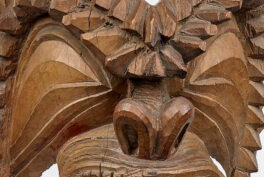
Asmat people, Bisj Pole, late 20th century, mangrove wood, plant fibers, and pigments, Jow Village, Indonesia, Musée du Quai Branly—Jacques Chirac, Paris, France. Detail.
The wing-like projection at the top of Bisj Pole from the Musée du Quai Branly is known as the rostrum or locally as the cemen which is the local word for a penis. Therefore, male virility and fertility are strongly associated with male ancestor worship. The cemen is the most visually prominent portion of the sculpture and features three small figures holding a crocodile. The dangerous animal is valued and revered by the Asmat people for its strength, cunning, and ferocity—all attributes valued in the warlike and warrior-honoring Asmat communities. It could be proposed that these three figures were warriors who died in battle or in some local conflict.

Asmat people, Bisj Pole, late 20th century, mangrove wood, plant fibers, and pigments, Jow Village, Indonesia, Musée du Quai Branly—Jacques Chirac, Paris, France. Detail.
The main section of Bisj Pole is known as bis anakat and contains 3 large figures. They form the main backbone of the sculpture and act as an anchor to the cemen. Further down, the lowest figure is the ci or canoe, and he forms the foundation of the entire group.
Some art historians interpret the bottom figure as the most important figure because of its closeness to the ground and foundational position. Another theory is he may be the ancestor to have died first, and Bisj Pole is a timeline of death with the deaths progressing upwards. Regardless of the interpretations, the ci is the lowest figure on the pole and is therefore the closest to the viewer. His lower position makes him more visually accessible and perhaps more mentally relatable compared to the other six figures higher above.

Asmat people, Bisj Pole, late 20th century, mangrove wood, plant fibers, and pigments, Jow Village, Indonesia, Musée du Quai Branly—Jacques Chirac, Paris, France. Detail.
Finally, at the lowest extremity is the bino or base that is shaped into a pointed arrow. This smooth and angular portion would have been inserted into the ground. Like a tent peg or a flag spike, it would secure Bisj Pole to stand majestically above the village rooflines.
Bisj Pole is a masterpiece due to its compositional complexity and its rarity. Not many bisj poles survive due to the ephemeral role they played in Asmat memorial feasts. During the ceremony, the erect poles directed the spirits towards Safan, the kingdom of the dead. However, the poles did not remain erect long after the ceremony.
Once the ceremony ended, bisj poles would be uprooted, broken into pieces, and left to rot in the nearby sago fields. The Asmat people believe that the spirits’ energy would cosmically transfer to the sago palm (Metroxylon sagu), which would enrich and vitalize this food staple of the Asmat diet. Therefore, not many bisj poles survive in Western collections because they must be acquired before their planned destruction.

Asmat people, Bisj Pole, late 20th century, mangrove wood, plant fibers, and pigments, Jow Village, Indonesia, Musée du Quai Branly—Jacques Chirac, Paris, France.
Therefore, how did bisj poles even survive into Western collections like the Musée du Quai Branly—Jacques Chirac? Sometimes locals were converted by Christian missionaries and therefore persuaded to abandon their ancestral practices and the bisj poles. Sometimes the poles were seized by scouting anthropologists, and other times, their broken parts were stolen from the fields and reassembled. Rarely would a pole be honorably acquired because its removal from the sago fields would violate the cosmic traditions of the Asmat people.
Therefore, while Western collectors view their acquisitions as “saving” art, local indigenous people would disagree and say their ancestor spirits have not been allowed to return to the earth. Perhaps they may even feel that the spirits are trapped in the poles’ figures? Bisj Pole crosses cultural boundaries and opens discussion on how art fits within society and what role it plays. Bisj Pole is a masterpiece of indigenous art, but it may also be a spiritually defiled haunted masterpiece.
DailyArt Magazine needs your support. Every contribution, however big or small, is very valuable for our future. Thanks to it, we will be able to sustain and grow the Magazine. Thank you for your help!

James W. Singer is an art historian and fine art photographer. He earned a Bachelor of Arts in Art History from the University of Florida. He later moved to Paris, France. He currently writes “Masterpiece” articles for DailyArt Magazine.

Antonia Chela is an avid art history fan, always seeking to know more about the wonderful world of art! She is a student of museum studies, and she is interested in learning about all aspects of the art world, current, past and future.
Judith and Holofernes is a Caravaggio masterpiece that captures Biblical murder and drama. Rarely has death been captured so intensely and violently...
James W Singer 13 September 2026
Explore an astonishing 1915 nude self portrait by American modernist painter Florine Stettheimer.
Candy Bedworth 21 September 2026
Winslow Homer (1836–1910) was one of the leading American Realist painters. His painting The Veteran in a New Field is a masterpiece of late...
James W Singer 30 August 2026
At first glance, A Goldsmith in His Shop (1449) appears to depict an ordinary visit to a jeweller. Yet Petrus Christus transformed an ordinary...
Shivani Gupta 23 August 2026