
Masterpiece Story: Judith and Holofernes by Caravaggio
Judith and Holofernes is a Caravaggio masterpiece that captures Biblical murder and drama. Rarely has death been captured so intensely and violently...
James W Singer 13 September 2026

Edward Hopper, Nighthawks, 1942, Art Institute of Chicago, USA. Source.
Edward Hopper was one of America’s most celebrated artists, renowned for delving into themes of loneliness and isolation in both urban and rural American settings. Perhaps his most iconic work, and arguably his masterpiece, Nighthawks, stands as one of the most famous artworks of the 20th century and a quintessential piece of American art. Let’s dive into the story about the painting of four individuals, each absorbed in their own thoughts in a downtown diner late at night, and how it still perfectly portrays modern society.
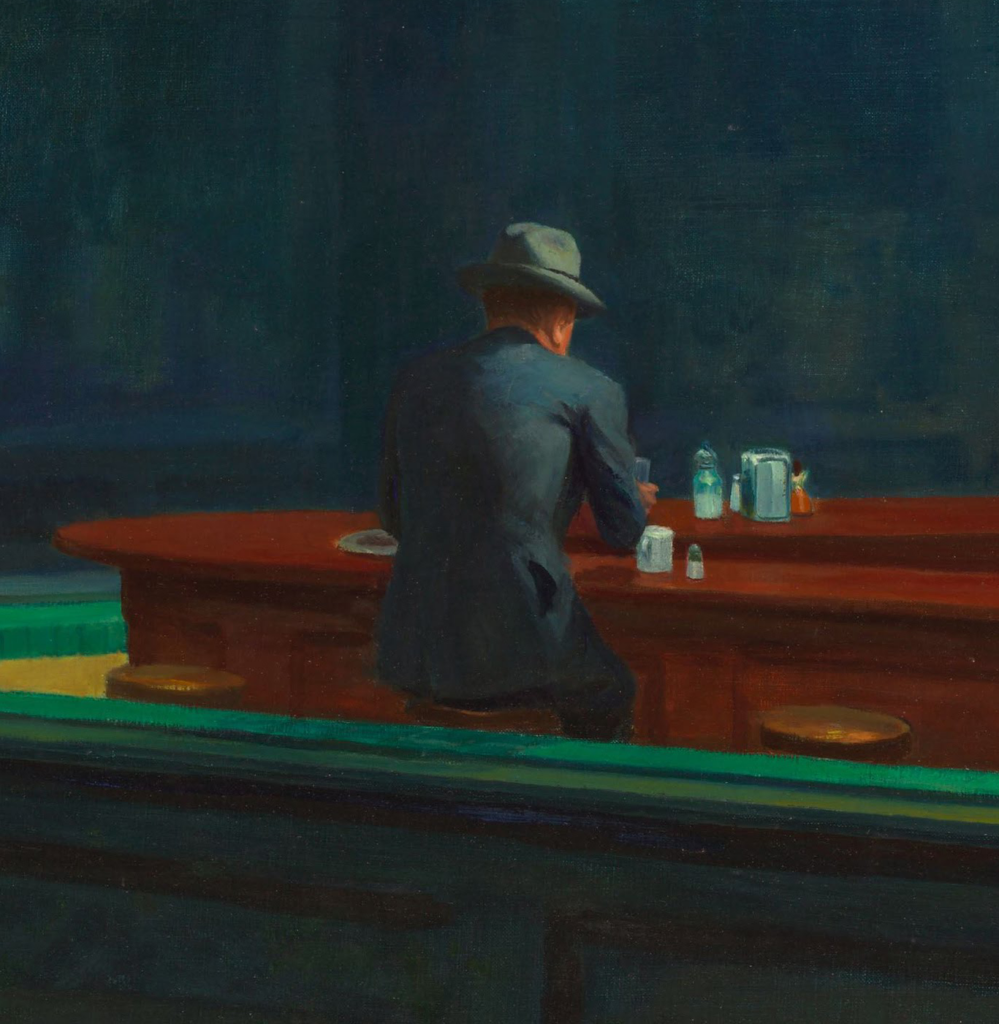
Edward Hopper, Nighthawks, 1942, Art Institute of Chicago, Chicago, IL, USA. Detail.
Four isolated individuals sit in a diner on a deserted street corner in the late hours of the night, seemingly lost in contemplation and disconnected from one another. We see the diner worker, dressed in a white uniform, staring distractedly out the window. On one side of the table, we see a customer who is seated alone and depicted only from behind. On the other side, a man is holding a cigarette and a woman is holding a sandwich. Unlike the other customers, they are shown from the front, however, they do not look directly at us. Their hands are on the countertop, almost touching but not quite.

Edward Hopper, Nighthawks, 1942, Art Institute of Chicago, Chicago, IL, USA. Detail.
Despite being physically close to one another, everyone in this uneasy scene seems preoccupied with their own thoughts, conveying an intense feeling of loneliness. Being in the same spot, their lives are momentarily overlapping but ultimately staying distinctly apart.
It is known that Hopper drew inspiration from a restaurant he had visited on New York’s Greenwich Avenue. However, the artist did not tend to imitate the specific location. Instead, he invites viewers to ponder the figures, their interactions, and the fictional world they inhabit.

Edward Hopper, Nighthawks, 1942, Art Institute of Chicago, Chicago, IL, USA. Detail.
The arrangement of the composition is meticulously structured and devoid of excess details. With a symphony of balanced geometric shapes and the warm illumination of the diner’s electric lights, Hopper formed a tranquil but also thought-provoking scene. Wide glass windows let out the fluorescent light from the diner, casting an unsettling, greenish hue upon the sidewalk. The lack of doors to the restaurant visible in this scene reminds the viewer of their position as a mere spectator and suggests a voyeuristic atmosphere.
Hopper examined the expressive possibilities of the Realist style at a time when abstraction was becoming more and more prevalent. A common interpretation of Hopper’s paintings is that they reflect the preeminent solitude of modern times, particularly during the Great Depression and World War II. Nighthawks also resonates with the social and economic anxieties of that time. To some extent, this can be attributed to the way the artist organized space to appear extensive, but never empty.
I didn’t see it as particularly lonely. I simplified the scene a great deal and made the restaurant bigger. Unconsciously, probably, I was painting the loneliness of a large city.
Through solitary moments and the subtle dynamics of urban life, Hopper’s art reveals the shared human experience of modern times. Likewise, Nighthawks also conveys a sense of detachment through the particular placement of the characters, as well as with the specific application of light and shadow.

Edward Hopper, Study of Nighthawks, 1941–1942, Whitney Museum of American Art, New York City, NY, USA. The Collector.
Hopper’s paintings often evoke the feeling that something is about to unfold in the depicted scene. However, his work is not narrative and rather focuses on the tension and the unsettling atmosphere of the scene. This is also evident in the 19 studies he made for Nighthawks trying to perfectly craft a sense of ambiguity.
In front of Edward Hopper’s paintings, I get the feeling they are scenes from movies that were never made. I start wondering what’s the story that is beginning here; what will happen to these characters in the next moment?
Two or Three Things I Know About Edward Hopper (dir. Wim Wenders), 2020
Many filmmakers continued to be influenced by Hopper’s works even after his death in 1967. His work is often compared to movie stills due to the similarity between usual cinematic techniques and his approach to composition, framing, and lighting. Therefore, it is no wonder that cult classics, thrillers, psychological dramas, comedic cartoons, teen shows, and music videos have all made references to his works.

Movie still from The Killers, directed by Robert Siodmak, 1946. The Collector.
The first of many cinematic references to Nighthawks appeared in the 1946 noir classic The Killers. It is a screen adaptation of Ernest Hemingway’s story of the same name that is also considered to be an inspiration for Nighthawks. The similarity between the two is again primarily recognized in distinctive lighting, framing and composition.
The timeless appeal of Edward Hopper’s Nighthawks continues to resonate through popular culture, finding new life in an array of media from films and advertisements to contemporary art. Even though the times have changed, Nighthawks still acts as a reflection of modern society. Only now, it also highlights the enduring themes of isolation and connection in our digital era. Therefore, the painting’s charm is found in its universal appeal—people from various backgrounds recognize aspects of their own lives in the nighttime stillness and the silent presence of strangers.
DailyArt Magazine needs your support. Every contribution, however big or small, is very valuable for our future. Thanks to it, we will be able to sustain and grow the Magazine. Thank you for your help!

History of art graduate and enthusiastic appreciator of anything art and culture-related. Currently very interested in Catalan Modernism and Postmodernism, Surrealist artist-designer Elsa Schiaparelli, and 15th-century Florentine art.

Judith and Holofernes is a Caravaggio masterpiece that captures Biblical murder and drama. Rarely has death been captured so intensely and violently...
James W Singer 13 September 2026
Explore an astonishing 1915 nude self portrait by American modernist painter Florine Stettheimer.
Candy Bedworth 21 September 2026
Winslow Homer (1836–1910) was one of the leading American Realist painters. His painting The Veteran in a New Field is a masterpiece of late...
James W Singer 30 August 2026
At first glance, A Goldsmith in His Shop (1449) appears to depict an ordinary visit to a jeweller. Yet Petrus Christus transformed an ordinary...
Shivani Gupta 23 August 2026