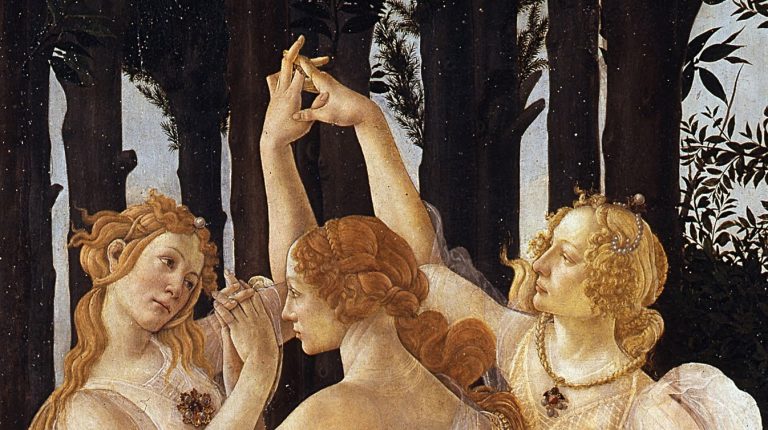
Paintings depicting the Three Graces appear consistently throughout art history. Although the characters remain the same, their representation changes significantly over time. Our story begins with Greek mythology and travels through time with the three goddesses, who epitomize the ideal of female beauty for artists across the centuries.
Everyone knows that Aphrodite (known as Venus to the Romans) is the goddess of love and beauty. In addition to being worshiped in temples of the ancient world, the irresistible goddess was also depicted by artists of all ages. But there were also other goddesses of love known as the Charites or the Graces.
According to the poet Hesiod, they were the daughters of Zeus and Eurynome, a sea nymph with whom the god of Olympus had a brief love affair. The Three Graces were called Aglaia, Euphrosyne, and Thalia, and they always stuck together. Besides love and beauty, the goddesses were also associated with goodwill, nature, creativity, fertility, charm, splendor, and joy, in other words, graces.
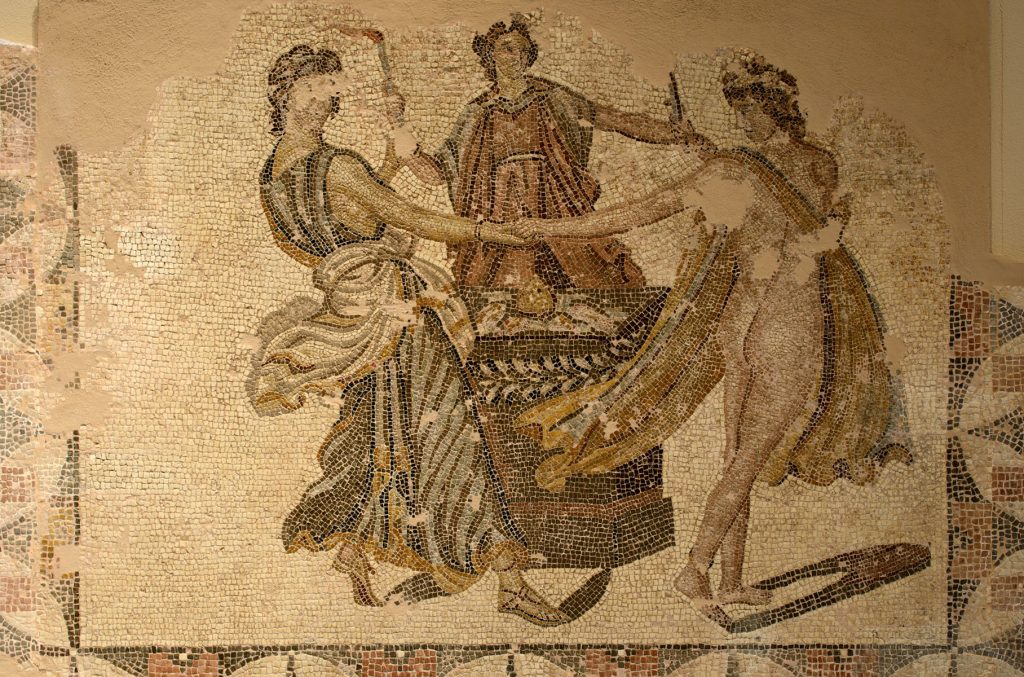
Floor mosaic with the Three Graces dancing, ca. 3rd century, National Archaeological Museum, Naples, Italy. AncientRome.
In some myths, they appear on top of Olympus, singing and dancing with the Muses and Apollo; in others, they are always in the company of Aphrodite.
When Aphrodite was born, from the foam of the sea, it was the Three Graces who received and cared for her. When Aphrodite wanted to seduce Anchises, the only mortal with whom she had a child, it was again the Three Graces who dressed her and perfumed her for the date. And even when the goddess was caught cheating on Hephaestus with Ares, and seen by all the gods, once again the Graces were there to dress her and console her.
Nicolas Vleughels, Venus and the Three Graces Tending Cupid, 1725, private collection. Wikimedia Commons (public domain).
Although in myths the Three Graces have always appeared as the assistants of Aphrodite, in art, they have become protagonists of countless works, from antiquity to the present day. And with that, they served to represent not only the mythological characters but also the ideal of female beauty of each period.
The earliest representations of the Three Graces appeared in mosaics and sculptures in ancient temples. During the Renaissance, the goddesses became a recurring theme in painting.
Raphael, The Three Graces, ca. 1503–1505, Musée Condé, Chantilly, France.
They became an easy excuse for nudes. At the time, presenting women as mythological characters was the only official way of displaying the naked female body; otherwise, it would be too scandalous.
One of these paintings is Raphael’s The Three Graces. Clearly based on ancient sculptures, the work emphasizes the pallor and indifferent gaze of the girls; their private parts are overtly exposed, yet shown with subtlety.
Lucas Cranach The Elder, The Three Graces, 1531, Louvre, Paris, France.
Lucas Cranach, like Raphael, portrayed the Three Graces completely naked; however, in his work, the goddesses do not hold symbolic attributes, such as an apple or flowers. Instead, they have props (a hat and necklaces). Only one of the girls leans on her sister, unlike in other paintings in which they are always holding each other’s hands.
The Three Graces by Raphael and Cranach have something in common: their bodies resemble teenage figures. The ideal of beauty seems to reside precisely in the youth of the models.
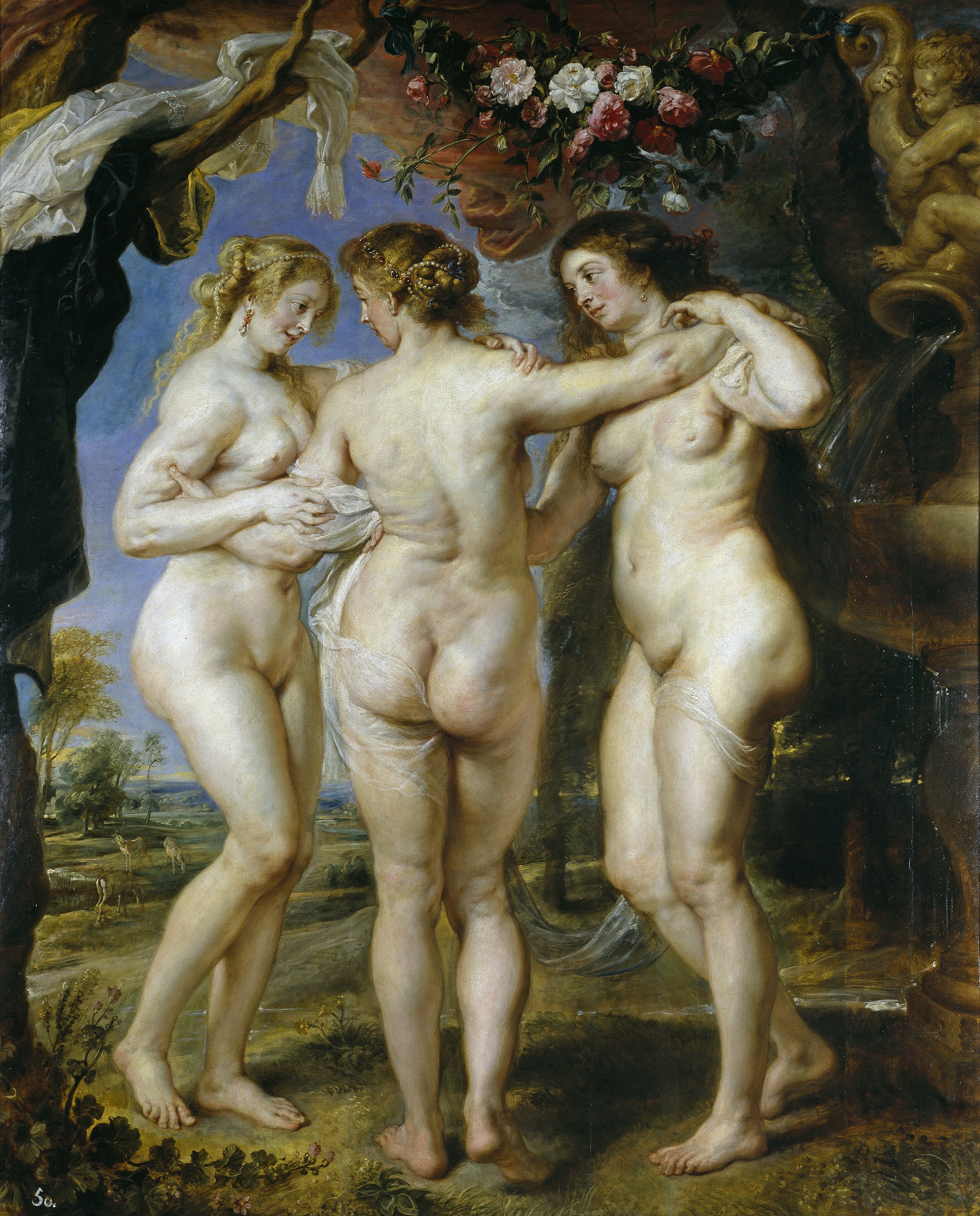
Peter Paul Rubens, The Three Graces, 1630–1635, Museo del Prado, Madrid, Spain.
A different approach can be seen in one of the most famous paintings on the theme, The Three Graces by Peter Paul Rubens. The Baroque master opted for more mature Graces, with voluptuous forms. Also, notice how their gazes intersect, perhaps suggesting a little more intimacy. The composition, however, is very similar—two of the girls are seen from the front, while the other is represented from the back.
Padovanino, The Three Graces, ca. 1620–1640, private collection. Wikimedia Commons (public domain).
Alessandro Varotari (Il Padovanino) slightly shifts this scheme, placing two of the goddesses in the foreground, while the third one is shown in the back. Though naked, the girls wear veils, an element that is repeated in other paintings depicting the Three Graces.
About two centuries later, when mythological themes began to be reviewed, paintings including the Three Graces continued to be created. The iconography, however, changed as it no longer showed anatomically perfect bodies, as in Raphael’s painting.
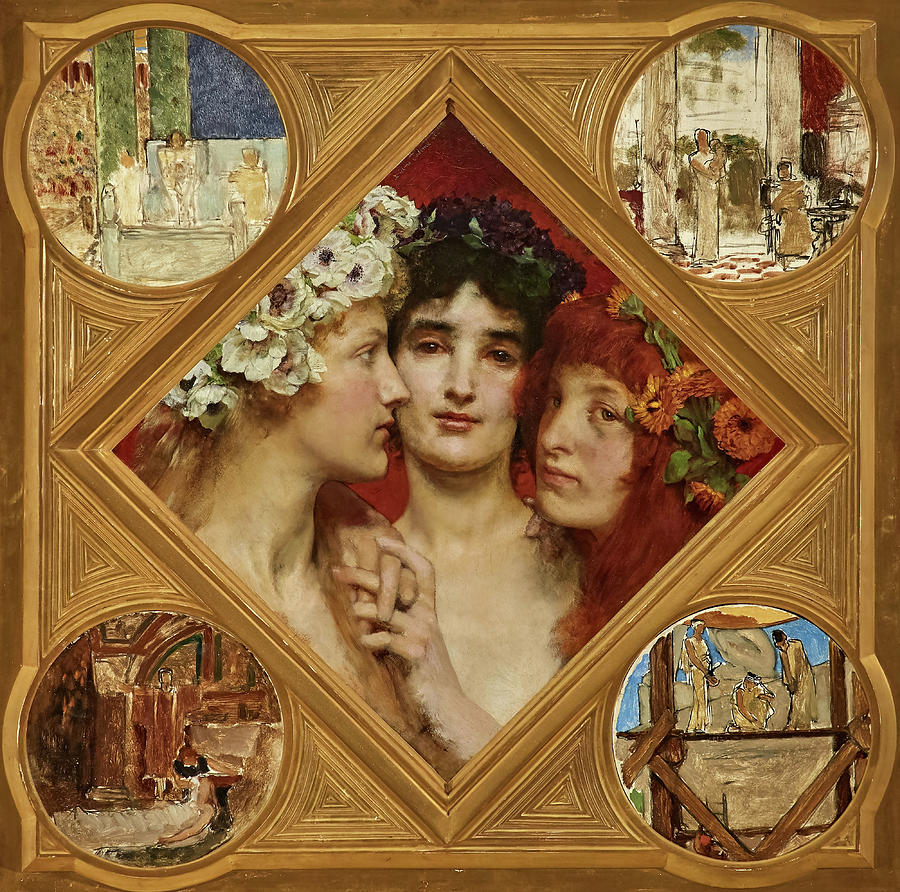
Sir Lawrence Alma-Tadema, The Three Graces, 1876, private collection. Artsy.
In his version of the Three Graces, Lawrence Alma-Tadema used a complex composition, with three main figures in the center and different allegories in the corners of the work. Law, Order, and Authority are depicted in the Senate House, Home in the garden, Religion in the catacombs, and Art on the scaffolding. As in previous paintings, the Graces are very close, but Alma-Tadema only portrayed their faces.
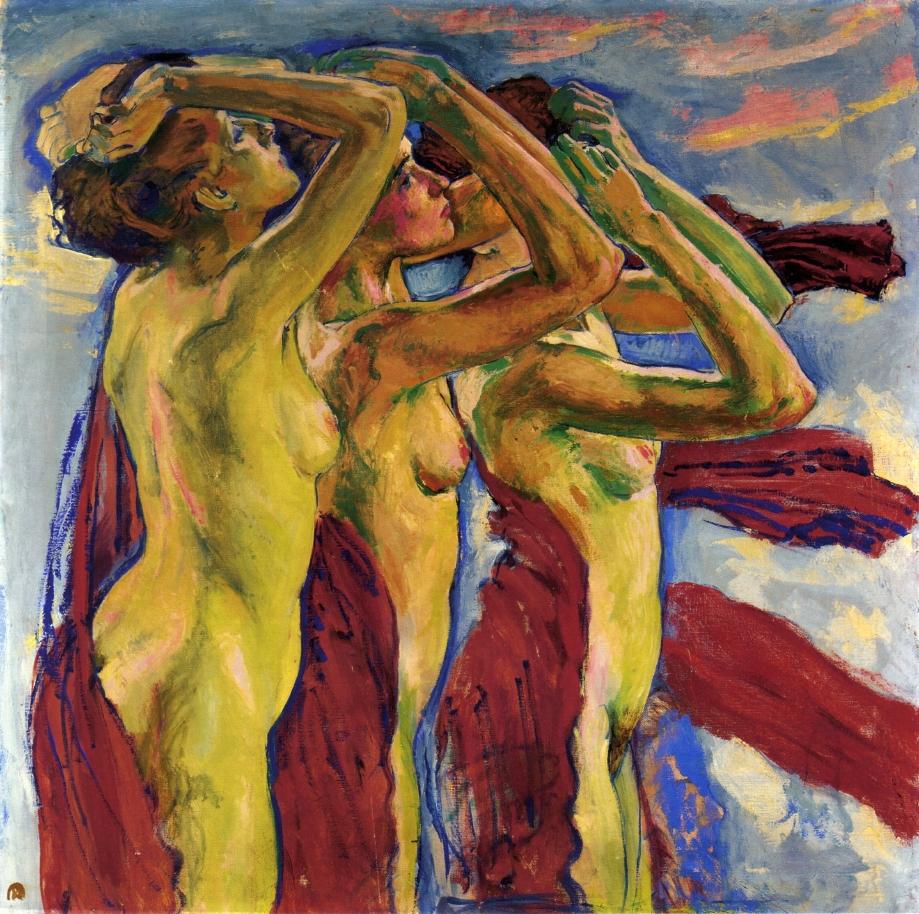
Koloman Moser, The Three Graces, private collection. WikiArt.
The mood of the paintings also changed; it was neither idyllic nor romantic anymore. Symbolist Koloman Moser shows the Three Graces sideways, with faces barely visible, their skin in tones of ochre and green. The scene isn’t set in a garden or field as it was in the past. Apart from the difference in composition, the work shows a change in the ideal of feminine beauty.
At the beginning of the 20th century, when the European avant-garde movements were at their peak, Robert Delaunay placed the Three Graces in Paris. Although Delaunay transforms them through a Cubist lens, we can still see that he follows the same compositional structure as Raphael. The Graces are, however, almost entangled with the surrounding architecture, reflecting the modernist admiration of progress and the beauty of man-made structures.
Robert Delaunay, La Ville de Paris, 1910–1912, Musée National d’Art Moderne, Centre Pompidou, Paris, France.
The paintings of the Three Graces prove that the idea of beauty is dynamic and that it changes over time. That is, however, where the paradox lies: the ideal of feminine beauty is not one ideal. Every woman possesses a unique quality that makes her beautiful—and that is the real grace of being a woman.
We love art history and writing about it. Your support helps us to sustain DailyArt Magazine and keep it running.
DailyArt Magazine needs your support. Every contribution, however big or small, is very valuable for our future. Thanks to it, we will be able to sustain and grow the Magazine. Thank you for your help!
Someone who believes, through reading and intuition, that the history of art is the true history of humanity. In love with Renaissance art and a huge fan of the Impressionists.
ProofreaderViktorija Isajeva
An admirer of antiquity, art, and architecture. An avid reader and amateur photographer. Always curious, always on an adventure.