



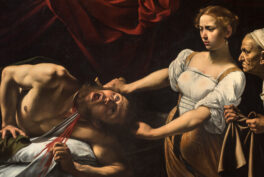
Masterpiece Story: Judith and Holofernes by Caravaggio
Judith and Holofernes is a Caravaggio masterpiece that captures Biblical murder and drama. Rarely has death been captured so intensely and violently...
James W Singer 13 September 2026
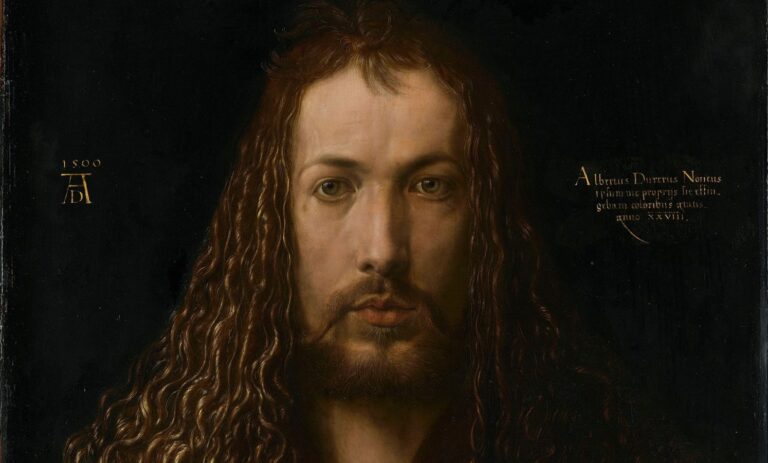
Albrecht Dürer, Self-Portrait at 28 Years Old Wearing a Coat with Fur Collar, 1500, Alte Pinakothek, Munich, Germany. Detail.
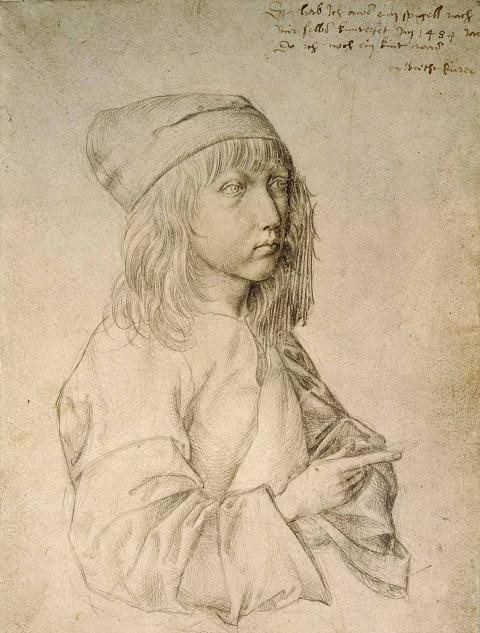
Albrecht Dürer loved self-portraits. In the first half of his life, he made a series of them. The earliest is from 1484, when the artist was a precocious boy of 13. It was drawn in silverpoint. Later, he wrote in the upper right corner:
This I have drawn from myself from the looking-glass, in the year 1484, when I was still a child — Albrecht Dürer.
But today we want to talk about another masterpiece, the iconic self-portrait, or Self-Portrait at 28 Years Old Wearing a Coat with Fur Collar, which was painted early in 1500, just before Dürer’s 29th birthday. It is the last of his three painted self-portraits. According to art historians, it is the most personal, iconic, and complex of his self-portraits, and the one that has become fixed in the popular imagination.

It is also famous because it resembles many earlier representations of Christ. The religious convention here is clear: the symmetry, the dark tones, and the manner in which Dürer confronts the viewer and raises his hands to the middle of his chest as if in the act of blessing.
He idealized his appearance. As the other drawing shows, his nose was originally irregular in shape. Dürer is approaching us in “Imitatio Christi,” an imitation of Christ. He has even painted himself with brown hair, although the other self-portraits show that it was actually reddish-blond.

In 1500, a frontal pose was exceptional for a secular portrait. Two of Dürer’s previous self-portraits were painted in three-quarters view. Fully frontal poses remained unusual, although Hans Holbein painted several portraits of Henry VIII of England and his queens in that pose, perhaps under instruction.
The artist’s monogram, “AD,” and the Latin inscription — “I, Albrecht Dürer of Nuremberg, portrayed myself in everlasting colors aged twenty-eight years” — are placed at eye-level to strengthen the effect. The year “1500” is written directly above the monogram “AD” giving it a second meaning as Anno Domini, which further reinforces the connection between Dürer and Christ.
DailyArt Magazine needs your support. Every contribution, however big or small, is very valuable for our future. Thanks to it, we will be able to sustain and grow the Magazine. Thank you for your help!

Art Historian, founder and CEO of DailyArtMagazine.com and DailyArt mobile app. But to be honest, her greatest accomplishment is being the owner of Pimpek the Cat.

Melanie is a freelance editor, proofreader, and writer within humanities fields. Follow her on Twitter @melaniesdemmer.
Judith and Holofernes is a Caravaggio masterpiece that captures Biblical murder and drama. Rarely has death been captured so intensely and violently...
James W Singer 13 September 2026
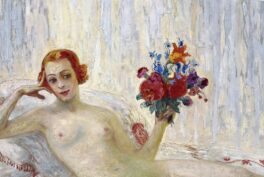
Explore an astonishing 1915 nude self portrait by American modernist painter Florine Stettheimer.
Candy Bedworth 21 September 2026
Winslow Homer (1836–1910) was one of the leading American Realist painters. His painting The Veteran in a New Field is a masterpiece of late...
James W Singer 30 August 2026
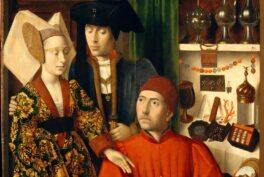
At first glance, A Goldsmith in His Shop (1449) appears to depict an ordinary visit to a jeweller. Yet Petrus Christus transformed an ordinary...
Shivani Gupta 23 August 2026