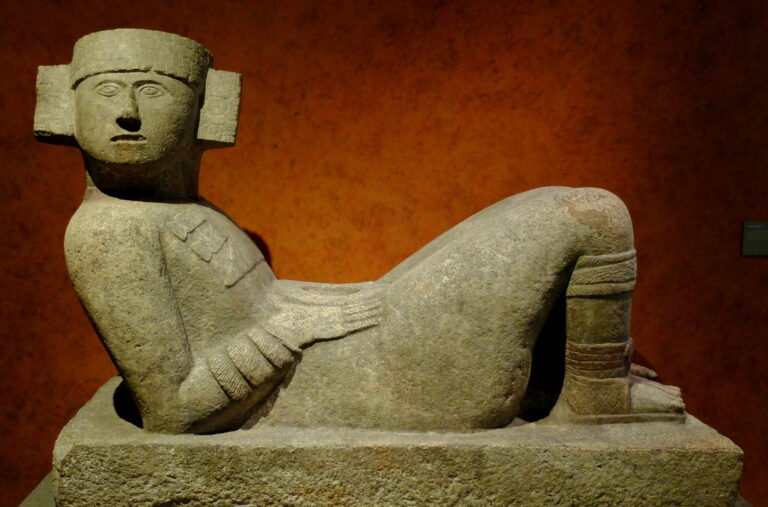
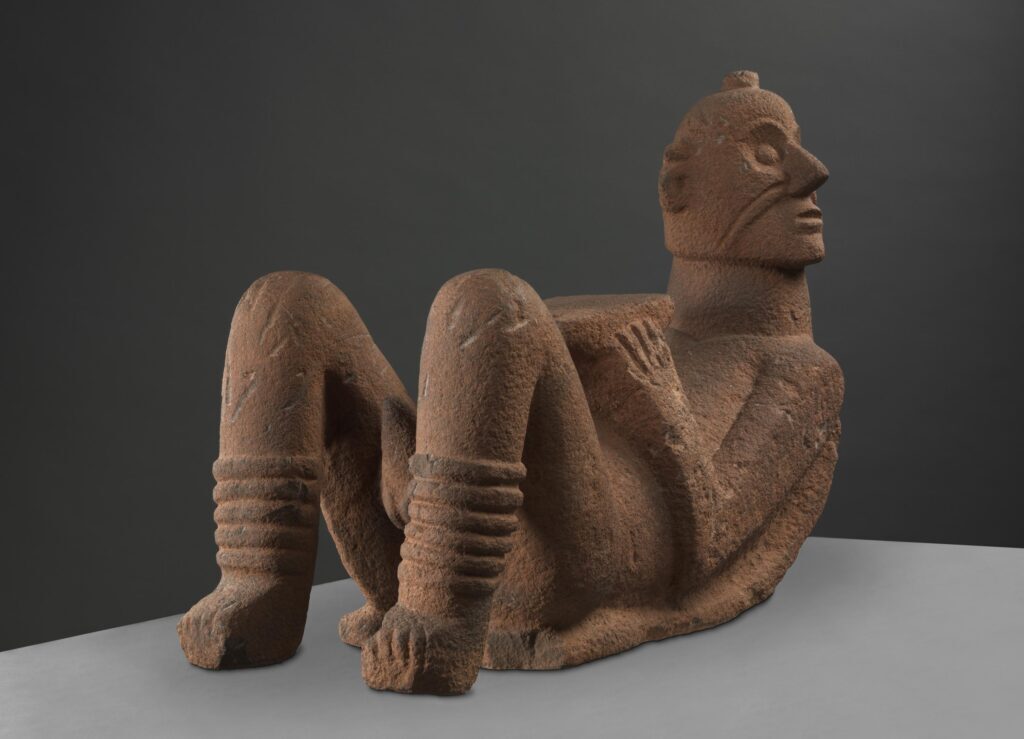
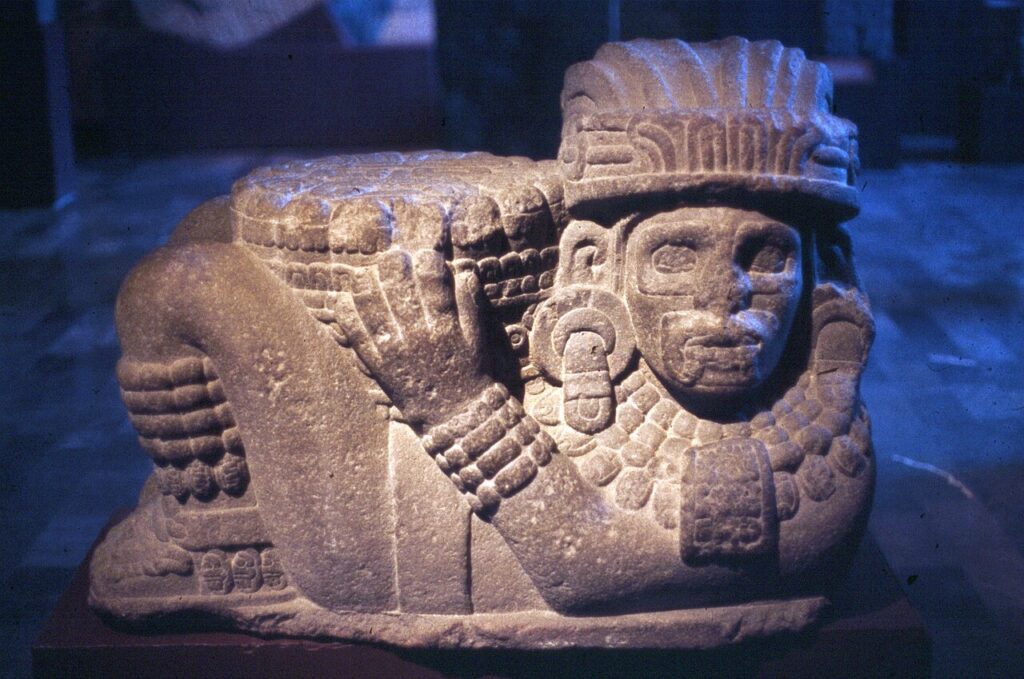
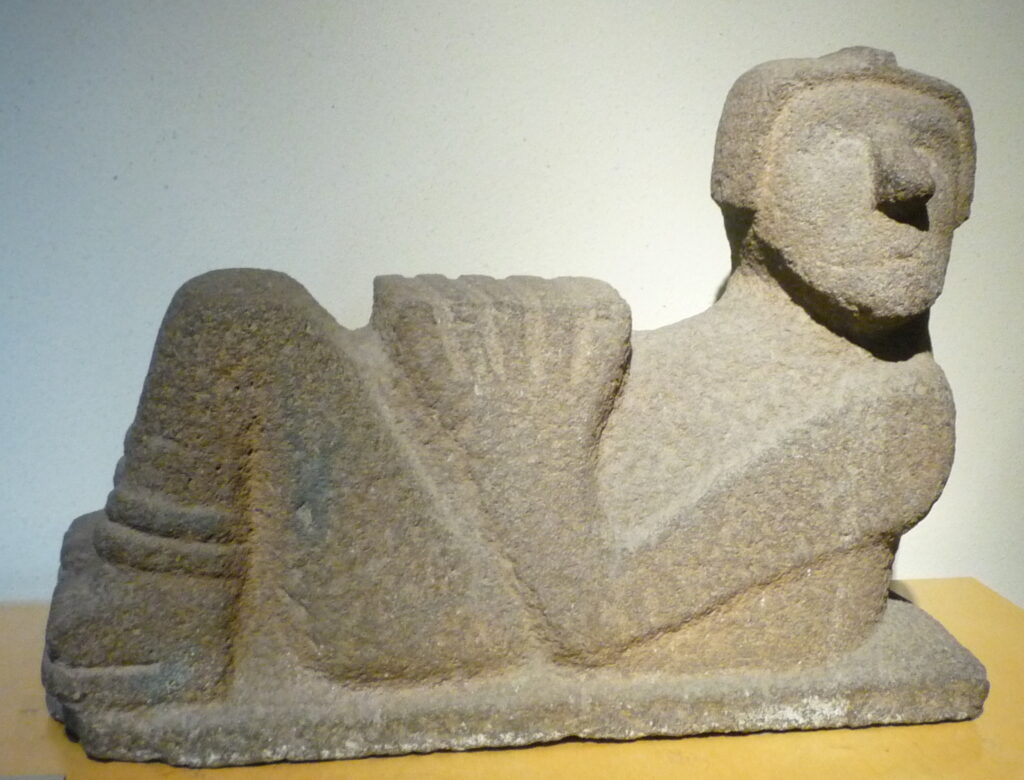
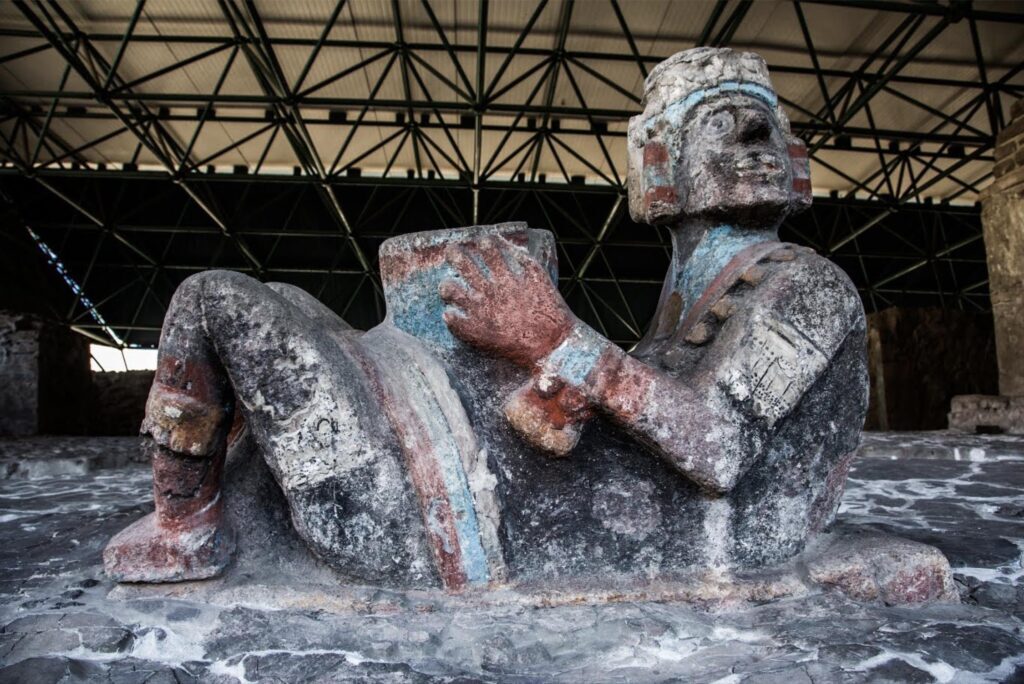
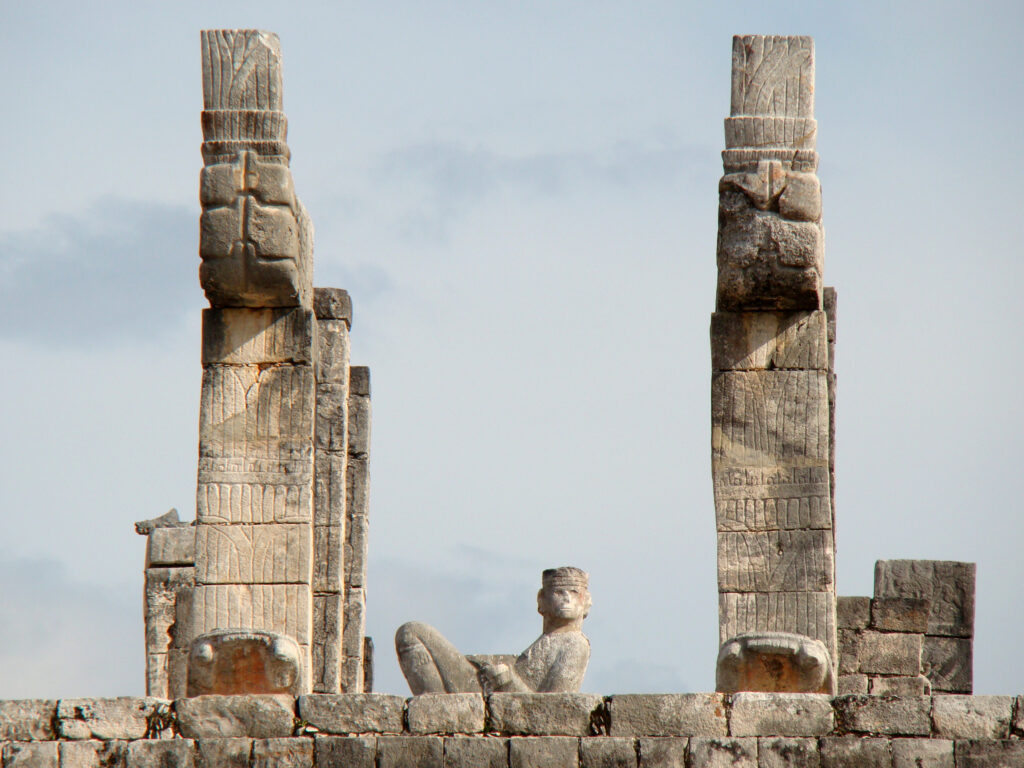
Today, the term Chac Mool is used as a modern label for the large number of three-dimensional sculptures of reclining humanoid figures found across Pre-Columbian Mesoamerica.
Defining Characteristics of the Chac Mool
A Chac Mool is defined as a reclining male stone figure with its torso upright, its head turned 90 degrees sideways, and its legs bent. Carved from different types of stone, such as limestone, basalt, or volcanic stone, these statues typically are two to five feet long (about 60 to 150 cm).
Across Mesoamerican cultures, Chac Mool figures have a plate, tray, disk, or vessel positioned on the figure’s stomach or chest, used for ritual deposits. But differences in facial features and adornments can vary from region to region.
Discovery and the Origin of the Name
Despite their importance to the cultures that created them, many of these sculptures were overlooked for long periods and left exposed to the elements. The first published accounts of such reclining figures appeared in the early 19th century after discoveries near Mexico City, though the figures were not consistently given a standardized name at the time.
The term Chac Mool is best understood as a modern label that has been attributed to British-American photographer, antiquarian, and amareur archaeologist Augustus Le Plongeon and Alice Dixon Le Plongeon, possibly around 1875. While the term Chac Mool ultimately became the standard archaeological term, the actual name intended by the creators has been completely lost to time.
Regional Variations of the Chac Mool
Archaeological evidence indicates that Chac Mool-like reclining tray-bearing sculptures were present in central Mexico before the Toltec civilization, with early examples reported from sites including Tula in Hidalgo, where the ancient Toltec capital used to be. Some scholars associate these early forms with religious symbolism connected to elite warrior culture and ritual life, though interpretations differ.
In regions associated with Maya traditions, reclining tray-bearing figures are sometimes described as more ornate. Some interpretations connect certain forms to Chaahk/Chac (the Aztec god of rain) based on contextual or iconographic readings. But there is no universal definition of it.
In Central Mexico, Chac Mool sculptures are frequently discussed in relation to water and rain symbolism. Examples from the Aztec period are sometimes interpreted as relating to gods such as Tlaloc, though the exact strength of the connection depends on the specific specimen and its archaeological context. Chac Mool sculptures are also often discussed in connection with sacrifice-related practices in Aztec contexts, suggesting that the offering trays could have been used in ceremonies involving human sacrifice.
It has also been proposed that some reclining figures might have served as a téchcatl or the sacrificial stone upon which victims were laid for human sacrifice, though there is no clear evidence to support this specific claim.
Ritual Use, Placement, and Function
The Chac Mool appeared to have ceremonial importance, but it is not clear that they were worshiped as deities themselves. Many have been found in architectural settings connected to temples, entrances, or ritual spaces, where they may have received offerings as part of religious ceremonies.
The trays or vessels on the figures are commonly interpreted as receptacles for offerings such as food, tobacco, flowers, or other ritual items. In some contexts, scholars also suggest a possible connection to heart-related offering traditions, particularly in Aztec settings, but such proposals depend heavily on context and vary among researchers.
Legacy of the Elusive Chac Mool
While it remains impossible to determine exactly where and when the Chac Mool first originated, or what they were called across Mesoamerica, the variation in form and context continues to make them compelling. Their continuing mystery reflects the complexity of Mesoamerican religious life and the challenges of interpreting ancient objects through incomplete archaeological and historical records.