

The Enduring Mystery of the Mesoamerican Chac Mool
The Chac Mool (also spelled chacmool) is a well-known icon of Mexico’s ancient past, yet its meaning and role remains a disputed subject.
Maya M. Tola 2 July 2026
3 August 2026 min Read
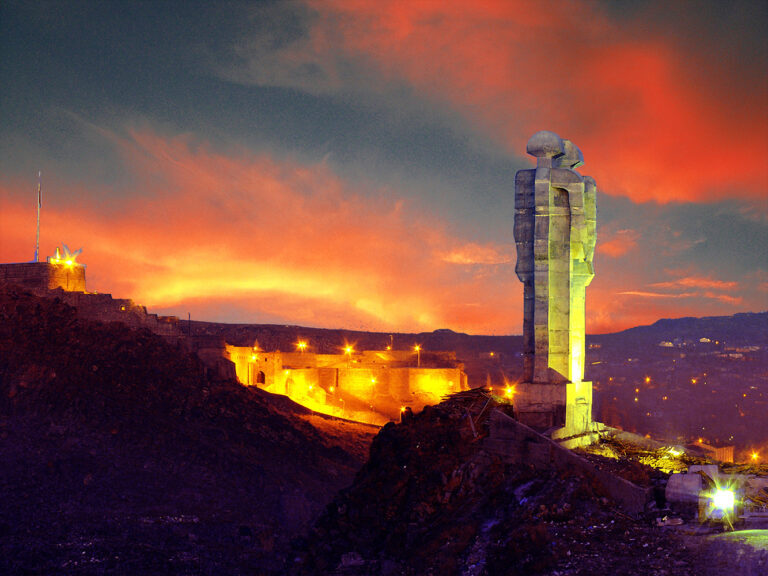
Mehmet Aksoy, Monument to Humanity (under construction), Kars, Turkey. Artist’s website.
The story of the Monument to Humanity (İnsanlık Anıtı) is about much more than a sculpture. This story shows us how bureaucracy and politics can shape collective memory and write our history.
The monument was designed by Turkish sculptor Mehmet Aksoy (b. 1939), one of Turkey‘s most prominent contemporary sculptors. After studying at the Istanbul State Academy of Fine Arts, he gained international recognition for his monumental public sculptures, many of which explore themes of human dignity, freedom, peace, and coexistence. Throughout his career, Aksoy has been known for creating works that engage with social and political questions, making him one of the country’s most influential, but also controversial, public artists.
The monument was commissioned by the municipality of Kars in the mid-2000s as part of an attempt to transform Kars into a cultural landmark. Located on Üçler Tepesi, overlooking the Armenian border, the sculpture was intended to become a landmark while symbolizing reconciliation between Turkey and Armenia.
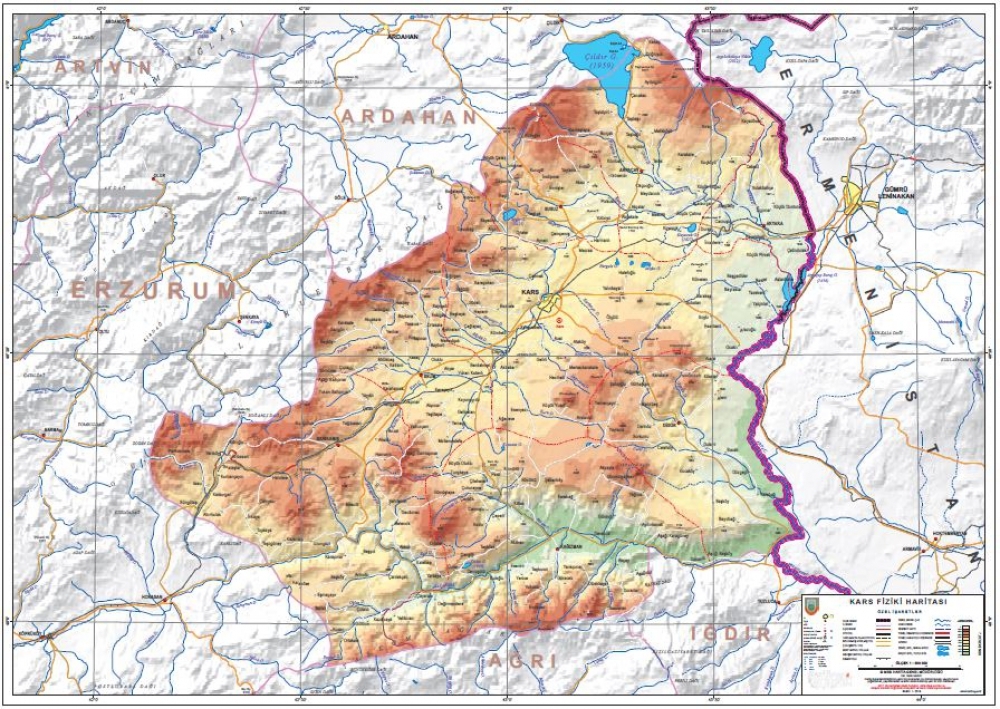
Physical map of Kars Province, Turkey, showing its location in relation to the Armenian border. Harita Genel Müdürlüğü.
The broader aim was to normalize diplomatic relations between the two countries after decades of closed borders and unresolved disputes over the Armenian genocide. With his artistic approach, Aksoy rejected the traditional language of heroic monuments of military victory and national leaders, and instead designed two enormous halves of a single human figure facing each other, depicting the humanity itself that has been divided by history.
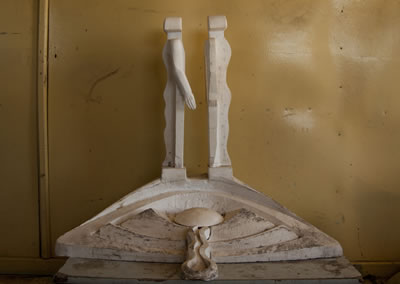
Model of Mehmet Aksoy, Monument to Humanity, 2008. Mimarlık Dergisi.
In the sculpture, one figure extends its hand to the other as an invite of reconciliation. Mehmet Aksoy himself described the monument as “a human being split in two” and “a bleeding eye that symbolizes conscience.” For him, it was fundamentally an anti-war monument rather than a monument belonging to either nation or legitimizing either narrative.
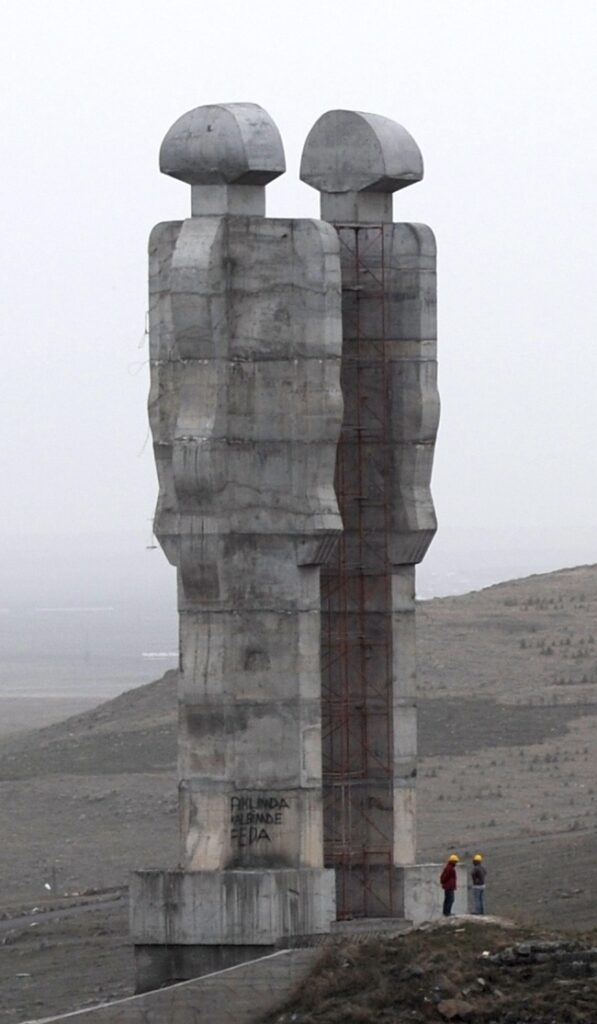
Mehmet Aksoy, Monument to Humanity (under construction), 2011, Kars, Turkey. Photograph by Ggia via Wikimedia Commons (CC BY-SA 3.0).
However, critics argued that “extending a hand toward Armenia” implicitly acknowledged Armenian historical claims or undermined the Turkish state’s official narrative regarding the events of 1915. Some critics even claimed the two figures represented an Armenian victor and a defeated Turk, although Aksoy repeatedly explained that they were two halves of the same human being separated by violence and reaching toward unity. The sculpture thus opened broader debates about the Armenian genocide and national identity while, in the process, straining the already fragile Turkish-Armenian relationship.
After construction had already started, military defense structures from World War II located on Üçler Tepesi were registered as protected cultural heritage. This changed the legal status of the site. Now the sculpture stood in a protected conservation area and required additional approvals, which was not the case before. That’s why, even though the regional conservation board initially approved the monument, subsequent decisions regarding conservation boundaries and planning permissions created legal uncertainty surrounding the sculpture’s continued existence. The Monument to Humanity thus became administratively difficult to construct just as it became politically controversial.
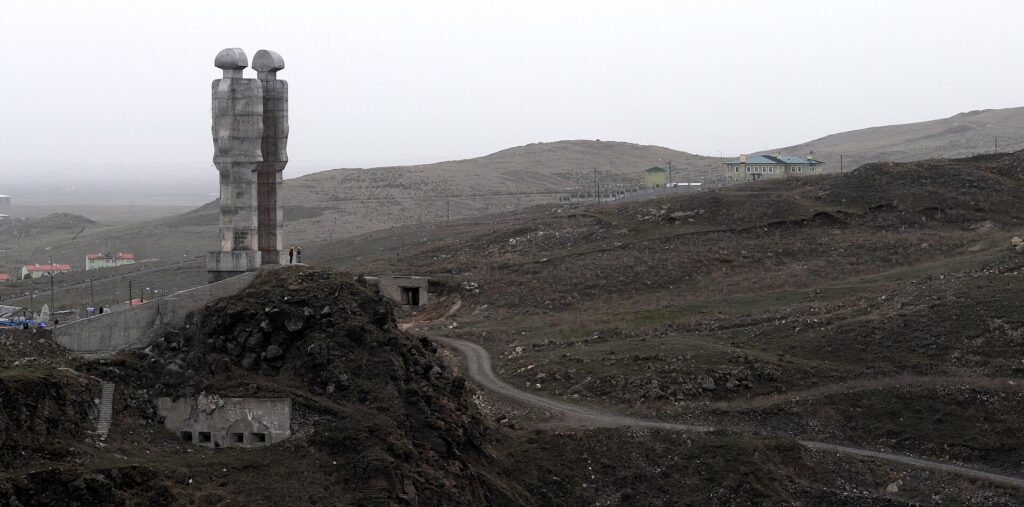
Mehmet Aksoy, Monument to Humanity (under construction), 2011, Kars, Turkey. Photograph by Ggia via Wikimedia Commons (CC BY-SA 3.0).
On January 8, 2011, the last blow on the fate of the monument struck. Although the monument had not yet been officially completed or inaugurated, it was already structurally almost finished. As shown in the photographs, the two monumental figures were largely in place, with only finishing work remaining when then-Prime Minister Recep Tayyip Erdoğan visited the site.
During his visit to Kars, Erdoğan publicly described the monument as an ucube (“monstrosity”) and said it should not stand near the nearby tomb of Hasan Harakani and the rest of the historic monuments on the site. Soon afterward, Kars Municipality voted in favor of demolition. Although Erdoğan later stated that his comment was purely aesthetic rather than political, it’s hard not to interpret the statement as a final decisive political signal.
Mehmet Aksoy filed lawsuits and sought injunctions to halt the demolition. During the legal proceedings, his lawyers argued that the administrative process had not been completed and the pending cases should suspend any demolition until the court reaches a final verdict. Nevertheless, the demolition began in April 2011 before the legal proceedings had concluded. Workers started by beheading the figures before dismantling the sculpture piece by piece over only several weeks.
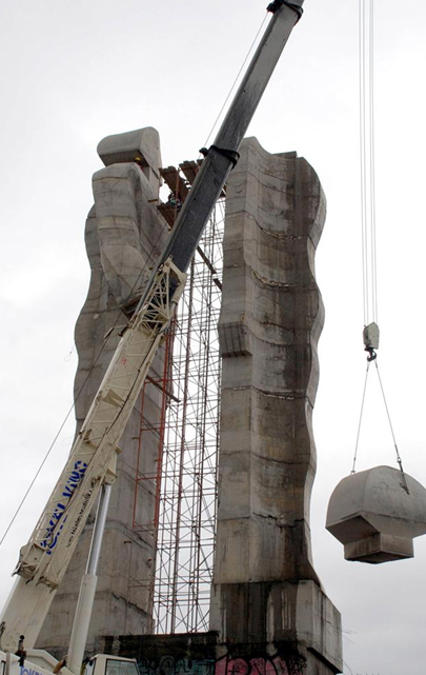
Dismantling of Mehmet Aksoy’s Monument to Humanity, 2011, Kars, Turkey. NTV.
In 2019, after the Monument to Humanity had been gone for over 8 years, the Turkish Constitutional Court ruled that demolishing the sculpture had violated Aksoy’s constitutional rights to freedom of artistic expression. The monument survives today only through photographs, court cases, writing, and public memory without any trace of physical presence.
The demolition of the Monument to Humanity demonstrates that public monuments have an impact fundamentally different from artworks displayed in galleries or museums. Because monuments are embedded within everyday public spaces, they participate in shaping collective perceptions of history and identity.
Unlike gallery artworks, which people need to encounter through a voluntary visit, public monuments confront passersby in their daily environments regardless of their intentions and continuously communicate ideas about national values, identity, and historical memory. In this sense, monuments function as a form of symbolic infrastructure through which national identities are constructed and maintained.
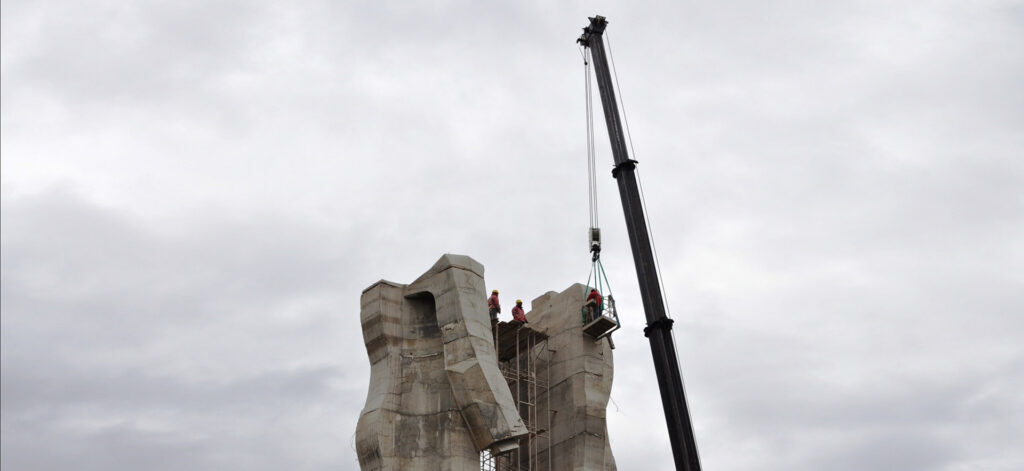
Dismantling of Mehmet Aksoy’s Monument to Humanity, 2011, Kars, Turkey. Artist’s website.
This distinction explains why Aksoy’s sculpture provoked such an intense political backlash and rapid decision making before it was finalized. The objection wasn’t due to the proposal of the reconciliation idea between Turkey and Armenia. The sculpture’s location over Kars facing Armenia transformed an abstract ethical proposition of reconciliation into a permanent feature of the national landscape. In doing so, it challenged the state’s authority over its historical narration of the Armenian genocide.
As Henri Lefebvre said in The Production of Space, public space is never neutral but is socially and politically produced through relations of power. The debates over the monument’s existence were therefore not simply about sculpture but about who has the authority to define the symbolic meaning of the public space and thus decide on the history and identity of a nation.
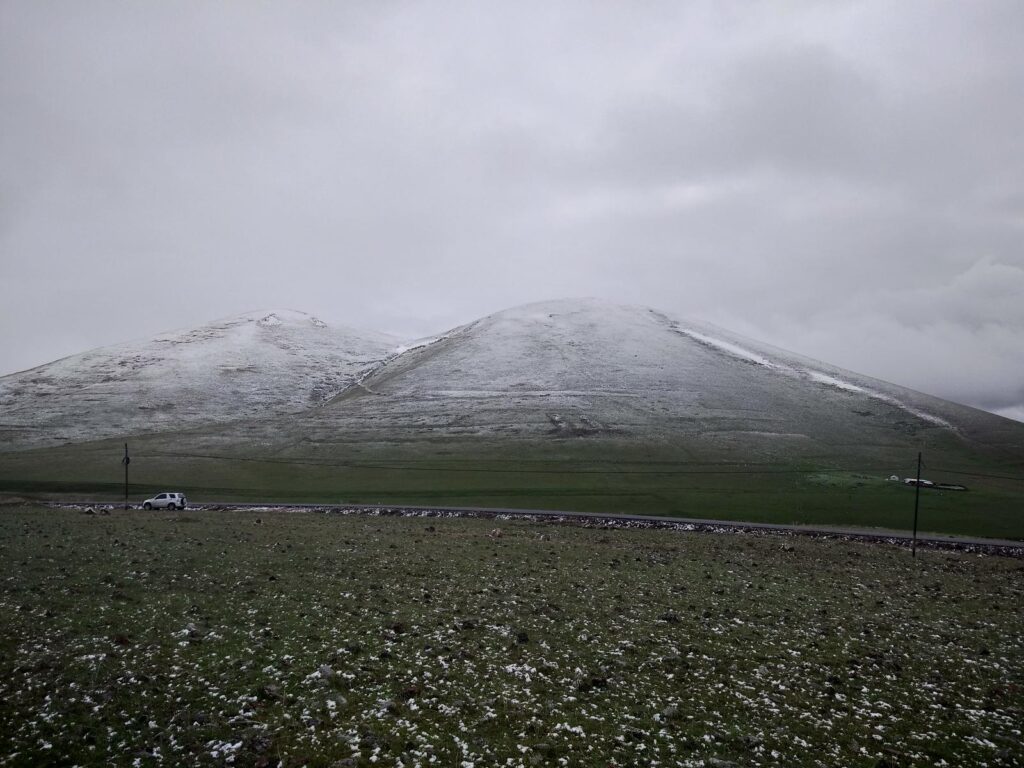
Üçler Tepesi, Kars, Turkey, after the removal of the Monument to Humanity. Photograph by Alpay Korkmaz via Wikiloc.
The demolition also demonstrated the complexity of the censor culture. Rather than banning the artwork right away, administrative and legal procedures made the process gradually complicated until the preservation of the monument was impossible. That’s why the fate of the monument had already been decided through a series of conservation decisions, property disputes, and planning regulations, long before Erdoğan delivered the final sentence with his “monstrosity” comment.
The case demonstrates that censorship in contemporary states can operate through complex administrative and legal procedures rather than through explicit prohibition. In this respect, the case resembles the Franz Kafkaesque world of The Trial (1925), where individuals are confronted with complex bureaucratic systems whose rules are difficult to understand and even harder to challenge. Bureaucracy itself became a means of exercising power—by delaying decisions, creating legal uncertainty, and limiting effective legal remedies, the state was able to achieve the monument’s removal without explicitly prohibiting it.
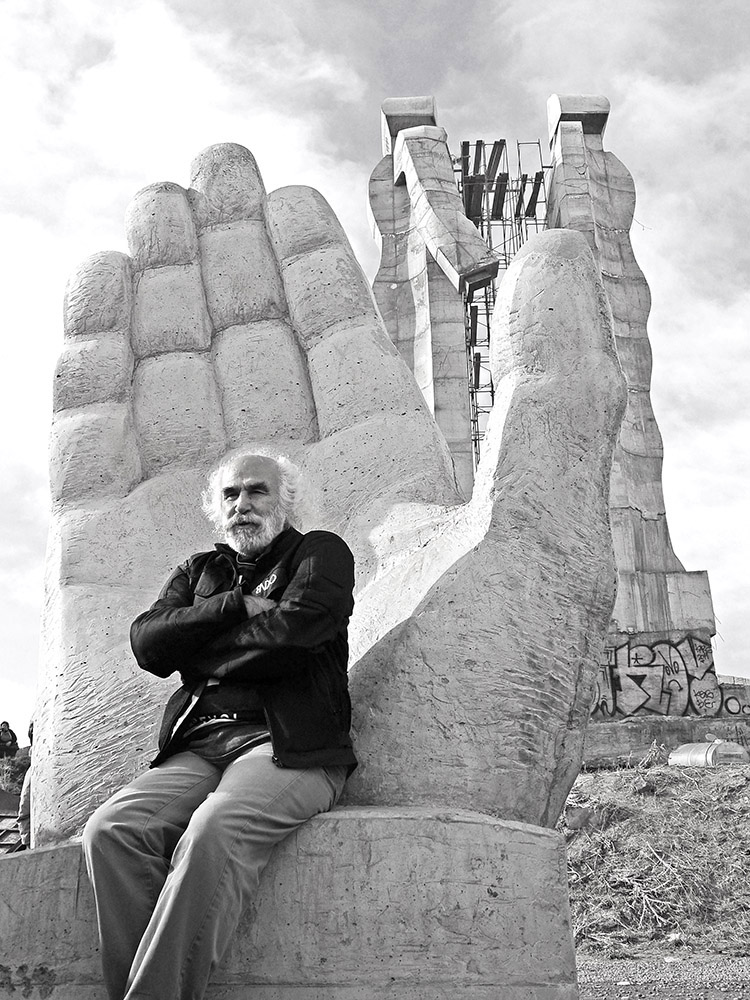
Mehmet Aksoy in front of the Monument to Humanity, Kars, Turkey. Artist’s website.
Despite never being officially completed, the monument became one of the most internationally discussed public artworks in the contemporary Turkish art scene. It has become one of the clearest examples in Turkey of how public art can raise debates about memory, identity, and political authority. Mehmet Aksoy later remarked that the work had become “the first sculpture in the world that exists through its absence,” showing us how suppressing cultural objects can even increase their symbolic power. Perhaps the physical object may be silenced, but its absence itself gets louder.
The Monument to Humanity survives today only as an empty hill, a reminder that the politics of public art extends far beyond aesthetics. Decisions about whether a monument may be built, remain in public space, or be removed are also decisions about which histories are publicly remembered, which identities are recognized, and which forms of expression are considered legitimate. Its destruction illustrates how the governance of public space can shape collective memory. Without relying on explicit censorship, administrative and political power can determine not only what occupies public space but also the historical narratives that endure within it.
Author’s bio:
Pelin Yılmaz is an architecture student exploring art, politics, time, and space. She writes on unexpected topics, diving into intriguing rabbit holes and uncovering fresh perspectives.
DailyArt Magazine needs your support. Every contribution, however big or small, is very valuable for our future. Thanks to it, we will be able to sustain and grow the Magazine. Thank you for your help!

This is our guest profile for occasional authors. If you have an interesting story about art to tell, send it to our Editor-in-chief Kate at [email protected]. You might be the next here!

Elizabeth Provost is a visual arts journalist, editor, and scholar of the Italian Renaissance based in New York City and Toronto. She is a PhD student at the Bard Graduate Center. Learn more about her on her website: www.elizabethprovost.com
The Chac Mool (also spelled chacmool) is a well-known icon of Mexico’s ancient past, yet its meaning and role remains a disputed subject.
Maya M. Tola 2 July 2026
In 2007, Damien Hirst unveiled something that stopped the art world cold. Encrusted with 8,601 diamonds and carrying a pear-shaped pink diamond at...
Errika Gerakiti 8 June 2026
People once thought Romanticism belonged only to painting, not sculpture. Auguste Préault challenged that belief with bold creativity. The...
Errika Gerakiti 26 September 2025
Can we feel sympathy for the devil, and can he be forgiven in his remorse? The Devil—A Life is the first major visual work of the famous musician,...
Marta Wiktoria Bryll, 20 January 2026




.jpg)