
Slinkachu Miniature Street Art in 10 Pieces
There is a particular vertigo in crouching down to look at something the size of a fingernail. Since 2006, Slinkachu has built an entire career...
Errika Gerakiti 3 August 2026
25 August 2026 min Read
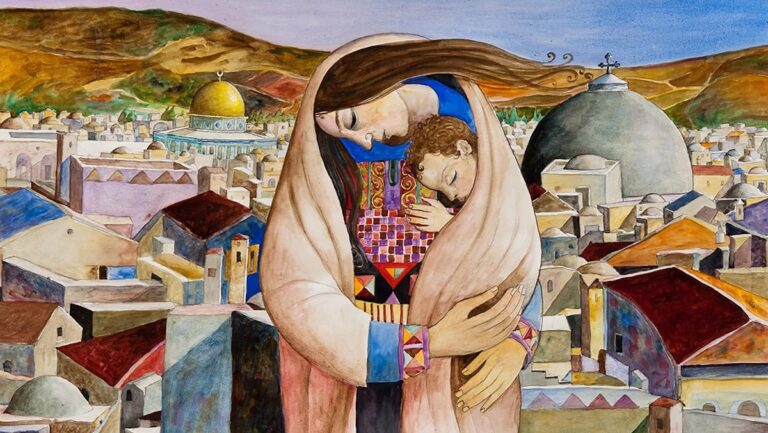
Sliman Mansour, Mother and Child, 2009. Artist’s website. Detail.
Sliman Mansour, one of the leading figures in Palestinian art, died yesterday at the age of 79. Mansour’s practice was profoundly intertwined with Palestinian identity and the experiences of dispossession, memory, resistance, and attachment to land. Born shortly before the Nakba of 1948, during which approximately 750,000 Palestinians were displaced from their homes, Mansour grew up amid its political and cultural aftermath.
Emerging as a prominent Palestinian artist during the 1970s, Sliman Mansour developed a visual language that asserted Palestinian identity against the material realities of displacement and the threat of cultural erasure. Rather than only depicting occupation and dispossession exclusively through scenes of explicit violence, he employed recognizable symbols such as the Dome of the Rock, the olive tree, Jaffa oranges, traditional Palestinian dress, and the Palestinian landscape. Through employing these motifs, Mansour transformed cultural memory itself into a form of resistance.
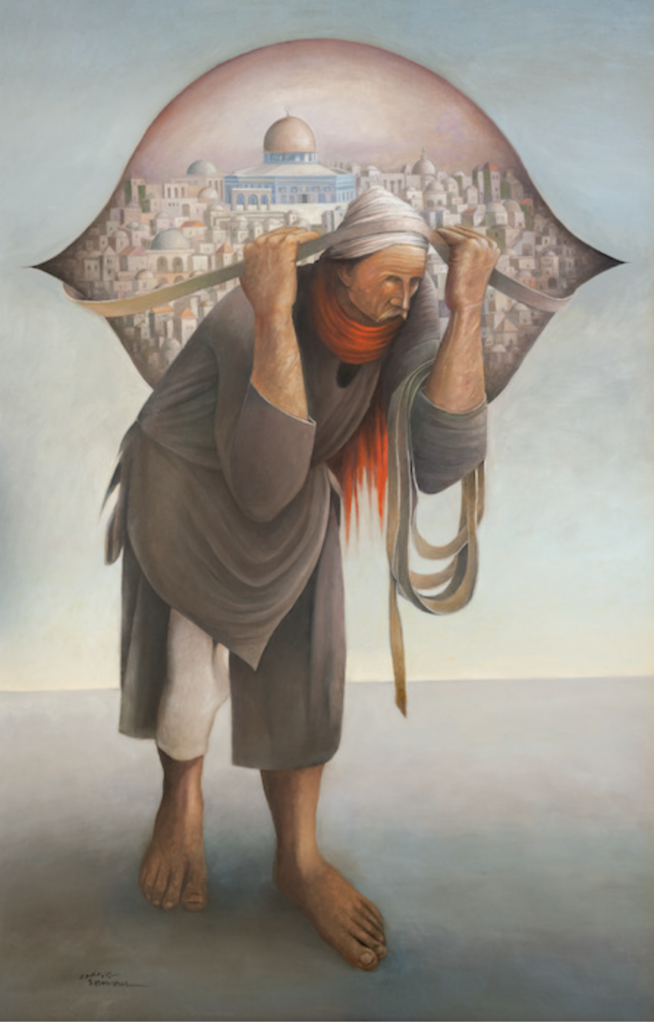
Sliman Mansour, Jamal Al Mahamel (The Camel of Hardships), 2005, Dalloul Art Foundation, Beirut, Lebanon.
This symbolic language is particularly evident in The Camel of Hardships (2005), one of Mansour’s most recognizable works. At its center is a recurring motif in his practice: Jerusalem contained within a spherical, almost eye-like form, with the golden Dome of the Rock forming its luminous focal point. Jerusalem is therefore represented not merely as a geographical location but as an object of memory, identity, and longing.
In The Camel of Hardships, however, this symbolic Jerusalem rests heavily upon the figure, suggesting the emotional burden of displacement. Impoverished and barefoot, the man bends beneath its weight, his stooped body expressing the exhaustion of persevering against oppression. Mansour transforms a historical condition into something corporeal: homeland as a physical weight, carried upon the backs of those who remain bound to it.
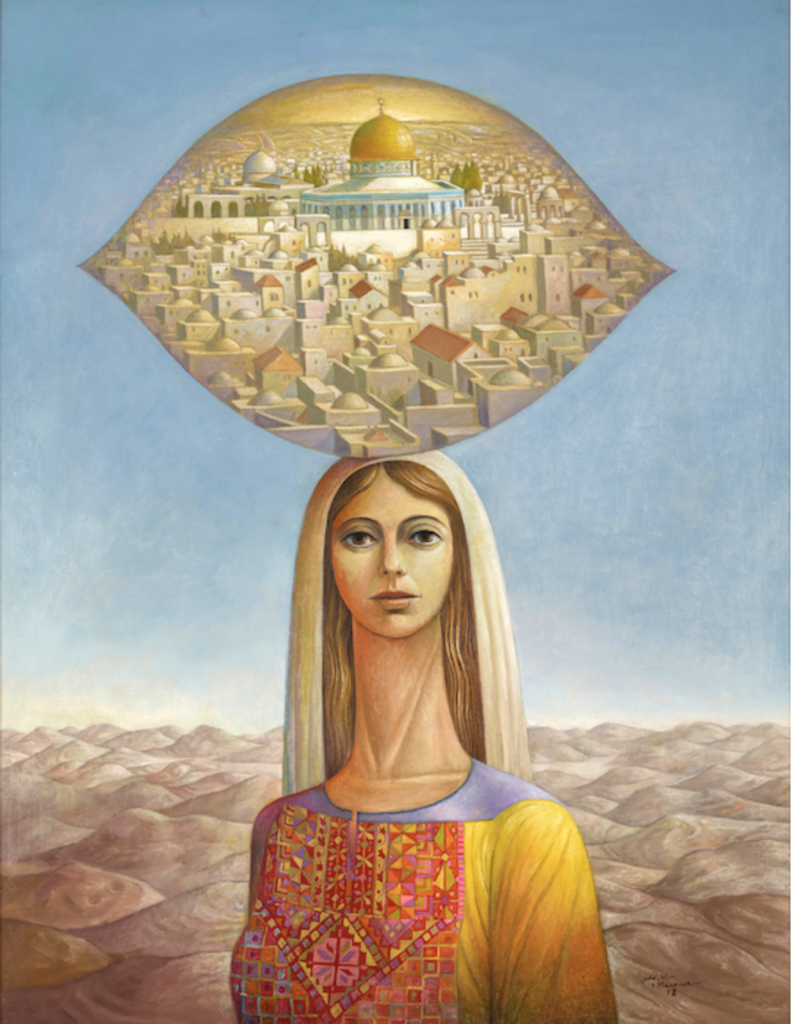
Sliman Mansour, The Daughter of Jerusalem, 1978. DAF Beirut.
The Daughter of Jerusalem (1978) offers another variation upon this relationship. Here, Mansour’s use of the spherical encapsulation of the Dome of the Rock demonstrates that the relationship between Palestinians and Jerusalem cannot be reduced to suffering alone.
Rather than struggling beneath the weight of perseverance, the woman balances the city upon her head. The color of her dress mirrors the bright golden dome, and her elongated neck resembles a column supporting its weight, monumentalizing the female figure and transforming her into an image of defiance and strength. Her dignified gaze extends directly beyond the pictorial space towards the viewer. Resolute yet composed, she does not appear defeated by the burden she carries. Instead, Jerusalem becomes almost an extension of her body and identity.
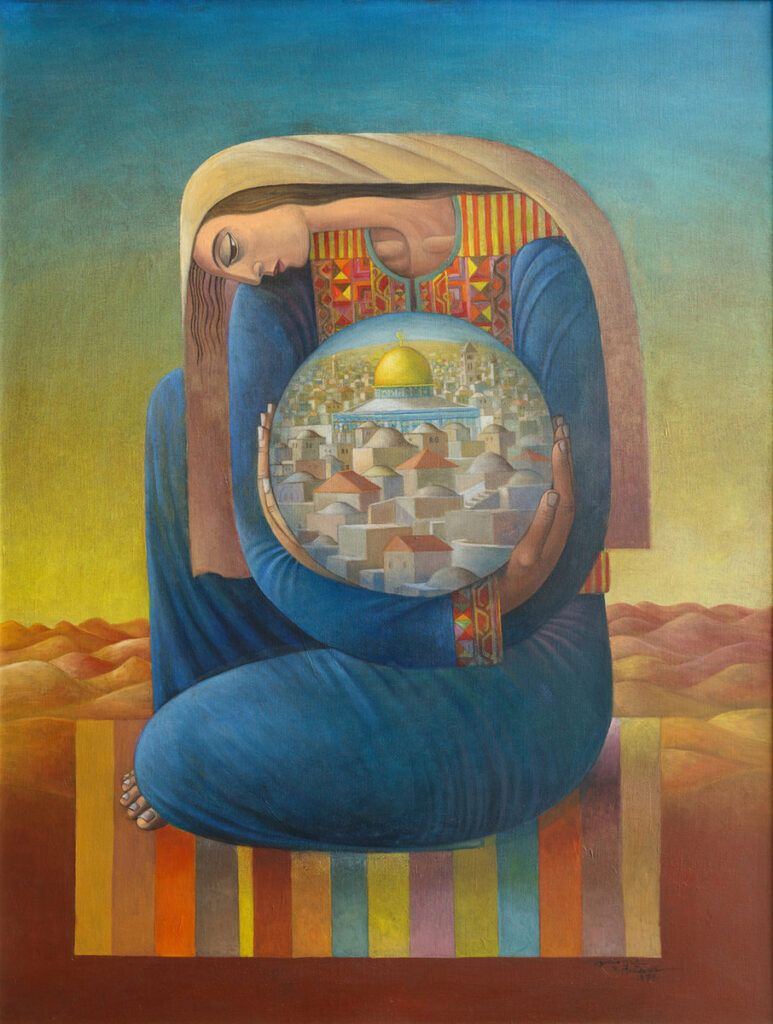
Sliman Mansour, Woman Carrying Jerusalem, 1979. Arab News.
In Woman Carrying Jerusalem (1979), the figure cradles Jerusalem as though she is holding a child. Her somber expression reflects the sense of loss present in The Camel of Hardships, but her vibrant clothing contrasts sharply with the tattered garments of the male figure. The sphere is not weighted on the figure’s body, but held close in her arms. She does not possess the bold resolve of the figure depicted in The Daughter of Jerusalem, but instead exhibits softness, tenderness, and contemplation. In this iteration of the sphere motif, remembrance becomes an act of nurture and preservation; Palestine is endangered but cherished. Consequently, sorrow coexists with belonging, hope, and endurance.
The three paintings share another significant visual feature in addition to the Dome of the Rock. The figures are situated against sparse, barren landscapes, and the absence of a clearly inhabited home intensifies the theme of displacement. These backgrounds can be understood as landscapes of rupture, suggesting both physical separation from place and the attempted stripping away of cultural identity.
At the same time, their emptiness creates a striking contrast with the intensely symbolic objects and figures placed within them. Against apparent desolation, Palestinian identity remains conspicuously present. Mansour, therefore, moves between struggle, strength and nurture as Palestine is simultaneously something to be carried, protected, and embodied.
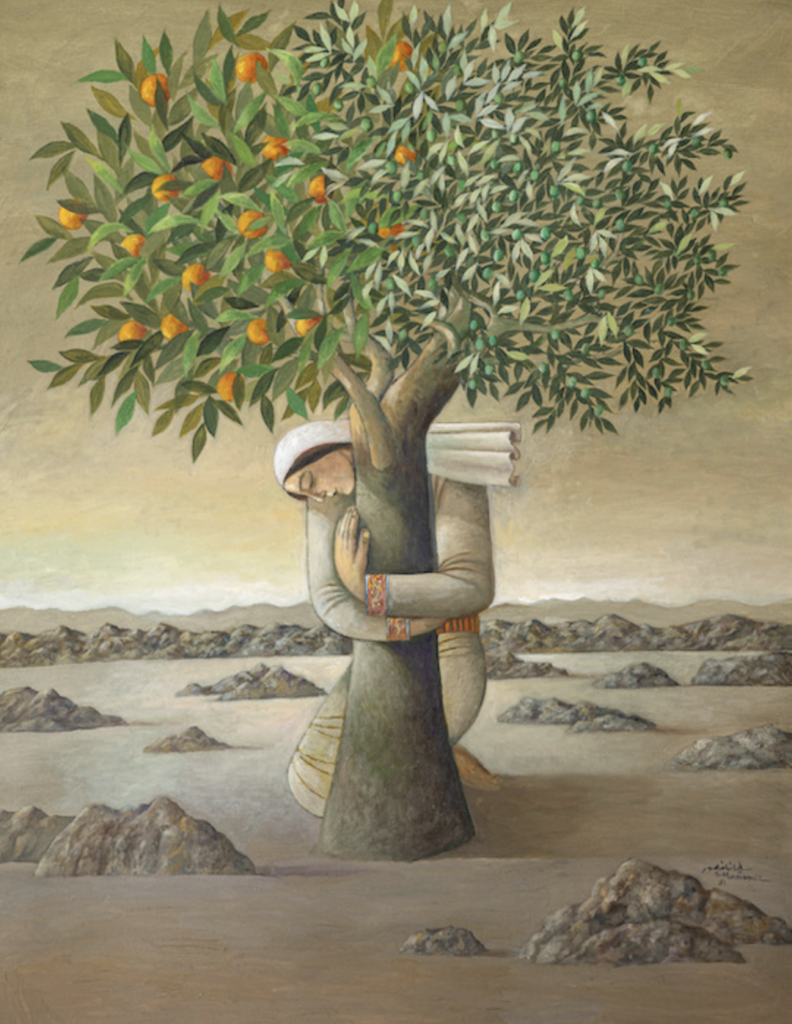
Sliman Mansour, From the River to the Sea, 2021. Al Jazeera.
The tension between barrenness and persistence reappears in From the River to the Sea, in which a woman clings to a fruit-bearing tree. Jaffa oranges and olives locate the image within Palestinian cultural and agricultural history, and gain further weight from Israel’s continued destruction of Palestinian olive groves, which has made the olive tree an enduring symbol of rootedness and collective memory. Against the surrounding emptiness, the tree remains alive, its roots in the soil, its branches still producing fruit. The landscape is not passive scenery but an active political symbol, and the tree’s survival becomes analogous to Palestinian survival and resistance to erasure.
Sliman Mansour explicitly connected this question of representation to the politics of Palestinian existence. In a 2023 interview with Middle East Eye, he described the strategy of the Zionist movement as being to “deny your existence,” arguing that such denial facilitates the seizure of land, imprisonment, and violence. His work can be understood as a visual refusal of precisely this erasure—by repeatedly depicting Palestinian dress, agriculture, architecture, and landscape, Mansour insisted on a cultural and historical presence. The olive tree and Jaffa orange thus function as more than nostalgic symbols—they point to forms of cultivation, labor, and economic life that materially connected Palestinian communities to the land.
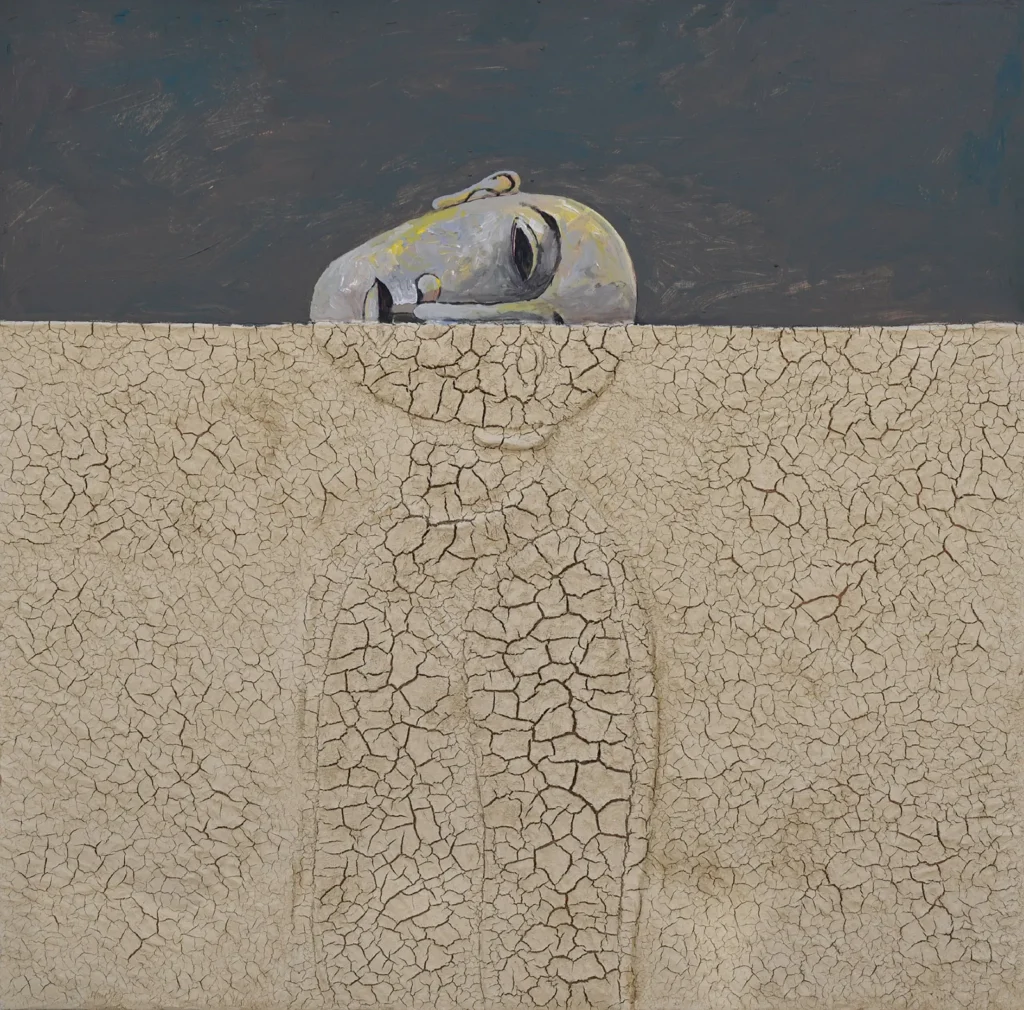
Sliman Mansour, Temporary Escape, 2019. WikiArt.
Sliman Mansour extended these principles beyond the subject matter of his paintings and into their physical construction. During the First Intifada, he co-founded the New Visions collective alongside artists including Vera Tamari, Tayseer Barakat, and Nabil Anani. The group sought alternatives to conventional imported art materials, incorporating locally available substances such as mud, clay, straw, leather, and natural dyes into their practices. This decision gave the artwork’s materiality political significance. Palestinian land ceased to be merely something represented within an image; it could become the substance from which the image itself was produced. The distinction between representing Palestine and physically working with Palestinian soil was therefore deliberately crafted.
In a distinctive style from his typical practice, this relationship is particularly striking in Temporary Escape (2019). A face appears partially engulfed by mud, while the remainder of the body seems submerged beneath a cracked, dry surface. At first glance, the work is claustrophobic. The figure appears trapped or suffocated by the earth, evoking associations of confinement, burial, and resignation. The title emphasizes the sense that the half-revealed face provides a brief moment of relief.
Yet the work also permits an opposing interpretation. Instead of being consumed by the ground, the figure is physically incorporated into it. Body and soil become almost indistinguishable. Read through the concept of sumud, this apparent entrapment can simultaneously signify rootedness. Even under conditions of immense pressure, the Palestinian figure remains inseparable from the land.
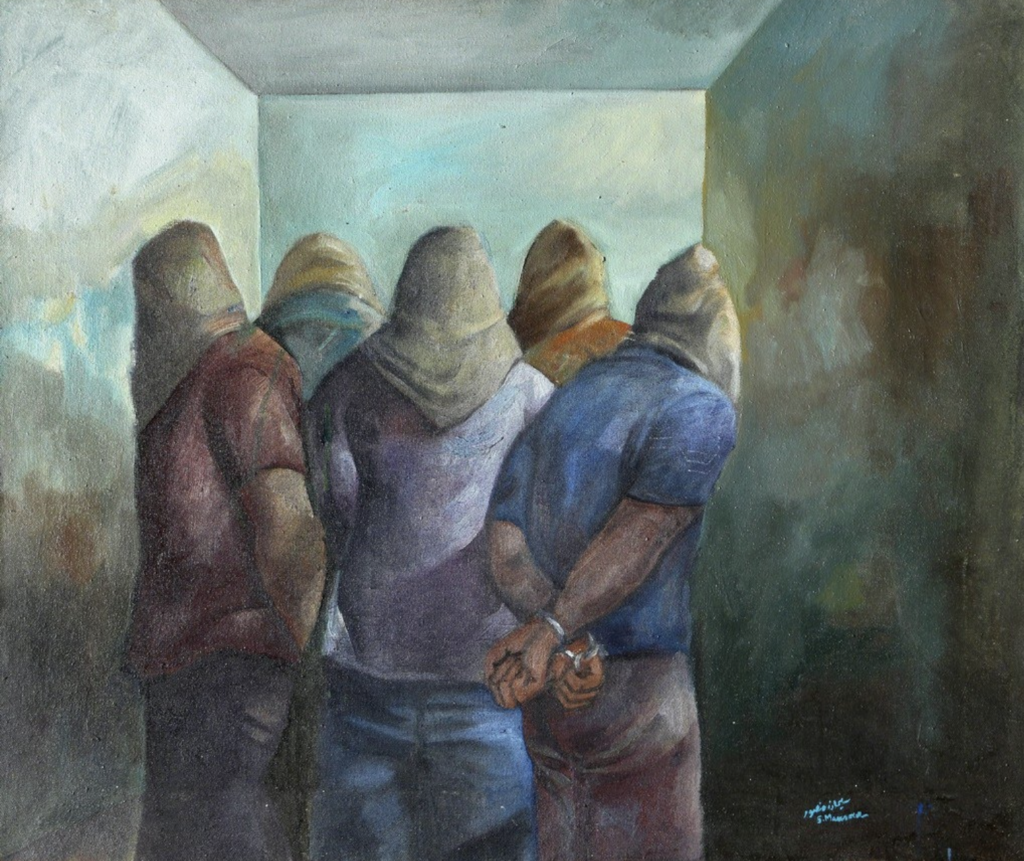
Sliman Mansour, Prison, c. 1982, Contemporary Art Platform, Kuwait City, Kuwait. Zaidan Gallery.
The use of ambiguity in Mansour’s work is important, as he rarely presents Palestinian identity as an uncomplicated triumph. His imagery oscillates between vulnerability and endurance, grief and hope, displacement and belonging. This is apparent when his vibrant symbolic landscapes are contrasted with the darker palette of his more explicit depictions of imprisonment, as in Prison (c. 1982). Here, the visual language of rootedness and cultural abundance gives way to confinement and anonymity. The prisoners’ covered heads obscure their faces, stripping them of individual identity; their bound hands restrict their freedom, and the darkness of the space intensifies the atmosphere of dehumanization and psychological isolation.
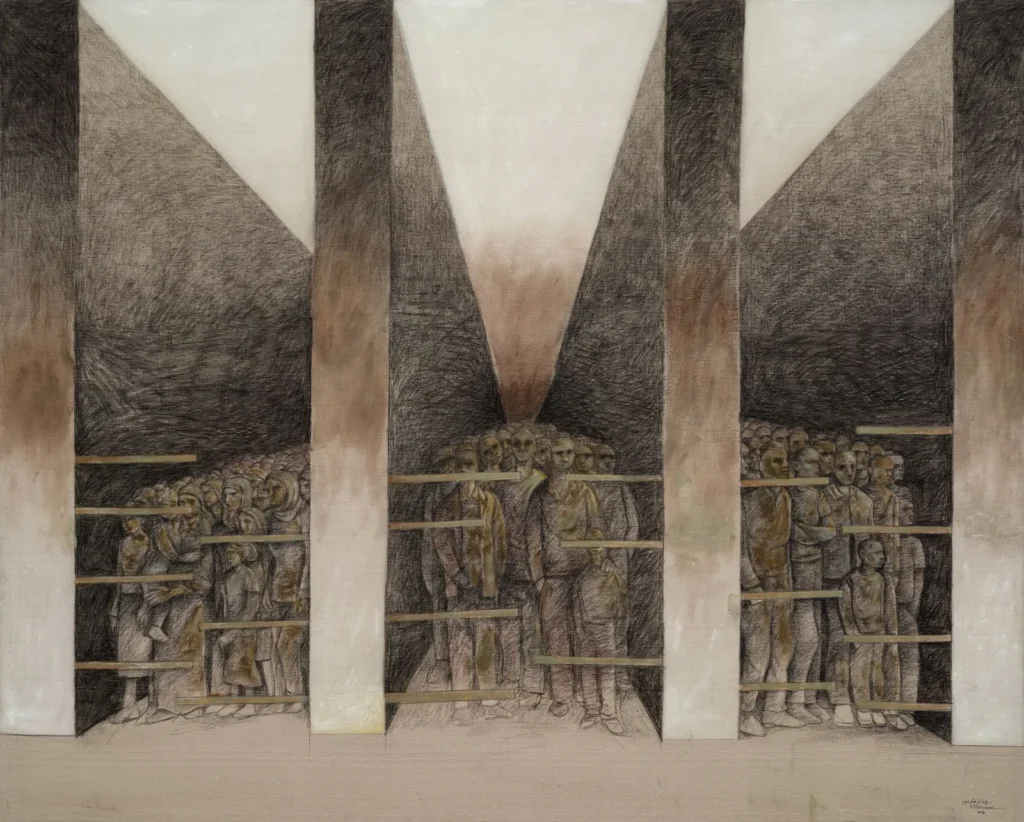
Sliman Mansour, Homeland, 2010, Dalloul Art Foundation, Beirut, Lebanon.
Where works such as The Daughter of Jerusalem emphasize visibility through the woman’s direct and unwavering gaze, Prison stages the violent removal of that visibility. This is similarly portrayed in works such as Homeland (2010), which depicts obscured, imprisoned figures, cramped between high walls in the dark; their identity and humanity stripped away.
Bound hands also appear in Perseverance and Hope (1976). However, in this painting, the figures look at the sky towards a dove, symbolizing their hope for peace. This is ultimately what underpins Sliman Mansour’s work: the search for hope amidst destruction, the search for peace amidst violence, and the search for identity amidst erasure.
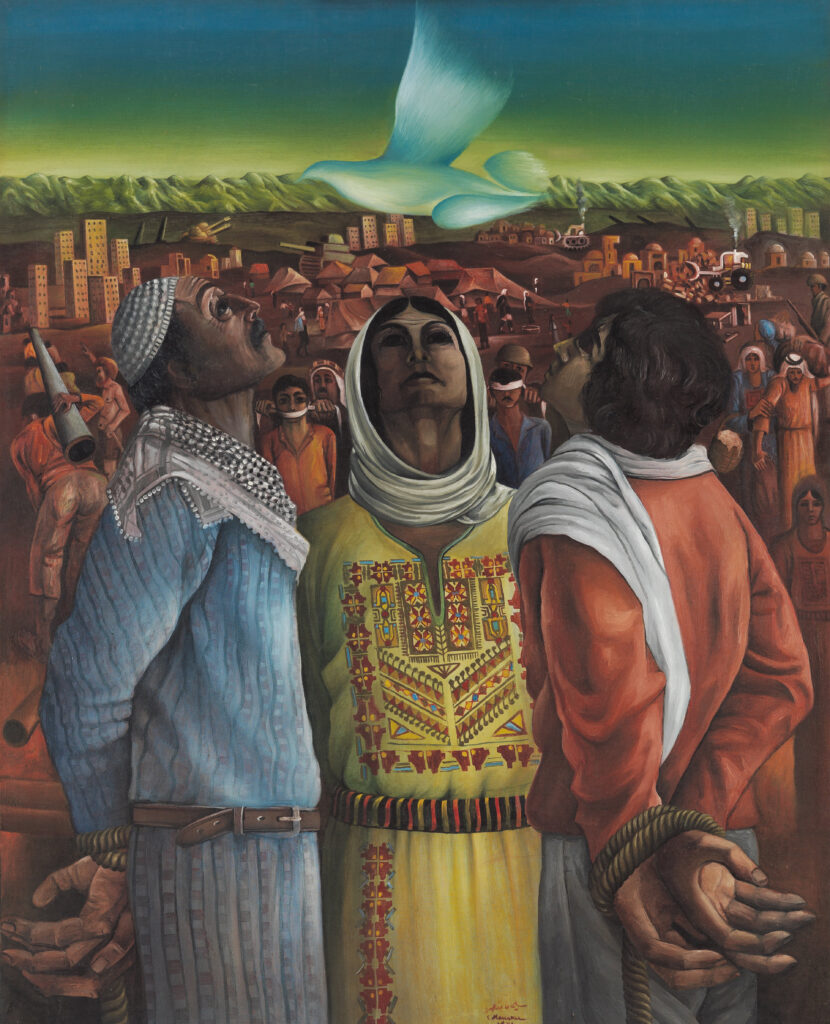
Sliman Mansour, Perseverance and Hope, 1976, Mathaf: Arab Museum of Modern Art, Doha, Qatar. Google Arts & Culture.
The contrast of darkened spaces, barren land, and suffering, with the vibrancy and references to Palestinian culture and landscapes, reveals a central tension running throughout Mansour’s practice. Occupation and dispossession threaten to render Palestinian people absent. By separating individuals from land, obscuring their identities or transforming inhabited landscapes into apparently empty spaces, Mansour’s art repeatedly reverses this process. His figures carry Jerusalem, embrace it, balance it upon their bodies, cling to fruit-bearing trees and ultimately merge with the soil itself. Palestine consequently exists in his work not simply as territory but as an embodied cultural memory.
Mansour’s recurring symbols should therefore not be understood simply as nostalgic references to a lost homeland. Their repetition performs a political function. The Dome of the Rock, olive trees, Jaffa oranges, Palestinian clothing, and the material substance of the earth establish continuity in opposition to displacement and erasure. Even when Mansour depicted suffering, his figures remain connected to something that exceeds the immediate conditions imposed upon them: land, memory, culture, and collective identity. In this sense, his work visualizes the fundamental logic of sumud. Resistance does not always appear as confrontation. It can take the quieter but deeply political form of continuing to cultivate, remember, create, and remain.
01 Work, The Art of War, Sliman Mansour’s Prison, with footnotes, Zaidan Gallery, 2024. Accessed: Aug. 25, 2026.
Nick Hilden, “We must ‘rehumanise ourselves’: Palestinian artist Sliman Mansour,” Al Jazeera, 2024. Accessed: Aug. 25, 2026.
Nadda Osman, “The Symbol as Resistance: Sliman Mansour on Occupation and Palestinian Identity,” Middle East Eye, 2023. Accessed: Aug. 25, 2026.
Rebecca Anne Proctor, Sliman Mansour: Evoking the Beauty, Perseverance and Resistance of Palestine, Dubai Collection, 2024. Accessed: Aug. 25, 2026.
DailyArt Magazine needs your support. Every contribution, however big or small, is very valuable for our future. Thanks to it, we will be able to sustain and grow the Magazine. Thank you for your help!

Historian of nineteenth and early-twentieth-century art, particularly drawn to themes relating to gender expression, spirituality, magic, and mythologies.

There is a particular vertigo in crouching down to look at something the size of a fingernail. Since 2006, Slinkachu has built an entire career...
Errika Gerakiti 3 August 2026
Few would claim real shock at the loss of an artist a month shy of turning 89. And then David Hockney passed away on June 11. Born in 1937, the lad...
MJ Rivera 22 June 2026
Between marquee art fairs, auction-house madness, downtown openings, uptown previews, long-awaited gallery and museum exhibitions, and the artsy...
MJ Rivera 28 May 2026
In 1952, a pianist sat before a waiting audience and played not a single note. Six years later in Paris, visitors entered a gallery expecting art and...
Tunacan Tuna 25 May 2026