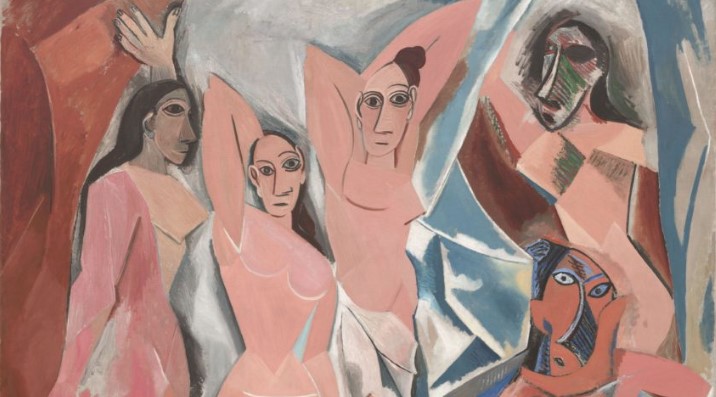
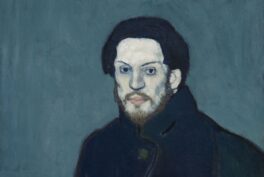
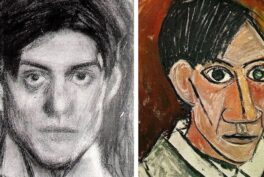
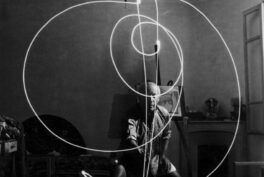
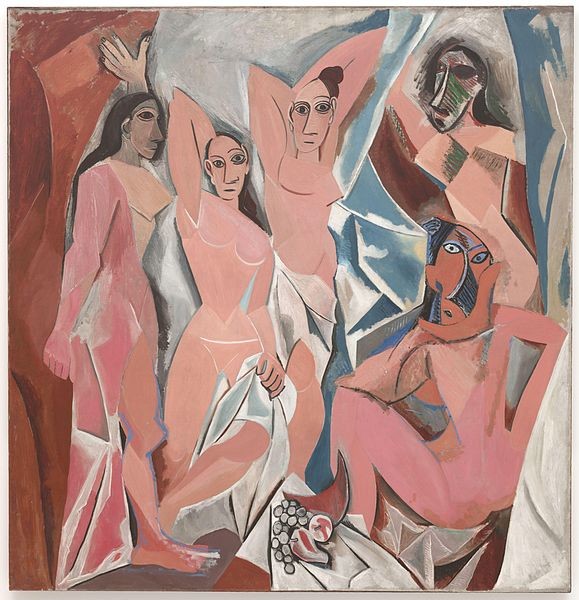
At the beginning of the 20th century, Pablo Picasso created the famous Les Demoiselles d’Avignon. Georges Braque was immediately inspired and five other avant-garde artists followed. They broke the rules and dived into an entirely new way of seeing and showing objects on canvas. And just like that, Cubism was born.
It’s 1907, and Picasso was feverishly working in Bateau-Lavoir, Montmartre. A large canvas of the sex workers from a hometown brothel was driving him mad. What began as a brothel scene morphed into something so radical that it changed art in one stroke. The figures, contorted, draped in very little, aggressively stare out at us. Two appear to be wearing tribal African masks, the latest craze. Bodies are angular, with no soft curves similar to Matisse’s Blue Nude. The figures are painted flatly onto the surface, overlapping shapes from the breasts and hips of these terrifying women. Suddenly, art was not about representation but conceptualization.
Pablo Picasso, Les Demoiselles d’Avignon, 1907, Metropolitan Museum of Modern Art, New York City, NY, USA.
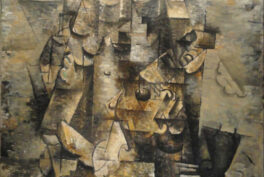
Georges Braque, astounded by this incredible work, began to collaborate. Showing their work in the galleries of Montmartre, the two became known as “Gallery Cubists“, adept at taking still-life compositions and breaking the rules. Forms fragmented into geometric shapes, brush strokes became visible, and patterns were formed, helping to flatten perspective and reduce reality.
Left: Pablo Picasso, Still Life with a Bottle of Rum, 1911, Metropolitan Museum of Art, New York City, NY, USA.; Right: Georges Braque, Still Life with Banderillas, 1911, Metropolitan Museum of Art, New York City, NY, USA.
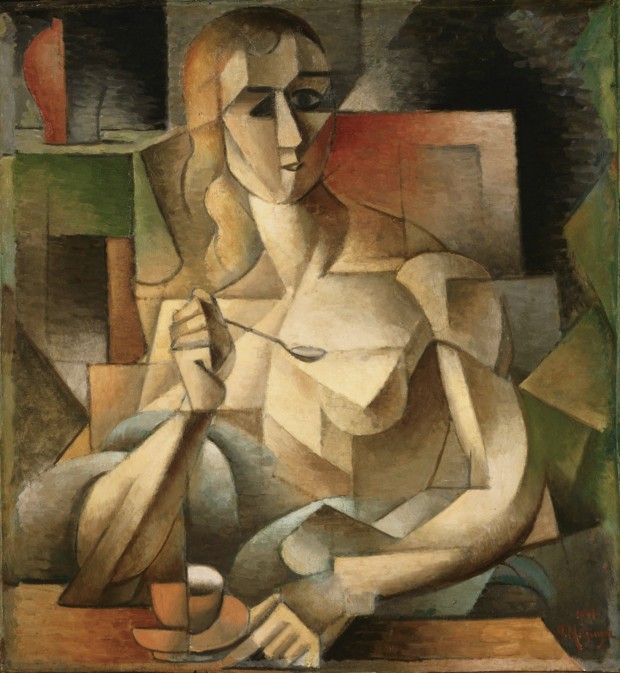
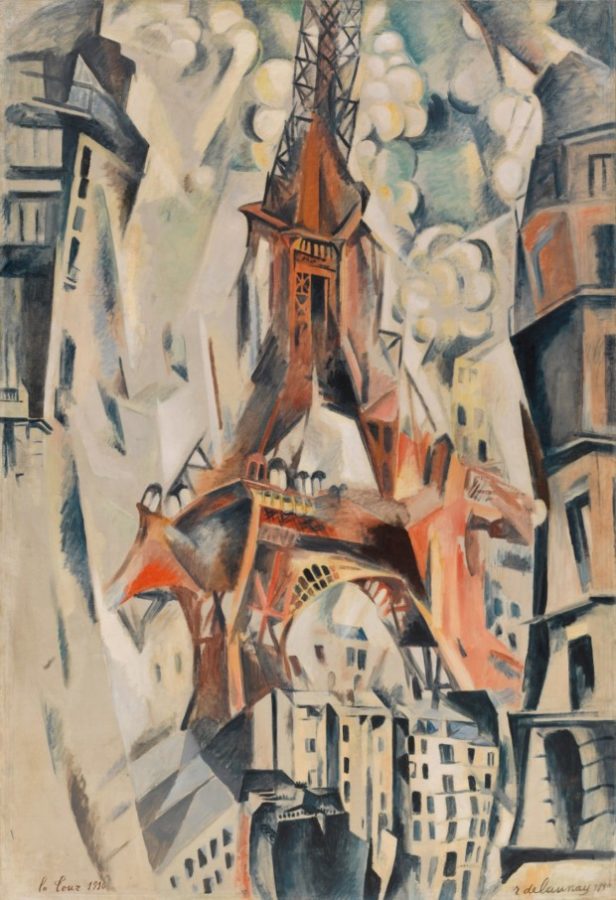
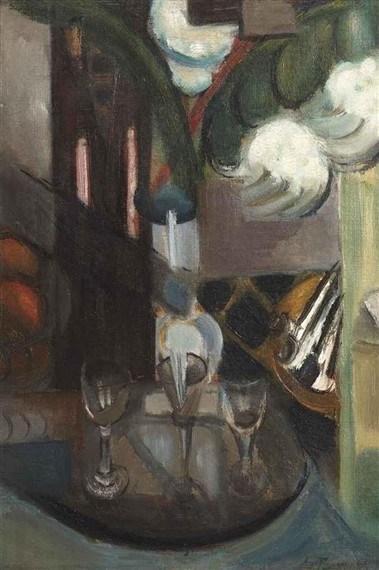
Their influence was almost instantaneous. Five avant-garde artists: Albert Gleizes, Jean Metzinger, Fernand Leger, Henri Le Fauconnier, and Robert Delaunay were inspired by what they saw, but their interpretations went further. Known as “Salon Cubists” because they were showing their work in public exhibitions rather than in private galleries, their palette began with the same monochrome subtlety, but the subjects became more varied through nudes, cityscapes, and domestic interiors, such as these examples by Metzinger, Le Fauconnier, and Delaunay demonstrate:
Jean Metzinger, Le Goûter (Tea Time), 1911, Philadelphia Museum of Art, Philadelphia, PA, USA.Robert Delaunay, Tour Eiffel, 1911, Guggenheim Museum, New York, NY, USA.Henri le Fauconnier, Still Life with a Carafe and Glasses, 1913, private collection. WikiArt.
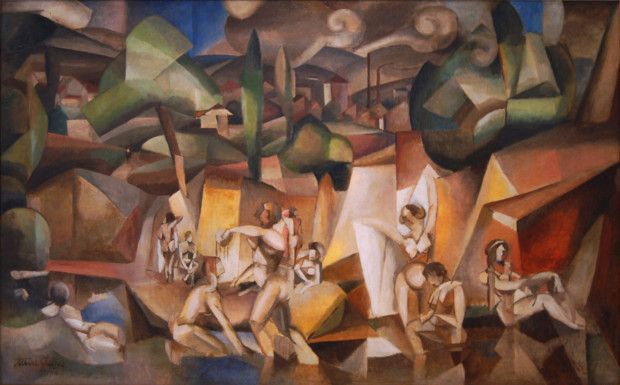
Excitingly, Gleizes’ Harvest Threshing (1912) combined the features of the “Gallery Cubists” technique with the linear structure to create space and movement.
Albert Gleizes, Les Baigneuses, 1912, Musée d’Art Moderne de la Ville de Paris, Paris, France.
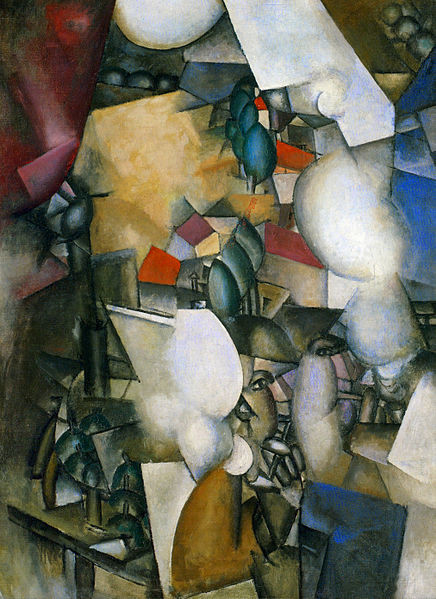
Fernand Leger began to bring color to the table in his works, using bold shades in non-faceted planes to great effect.
Fernand Léger, Les Fumeurs (The Smokers), 1911-1912, Solomon R. Guggenheim Museum, New York, NY, USA.
As a consequence of such radicalism, other art forms such as the Italian Futurists and the British Vorticists came into being, changing art in a way that had never been seen before and which sent us into the modern era shaped by Cubism.
Click and follow us on Google News to stay updated all the time
We love art history and writing about it. Your support helps us to sustain DailyArt Magazine and keep it running.
DailyArt Magazine needs your support. Every contribution, however big or small, is very valuable for our future. Thanks to it, we will be able to sustain and grow the Magazine. Thank you for your help!
Pablo Picasso, a prolific producer of paintings, prints, ceramics, and sculpture, his work has perhaps become over-familiar. Equally, in recent years...