Rediscovering Fauvist Georgette Agutte in 10 Paintings
Georgette Agutte was one of the very few women who participated in the Parisian art scene at the turn of the 20th century. She was a sculptor and a...
Nikolina Konjevod 26 March 2026
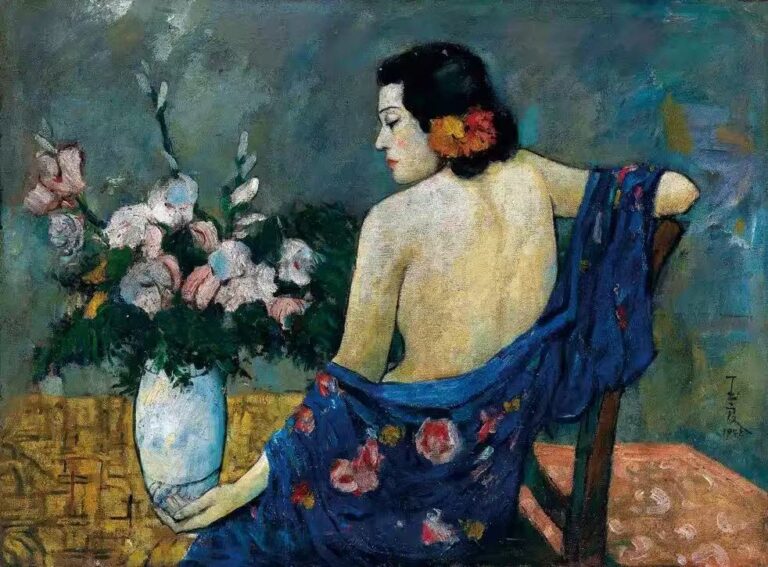
Pan Yuliang, Lady in Blue Dress, 1942. MutualArt.
Pan Yuliang lived many lives in one lifetime. She was a girl from Yangzhou who entered adulthood under precarious circumstances, a student in Shanghai, Lyon, Paris, and Rome, a painter who worked across China and France for decades, and a woman who kept painting even when home and exile took a toll on her in different ways.
She is still often introduced through a dramatic biographical voice, yet her real impact lies in what she made of life. Again and again, she returned to women—their bodies, their presence, their inwardness, their right to occupy space with dignity. Her paintings carry the tensions of modern Chinese art, the pressure of gendered scrutiny, and the question of who gets to look and who gets to be seen.
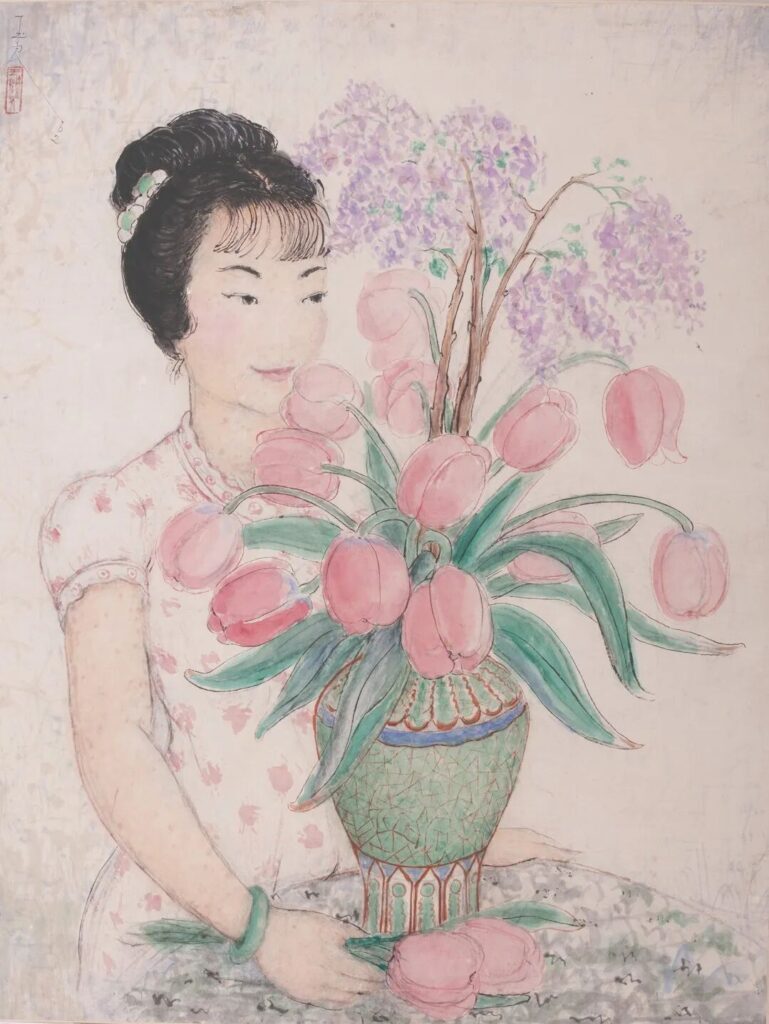
Pan Yuliang, Young Woman with Lilacs, 1962, Anhui Museum, Hefei, China. Museum’s website.
Pan Yuliang (潘玉良, born as Chen Xiuqing [陈秀清]) was born in Yangzhou, China, in 1895. Her father died when she was one year old, and her mother died when she was eight, leaving her under the guardianship of an uncle. Later accounts connect her early life to a brothel, though sources differ on the exact nature of that experience. Some describe her as having been sold into prostitution, while others suggest Pan Yuliang worked there as a servant.
What remains clear is that her youth unfolded under themes of vulnerability, dependence, and public judgment long before she ever stood before a canvas. Even after she became a respected painter, many viewers continued to read her through that past first, as though her body had entered public view before her mind had the chance to.
Her life changed in the years after her marriage to Pan Zanhua. She took his surname, Pan, received schooling in Beijing, moved to Shanghai, and began studying painting with Hong Ye during her formative years. In 1920, Pan Yuliang enrolled at the Shanghai Arts Academy in its first coeducational class, an important milestone in the history of modern art education in China. There, drawing and painting became forms of self-making. She did more than move from hardship toward success. She crossed a more profound boundary. A woman long exposed to others’ gaze became someone who could decide how to see, what to paint, and how to position herself within modern life.
But before she painted women, she had to become one on her own terms.
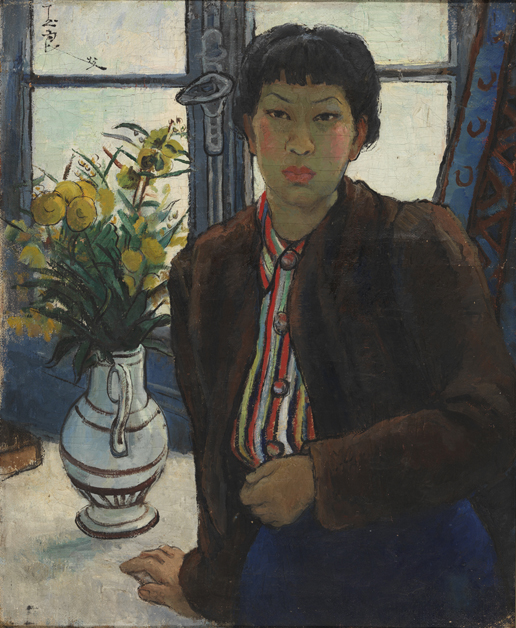
Pan Yuliang, Self-Portrait, 1945, National Art Museum of China, Beijing, China. Museum’s website.
At the Shanghai Arts Academy, Pan Yuliang entered a world that offered women a new kind of future, though it remained narrow, fragile, and deeply shaped by class and respectability. She studied in the Western Painting Department and took part in school life with unusual visibility, from public speaking to outdoor sketching trips led by prominent teachers of the period. Her time there gave her an early technical foundation and placed her inside a modernizing art culture that was beginning to imagine women as serious students of art.
Her stay at the academy was brief. One biographer has suggested that once her earlier life became known, student pressure may have contributed to the school’s request that she withdraw. Whether or not the full circumstances can now be fully retraced, the experience shows how quickly a woman’s social past could be used against her even within progressive art spaces.
Her path through art education quickly expanded beyond Shanghai. In 1921, after leaving the academy, Pan Yuliang left for France and enrolled at the Sino-French Institute in Lyon, while also taking drawing and painting classes at the École des Beaux-Arts de Lyon. She later studied in Paris, entered the École des Beaux-Arts there, and then continued on to Rome, where she studied painting and sculpture and won a gold medal at the Roman International Art Exposition in 1926. By the time she returned to Shanghai in 1928, she had moved through several of the most demanding academic systems available to a young artist of her generation. Those years earned her far more than techniques. She established her authority. She learned how to study the figure, how to trust her hand, and how to claim space in institutions that had rarely made room for women on equal terms.
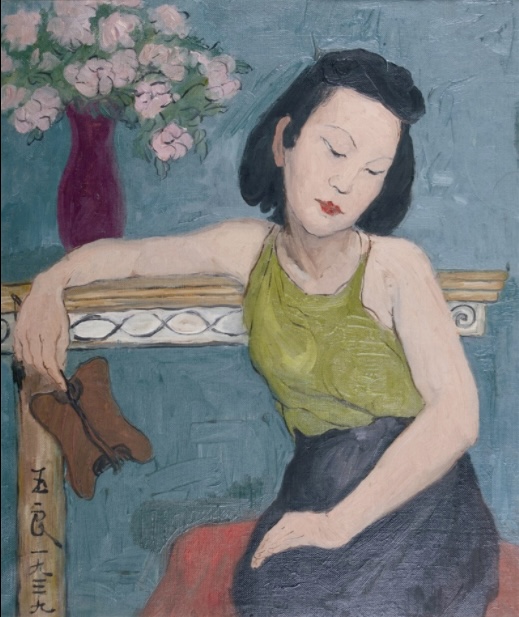
Pan Yuliang, Taking the Air, 1939, Anhui Museum, Hefei, China. Museum’s website.
Pan Yuliang returned to women again and again because the female figure gave her a way to think through freedom, dignity, and selfhood. In Republican China, the nude was already a charged subject. For a woman artist to work with it carried extra force. It challenged expectations about propriety, authorship, and who had the right to study the body at all. Pan Yuliang understood that pressure firsthand, and she continued anyway. Her persistence matters as much as the subject itself. She chose a field of painting that brought the anxieties of her time into full view, especially the unease surrounding women who entered public artistic life with too much independence.
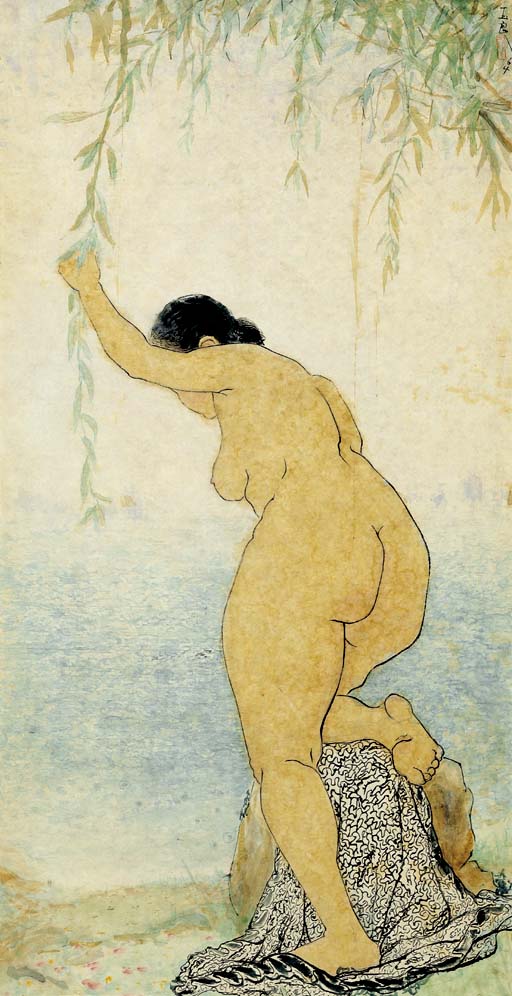
Pan Yuliang, Woman and Willow Frond, 1964. Christie’s.
Her women carry themselves with physical presence and psychological depth. They sit, recline, turn, dress, undress, or meet the viewer with a calm that feels self-possessed. Scholars have often pointed out that Pan Yuliang used her own body as a model in many of these works, which deepens their significance. She was shaping a modern female image from within, using the body as a site of authorship and self-definition. Across her nudes and self-portraits, the female figure becomes something steady, thinking, and fully there. Pan Yuliang gave women room to occupy the picture as subjects of their own lives, with gravity, inwardness, and control over how they present themselves.
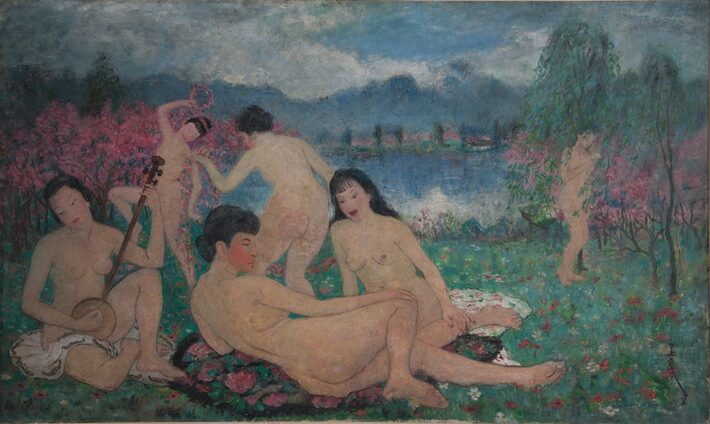
Pan Yuliang, Song of Spring, 1952, Anhui Museum, Hefei, China. Museum’s website.
When Pan Yuliang returned to China in 1928, she came back with serious academic training, international experience, and a visual language shaped across Shanghai, Lyon, Paris, and Rome. She quickly took on major teaching and administrative roles, holding positions at the Shanghai Arts Academy, Central University in Nanjing, and Xinhua Art College. She exhibited widely, held several solo shows, and became active in the art world of Republican China. Yet she also worked in a climate that could be deeply hostile to a woman painting female nudes. Criticism of her work carried more than aesthetic disagreement. It exposed broader anxieties about women in public culture, women in art schools, and women claiming authority over the human body.
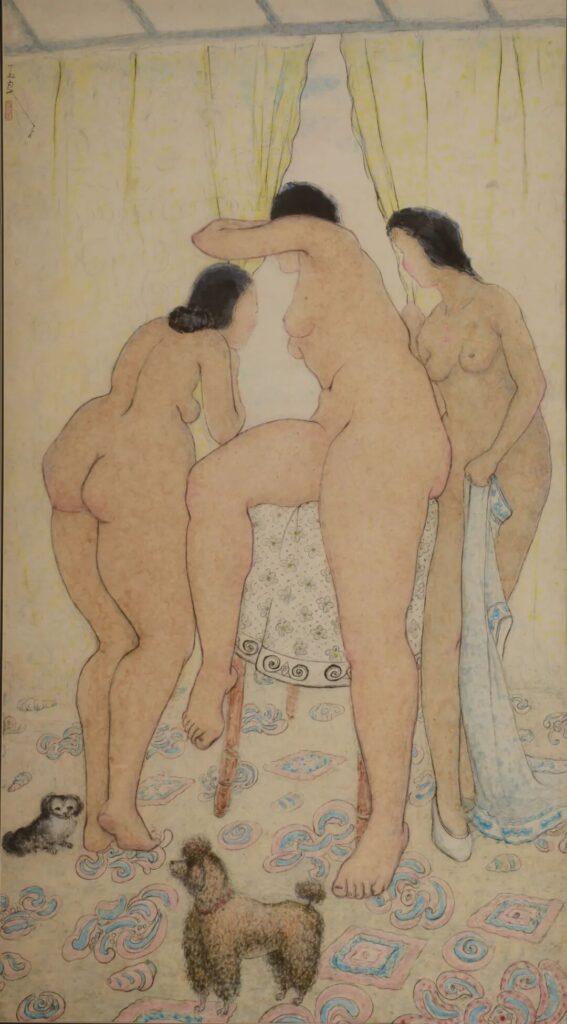
Pan Yuliang, Curiosity, 1968, Anhui Museum, Hefei, China. Museum’s website.
In 1937, Pan Yuliang left China for Europe with plans to stay only two years. World War II turned that journey into a permanent exile. Her life in France, however, was far from invisible. In 1938, she showed work at the Salon des Tuileries. In 1942, the French state acquired one of her ink drawings through the Centre national des arts plastiques. Three years later, she was elected chair of the Association des artistes chinois en France, a sign of the respect she had earned within the community of Chinese artists in Paris.
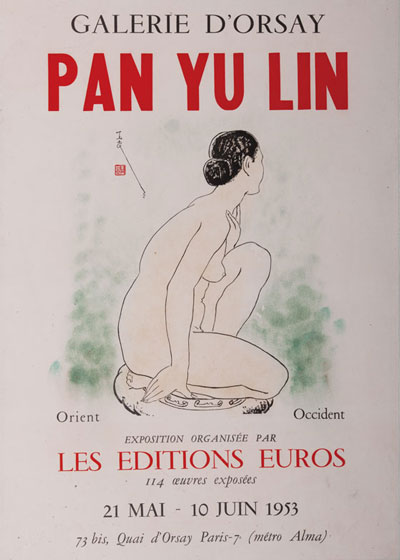
Poster of Pan Yuliang’s solo exhibition at the Galerie d’Orsay, 1953. Panyulin.org.
In 1946, she participated in UNESCO’s International Exhibition of Modern Art at the Palais de Tokyo, and in 1953, she held a solo exhibition at the Galerie d’Orsay. Over time, her work also entered the orbit of the Cernuschi Museum, which remains one of the most important public collections of her art outside China.
That in-between quality also appears in the work itself. Even her flower paintings channel her understanding of both Eastern and Western art worlds, bringing Chinese subjects into a visual language shaped by European training.
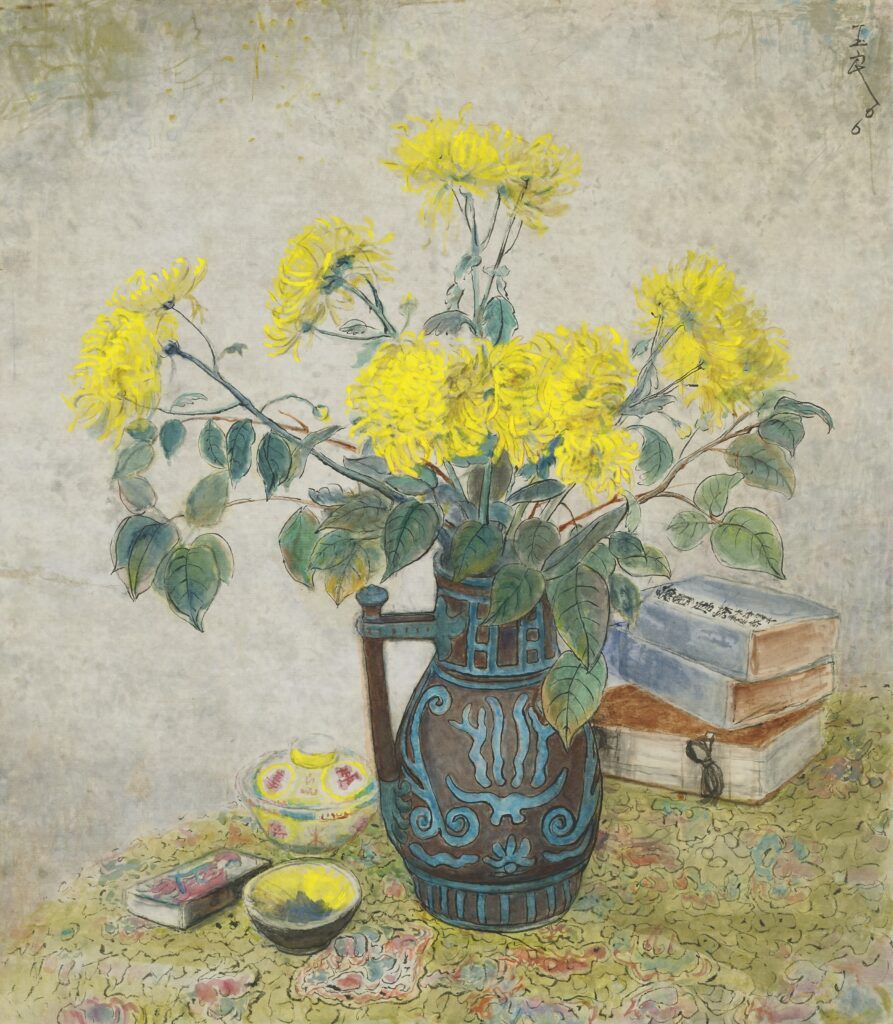
Pan Yuliang, Yellow Flowers in a Vase, 1966. Christie’s.
The mentioned facts matter because they complicate any clear-cut narratives of exclusion. Pan Yuliang did receive recognition in France, and she remained active there for decades through exhibitions, institutions, and artist networks. Yet recognition did not resolve the deeper question of belonging. Her long absence weakened her place within the story of modern Chinese art, while her life in Paris continued to place her at a slight distance from the French center. She moved across two artistic worlds that never fully became home one way or another. What stayed with her was a life lived between systems, languages, and forms of recognition that arrived without ever settling into certainty.
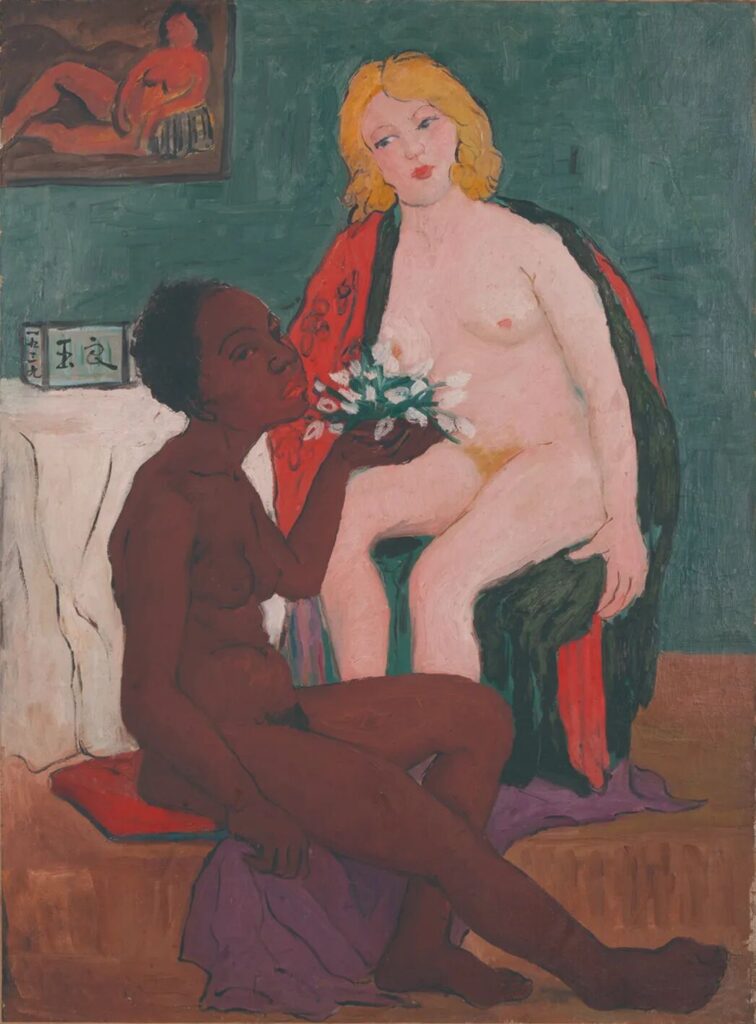
Pan Yuliang, Interplay of Black and White, 1939, Anhui Museum, Hefei, China. Museum’s website.
Pan Yuliang spent much of her life working through distance. Distance from home, from easy acceptance, from any stable sense of artistic belonging. She kept painting through all of it. She painted despite criticism in China, despite war and exile in Europe, and through years when recognition arrived in waves rather than permanence. That steadiness matters. Her career was built through discipline, persistence, and the daily choice to keep working from wherever she found herself.
That is part of why she still feels so contemporary. Her paintings hold together questions that remain urgent: who gets to study the body, who gets to define femininity, who gets to move between cultures without being reduced by them. Pan Yuliang gave those questions form through labor, training, and a deeply personal sense of purpose. Painting became the place where she could claim her own way of seeing. That way of seeing still reaches us, clear and steady, across time.
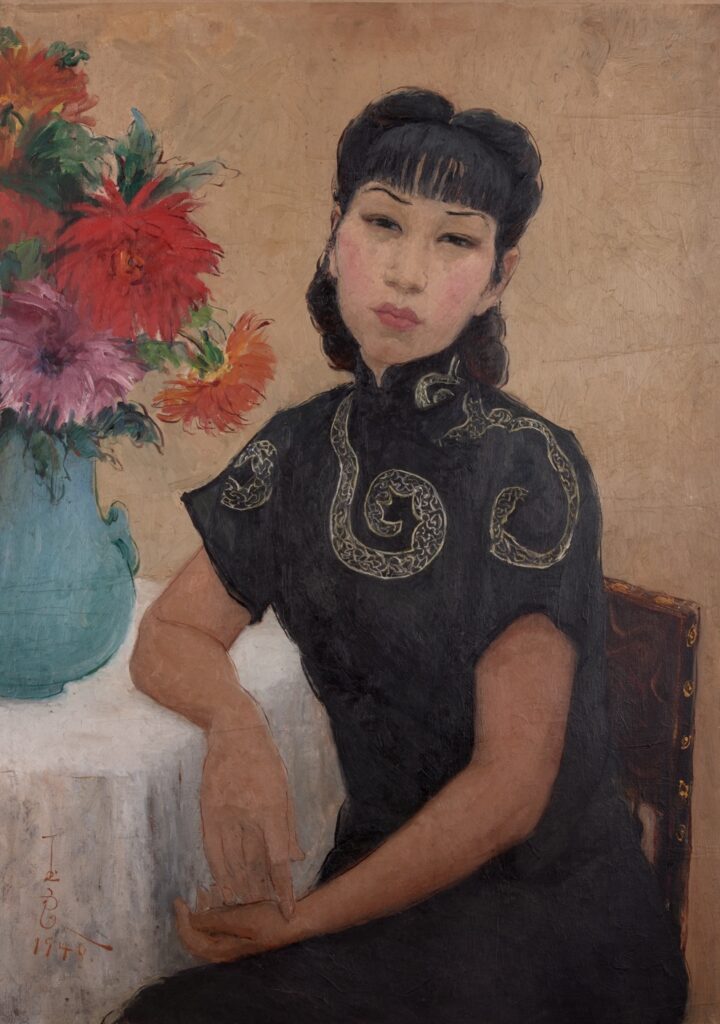
Pan Yuliang, Self-Portrait, 1940, Anhui Museum, Hefei, China. Museum’s website.
Get your daily dose of art
Click and follow us on Google News to stay updated all the time

DailyArt Magazine needs your support. Every contribution, however big or small, is very valuable for our future. Thanks to it, we will be able to sustain and grow the Magazine. Thank you for your help!

Art historian and curator specializing in early modern European art, with a focus on 17th‑ and 18th‑century visual culture. She brings a cross‑cultural perspective and a strong curatorial background to her writing, combining scholarly research with accessible storytelling for a wide audience.

Georgette Agutte was one of the very few women who participated in the Parisian art scene at the turn of the 20th century. She was a sculptor and a...
Nikolina Konjevod 26 March 2026
For most of her life, Grandma Moses was a wife, a mother, and a hardworking woman living on a farm. She began painting in her late seventies to keep...
Kinga Dobosz 30 March 2026
Helene Schjerfbeck, famous in her native Finland, is not nearly as well known in the rest of the world. A genuine one-off, she studied in Paris and...
Catriona Miller 11 March 2026
If you are a frequent visitor to museum stores and bookshops, or a regular reader of The New Yorker, you have probably encountered the work of Maira...
Aniela Rybak-Vaganay 9 March 2026