
Georges Papazoff: The Surrealist Who Refused to Behave
Too wild for the canon, too slippery for nationalism, and too early to be officially celebrated: that’s Georges Papazoff—a 20th-century Bulgarian...
Katie Mikova 2 April 2026
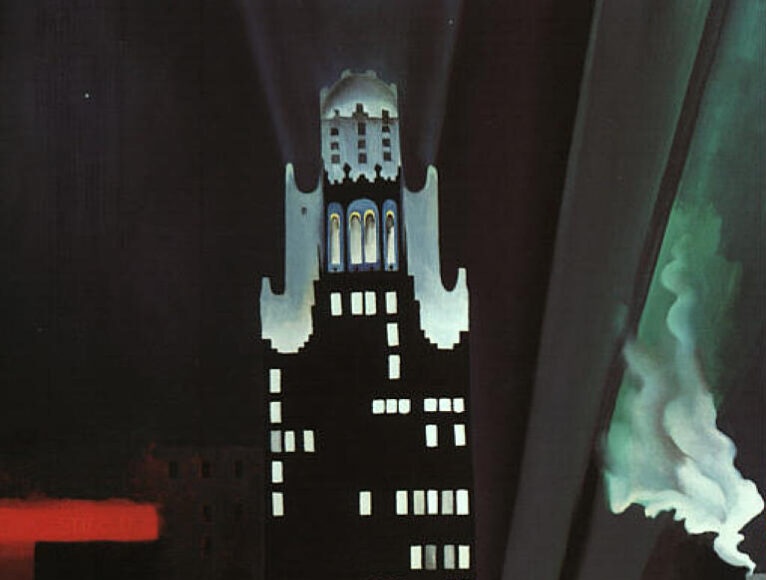
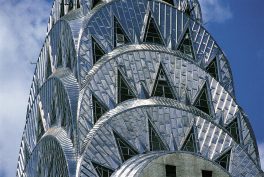
Georgia O’Keeffe, Radiator Building–Night, New York, 1927, Crystal Bridges Museum of American Art, Bentonville, AR, USA. Museum’s website. Detail.
One of the most recognizable works of art about New York City is a song. When the opening vamp begins to play (especially if it’s Frank Sinatra’s famous cover), everyone knows they’re about to hear “New York, New York,” the theme song of the city. The city itself is instantly recognizable when featured in cinema or photographs. Many painters have also captured its skyline and city streets.
However, as New York City has evolved, so has art. Some of the greatest paintings of New York are nearly unrecognizable representations. Artists have used their styles to go beyond the signature yellow taxi cabs and skyscrapers to more abstract, intimate, or focused depictions of the city that never sleeps. These works are unexpected yet brilliant compositions of the city’s likeness and personality through disparate angles, views, and formations.
New York has always been a refuge for the arts and an ideal subject for many artists to experiment with. Whether a concrete depiction of the city’s structural beauty or a conceptual representation of its diverse and vibrant culture, New York City has always been captured in astonishing arrangements.
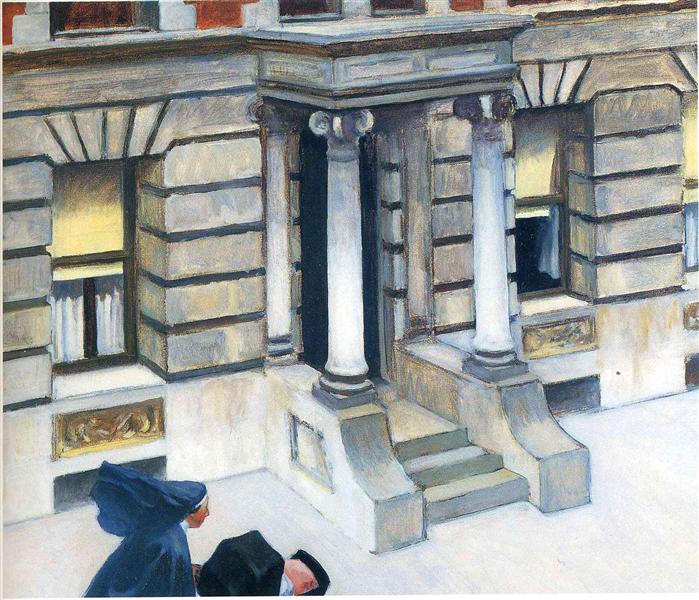
Edward Hopper, New York Pavements, 1924–1925, Chrysler Museum of Art, Norfolk, VA, USA.
Edward Hopper specialized in focused, small-scale paintings of New York City. New York Pavements is an impersonal representation of the city. The piece features a modern apartment building as its main subject. The building’s entryway stoop is small and intimate, with only three steps on the staircase and two columns closing in on the door. The lighting is subtle while the gray building contrasts with a passerby’s blue cloak in the corner. This person appears to be a woman, perhaps a nanny, pushing a stroller. The scene depicts the typical Hopper theme of closed-off, urban isolation.
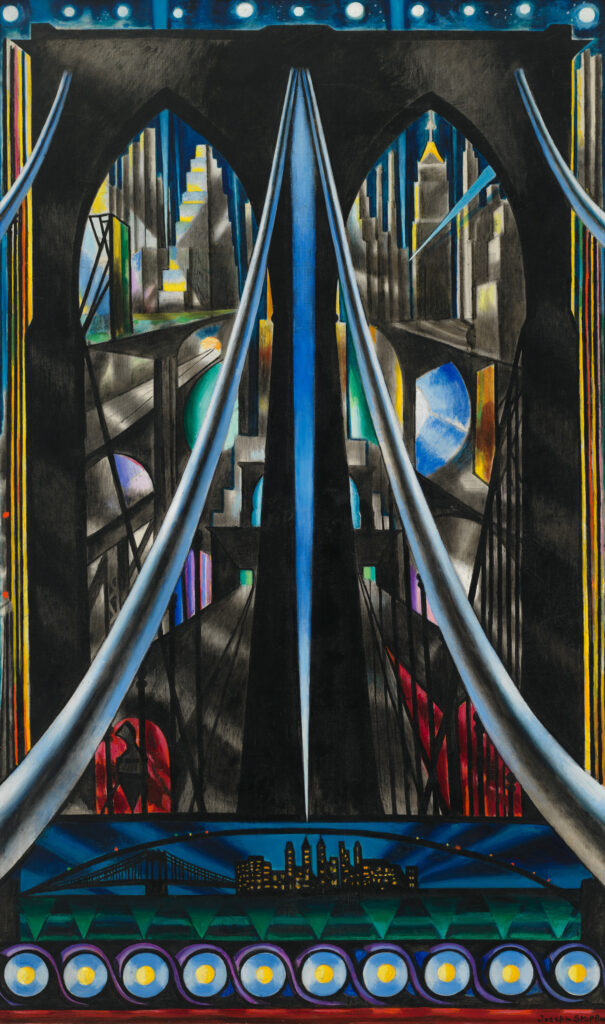
Joseph Stella, Brooklyn Bridge: Variation on an Old Theme, 1939, Whitney Museum, New York City, NY, USA.
Joseph Stella’s depiction of the Brooklyn Bridge is one of the most unique renderings of the iconic bridge. Influenced by Italian Futurism, Stella displays the bridge in an almost stone-glassed mosaic manner. Like the city he immigrated to, the painting is frenetic and dynamic, full of lively color and lines.
The stone-masonry facade of the bridge and its cables dominate the frame, suggesting the technological prowess of the structure. These parts are juxtaposed with buildings, other colorful parts of the bridge, and the night sky. Under the bridge at the bottom of the painting is a cityscape with the bridge leading to the skyscrapers. This is, at least, one of the coolest paintings of New York.
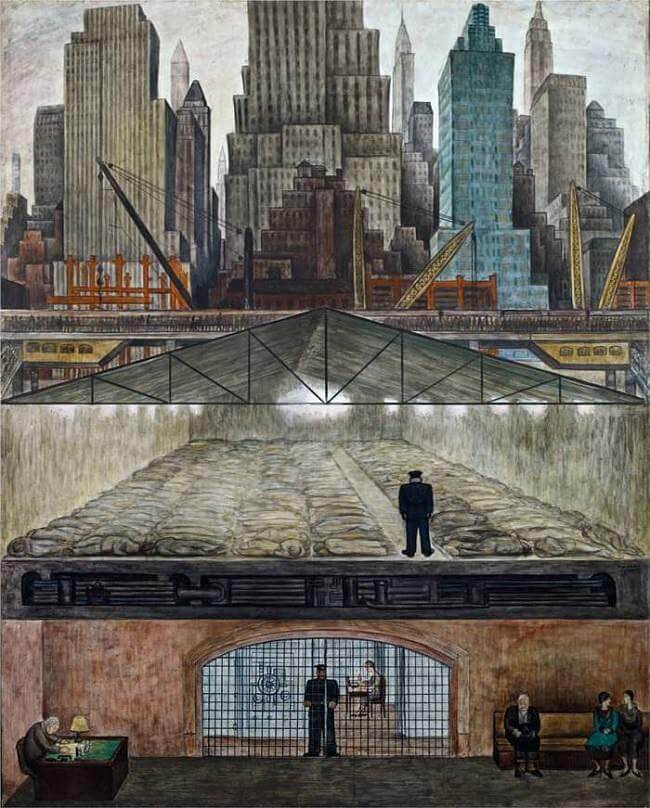
Diego Rivera, Frozen Assets, 1931–1932, Museo Dolores Olmedo, Xochimilco, Mexico. DiegoRivera.org.
Diego Rivera’s murals were no strangers to the Big Apple. This particular fresco is a candid depiction of New York City in the 1930s. Many people during this time of economic depression could certainly relate to the piece’s startling representation of the city.
The symbolic skyline sits at the top of the fresco, overpowering and seemingly weighing heavily on the bottom two sections of the piece. The middle section features a warehouse of body bags with one man watching over them. The bottom section appears to be a bank vault, barred off from those in a waiting room, perhaps wondering about certain frozen assets caused by the stock market crash. The colors are stark yet realistic, distressing the viewer while simultaneously stressing the urgent need for change.
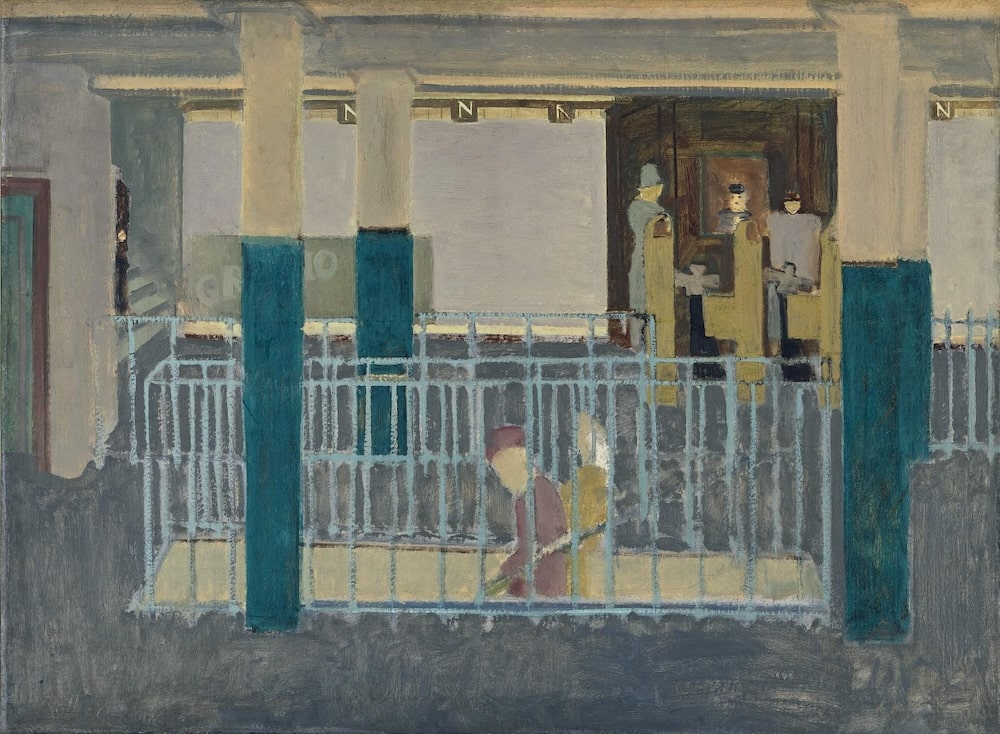
Mark Rothko, Entrance to Subway, 1938, private collection. MarkRothko.org.
Before Mark Rothko produced the abstract paintings for which he is most famous, he drew inspiration from the influences of painters he admired. Entrance to Subway depicts an urban environment like an Edward Hopper piece.
Two people pass each other on the staircase to the subterranean station, one ascending while the other descends. The figures in the painting are mostly faceless, harbingers for Rothko’s ultimate fascination with Abstract Expressionism. Hopper’s themes of urban isolation and loneliness clearly resonate in this piece. The drab colors invoke an uneasy, prosaic atmosphere; as if the routine and monotony of daily life render one lifeless.
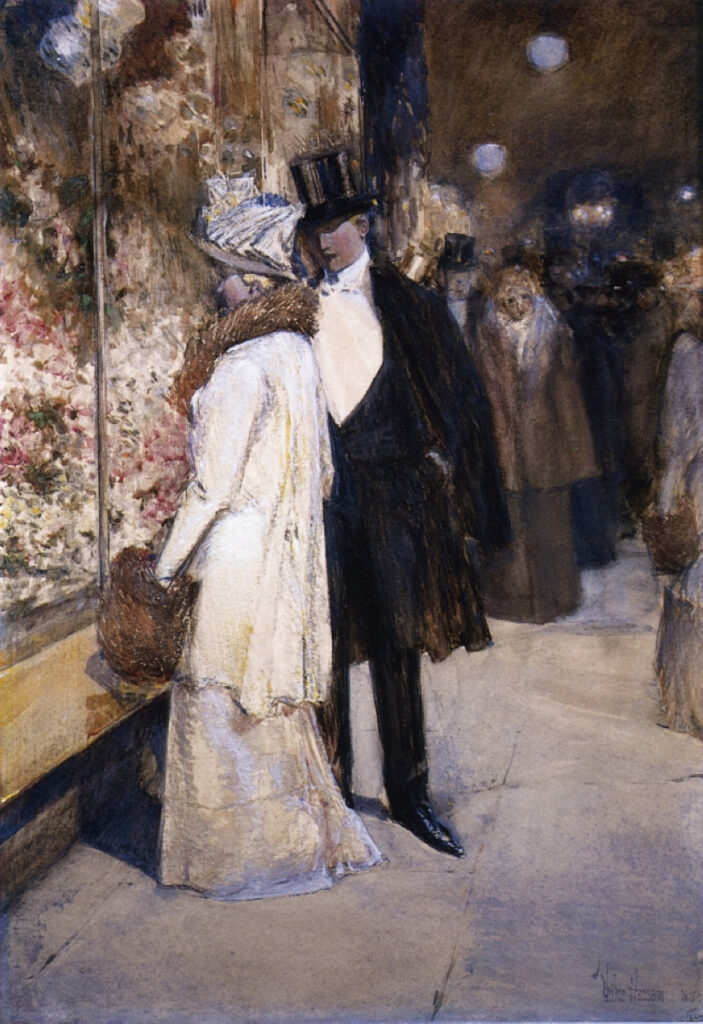
Childe Hassam, A New Year’s Nocturne, New York, 1892, private collection. WikiArt.
This remarkable work by American Impressionist Childe Hassam reveals how little has changed. New Year’s in New York City was just as radiant then as it is now. A well-dressed couple is centered in the frame. The woman looks into a shop window while the man in a top hat seemingly waits for her. His stance is almost one of impatience, as if they are late to a New Year’s Eve gathering. Though it is obviously nighttime, a soft light emanates over the couple and reveals passersby in the background. The city is always busy, but New Year’s Eve is an especially bustling time.
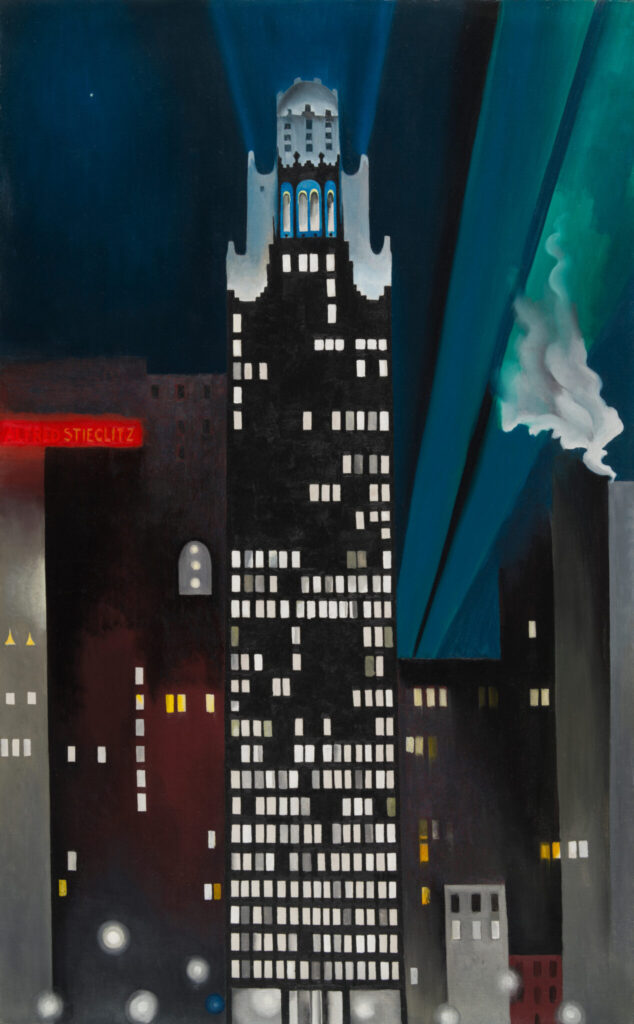
Georgia O’Keeffe, Radiator Building–Night, New York, 1927, Crystal Bridges Museum of American Art, Bentonville, AR, USA. Museum’s website.
Perhaps this painting isn’t too unexpected as a New York City scene. However, it was still a relatively new building when Georgia O’Keeffe painted it in 1927. Though the building is still a recognizable landmark in this work, O’Keeffe adds layers of abstraction, placing this emblem of modernity within the context of modernism.
The building appears as a flat plane all the way to the two ornate pinnacles and shining blue beacon at the top. Its body looks more like the Empire State or Chrysler Buildings, two skyscrapers completed just a few years afterward. The actual American Radiator Building has setbacks leading to the top with smaller gold pinnacles on the corners. O’Keeffe also leaves some windows on the building dark while the rest shine brighter than the windows on the buildings around it.
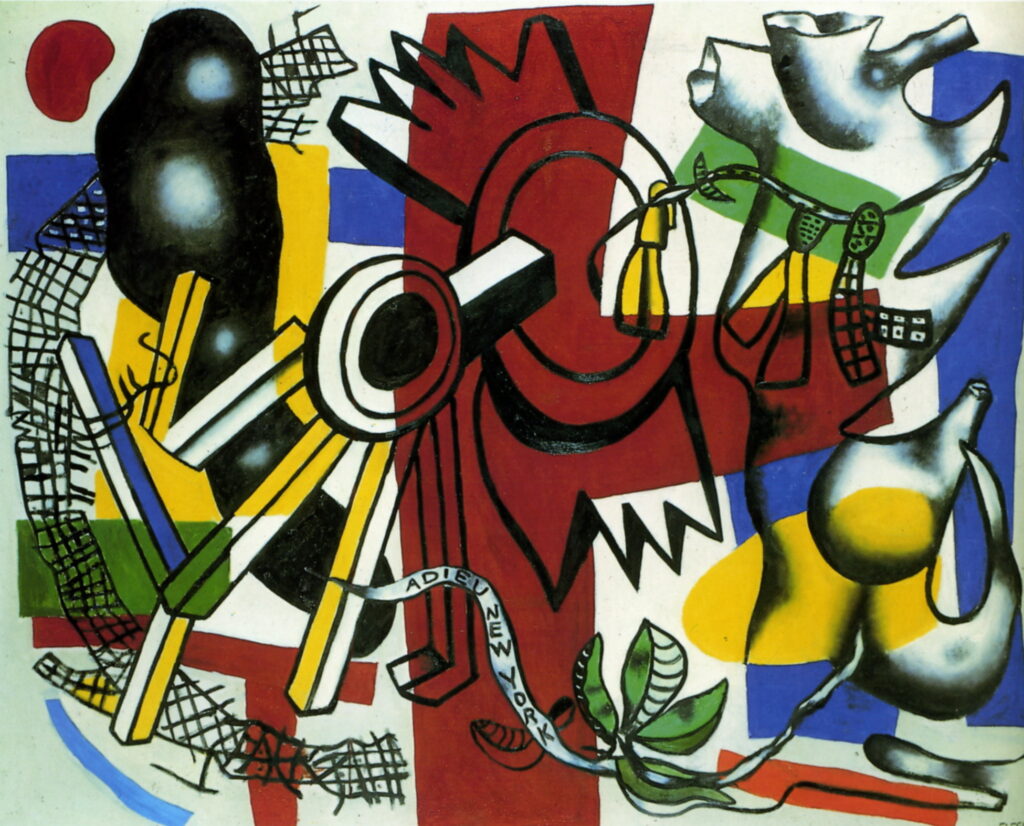
Fernand Léger, Adieu New York, 1946, Centre Pompidou, Paris, France. Museum’s website.
Fernand Léger’s Adieu New York is a striking example of abstract art. Influenced by his Purism roots, Léger bids goodbye to New York City with a colorful array of shapes, lines, and forms. The painting dares the eye to roam its visual splendor, relish in its dynamism, and find objects like the leaf or ribbon just underneath it, flowing to the center, etched with its French adieu to New York. A lovely way to pay homage and say goodbye to a great city.
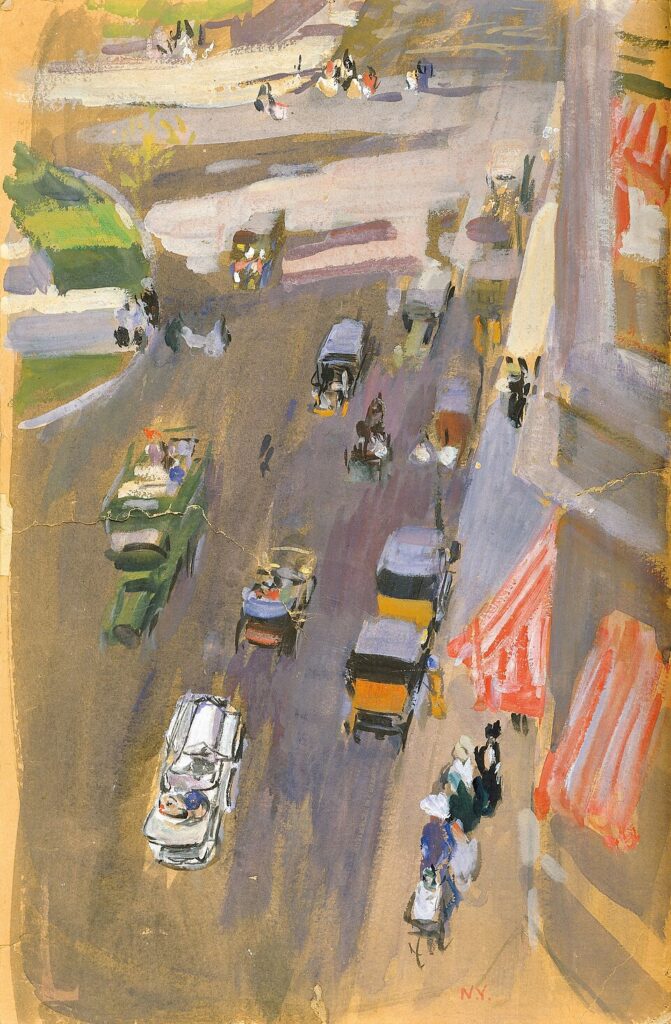
Joaquín Sorolla, Fifth Avenue, New York, 1911, Sorolla Museum, Madrid, Spain.
This painting by the Spanish painter Joaquín Sorolla is an intriguing piece just for the angle alone. This is quite a vantage point for 1911, when New York City certainly had tall buildings yet was still over a decade away from substantial skyscrapers. The most significant sign of modernity in the piece, however, is the many automobiles on the street. There are more cars than figures on the sidewalk. This scene is captured with loose, long brushstrokes, simultaneously heightening the activity of the city and emphasizing the new modern routine of life in a big city.
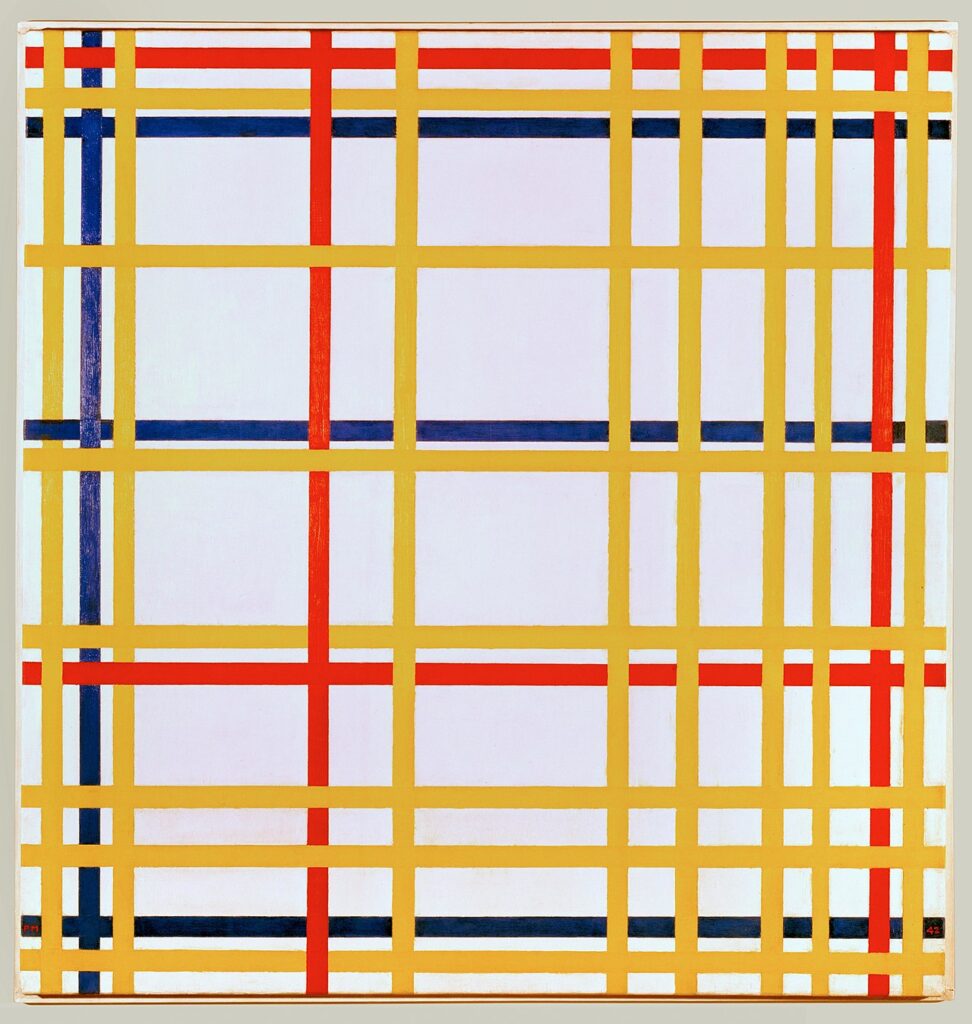
Piet Mondrian, New York City, 1942, Centre Pompidou, Paris, France.
Perhaps the most famous abstract geometric homage to New York City, Piet Mondrian’s painting is delightful to look at. Using colored strips, Mondrian rearranged them on the canvas to conceive his final result. Lines of blue, yellow, and red overlap or underlap each other, sometimes running parallel or perpendicular. Even lines of the same color connect or run together. An interweaving of primary colors reflects the vibrancy of New York City and its impressive construction on a narrow island, particularly the borough of Manhattan, where Mondrian lived just before his death.
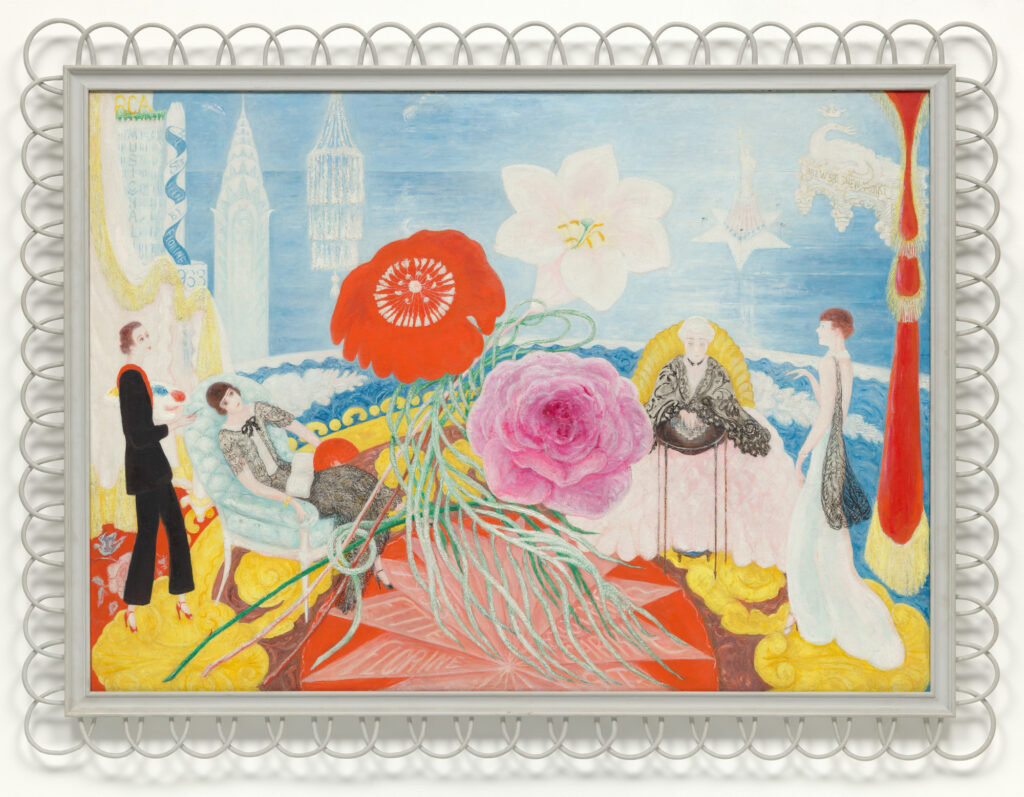
Florine Stettheimer, Family Portrait II, 1933, Museum of Modern Art, New York City, NY, USA.
Florine Stettheimer has a more obvious New York painting, but Family Portrait II is a more fitting piece for our theme. Being a major figure of the avant-garde scene in New York City, Stettheimer hosted parties at her apartment in the city. This particular scene presents the artist and her family. She is dressed in a black pantsuit to the left; her sisters, one with a cigarette in hand, stand by while her mother sits in a large, golden armchair center-right.
A floral arrangement dominates the center of the composition, and in the background to the left, the Chrysler Building stands upright next to a resplendent chandelier. The background also features the Statue of Liberty and midtown landmarks such as Radio City Music Hall and the Comcast Building. It’s a lavish, lovely, bright scene of 1930s Art Deco New York representing the independent, modern woman of the time. It was also Stettheimer’s favorite work, calling it “my masterpiece.” Indeed, it is.
Get your daily dose of art
Click and follow us on Google News to stay updated all the time

DailyArt Magazine needs your support. Every contribution, however big or small, is very valuable for our future. Thanks to it, we will be able to sustain and grow the Magazine. Thank you for your help!

A writer devoted to the arts with a Master's degree in English and a specialization in film studies/history. Ars longa, vita brevis.

As an educator, writer, and neurodivergent creative, I enjoy learning and sharing through nature, the arts and novel experiences.
Too wild for the canon, too slippery for nationalism, and too early to be officially celebrated: that’s Georges Papazoff—a 20th-century Bulgarian...
Katie Mikova 2 April 2026
Throughout the centuries, women’s bodies have consistently been staged for display rather than simply allowed to exist. John Berger’s...
Guest Author 12 March 2026
As we are in the middle of the season of Great Lent, sacred imagery becomes a bridge between the material world and spiritual reflection. Even today,...
Guest Author 12 March 2026
Picasso is usually thought of as a genius who by a divine miracle possessed inexplicable artistic talent. This would probably annoy Picasso, because...
Alvaro Alonso Pardal 26 March 2026